Buying a Forest Permit at a Convenience Store
A convenience store near a Missouri trailhead can be a handy last stop for fuel, snacks, and an off-highway vehicle permit—but don’t assume every store sells the permit you need. This guide explains how to check before you ride, what to bring when buying locally, and how to avoid arriving at a forest trailhead with the wrong permit or no permit at all.
What a Missouri forest permit covers
Forest permits are not the same as state park permits
A permit for riding in a national forest is separate from a Missouri state park ORV permit. Each applies to a different land manager and riding area, so a permit you bought for one destination may not cover another. That distinction matters if you are planning a weekend that includes more than one kind of riding area.
For example, a trip might include a day at St. Joe State Park and a ride in the Mark Twain National Forest. The state park has its own access requirements, while a national forest trail system may have a separate permit process and rules. Before you load up, compare the destination’s requirements with [Missouri ORV Permits Explained] and [Missouri Rules for Riding a National Forest].
A permit also does not automatically give you permission to ride anywhere in the forest. Motorized use is limited to designated routes and areas, and roads or trails can have different rules. A permit is not permission to ride a closed trail, cross private property, or take a machine onto a route that is not open to that vehicle type.
Check the rules for the exact riding area
“Missouri forest permit” can mean different things depending on where you plan to ride. The Chadwick area, Sutton Bluff, and other Mark Twain National Forest riding locations may have distinct access details, trail limitations, or permit instructions. Confirm the requirements for your actual destination rather than relying on a friend’s permit or advice from a different riding area.
Check whether your machine is allowed on the route. Width restrictions can be especially important for side-by-sides, since a trail that works for a narrow ATV may not accommodate a wider UTV. If your machine is close to a stated limit, measure it as the land manager directs instead of judging by eye. The guidance in [Missouri Trails for a Wide Machine] can help you think through that issue before you travel.
Also check for seasonal closures, storm damage, maintenance work, and other alerts. A valid permit does not mean a trail is open on the day you arrive. Forest conditions can change after heavy rain or wind, and a route that appeared on an older map may be temporarily closed. For practical pre-trip checks, see [Missouri Trail Closures to Check First].
Buying a forest permit at a convenience store
Verify that the store sells the permit you need
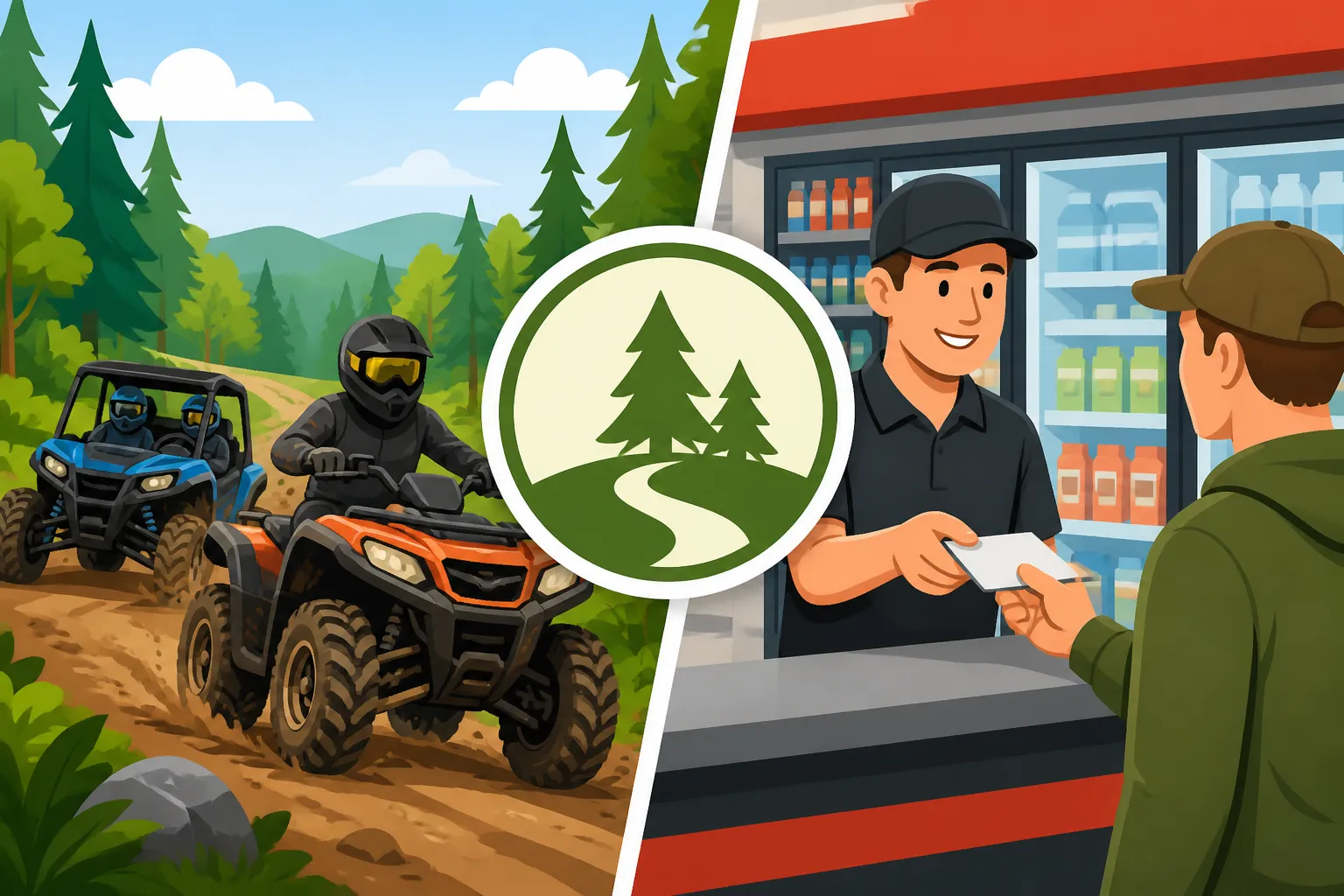
Some riders hope to buy a permit on the way to the trail, but a nearby convenience store is not necessarily an authorized seller. A store may sell fuel and snacks without selling permits, may carry permits for a different recreation area, or may have stopped offering them. Treat local availability as something to confirm, not something to assume.
Start with the official information for the forest or riding area. Look for its current permit instructions, including any list of authorized vendors. If the information is unclear, contact the relevant Forest Service office before setting out. When you call, ask specifically whether the store sells permits for your destination and machine type, and whether the permit is available on the day you expect to arrive.
If you’re heading toward the Chadwick area, for instance, a store in or near Sparta may look like a convenient stop on the route. That does not by itself confirm that the store sells the correct permit. Check the area’s official instructions first, then call the store if it is listed as a seller. The same approach applies when traveling toward Sutton Bluff through nearby communities: proximity is useful, but it is not proof of permit availability.
Ask clear questions before you reach the counter
A quick call can prevent a frustrating detour. Use the name of the riding area, identify whether you’re riding an ATV or UTV, and ask what kind of permit the location sells. If you are traveling with more than one machine, ask whether each machine needs its own permit and whether the store can issue the number you need.
It can help to ask these questions:
- Is this store currently an authorized seller for the riding area I’m visiting?
- Does it sell the permit type required for my machine?
- Can I buy the permit on the day I plan to ride?
- What proof or permit display does the forest require?
- Is there another official purchase option if the store is out or closed?
Don’t rely on a vague answer such as “we sell trail stickers.” A sticker may belong to another land manager or recreation program. Confirm the permit’s destination and instructions before paying, and read the receipt or permit details while you are still at the counter.
| Before buying locally | What to confirm | Why it matters |
|---|---|---|
| Seller status | The store is currently listed or confirmed as an authorized seller | A nearby shop may not issue forest permits |
| Riding area | The permit is valid for your intended destination | Forest and state park permits are separate |
| Machine type | The permit applies to your ATV or UTV | Vehicle rules and permit requirements can differ |
| Permit instructions | How to display or carry the permit | A permit may need to be shown or attached as directed |
| Trail status | The route is open for your planned ride | A permit does not override a closure |
Plan a backup if the store cannot help
Use an official purchase option when local sales fall through
If the convenience store is closed, out of permits, or not an authorized seller, pause before riding. Check the official permit instructions for another approved purchase method. Some forest recreation permits may be available through an online system or another designated vendor, but the method and availability can vary by area and permit type. Use the specific instructions for your destination rather than assuming every forest uses the same process.
When an online option is available, complete the purchase before leaving reliable internet access. Save the confirmation and follow the official directions for displaying or carrying proof. A screenshot can be a helpful backup for your records, but do not assume a phone image replaces a required physical permit or display. Follow the permit’s stated instructions.
Navigation tools can also help you prepare for the ride itself. For example, onX Offroad can help riders review routes and organize trip planning, but an app map should not replace official closure notices, land-manager rules, or a required permit. Use official forest information to confirm what is open and legal, then use your preferred mapping tools to help orient yourself on the permitted route.
Don’t treat a permit as a substitute for trail preparation
A last-minute permit purchase is only one part of getting ready. Save the trailhead location, check the route’s access instructions, and make sure you know where parking and staging are allowed. If your group is arriving in separate vehicles, share the same route details so nobody follows an outdated map or heads to a different entrance.
Phone service can be unreliable in parts of the Ozarks. Before leaving town, download or save the information you’ll need, including the permit confirmation, trail map, and emergency contacts. onX Offroad may be useful for offline route planning where its map features support your trip, but carry the official permit details and check land-manager notices separately. A saved map does not tell you that a trail reopened or that a closure was lifted.
Pack for conditions, too. Rain can turn a manageable creek crossing into a hazardous one, and loose rock or mud can make an unfamiliar route harder than expected. Bring water, basic recovery gear, and a way to contact help if service drops. For local trail considerations, [Missouri Riding After Heavy Rain] and [Creek Crossings in the Ozarks] are useful planning reads.
Avoid common permit mistakes at the trailhead
Keep the permit proof and follow its display directions
After purchasing a permit, read the instructions before you drive away. Some permits may require a specific display method, while others may require you to keep proof available for inspection. Do not guess where a decal belongs or assume that a receipt alone is sufficient. Follow the directions issued with the permit.
Keep the purchase confirmation and any required paperwork dry and accessible. A small document pouch or sealed bag can protect paper from rain, mud, and creek spray. If the permit must be attached to the machine, check that it is visible and secured as instructed before unloading. The general habit of [Keeping Paperwork in a Dry Bag] can save time when a ranger or officer asks to see documentation.
If the permit is digital, save it where you can access it without a strong signal. If it is a physical permit, avoid leaving it loose in a truck console or buried under riding gear. These small details are easy to overlook when everyone is eager to get on the trail, but they can turn a smooth arrival into a frustrating start.
Recheck the route and vehicle rules before unloading
At the trailhead, read posted signs and notices even if you reviewed the route at home. Signs may identify a closure, a vehicle-width restriction, a one-way route, or a rule that applies to that particular trail system. If a posted notice conflicts with an older map or saved route, follow the current on-site direction and contact the land manager if you need clarification.
Pay attention to machine width and permitted vehicle types. A route suitable for an ATV may not be suitable for a side-by-side, and some areas have restrictions that are easy to miss when planning from a general map. Check the requirements for the specific riding area before you unload; [Why a Wider Machine Pays More] explains why vehicle size can affect access planning in Missouri.
Finally, keep the permit’s limits in mind throughout the ride. Stay on routes open to your machine, respect gates and closure signs, and do not assume that a nearby forest road is an authorized OHV trail. If you are uncertain, stop and verify rather than turning a convenient store purchase into a citation or an unsafe detour. A few minutes spent checking the permit, route, and current notices can spare your group a much longer problem later.
Disclaimer
This article is for general informational purposes only and does not constitute professional advice. Laws, prices and regulations vary by location and change over time. Consult a qualified professional for guidance on your specific situation.