Meeting a Forest Gate Closed for Logging
A closed forest gate can derail an ATV or UTV ride before you reach the trail, especially when logging trucks, fresh road damage, or a temporary closure are involved. In Missouri, the safest response is simple: stop, read the notice, and don’t go around the barrier. This guide explains what the closure may mean and how to reroute without turning a frustrating detour into a dangerous one.
What a Closed Forest Gate Means for ATV and UTV Riders
Treat the gate as a real closure
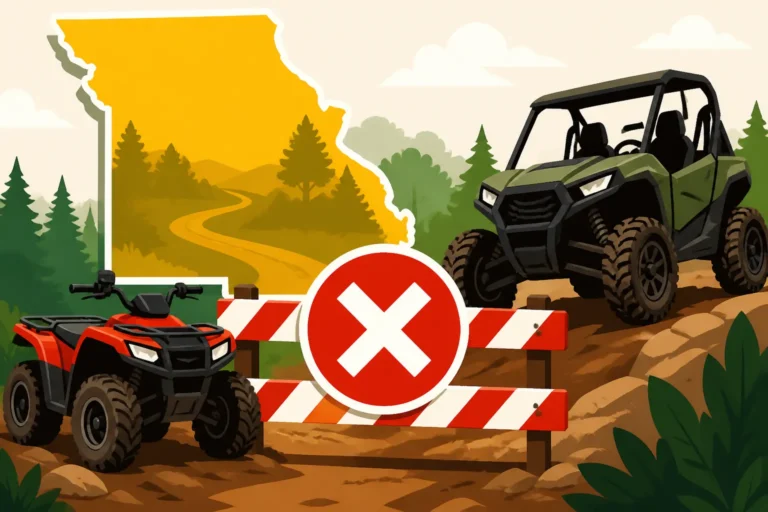
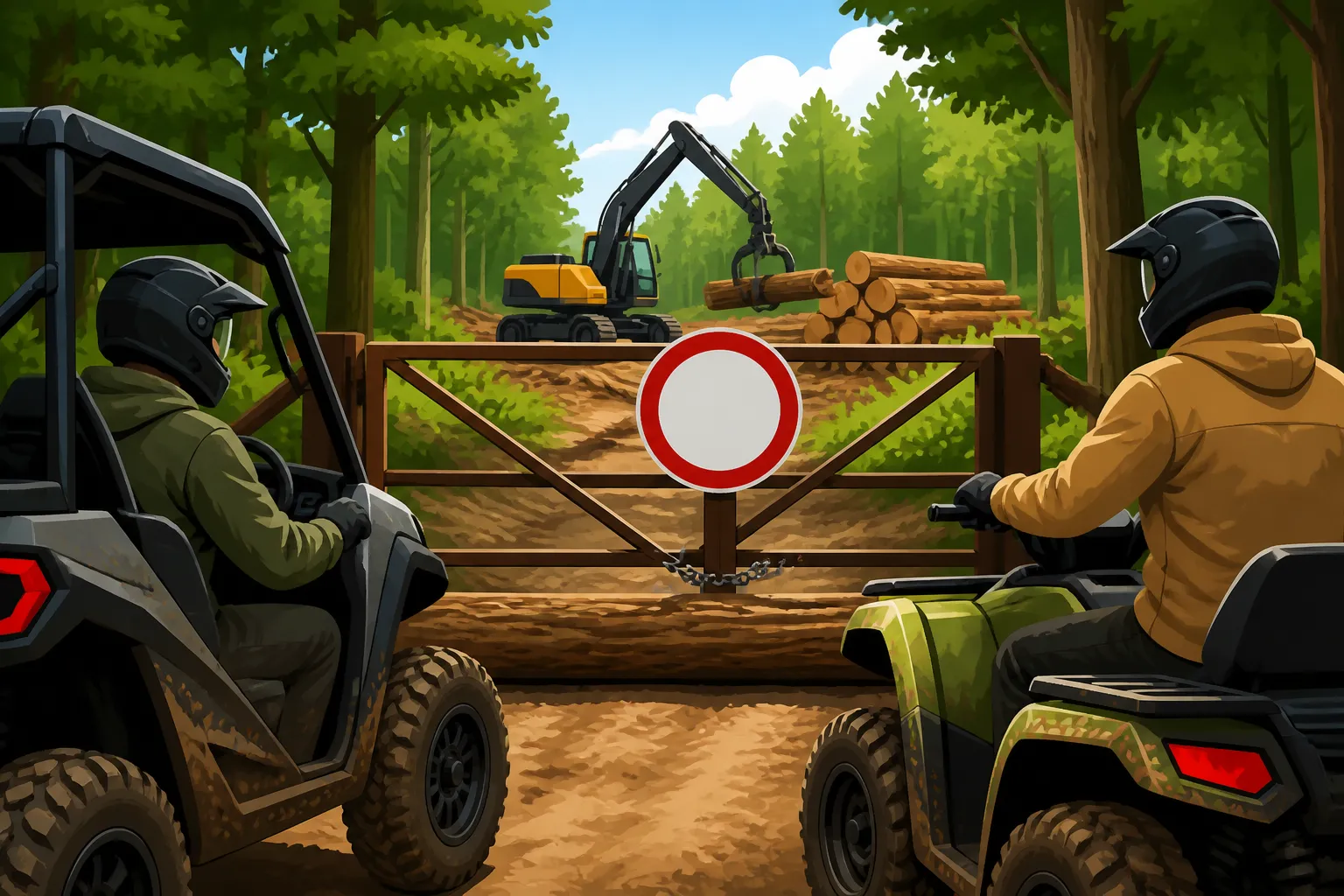
A gate across a forest road is not just an inconvenience or a suggestion to find another way through. It may mark a road or trail that is closed to motorized traffic, sometimes temporarily and sometimes for a longer period. If a sign identifies logging, road work, or a closure area, stay on the open side of the gate unless the notice specifically says otherwise.
It can be tempting to think, “I’ll just ride around the edge.” That can put you inside an active work zone, on a route that is not open to public motorized use, or on ground where the closure is meant to protect riders from a hazard. Even when the road looks quiet, crews or trucks may enter from another direction or return after a break.
A gate may also block a road that appears on a phone map or an older paper map. The line on the map tells you a route exists; it does not guarantee that it is open today. Keep the distinction in mind when planning a ride in the Mark Twain National Forest or another Missouri riding area. For broader planning context, see Missouri’s National Forest Riding.
Why logging closures can be especially risky
Logging work can involve heavy trucks, loaders, equipment moving between work areas, and material stacked near a road. A rider who slips past a gate may meet a truck on a narrow route with little room to pull over. Dust, bends, vegetation, and changing light can make it hard for either person to see the other in time.
The hazards are not always obvious from the gate. A work crew might be operating farther up the road, or a truck may be traveling in and out while the work itself is out of sight. Freshly disturbed soil can also conceal ruts, loose material, soft shoulders, or drainage changes. A familiar-looking road may handle very differently after heavy equipment has used it.
Logging trucks and other large vehicles need space, and an ATV or UTV rider should not assume they can quickly squeeze past or turn around once they are inside a narrow stretch. If you encounter a work vehicle on an open route, slow down, make yourself visible, and follow directions from the operator or crew. For practical riding considerations around large vehicles, Meeting a Log Truck on an Ozark Road is a useful related read.
Read the notice before choosing a detour
Look for the details on the closure sign: the road or route name, the reason for the closure, any dates or conditions, and whether a detour is identified. Take a moment to read the full notice rather than relying on one large word such as “logging.” The exact wording may explain which route is closed and whether nearby routes remain open.
If the notice is weathered, partly obscured, or unclear, don’t guess that the closure applies only to trucks. Don’t assume that a route is open because another group has gone through, either. A gate can be placed for a specific section or work area, and a rider arriving later may not know what the other group was told.
When you are unsure, turn around to a safe place and check with the relevant forest office or land manager before attempting another route. A quick question can save a long, uncertain detour and prevent an unsafe entry into an active work area. Calling a Ranger District First covers why it can be worth checking directly instead of relying on assumptions.
What to Do When You Reach the Gate
Stop somewhere safe and assess the scene
Don’t stop directly in a truck’s path or block the gate, entrance, or turnaround area. If the road allows it, pull off to a stable spot where you are visible and not crowding the barrier. On a group ride, bring everyone to a halt before people start discussing or attempting different ways around.
Look for approaching vehicles, equipment, loose gravel, steep shoulders, and a safe place to turn around. Avoid backing a trailer or a long UTV into a tight road without first checking the space and the traffic behind you. If the group is spread out, make sure the last riders know the route is closed before anyone continues toward it.
Keep children and passengers close to the machines while you decide what to do. A gate area can feel calm, but it may be near a work route where a vehicle can appear quickly. Don’t let riders walk beyond the barrier to “see how far the work goes.” The closure itself is the information you need to make the next decision.
Check the map, but don’t let it overrule the sign
Digital maps can help you understand the surrounding road network, identify a route back to a staging area, or compare possible alternatives. onX Offroad can be useful as a planning aid when you want to see mapped routes and orient yourself around nearby roads. But a mapped line is not permission to ride, and a map may not show a temporary closure or the latest on-the-ground conditions.
Use the map to ask practical questions: Is there a safe route back the way you came? Does the apparent alternative connect to a route you know is open? Does it lead toward a private boundary, a different management area, or another closed route? If the answer is uncertain, don’t treat the line as an invitation to explore.
Before a ride, download or save the information you expect to need if you will be in an area with weak cell service. Mark your staging point and identify more than one reasonable way to return. onX Offroad may help you prepare that overview, but pair it with current land-manager notices and signs at the site. Checking a Missouri Trail Notice Before You Load and Reading the Trailhead Board Before You Unload can help make closure checks part of the ride routine.
Turn around rather than making your own bypass
A gap beside a gate, worn tire tracks around a barrier, or an unofficial path nearby does not establish that the route is open. Avoid widening a gap, moving a barrier, cutting through vegetation, or following tracks around the closure. A bypass can take you onto fragile ground or into the very work zone the gate is intended to protect.
Turn around using a safe, legal place. If the road is too narrow to turn a machine comfortably, move back to a wider area rather than forcing a tight maneuver beside the gate. On a steep or loose surface, take turns slowly and give each rider enough room to complete the turn without being pressured by the group behind them.
Once you are back on a route you know is open, reassess the day’s plan. You may be able to choose another approved trail, return to the staging area, or end the ride. The disappointing option is often the sensible one: a missed loop is easier to live with than an injury, a damaged machine, or a conflict with a work crew.
How to Plan Around Forest Closures
Check conditions before leaving home
Make closure checks part of the same routine as loading fuel, helmets, and tie-downs. Look for current notices from the responsible land manager, then compare them with the route information you plan to use. Closures can change because of logging, storm damage, maintenance, fire danger, or other site conditions, so an old ride report may not reflect what you will find.
If you are heading to an unfamiliar area, identify the specific trailhead or road access point rather than relying on a broad search result or a dropped pin. Check whether the route is meant for motorized use and whether your machine fits the applicable access rules. Do not assume that permission for one trail, forest road, park, or permit area automatically applies to another.
Save the contact information for the relevant office and write down the name of the road or trail you intend to use. If you need to ask about a closure, a precise question is more useful than “Are the trails open?” For example: “Is the road from this staging area toward the named trail open to ATVs today, and is there a marked detour?” Use Missouri Trail Closures to Check as a reminder to verify access before you commit to the drive.
Build a backup plan with realistic routes
A backup plan should be more than a second colored line on a screen. Know where it starts, whether it is open to your type of machine, and whether it returns you to a safe parking or staging location. If you cannot establish those basics, consider it an idea to verify—not a route to ride.
The alternatives may include retracing your route, choosing a separate open trail system, or calling the day early. If you’re riding with a group, agree before you start that a closure means the whole group stops and regroups. That prevents one person from continuing while others wait at the gate or attempt to catch up through an uncertain route.
A compact comparison can help when deciding what to do:
| What you find at the gate | Safer response | Avoid |
|---|---|---|
| A clear logging closure notice | Read it, remain outside the closed area, and turn back | Riding past the barrier to look |
| A closed gate with no readable notice | Treat the route as closed until the land manager clarifies it | Assuming the gate is only for trucks |
| A marked detour | Follow it only if it is clearly intended for your vehicle and use | Choosing an unmarked track that looks similar |
| A map showing the route as open | Use the map for orientation, then follow current signs and notices | Treating a map line as proof of access |
| A crew or truck nearby | Keep clear, be visible, and follow directions | Entering the work area or blocking the road |
Make closure awareness part of group etiquette
The rider who notices a gate first should signal the group early, using a clear stop signal or radio communication if available. Don’t let riders bunch up in front of the barrier or spill into a work road while they debate. Once everyone is stopped safely, share what the sign says and decide together what to do.
A closure is also a good moment to confirm that the group still has enough daylight, fuel, and water for a revised route. A detour can stretch a ride longer than expected, especially when the group has to retrace a winding forest road. If the remaining route is uncertain or the group is running short on time, heading back may be the best call.
If you later report the closure to other riders, be specific and careful. Share the location and what the sign actually said, and avoid claiming that every nearby trail is closed unless the notice confirms that. Missouri Trail Conditions Before You Ride offers related planning context for checking conditions before setting out.
Common Mistakes to Avoid at a Logging Gate
Assuming “no workers in sight” means the route is safe
A quiet work site can still be an active work area. Logging crews may be operating farther along the road, working off another access point, or temporarily away from the gate. Vehicles can enter or leave without warning, and machinery may be positioned beyond the visible section.
Don’t use the absence of noise or fresh traffic as a reason to cross. You are unlikely to know the work schedule, traffic pattern, or boundaries of the closed area just by looking from the gate. The sign and barrier are a clearer indicator than your impression of whether anyone is nearby.
Trusting tracks around the barrier
Tire marks can be old, made by authorized vehicles, or left by someone who ignored the closure. They don’t tell you whether the route is open to public riding. Following them may also turn a narrow, unofficial path into a wider scar through vegetation or soft ground.
This is where a navigation app can help with orientation but still cannot settle the access question. onX Offroad may show the broader route network, yet neither a displayed route nor another rider’s track replaces a posted closure notice. When the route status is uncertain, pause and verify instead of experimenting.
Treating a detour as automatically suitable
A detour sign may be intended for a particular kind of traffic, or the alternative may involve a road that is not open to your machine. Read the directions and look for any restrictions. If there is no clear, safe alternative for your group, return to a known open route and seek guidance.
For riders exploring Missouri’s forest routes, the habit that matters most is straightforward: confirm access, obey the gate, and keep a fallback plan. That approach helps protect riders and workers alike, and it keeps a closed logging road from becoming the most memorable part of the day for the wrong reasons.
Disclaimer
This article is for general informational purposes only and does not constitute professional advice. Laws, prices and regulations vary by location and change over time. Consult a qualified professional for guidance on your specific situation.