Registering a Quad Kept at a Deer Camp
You've finally found that perfect slice of Missouri heaven—a cozy deer camp, maybe tucked away in the Ozarks or nestled beside a quiet stream. Naturally, you've got your trusty quad there, ready to haul gear, scout trails, or drag out that trophy buck. But then a question niggles at the back of your mind: does that ATV, sitting patiently by the cabin, actually need to be registered and titled in Missouri? It's a common dilemma, and the rules aren't always crystal clear when your machine rarely sees pavement. This guide will walk you through Missouri's requirements, helping you understand whether your deer camp quad needs a decal, a title, or both, so you can focus on the hunt, not on legal worries.
Does Your Deer Camp Quad Really Need a Missouri Decal?
It's a common assumption that if your ATV lives its life primarily on private land, especially a remote deer camp, it's somehow exempt from state rules. While there's a kernel of truth to the idea that you won't need a street-legal setup, Missouri's titling and registration laws cast a wider net than many folks realize. The reality is often more nuanced than a simple "private land, no problem" approach.
The Definition of an ATV in Missouri
Before we dive into registrations, let's nail down what Missouri actually considers an ATV. The state has specific criteria that help differentiate these machines from utility vehicles (UTVs) or recreational off-highway vehicles (ROVs), which have different rules entirely. For an off-road machine to be classified as an ATV in Missouri, it typically needs to meet several conditions. It must be designed to travel on three or more wheels, have a dry weight of less than 1,500 pounds, be no more than 50 inches wide, and, crucially, be designed for a rider to straddle the seat. Think of your traditional quad – handlebars, straddle seat, and that familiar four-wheel stance. If your machine fits this description, then it falls under Missouri's ATV laws. If it's wider, has side-by-side seating, or a steering wheel, it might be an ROV or UTV, and while those generally don't get the same registration decal, they still need a title. Understanding [What Missouri Counts as an ATV] is the first step in figuring out your obligations.
This definition is important because it dictates which set of regulations applies to your machine. Many folks at deer camps might have older, modified, or even custom-built machines, and whether they strictly adhere to these dimensions can sometimes be a gray area. However, for most factory-built quads, the definition is straightforward. Knowing this helps you determine if you're even looking at the right set of rules for your beloved camp vehicle.
The "Closed Course" or Private Land Myth
Here's where a lot of confusion stems from. Many ATV owners believe that as long as their machine never touches a public road or a designated public trail, it's entirely outside the purview of state titling and registration. While you might not need a decal if your machine literally never leaves private property and never crosses a public roadway, the title is almost universally required. Let's say your deer camp property is vast, and you ride exclusively within its boundaries. You might think, "Who would ever know?" But consider this: what if you need to tow your machine to a repair shop? What if you sell it to a new owner? What if, heaven forbid, it's stolen? Without a title, proving ownership becomes incredibly difficult, and law enforcement or insurance companies will have a much harder time helping you.
The key distinction is often between "titling" and "registering" (getting the decal). Titling is about proving ownership and establishing a legal record of the vehicle. Registration, with its corresponding decal, is generally what grants you permission to operate on state-sanctioned trails or to legally cross public roads where permitted. So, even if your machine is primarily a "closed course" vehicle on private ground, the need for a title for legal ownership and transfer is still very real.
Why Even a Private Land Machine Needs a Title
A title is more than just a piece of paper; it's the official document that proves you are the legal owner of your ATV. Even if your quad spends 364 days a year hauling corn feeders and tree stands around your private deer camp, and only one day getting trailered for maintenance, that title is indispensable. Without it, you essentially have no legal proof that the machine belongs to you. Imagine you're selling your well-loved camp quad to a fellow hunter. They'll almost certainly ask for the title, and rightly so. A buyer who purchases a machine without a title is taking a huge risk, as they have no definitive proof the seller actually owned it, and they'll struggle to ever register it in their own name if they decide to ride it on public land.
Moreover, if your ATV is ever stolen from your camp, filing a police report and having any hope of recovery or an insurance claim hinges entirely on possessing a valid title. The vehicle identification number (VIN) on your ATV is linked to that title. Without this documentation, it's just a piece of equipment, much harder for authorities to track or return. So, even for a machine that never leaves the woods, securing a title is a fundamental step in responsible ownership and protects your investment. [Titling an ATV in Missouri] is a process that applies to almost all machines, regardless of their primary use location.
Titling Your Deer Camp Quad in Missouri
Now that we've established the importance of titling, let's talk about how to get it done for your deer camp machine. This process is fairly standardized across Missouri, whether your quad is brand new or a seasoned veteran of many hunting seasons. The goal is to get that official document linking your name to your ATV's VIN.
Gathering Your Paperwork
The first step in titling your quad is to make sure you have all the necessary documentation. If you bought your ATV new from a dealer, you'll need the Manufacturer's Statement of Origin (MSO), sometimes called a Certificate of Origin (MCO). This is essentially the birth certificate of your ATV. If you purchased a used machine, you'll need the previous owner's properly assigned title. This means they should have signed it over to you in the designated section, often with a notarized signature, though notarization isn't always required in Missouri for ATV titles specifically, it can sometimes be a good idea for clarity. Always ensure the VIN on the title matches the VIN on the machine itself. A [Missouri Bill of Sale for an ATV] is also a crucial document for used purchases, even if the title is available. It outlines the terms of the sale, the purchase price, and often includes information about the buyer and seller, which can be invaluable, especially for tax purposes.
If you're dealing with a used machine where the title might be lost or missing, that's a more complicated scenario that often requires applying for a duplicate title or going through a bond process, which can be a real headache. Always prioritize getting a clear, signed-over title when [Buying a Used ATV Privately in Missouri] to avoid future complications. The state also requires you to submit a title application form, which you can usually get at your local license office or download online.
The Sales Tax Conundrum
Ah, sales tax. Even for a deer camp quad purchased privately, Missouri expects its share. When you title your ATV, you'll generally be required to pay state sales tax on the purchase price, along with any applicable local sales taxes. This is true even if you bought the machine from your buddy down the road. Missouri's sales tax rate is applied to the purchase price, and then local taxes (county, city, district) are added on top, based on where the buyer lives, not where the sale took place.
There is a notable exception: [The $3,000 Sales Tax Line in Missouri]. If you buy a used ATV from a private seller for less than $3,000, you are generally exempt from paying Missouri state sales tax on that transaction. However, this exemption only applies to private sales and only for the state portion of the tax. Any applicable local sales taxes might still be due, depending on your jurisdiction. This rule often catches private buyers by surprise, as they assume no sales tax is due on any private sale. Be prepared for this when you go to the license office, as the sales tax is paid at the time of titling.
Where to Go and What to Expect
Once you have all your paperwork in order, your next stop is a Missouri license office. These are the places that handle vehicle titling and registration for the Department of Revenue. You can find one in almost every county, often in larger towns. When you arrive, you'll present your title application, the MSO or signed-over title, your bill of sale, and proof of identification. The clerks there are well-versed in the process and can guide you through any specific questions.
You'll pay a state title fee, which is a fairly modest amount. However, be mindful of deadlines. Missouri has a [Missouri's Thirty-Day Titling Deadline] from the date of purchase. If you miss this deadline, you'll start incurring a [Missouri's Late Titling Penalty]. This penalty begins with a certain amount and increases for every 30-day period you're late, though there is a cap to how high it can go. So, even if your quad is sitting patiently at the deer camp, make sure you get it titled promptly after purchase to avoid unnecessary fees. You can find more information about [Where to Title an ATV in Missouri] at your local Department of Revenue office.
Registering Your Quad for Deer Camp Adventures (or Not)
After titling, the next consideration is registration, which in Missouri means getting that distinctive three-year decal. This is where the "deer camp" aspect truly comes into play, as your specific use case will dictate whether a decal is actually a necessity.
The Missouri Decal: What It Is and Why You Need It
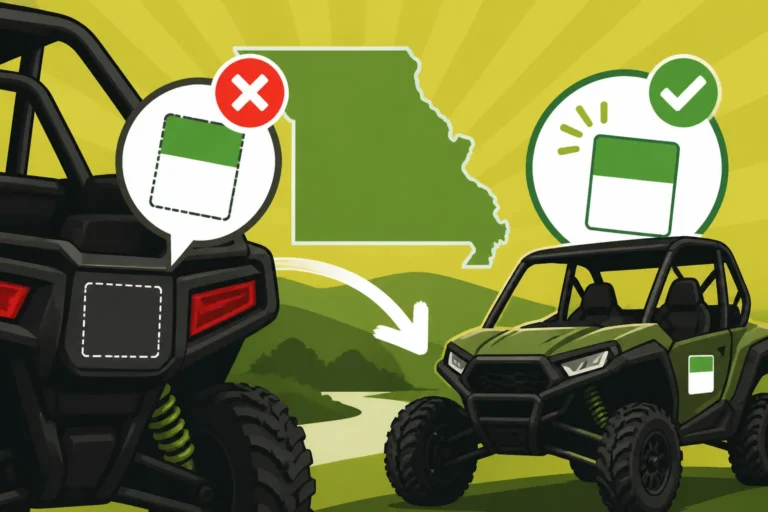
Unlike cars, Missouri ATVs don't get a traditional license plate. Instead, they receive a small, adhesive decal that you affix to the right front fork of your machine. This decal serves as your proof of registration and is valid for three years. The purpose of this [Missouri's Three-Year ATV Decal] is to signify that your ATV is legally registered to operate on designated public lands and trails within Missouri. It's not a permit for street legal use (Missouri has very limited street-legal options for ATVs), but rather a green light for specific off-road recreation areas and for legal crossing of roads where permitted.
If your deer camp adventures involve riding at state parks like St. Joe or Finger Lakes, or utilizing areas within the Mark Twain National Forest, you absolutely need this decal. Park rangers and forest service officers will check for it, and riding without one can lead to fines. It's a system designed to fund the maintenance and development of these riding areas, ensuring they remain open and enjoyable for everyone.
When Registration Becomes Essential
So, when does that deer camp quad definitely need a decal?
- Accessing Public Trails: If your deer camp is near or provides access to public ATV trails (state parks, national forests, managed conservation areas), you'll need the decal. This is the primary reason for registration.
- Crossing Public Roads: Even if your primary riding is on private land, if you ever need to cross a county road, a state highway (at a perpendicular angle, and only where permitted), or drive briefly down a public gravel lane to get from one section of your private property to another, the decal is essential. Most private land is not one contiguous block, and road crossings are often necessary.
- Moving Between Properties: If you have multiple parcels of private land, and you use a public right-of-way (even a ditch or shoulder) to move your quad between them, the decal applies.
- Local Ordinances: Some smaller towns or counties, particularly around popular recreation areas, may have specific ordinances regarding ATV use on local roads for short distances. While rare for ATVs, if your deer camp is in such an area and you plan to take advantage of it, the decal would be required.
Essentially, if your ATV's tires ever touch anything that isn't exclusively your private land, the three-year decal becomes a requirement. It’s better to be safe than sorry, especially if a conservation agent or sheriff’s deputy sees you crossing a county road near your camp. The cost is minor compared to a potential citation. The decal also lasts for a good while; [How Long a Missouri ATV Decal Lasts] is generally three years from the month of purchase.
The Costs and the Commitment
The cost to [Registering an ATV in Missouri] is relatively inexpensive, especially when you consider it's a three-year registration. You'll pay the registration fee at the same time you title your machine at the license office. This fee covers the cost of the decal and contributes to the state's off-road vehicle funds. After the initial three years, you'll need to renew your decal, which typically involves a smaller renewal fee.
This is an ongoing commitment, but a minor one. Mark your calendar for the renewal date so you don't accidentally let it lapse. For many deer camp owners, the ability to legally cross a county road to get to the back forty, or to ride a short connector trail to a state forest, makes the registration fee a small price to pay for peace of mind and expanded riding opportunities.
Practical Considerations for Your Deer Camp Quad
Owning a quad, especially one kept at a semi-remote location like a deer camp, comes with its own set of practical challenges beyond just titling and registration. Thinking ahead about documentation, security, and common pitfalls can save you a lot of headaches later on.
Bills of Sale and Ownership Proof
When you're dealing with a used quad for a deer camp, a robust bill of sale is your best friend, even if you have a properly signed title. This document should clearly identify the buyer and seller, the date of sale, the purchase price, and a detailed description of the ATV, including its VIN. It acts as a secondary layer of proof, especially for sales tax purposes or if there's ever a dispute about the transaction. For private sales, a simple handwritten note might seem sufficient, but a more comprehensive form can offer much better protection.
If you ever find yourself needing a solid bill of sale, especially one that's legally sound and easy to customize, resources like LawDepot offer templates for various legal documents, including bills of sale. Using a template ensures you cover all the important bases and protect both yourself as the buyer or seller. This can be especially helpful if you're buying a quad from a friend or family member for a nominal fee, and you want to ensure the transfer of ownership is clearly documented for future titling and tax purposes.
Security and Documentation at the Camp
Deer camps, by their very nature, can sometimes be in isolated areas, making them targets for theft. Your ATV is a valuable piece of equipment, and protecting it is paramount. Always keep your original title in a secure location off-site, such as a safe deposit box or a fireproof safe at your permanent residence. Do not leave the original title at the deer camp. Instead, consider keeping a laminated copy of your title and registration decal at the camp, perhaps in a dry bag on the ATV itself, or stored securely in the cabin.
Additionally, take photos of your VIN, engine numbers, and the machine itself from multiple angles. Store these photos digitally on your phone or in cloud storage. This way, if your machine is ever stolen, you have immediate access to crucial identification details to provide to law enforcement and your insurance company. Remember, a picture of your title on your phone is not a legal substitute for the physical document for official transactions, but it's great for quick reference and emergencies.
Avoiding Common Pitfalls
There are a few common traps that deer camp quad owners often fall into:
- Buying without a clear title: Always insist on a clear, properly assigned title when purchasing a used ATV. A seller who claims they "lost" the title or that it "doesn't have one" should raise a major red flag. Dealing with a missing title can be a bureaucratic nightmare and may signal a stolen machine.
- Ignoring sales tax: Assuming a private sale means no sales tax can lead to an unwelcome surprise at the license office, especially if the machine cost over $3,000. Be prepared for [Missouri ATV Sales Tax at Titling].
- Assuming "private land" means "no rules": As discussed, while extensive private use might negate the need for a registration decal, the requirement for a title remains. And if you ever stray onto public property, even momentarily, without a decal, you risk a fine. A common scenario is taking a short cut across a county road from one part of your deer camp property to another – that brief moment on public tarmac could be enough to warrant a registration.
- Not understanding what constitutes an ATV vs. a UTV/ROV: If your deer camp machine is a side-by-side, it's governed by different rules. While it still needs a title, it generally does not get a three-year registration decal like an ATV. Ensure you know the difference to apply the correct regulations.
By being proactive about documentation, understanding Missouri's specific requirements, and anticipating common issues, you can ensure your deer camp quad remains a reliable workhorse and a source of enjoyment, free from legal entanglements.
| Document Type | Purpose | Required for Titling? | Required for Registration Decal? | Important for Deer Camp Quad? |
|---|---|---|---|---|
| Certificate of Origin | Proof of new machine ownership | Yes (for new) | Yes (for new) | Yes |
| Signed-Over Title | Proof of used machine ownership transfer | Yes (for used) | Yes (for used) | Yes |
| Bill of Sale | Records sale terms, price, parties | Highly Recommended | No | Yes (for tax, proof) |
| Title Application | Form to request new title in your name | Yes | Yes | Yes |
| Proof of Identity | Verifies who you are at the license office | Yes | Yes | Yes |
| Payment for Fees | Covers title, sales tax, registration (if applicable) | Yes | Yes | Yes |
Disclaimer
This article is for general informational purposes only and does not constitute professional advice. Laws, prices and regulations vary by location and change over time. Consult a qualified professional for guidance on your specific situation.