Why Sutton Bluff Stops Machines at 50 Inches
Sutton Bluff’s 50-inch limit can be frustrating when a machine that fits comfortably on a gravel road is turned away at a trail entrance. The key is that the rule concerns the machine’s width, not how carefully you plan to ride. This guide explains why the limit matters, how to check your ATV or UTV, and what to do if your machine is too wide.
What the 50-inch limit means at Sutton Bluff
It is a machine-width restriction, not a riding-skill test
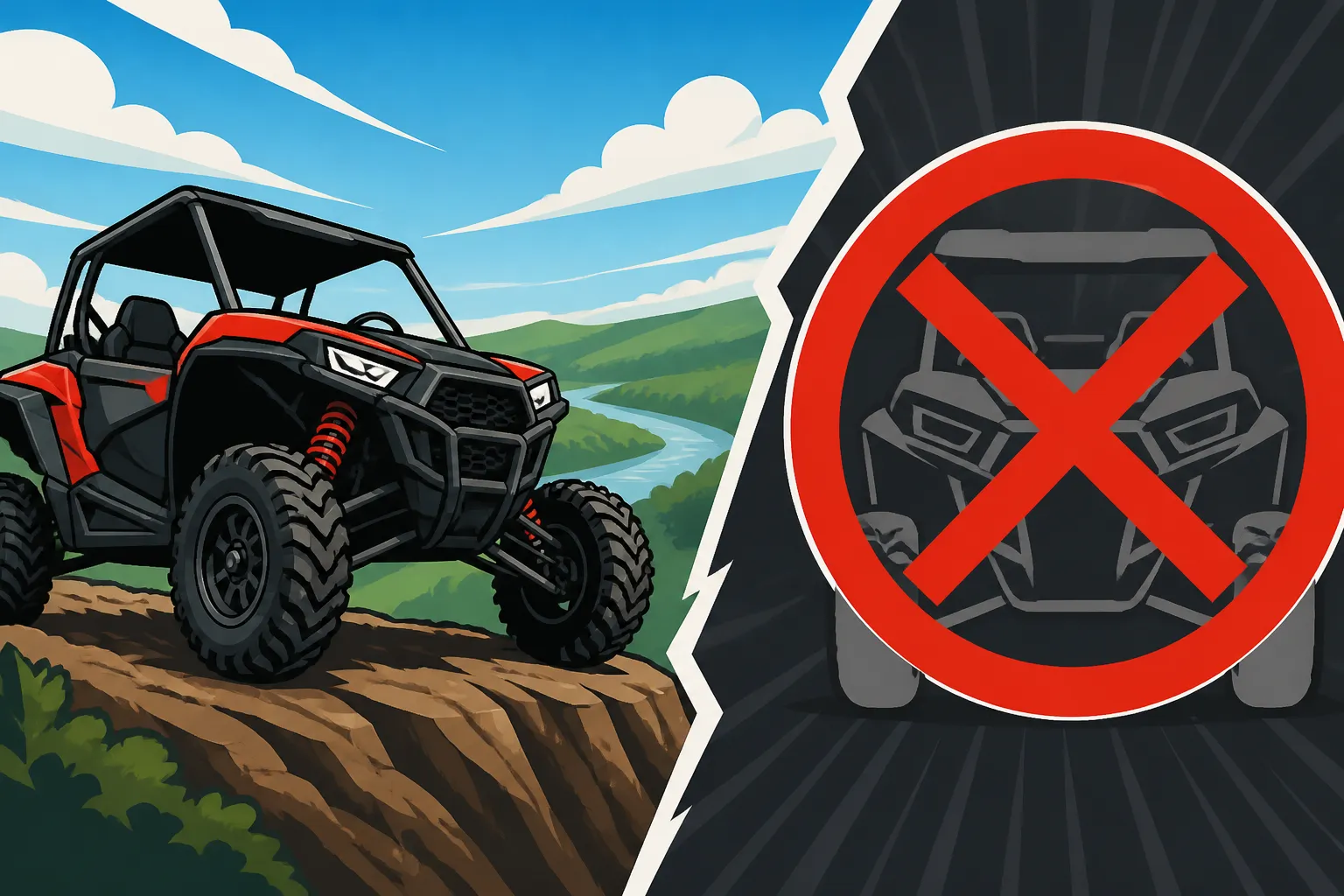
At Sutton Bluff, the 50-inch restriction determines which machines can use the designated trails. A rider’s experience, a machine’s low speed, or an intention to stay on a wider-looking section does not make an over-width vehicle eligible. The limit applies to the machine itself, so it is worth confirming your vehicle’s dimensions before you load the trailer and drive to Reynolds County.
That can be an unwelcome surprise for a new owner. A side-by-side may look compact beside a truck, yet still exceed a trail system’s width limit. Even some ATVs can be wider than expected, especially if they have been fitted with aftermarket wheels, tires, spacers, or other accessories. The vehicle’s name or general category is not enough to determine whether it qualifies.
Sutton Bluff’s limit is a practical gatekeeping rule: machines wider than 50 inches should not be taken onto trails subject to the restriction. If you are unsure how the width is assessed, contact the managing office or check the latest trailhead information before your trip. Don’t assume that a machine will fit just because it can pass through a particular opening or squeeze between trees.
The restriction matters across the trail system
Trail width is not consistent from one stretch to the next. A route may begin on an open section and narrow as it enters woods, climbs a slope, or winds around a bend. A machine that clears the first part of a trail might have trouble farther along, where the trail edge is less forgiving or a fixed feature leaves little room to maneuver.
That is one reason a rider should not treat a wide opening at the entrance as proof that a larger machine is allowed. A gate or trailhead feature can help control access, but it may not represent the narrowest point on every route. The posted vehicle restriction is the more important guide to what is permitted.
Sutton Bluff has a distinct trail setting in the Mark Twain National Forest, so rules and conditions may differ from those at other Missouri riding areas. Before traveling, review [Sutton Bluff Permit Requirements] and [Trails Closed at Sutton Bluff]. They can help you separate the width question from other issues, such as access requirements or temporary trail closures.
Why a trail system limits vehicle width
Narrow trails leave less room for safe passing and control
A wide machine takes up more of the trail and leaves less space between its tires and the trail edges. On a straight, level stretch, that may not seem like a major concern. But trails curve, rise, dip, and change surface. A rider needs room to steer around rocks, ruts, roots, and other trail features without putting a tire over an unstable edge.
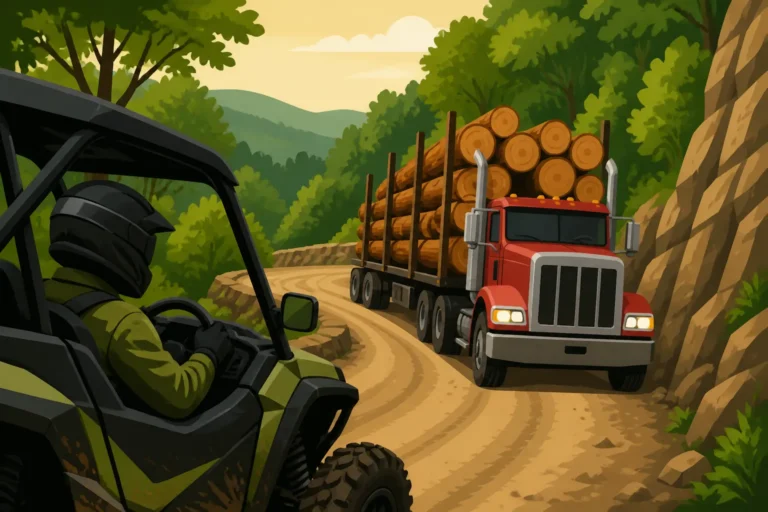
Passing is another consideration. On a narrow route, two riders meeting head-on may need to find a suitable pull-off or back up to a wider area. A larger vehicle can make that interaction harder, especially where there is limited visibility around a bend. The point is not that every narrow trail is dangerous; it is that width affects how much room riders have to respond when something unexpected happens.
Picture a side-by-side meeting an ATV on a tight, wooded section. If the wider vehicle has little clearance on either side, both riders may have fewer options for getting past one another without leaving the established trail. A width restriction helps keep the trail’s intended use within the physical space available.
Wider machines can increase pressure on trail edges
When a vehicle is wider than a trail was designed to accommodate, its tires may repeatedly ride over the margins. That can widen the route unintentionally, disturb vegetation, and contribute to erosion—particularly where the trail crosses a slope or drains poorly. A rider may only be trying to avoid a rut, but repeated tire traffic in the same place can gradually change the trail surface.
The effect can be more pronounced after rain. Soil that is already soft may give way under tire pressure, and a wider machine may push riders toward the edge while they try to stay clear of obstacles. The result can be damage beyond the visible tire track, including loose soil moving downhill or water beginning to run along the route instead of draining away from it.
This is not a claim that one over-width trip will ruin a trail. It is a reason managers use vehicle limits to reduce repeated stress over time. If rain is in the forecast or the ground has been wet, check [Missouri Riding After Heavy Rain] and current trail notices before heading out. Conditions can make a narrow trail more vulnerable and a marginal fit more difficult to manage.
Trail design and land management shape the rule
A trail system is not simply a road with trees on both sides. Its route, surface, drainage, turns, and obstacles all affect which vehicles can use it responsibly. A maximum width can help keep the intended type of machine on the route and make it easier to maintain the trail without continual widening.
Land managers also need rules that can be applied consistently. A rider’s promise to go slowly cannot change the width of a vehicle or create extra clearance at a tight turn. A clear limit gives riders a concrete measurement to check before arrival, rather than asking staff to judge each vehicle’s handling ability or each person’s confidence.
The 50-inch standard should therefore be treated as an access requirement, not a challenge to work around. If you are planning around Sutton Bluff’s trail options, [Sutton Bluff's 45 Miles in Missouri] and [Missouri Trail Difficulty Ratings] can help with broader trip planning. They do not replace posted rules, but they can help you consider whether the area and route style suit your group.
How to check whether your ATV or UTV is within 50 inches
Start with the exact machine specifications
Look up the width for your exact make, model, year, and trim. Manufacturer specifications are a useful starting point, but take care to match the details: two versions of a model may differ, and accessories or modifications may change the machine’s overall dimensions. A listing for a similar vehicle is not as reliable as documentation for the one sitting in your garage.
If the specification lists a width close to 50 inches, don’t rely on a rounded figure or a guess. A quoted measurement may be rounded, may describe a particular configuration, or may not include later modifications. Check the owner’s manual or manufacturer information, and ask the appropriate land-management office if you cannot tell how its limit is applied.
Keep in mind that “it looks narrow” is not a measurement. A machine can appear slim from the front but have a wider stance at its tires, or have accessories extending beyond the original setup. If you are preparing for a trip and the published width is borderline, resolve the question before you leave home rather than at the trailhead.
Measure the machine you actually plan to ride
A careful physical check can help you understand whether your current setup matches the published specification. Park on level ground, keep the wheels straight, and identify the widest points of the vehicle. Depending on the setup, those points may be at the tires, wheels, fenders, or an installed accessory. Measure from the outermost point on one side to the outermost point on the other.
Use a tape measure that is long enough to span the vehicle without bending around a tire or following the curve of a fender. Measure across the machine, not along the bodywork. If the result is close to the posted limit, repeat the measurement and compare it with the manufacturer’s stated dimensions.
A home measurement is a planning tool, not a substitute for the official interpretation of Sutton Bluff’s rule. If you are unsure whether a specific accessory counts, ask before riding. That is especially sensible if you have added wheel spacers, a wider tire setup, or aftermarket fenders. For another practical perspective, see [Measuring Your Machine at a 50-Inch Trail Gate].
Check modifications and accessories one by one
Owners often add equipment for understandable reasons: wider tires for traction, protection for rocky routes, or racks and guards for utility. But modifications can change the vehicle’s overall width, even if each individual addition seems small. A setup that was within the limit when new may no longer be within it after upgrades.
Pay special attention to parts that extend beyond the original body or wheel line. Check both sides rather than assuming the vehicle is symmetrical. A bent component, an offset wheel setup, or a poorly aligned attachment could create a wider point on one side.
If your machine is near the cutoff, make a simple pre-trip checklist: confirm the exact model specification, note any modifications, measure the widest point, and get clarification on any uncertain item. That small amount of preparation is easier than discovering at the staging area that your machine cannot legally or appropriately use the trails.
| Check | What to do | Why it helps |
|---|---|---|
| Model and trim | Match the specification to the exact vehicle | Similar models can have different dimensions |
| Modifications | Include tires, spacers, fenders, and attachments | Added parts may change the widest point |
| Physical measurement | Measure across the actual setup on level ground | Confirms what is on the machine now |
| Borderline result | Ask the managing office how the rule applies | Avoids relying on a rounded or uncertain measurement |
| Trail status | Check current notices before leaving | Closures and conditions can change trip plans |
What to do if your machine is wider than the limit
Choose a riding area suited to your machine
If your machine exceeds the restriction, the responsible choice is not to try a short section or see whether it fits once you arrive. Plan for a place whose access rules and trail dimensions match your vehicle. This may mean choosing another public riding area, a private riding park, or a permitted location where your machine is allowed.
Before changing destinations, verify the applicable rules directly. Width limits can differ between trail systems, and a machine that qualifies in one place may not qualify in another. Also check whether a site has separate requirements for permits, vehicle type, sound, flags, spark arresters, or trail conditions. A general search result or an old map may not reflect the rules posted at the entrance.
Online maps can help you explore routes and prepare for a trip. For example, onX Offroad can be useful for reviewing mapped riding areas and planning what to check. Treat any mapping app as a planning aid, not the final word on access: confirm the current restrictions and closures with the land manager before you haul a machine to the trailhead.
Don’t try to make an over-width machine work on a narrow route
It can be tempting to argue that a careful driver can handle a wider vehicle, or that the machine will only use the wider-looking portions. That approach puts the burden on trail edges, other riders, and the people responsible for maintaining the route. It also risks leaving you with a difficult turnaround after you have already entered a narrow section.
Trying to avoid a restriction by riding off the marked trail is not a good solution. Leaving the established route can cause additional ground disturbance and may violate site rules. A narrow spot should not be treated as an invitation to widen the trail by driving around an obstacle or brushing past vegetation.
If staff or signage make clear that a machine is not permitted, follow that direction and use your backup plan. The best outcome is a day of riding somewhere appropriate—not a confrontation at the trailhead, damage to a route, or a difficult recovery on a trail your vehicle cannot safely navigate.
Compare options before you book or load
If Sutton Bluff is one stop in a longer trip, consider whether a different machine can come along or whether the group can choose another destination. For families or groups with mixed vehicles, this can be a real logistical headache: one person’s ATV may fit the rule while a friend’s side-by-side does not. Confirm every machine separately rather than planning around the narrowest vehicle in the group.
Use a map to review the general area, then confirm access details with the responsible office. onX Offroad may help you compare mapped routes and nearby riding options, but the map should not be treated as permission to ride every line shown. Verify that the route is open to your vehicle type and that the land manager allows the intended use.
A backup destination is especially useful when traveling from outside Reynolds County. Before you leave, save contact information, review access requirements, and decide what the group will do if a trail is closed or a vehicle is ineligible. That preparation keeps a single width issue from derailing the whole weekend.
Planning a Sutton Bluff ride around the restriction
Confirm rules, permits, and trail conditions together
Width is only one part of trip planning. Before setting out, confirm that your vehicle qualifies, find out what permit or access requirements apply, and check whether the trails you intend to use are open. These are separate questions, so answering one does not automatically answer the others.
Use [Missouri Trail Conditions Before You Ride] as a reminder to check current notices rather than relying on a past visit. A route you rode previously may be affected by weather, maintenance, or a temporary closure. A printed or saved map is useful for navigation, but current direction from the managing office and signs at the site should take priority.
If you use onX Offroad to plan a route, review it before the trip and keep a second way to access important information. Cell coverage can be unreliable in wooded or rural areas, and a digital route line does not guarantee that a trail is open or suitable for your machine. Save what you need ahead of time and confirm the official access information separately.
Pick routes for your group, not just your vehicle
A qualifying vehicle does not automatically make every trail a good fit for every rider. Consider experience, comfort on uneven ground, passenger needs, and how your group handles narrow turns or obstacles. A route that feels manageable to an experienced rider may feel stressful to someone new to off-road riding.
Agree on basic group habits before starting: maintain spacing, stop where there is room, communicate at turns, and avoid blocking the trail while checking a map. If riders have different experience levels, keep the pace comfortable and choose routes that allow the group to stay together without pressure.
You can also use [Finding Your Way on Sutton Bluff's Numbered Trails] to think through navigation before riding. Bring a map or a downloaded route, but remain attentive to signs and trail markers. If a marked route appears closed or conditions look unsafe, turn back rather than assuming the map is more current than the notice on the ground.
Respect the limit even when the trail looks wide
Some sections may appear spacious, especially near an open area or a broad turn. That does not change the overall access restriction. The rule is not permission to use a wider machine on the parts that look comfortable; it is a boundary for which machines belong on the restricted trails.
Riding within the rule also helps other visitors know what to expect. When vehicles fit the intended use, riders have more predictable room to pass, pause, and navigate obstacles. That matters on shared trails where people may be approaching from the other direction or moving at different speeds.
If you are still uncertain about your machine, contact the managing office before the trip and explain the exact model and modifications. A short conversation can spare you a long drive with the wrong setup. For additional context on the area, [Riding Sutton Bluff in Reynolds County] can help you plan the destination while keeping the 50-inch access rule front and center.
Disclaimer
This article is for general informational purposes only and does not constitute professional advice. Laws, prices and regulations vary by location and change over time. Consult a qualified professional for guidance on your specific situation.