Missouri Riding in Hunting Season
Hunting season can make a familiar Missouri trail feel very different: more trucks at the trailhead, hunters moving through the woods, and sudden changes to access or trail conditions. This guide explains how to plan an ATV or UTV ride around hunting activity, choose safer routes, respect land boundaries, and avoid turning a recreational trip into a dangerous or unwelcome surprise.
Plan your ride around Missouri hunting activity
Check the season and the specific area
“Deer season” is not one uniform window across Missouri. Different hunting seasons and methods have different dates, and the rules can vary by species and location. Before you load the trailer, check the current Missouri Department of Conservation regulations and any notices for the particular public land or trail system you plan to visit. Don’t rely on a calendar from a previous year or assume that a trail you rode last fall is open now.
The difference between a legal riding route and a hunting area can be less obvious on the ground than it looks on a phone screen. A forest road may lead close to a hunting access point, while an established off-highway trail may be open nearby. Confirm which roads and trails are designated for motorized use rather than treating every visible track as an invitation. These basics are worth reviewing in [Missouri Rules for Riding Public Land] and [Missouri Rules for Riding a National Forest].
If your usual destination is in the Ozarks, check the relevant notices for the Mark Twain National Forest and the specific riding area—not just a general regional update. Routes around Chadwick, Sutton Bluff, or another forest recreation area may have different conditions from roads nearby. Before setting out, use [Missouri Trail Closures to Check First] and [Missouri Trail Conditions Before You Ride] as reminders to verify both access and surface conditions.
Choose your timing and route deliberately
A quiet weekday ride can be a very different experience from a weekend during a popular firearms season. Hunters may arrive before daylight, park along forest roads, or walk away from a staging area and into the woods. That can mean more vehicles on narrow approaches and people positioned where you don’t expect to see them. If you have flexibility, consider riding outside the busiest hunting periods or choosing a well-established riding area with clear, current access information.
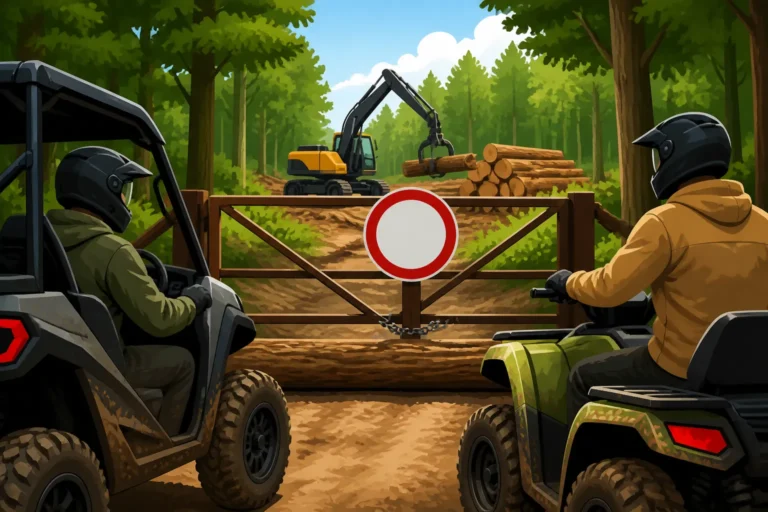
Plan your route to avoid unnecessary travel through hunting access points. If the approach road is lined with parked trucks or you see people carrying hunting equipment, don’t squeeze past them or continue into an area where your route could intersect their activity. Stop somewhere safe, check the map and signage, and choose another legal route if needed. A little detour is a much better outcome than surprising someone in the woods.
Navigation apps can help you plan around roads, trailheads, and property boundaries, but treat them as planning aids—not as proof that a route is open. onX Offroad can be useful for reviewing a route before you leave, especially when your ride crosses a patchwork of public and private land. Cross-check what you see with official maps, signs, and current closure notices, and save any useful information before you enter an area with poor cell reception.
Stay visible, predictable, and considerate
Make your machine easy to notice
ATVs and UTVs can be surprisingly difficult to hear in a forest, especially when terrain, wind, or other machines interfere. Slow down around blind corners, trail junctions, parked vehicles, and places where a footpath meets a road. Use your lights when appropriate, even during daylight, and avoid sudden acceleration near people who may be hunting or walking.
Wearing blaze orange is a sensible visibility choice during hunting season, particularly when you’re walking away from your machine, helping someone with a breakdown, or standing near a trailhead. It is a practical precaution, not a substitute for checking the rules that apply to the area. Missouri’s public-land and park requirements can differ, so review the specific property rules rather than assuming one statewide rule covers every situation. [Blaze Orange on a Forest Trail] offers a useful reminder about being visible in shared woods.
Make yourself visible when stopping, too. Pull completely off the traveled route where it is safe and permitted; don’t park over a trail junction or block a gate. If your group needs to discuss a map or fix a machine, choose a spot where approaching riders can see you in time to slow down. During hunting season, a stopped vehicle may be mistaken for a hunter’s parked rig, while a person standing behind a machine can be hidden from someone coming around a bend.
Keep noise and group behavior under control
Riding loudly or revving repeatedly near hunting access can frustrate people who are trying to use the land for a different activity. Keep your pace measured near trailheads, camps, homes, and shared roads. If a group is large, agree in advance on a leader and regrouping points so riders don’t spread out, miss turns, or keep circling while waiting for someone.
Give hunters and other trail users room. Don’t ride toward someone to ask what they’re doing, follow them down a side path, or use a hunting access route as a shortcut unless it is clearly open to motorized travel. If you encounter someone on foot, slow down early, make your presence known calmly, and wait until you can pass without crowding them. A friendly wave and a few seconds of patience can prevent a tense encounter.
Be especially cautious at dawn and dusk, when visibility is reduced and wildlife may be moving. Don’t assume that a quiet trail means nobody is nearby. A hunter can be stationary and difficult to spot, and a person walking in muted clothing may be less visible than another rider. Reduce speed enough that you can stop safely within the distance you can see.
Know where you are allowed to ride
The presence of a trail, gate, or tire track does not automatically mean motorized riding is allowed. Public land may have designated routes, seasonal restrictions, or areas closed to particular vehicles. On private land, get permission from the landowner before riding; a hunting lease or a neighbor’s past invitation does not necessarily give you permission to cross the property. Review [Missouri Landowner Permission Requirements] before planning a route across private ground.
Use a map to understand the boundaries, but don’t rely on a colored line alone. Signs at the site, barriers, and official notices matter. If you’re using onX Offroad to see where a route appears to cross public or private land, confirm that the route itself is authorized for your machine. A mapped road can still be closed, non-motorized, or subject to a temporary restriction.
| Situation | Safer choice | What to verify |
|---|---|---|
| You see trucks parked near a forest road | Slow down and avoid crowding the access point | Whether the road is open to your machine and where the legal route continues |
| Your planned route crosses private land | Stop before entering and use a confirmed public route | Written or direct permission from the landowner |
| A trail sign conflicts with your app | Follow the posted restriction and check official notices | Current area-specific maps or management updates |
| Your group encounters a hunter on foot | Stop or pass slowly only when there is clear space | Whether you are on a designated motorized route |
| Cell service drops on a forest ride | Use your saved route information and stay on known trails | Offline map availability, trail markers, and a backup plan |
Prepare for remote trails and changing conditions
Download maps and carry a backup plan
Cell service can disappear quickly in wooded hollows and remote parts of the Ozarks. Before leaving home, save your route and the information you need to get back to the staging area. onX Offroad may help with advance route planning and offline navigation, but don’t make a phone app your only backup. Carry a paper map or another navigation option, and make sure everyone in the group knows the planned route and the intended return time.
Tell someone who is not riding with you where you’re going and when you expect to return. Share the name of the trail system or access point, not just “somewhere near the forest.” This is particularly helpful if a machine breaks down, a rider becomes separated, or a route takes longer than expected. For more on planning around poor reception, see [Cell Dead Zones in the Ozarks].
Keep your phone charged and protected from rain, mud, and impact. A portable battery can help, but it won’t solve every problem if you’ve lost reception or your phone is damaged. Store essential details—such as the trailhead name and a contact number—in a place you can reach without relying on a data connection.
Expect wet leaves, mud, and reduced visibility
Autumn conditions can disguise hazards. Wet leaves may cover rocks, ruts, roots, and drainage channels, while early frost can make shaded sections slick. A trail that felt easy in summer may require a slower pace after rain or when leaves obscure the surface. Leave extra stopping distance and avoid riding so close behind another machine that you can’t react if it brakes or slides.
Creek crossings and low spots deserve particular caution after heavy rain. Water can rise, banks can soften, and a route that was passable on the way in may be unsafe later. Don’t enter moving water if you can’t judge its depth, bottom, and exit. Turning around is frustrating, but it’s better than getting stuck in a place where help is far away.
Pack for a delay, not just the ride you hope to have. Bring water, basic first aid supplies, warm layers, a charged phone, and equipment appropriate for your machine and route. If you’re riding with children or inexperienced operators, choose a shorter route with clear landmarks and a straightforward way back. Tell the group in advance that no one should leave the trail to “catch up” or take an unmarked shortcut.
Park and stage without blocking access
At a trailhead, park only where signs or marked spaces allow. Hunting-season traffic can make a narrow lot or access road busy, and a poorly positioned trailer can prevent other users or emergency vehicles from getting through. Use designated parking where available, leave room around gates and turnarounds, and don’t assume a wide shoulder is suitable for overnight parking. [Parking a Rig at a Mark Twain Lot] is a helpful topic to check when planning a forest-area trip.
Before unloading, read the trailhead board. Look for temporary closures, route restrictions, required permits, and any rules specific to the riding area. A permit that covers one destination may not cover another, and general ATV registration is not a substitute for a trail or recreation permit where one is required. If a notice is unclear, ask the managing office or ranger district before riding.
When you return, check that your group and machines are accounted for before leaving the area. If someone is delayed, don’t send riders searching down random side roads. Keep to the planned route, use agreed meeting points, and contact the appropriate local office or emergency services when the situation warrants it.
A practical hunting-season ride checklist
Before loading the trailer
Start with the destination, not just the route you want to ride. Confirm that the area is open, your machine is allowed, and any required permits are in order. Check current hunting-season information and land-management notices, then compare those details with your map. If anything conflicts, pause and get clarification rather than hoping the trail will be open when you arrive.
Review the route with everyone in the group. Point out the staging area, likely turnarounds, and places where you’ll stop to regroup. Agree that riders will stay on designated routes and won’t cross private property without permission. If anyone is new to the area, make sure they know how to recognize trail markers and what to do if they lose sight of the group.
Use onX Offroad or another mapping tool to prepare, but save maps for offline use where possible and carry a backup. Confirm that the route matches official information. An app can help you notice a boundary or plan a turn; it cannot replace a posted closure sign or permission from a landowner.
At the trailhead and on the trail
Take a moment to check the trailhead board before unloading. Look for closures, permit rules, required safety equipment, and restrictions on width or vehicle type. Keep your machine and trailer out of the way, and avoid gathering in a spot where other users need to pass.
On the trail, ride at a speed that gives you time to respond to people, wildlife, and hidden obstacles. Slow down at blind corners and shared-use areas. If a hunter or other trail user is nearby, give them space and avoid unnecessary noise. Wear visible clothing, especially when away from your machine, and don’t mistake a map line for permission to leave the marked route.
Finally, be willing to change plans. A closure, crowded access point, washed-out crossing, or uncertain boundary is a reason to choose another legal route—not a challenge to push through. Hunting season can still be a great time to ride in Missouri, but a little extra planning helps keep the woods safe and welcoming for everyone.
Disclaimer
This article is for general informational purposes only and does not constitute professional advice. Laws, prices and regulations vary by location and change over time. Consult a qualified professional for guidance on your specific situation.