Loading Up Before an Ozark Storm
An Ozark ride can turn from dusty to dangerous faster than expected when a storm rolls over the hills. Rain may make rocky trails slick, hide washouts, and send water through low creek crossings. This guide helps you decide when to leave, what to check before loading, and how to prepare your ATV or UTV for a safer trip.
Check the storm risk before you load
A forecast is more useful when you look beyond the word “rain.” A brief shower can be very different from a line of thunderstorms or several hours of steady rain over the same watershed. In the Ozarks, steep slopes and narrow hollows can funnel runoff toward trail crossings even when the sky above your staging area looks manageable.
Look at timing, intensity, and the whole route
Check the forecast for the riding area, not just your home or the nearest large town. Conditions around Chadwick, Sutton Bluff, and the Mark Twain National Forest can differ from those in Springfield or another city several miles away. Before you leave, consider when rain is expected to begin, how long it may last, and whether thunderstorms or heavy downpours are part of the forecast.
Think about your entire outing, including the drive to the trailhead and the return trip. If storms are forecast for late afternoon, a morning departure does not automatically make the ride a good idea. A mechanical problem, a wrong turn, or slow progress over wet rock can leave you farther from the staging area than planned when the weather changes.
Look for more than a single forecast screen. Check official weather alerts and notices for the area, and review any trail or land-manager updates before setting out. Missouri Trail Conditions Before You Ride is a useful companion when you are deciding whether the route is suitable for the day.
Treat water crossings as a separate hazard
The most serious storm risk may not be the rain falling where you are. Water can rush into a hollow from upstream, and a crossing that looked shallow earlier may become deeper or faster while you are riding. Muddy water also makes it harder to judge the bottom, spot a drop-off, or see debris moving beneath the surface.
Never assume that a familiar crossing is safe just because you or a friend crossed it before. If water is moving quickly, has risen over the trail, or conceals the banks and bottom, turn around and choose a safe alternative. Do not attempt to walk or ride through floodwater to “test” it. A machine’s weight and traction do not make moving water predictable.
Plan your route with the possibility of turning back in mind. On a loop, identify places where you can safely retrace your route rather than continuing toward a creek or low point. For more on the particular risks of Ozark water, see Flash Floods in a Hollow and Creek Crossings in the Ozarks.
Make a go, delay, or cancel decision
It is frustrating to unload a trailer, drive a long way, and then decide the trails are not safe. Still, setting a clear decision point before you leave can prevent a sunk-cost mindset from taking over. The time and fuel already spent are not reasons to ride into a storm.
Use a simple decision table
Use the conditions below as planning guidance, not as a substitute for official warnings or on-site judgment.
| Conditions before or during the ride | Safer choice |
|---|---|
| Thunderstorms are expected during the planned riding window | Delay or cancel, especially if the route is exposed or remote |
| Heavy rain has recently affected the area | Check for closures, washouts, and rising streams before unloading |
| Water covers a crossing or moves quickly | Do not cross; turn around and use a safe route back |
| A trail notice reports a closure or storm damage | Do not enter the closed area |
| Light rain is possible, but trails and crossings are open and conditions are manageable | Consider a shorter route with an early turnaround plan |
| Thunder is heard or lightning is seen while riding | Stop the ride and seek safer shelter away from exposed areas |
A short ride near a familiar staging area may be easier to manage than a long loop deep in the forest, but it is not automatically safe. Even close to a trailhead, lightning, slick slopes, and fast-rising water can create serious problems. Be willing to call the day if the actual conditions do not match what you expected.
Check closures and trail access directly
Heavy rain can damage trails, create hazardous crossings, or lead land managers to close an area. A trail shown on a map is not necessarily open or passable that day. Check the relevant park, forest, or recreation-area information before loading, then look for posted signs and notices when you arrive.
This matters at places such as Chadwick and Sutton Bluff, where the ride may involve forest roads, shared recreation areas, and terrain that responds differently to rain from one section to another. A route may be open while a particular segment is blocked or unsafe. Read the trailhead board before unloading and follow closure signs rather than trying to find a way around them. Missouri Trail Closures to Check First and Reading the Trailhead Board Before You Unload can help you build that check into your routine.
Prepare your route, machine, and people
Once you have decided conditions are suitable, prepare as though rain could arrive earlier or be heavier than expected. The goal is not to make an ATV or UTV storm-proof. It is to avoid preventable problems, keep everyone informed, and make it easier to turn back.
Plan a route that is easier to shorten
Choose a route with clear options for returning to the staging area. In uncertain weather, avoid ambitious plans that depend on reaching a distant point or completing a full loop before dark. Agree on a turnaround time and a weather trigger with everyone in the group. For example, the group might agree to head back if thunder is heard, rain becomes steady, or a crossing has noticeably changed.
Offline maps can be helpful when cell service is limited. If you use onX Offroad or another mapping tool, download the area in advance and confirm that the map is available without a connection. Check your device’s battery, bring a backup power source if appropriate, and carry a paper map or another navigation backup. A mapping app can help you understand your position; it cannot confirm that a flooded crossing is safe or that a trail is open.
Share your plan with someone who is not on the ride. Give them the riding area, intended route, expected return time, and a time when they should check in if they have not heard from you. If you change plans significantly, tell them when you can. This simple step is especially helpful when a group is heading into a remote area with limited reception.
Inspect the machine and pack for changing conditions
Before loading, inspect tires, brakes, steering, lights, and the machine’s general condition. Check that cargo is secured and that anything you need to reach quickly is not buried under other gear. Mud and water can make a minor maintenance issue harder to manage, so take care of known problems before the ride rather than hoping they hold up.
Pack rain layers, a warm layer, water, basic first aid supplies, a flashlight or headlamp, and a way to contact help. Put paper documents and essential items in a waterproof bag. Keep your phone protected, but do not rely on it as your only navigation or communication option. If the group has multiple machines, agree on what to do if one breaks down or a rider needs to stop.
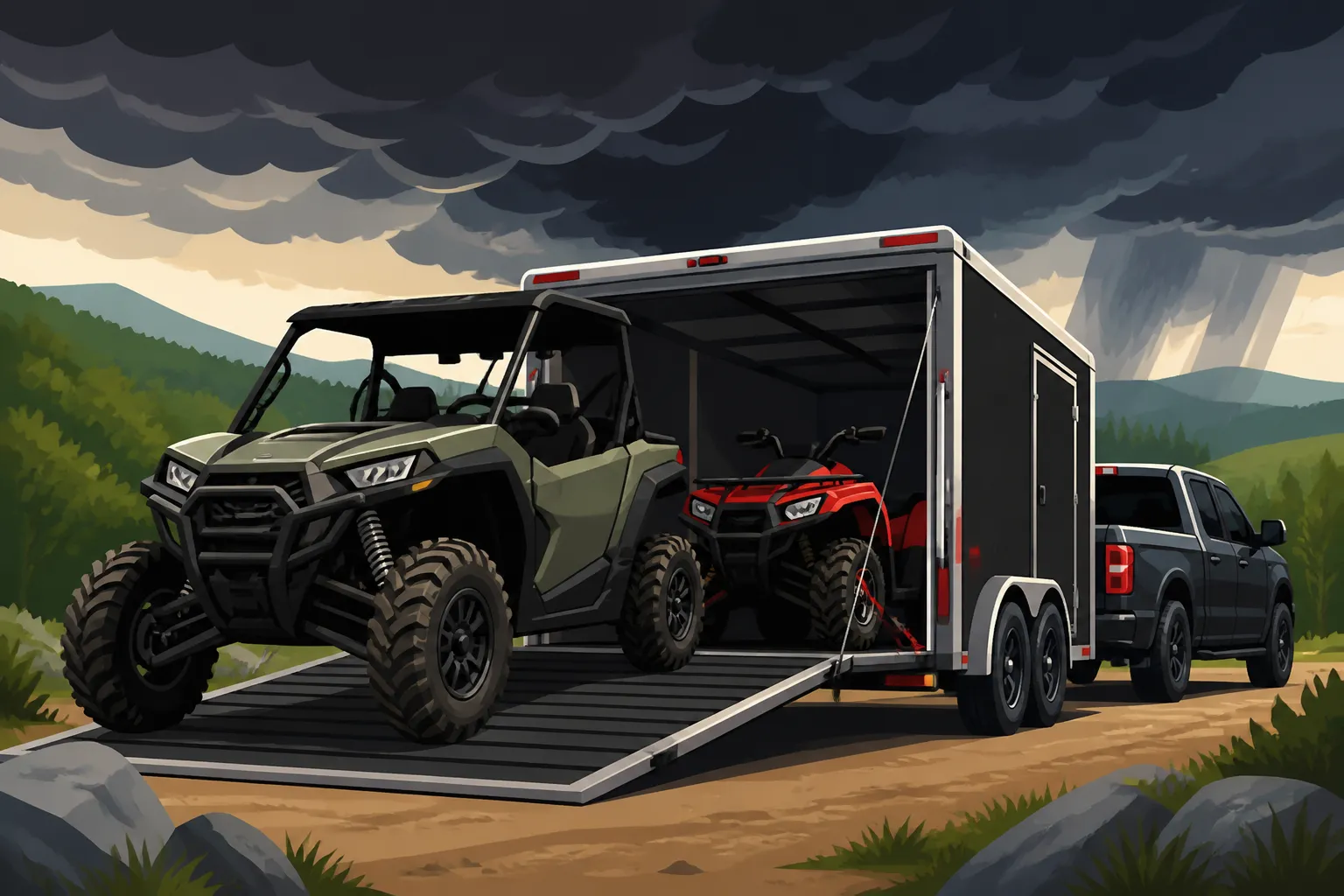
Weather preparation should include the trailer and tow vehicle, too. Check tie-downs, lights, tires, and the loading area. A storm arriving while you are unloading can turn a simple staging routine into a slippery, rushed job. Decide where the group will meet if conditions worsen and make sure everyone knows where the vehicles are parked.
Set expectations with the group
Groups often have different comfort levels. One rider may be eager to continue through rain, while another is worried about a child, a newer rider, or an unfamiliar machine. Talk through the plan before the helmets go on: who can call a turnaround, how the group will stay together, and what counts as a reason to stop.
Do not pressure someone to cross an obstacle or continue in deteriorating conditions. A cautious rider may be noticing something others have missed, and nobody should have to choose between speaking up and keeping pace. If children are riding, make the plan simpler: shorter loops, frequent check-ins, and a clear instruction to stay with the adult leading the group.
Ride cautiously if conditions change
A ride that begins under clear skies can still become wet, windy, or unsafe. Keep checking the weather and the terrain as you go. If the trail is slicker than expected, visibility drops, or water is rising, shorten the ride instead of trying to make the original plan work.
Slow down on wet Ozark terrain
Wet rock, leaves, clay, and loose gravel can reduce traction. Braking distances may increase, and a slope that felt easy when dry may be difficult to climb or descend. Leave more room between machines, use a controlled pace, and avoid sudden steering or braking where the surface is slippery.
Watch for signs of recent runoff: debris across the trail, fresh erosion, muddy water, damaged culverts, or a section that has begun to wash away. Do not ride around a damaged trail by cutting through vegetation or creating a new path. That can worsen erosion and may put you on unstable ground. If a route is unsafe or closed, turn back and report the issue through the appropriate land-management channel when practical.
For guidance on the conditions that can follow a wet week, see Missouri Riding After Heavy Rain. If rain is still falling, take an especially conservative approach; conditions can change faster than a group can travel back to the staging area.
Know what to do when thunder or flooding starts
If you hear thunder or see lightning, end the ride and move toward safer shelter. Avoid exposed ridges, open areas, isolated trees, and water. A vehicle with a hard roof can provide better protection than remaining outside, but reaching it may take time. Do not wait for the storm to become severe before acting.
If water is rising or a crossing becomes unsafe, do not try to beat the current or follow another rider through. Turn away from the water and move to higher ground when you can do so safely. Keep the group together, account for every person, and contact emergency services if anyone is injured, trapped, or in immediate danger. Do not place yourself at risk trying to recover a machine from moving water.
After the storm, do not assume the trail is safe because the rain has stopped. Runoff can continue moving through hollows, and fallen limbs, washouts, and loose rock may remain. Pause, reassess, and choose the safest route back rather than treating the end of the rain as an all-clear.
Before you put the ramps away
Make the final decision based on conditions at the riding area, not on the effort it took to get there. Check the forecast, review closures, plan a route you can shorten, and agree on clear reasons to turn around. If storms or rising water make the trip uncertain, postponing the ride is a practical choice—not a wasted one.
After a wet outing, inspect the machine and trailer before heading home. Remove mud and debris when it is safe to do so, check for damage, and make a note of any washed-out or blocked trail sections. That information can help you plan more responsibly next time and alert other riders to a hazard.
Disclaimer
This article is for general informational purposes only and does not constitute professional advice. Laws, prices and regulations vary by location and change over time. Consult a qualified professional for guidance on your specific situation.