Missouri Permits for a Race
A Missouri ATV or UTV race may need more than a permit for each rider. The approvals depend on where the event takes place, what land is involved, and whether the course affects roads or other public use. This article explains how to identify the right land manager, what to ask before advertising a race, and how rider access permits fit into the larger event plan.
Start by identifying who controls the race site
There is no one permit that automatically authorizes an ATV or UTV race everywhere in Missouri. The first question is not which rider permit to buy; it is who controls the proposed course and staging area. A private owner, state park, national forest, or local government can have different rules and approval processes.
A race organizer should map the entire footprint, not just the part where machines compete. Include the course, pit and staging areas, parking, spectator space, access roads, vendor area, and any place used for registration or camping. A route that crosses more than one kind of property may need approval from more than one authority.
The main situations are:
| Proposed site | First contact | What to clarify |
|---|---|---|
| Private property | Owner or authorized land manager | Written permission, event conditions, access, and any local approvals |
| Missouri state park | Park management or the relevant state parks office | Whether a race or organized event is allowed, and what application and rider requirements apply |
| Mark Twain National Forest | The appropriate Forest Service office | Whether the proposed activity can be authorized and whether a special use permit is required |
| City or county property | The city or county department responsible for the site | Event authorization, traffic or road controls, and local requirements |
| Course touching public roads | The road authority and relevant local officials | Whether the route can use or cross the road and what traffic controls are required |
Do not assume that a trail open to ordinary riding is also open to racing. A race is an organized event, often with concentrated use, spectators, timing equipment, support vehicles, and temporary facilities. The land manager may treat it differently from an individual or small group ride.
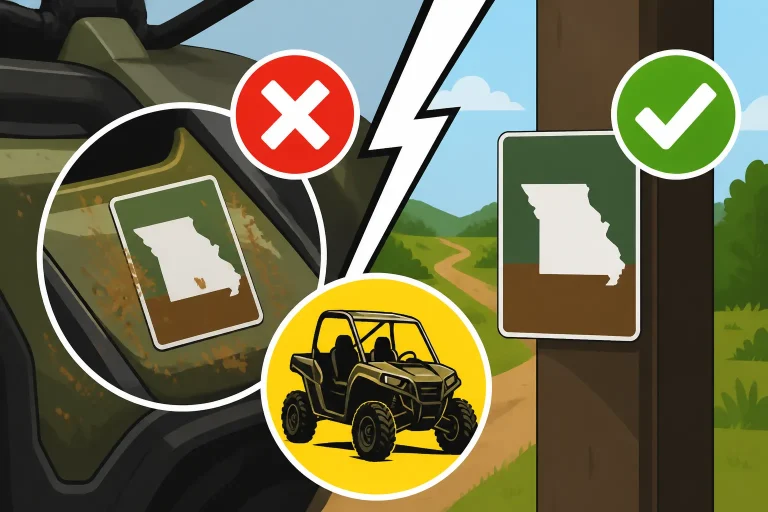
Likewise, permission to hold an event does not necessarily give every participant permission to ride every trail. The event organizer and individual riders may have separate obligations. A participant might still need a facility-specific permit, decal, or other access credential, even when the organizer has authorization to hold the race.
For general public-land planning, see Missouri Rules for Riding Public Land. If your event is a group ride rather than a timed competition, Missouri Rules for an Organized Ride can help distinguish ordinary organized riding from a more involved event. The land manager should make the final call about how it classifies your proposed race.
Ask the land manager before you announce the event
A common planning mistake is setting a date, taking registrations, or promoting a race before asking whether the location can host it. Start with a short description of the event and ask the land manager what process applies. Be clear that the proposal involves competition; describing a race as a casual group ride can lead to the wrong permit advice and costly changes later.
Prepare enough detail for the agency or owner to understand the scale and possible impacts. You do not need a finished operations manual for an initial inquiry, but the more specific the proposal, the more useful the response is likely to be.
Include:
- The proposed date and any alternate dates.
- The expected number of racers, workers, and spectators.
- The machine types and approximate range of vehicle sizes.
- A map showing the course, start and finish areas, parking, and support locations.
- Whether the event is timed, scored, practice-based, or spectator-oriented.
- The expected operating hours and how long setup and cleanup will take.
- Plans for emergency access, sanitation, trash, and noise management.
- Whether the course uses existing trails, newly marked routes, roads, or private access.
- Any proposed vendors, food service, camping, or overnight activity.
Ask direct questions rather than relying on a general statement that events are sometimes allowed. For example:
- Is a competitive ATV or UTV event eligible to take place at this location?
- Is an event permit or special use authorization required?
- Are the proposed course and staging areas available for the requested dates?
- Are there machine-width, sound, spark-arrestor, flag, helmet, or other site-specific rules?
- Do racers need their own permits in addition to the organizer’s event authorization?
- Does the land manager require insurance, a safety plan, a site visit, or an event deposit?
- Are spectators, vendors, camping, or support vehicles allowed?
- What is the application process, and when should a complete request be submitted?
- Who can confirm approval in writing?
The answers may differ by location, and requirements can change. Ask the responsible office for its current forms, submission instructions, and event conditions. A phone conversation is useful for learning where to start, but get important decisions and conditions in writing before you make commitments to entrants.
The organizer should also ask what would make the event unacceptable. A site might be suitable for routine riding but not for a race because of crowd size, limited emergency access, trail conditions, seasonal restrictions, or conflict with other users. Finding that out early may save the expense of designing a course around a site that cannot be approved.
Understand the event authorization and each rider’s permit
An event permit and a rider permit solve different problems. The event authorization is about the organizer’s use of a particular location for a particular activity. A rider’s permit or credential is about that individual machine’s access to a riding area under the rules that apply there.
Do not treat one as a substitute for the other. If a facility requires each rider to carry its normal permit, an organizer’s event approval may not waive that requirement. Conversely, every participant buying an ordinary trail permit does not by itself authorize a race, reserve a course, or permit spectators and event operations.
Missouri’s riding areas do not all use the same access system. Requirements can differ between state parks, national forest riding areas, private parks, and other public properties. The organizer should confirm the rules for the specific location, machine type, and event date rather than assuming a Missouri decal or permit is accepted everywhere. Missouri ORV Permits Explained and What the Mark Twain Forest ATV Permit Covers provide useful background on distinct public-land access systems.
Ask the land manager to clarify which costs and credentials apply to the event. Some expenses may belong to the organizer, while others may be the responsibility of each entrant. For a state park, for example, the applicable event approval and ordinary riding access should be confirmed separately with park management. Do You Need a Permit for Missouri State Park Trails? explains why routine access permission should not be confused with permission to stage an event.
For Mark Twain National Forest land, contact the Forest Service office responsible for the proposed location before finalizing the course. Organized competitions or events may require a special use authorization, and not every requested activity or route will necessarily be approved. The general process is covered in Applying for a Forest Service Special Use Permit. The forest’s regular rider permit, where applicable, is a separate issue from authorization for an organized race.
This distinction matters if an event is advertised as “permit included.” Spell out exactly what that means. Does the entry fee cover a required site access permit, the event authorization, or neither? If entrants must obtain their own credential, explain where and when they must do so. Avoid promising that one payment covers all riding access unless the responsible authority has confirmed that arrangement.
A permit may also be limited by location, date, route, and activity. Permission to use one staging area does not automatically authorize a different trail, an extra practice day, or a route extension. If the event plan changes, ask the land manager whether the approval needs to be amended.
Plan lead time, safety, insurance, and operations
A race permit is not just a form to complete shortly before the event. The land manager may need time to review the route, consult other staff, evaluate possible effects, or request more information. The review period depends on the authority and the complexity of the proposal. Begin early, and do not rely on a verbal estimate as a guaranteed turnaround time.
For a proposed event on Mark Twain National Forest land, ask the Forest Service which office handles the request and how much lead time its current process requires. Lead Time on a Mark Twain Event Permit focuses on this scheduling issue. Even if a previous event at the same location was approved, that history does not guarantee approval for a new date, course, or event format.
The application may call for information about safety and the effect of the event on the site. Be ready to explain how the event will work, not just what riders will do on the course. A clear plan can address:
- Course marking and access control, including how unauthorized riders will be kept off the route.
- Start and finish procedures, racer spacing, and supervision at crossing points.
- Emergency communications and access for responders.
- First-aid arrangements and the procedure for reporting an injury.
- How spectators will be kept away from moving machines.
- Parking, traffic flow, pit areas, and separation between machines and people on foot.
- Sanitation, trash, fuel handling, and cleanup after the event.
- Steps for preventing or responding to dust, mud, erosion, and damage to the site.
- Noise management and compliance with any limits set by the land manager.
- Event cancellation or course modification if weather or site conditions become unsafe.
The land manager may request insurance, but do not assume a standard personal ATV policy satisfies an event requirement. Ask the authority what coverage it expects, whether it needs proof before issuing approval, and whether any additional parties must be included on the policy documents. An insurance professional can help match the coverage to the activity and the land manager’s written requirements. Insurance a Missouri Ride Organizer Carries offers more detail about insurance questions that can arise for an organized event.
If the route includes a public road, trailhead access road, or road crossing, raise that issue at the start. The agency controlling the riding area may not control the road. Separate permission or traffic arrangements may be required from the relevant road authority, city, or county, and the event’s off-road authorization should not be treated as permission to race on a public road.
A course that crosses several jurisdictions deserves a written route review. Put every road, trail, and property boundary on the map. Ask each authority whether its approval covers the proposed use and whether the event must use a different crossing or access point. If the route is not approved, change the course rather than assuming that ordinary road-use rules create an exception for a race.
The land manager may also limit the number of riders, schedule, operating hours, machine types, or spectator access. Build those conditions into the event rules and registration information. If the approval sets a sound limit, width restriction, or equipment requirement, communicate it before people arrive. A rider turned away at the gate can create delays and disputes that are difficult to resolve on race day.
Private land and local requirements still need careful planning
Private property can offer more flexibility than a public trail system, but the owner’s permission is only the starting point. Get written authorization that describes the event, location, date, access routes, and areas participants may use. If the owner is not the only person with authority over the property, confirm that the person granting permission can approve the proposed activity.
A written agreement should also clarify practical responsibilities. Who maintains or marks the course? Who controls parking and spectators? Who handles trash and damage? What happens if weather makes the site unsafe? The agreement may need to address emergency access, insurance, cleanup, and the use of buildings or utilities. These are planning questions, not a substitute for legal advice or any approvals required by local authorities.
Check with the city or county before assuming that a race on private land needs no other authorization. Depending on the location and event design, local rules may address noise, temporary structures, fire safety, food sales, parking, traffic, or public gatherings. The appropriate requirements depend on the site and activity, so contact the relevant local offices and ask specifically about a motorized race with the expected number of participants and spectators.
Take particular care if the course approaches a public road or neighboring property. Entrants and spectators need to know where they may travel, where they may park, and which areas are off limits. Do not route riders across adjacent land based on informal assumptions that a fence gap or farm lane is open. Written permission should cover every property the event uses.
For a private venue, decide whether it is a closed event for invited participants or an event open to the public. That difference can affect traffic, staffing, insurance, and local review. It can also change the work needed to keep people away from the course. A race advertised broadly may draw more spectators than expected, so plan parking and crowd control around a realistic turnout rather than the number of racers alone.
Keep the final event map and written approvals accessible to the people running the event. Course marshals, registration staff, and the person responsible for emergency coordination should understand the boundaries and conditions. If the owner or authority approves one course but the event team later shifts the route, check whether renewed permission is needed before using the revised route.
A practical sequence for getting approval
The steps below help keep event authorization, rider access, and local requirements from getting mixed together.
- Choose a site and draw the full footprint. Mark the course, start and finish, staging, parking, spectator areas, access routes, and any road crossings.
- Identify every property and road authority. Determine who controls each part of the event area. If the route crosses boundaries, list each authority separately.
- Contact the land manager before public promotion. Describe the event as a race, give a realistic attendance estimate, and ask whether the proposed use can be considered.
- Request the current application and conditions. Confirm the process, submission materials, fees if any, review time, insurance requirements, and whether a site visit is needed. Current figures and requirements should come from the responsible authority.
- Build an operations and safety plan. Include course control, emergency access, spectator separation, communications, sanitation, cleanup, and weather contingencies.
- Confirm rider-by-rider access requirements. Ask whether participants need a separate park or forest permit, what equipment rules apply, and how those requirements will be checked.
- Get approvals in writing. Review the exact date, course, machine types, operating hours, and conditions. Do not assume an informal answer covers details that were not discussed.
- Update registration and event instructions. Clearly state what is included, what each rider must obtain, what equipment is required, and where participants may go.
- Recheck before race day. Confirm that no trail closure, land-management notice, or change in site conditions affects the approved plan. Keep the approval and event map available at the site.
If approval is denied or the proposed course is restricted, ask whether a smaller event, different date, or revised route could be considered. Do not proceed on the theory that a lack of response counts as permission. If an event is canceled or moved, notify entrants and follow the land manager’s instructions about refunds, rescheduling, and restoration of the site.
Frequently Asked Questions
Does a regular ATV or UTV trail permit let me hold a race?
Not by itself. An individual access permit and an organizer’s authorization for a competitive event are different. Confirm both requirements with the authority responsible for the race site.
Does Missouri have one statewide permit for every ATV or UTV race?
Do not assume a single statewide permit covers all race locations. Approval depends on the property and activity. Contact the land manager and relevant local authorities to learn what applies to the specific course.
Can I hold a race on private land without contacting the city or county?
The owner’s permission is essential, but other local requirements may apply depending on the event and location. Ask the appropriate local offices about noise, traffic, fire safety, temporary facilities, and other relevant rules.
How early should a race organizer apply?
Start as early as practical, especially for public land. Review times and submission requirements vary. Ask the responsible office for its current schedule, and avoid announcing a date as confirmed until the necessary approvals are in place.
Disclaimer
This article is for general informational purposes only and does not constitute professional advice. Laws, prices and regulations vary by location and change over time. Consult a qualified professional for guidance on your specific situation.