What the Mark Twain Forest ATV Permit Covers
A Mark Twain National Forest ATV permit is permission to use certain designated riding opportunities, not a pass to roam anywhere on federal land. It also does not replace a state decal, a park permit or local road authorization. Knowing what it covers—and what it leaves out—helps you avoid a wasted trip, a citation or a machine that does not fit the trail.
What the Mark Twain Forest ATV permit is for
The permit is tied to motorized recreation on authorized routes in the Mark Twain National Forest. In practical terms, it helps pay for access to the specific trail system or riding area named in the permit terms, subject to that area’s posted rules and current openings.
The word “forest” can make the permission sound broader than it is. Mark Twain National Forest is a large, varied landscape, but a forest permit does not make every road, two-track, field or utility corridor open to ATVs. You still need to identify the particular riding area and follow its designated routes. A route being visible on a map, worn into the ground or open to another kind of vehicle does not automatically mean it is open to your ATV or UTV.
Think of the permit as one part of your ride plan:
- The permit gives you authorization for the covered riding opportunity, under its conditions.
- Trail signs and official maps tell you where that opportunity applies.
- Vehicle rules determine whether your machine is allowed on the route.
- Separate state, local or landowner rules may apply to the rest of your trip.
The permit does not guarantee that every trail will be open when you arrive. Weather, maintenance, fire danger, resource protection and other conditions can lead to temporary closures or restrictions. Check the status of the exact riding area before you haul your machine. A permit is not a promise of access to a closed trail.
Permits may be offered in different durations or formats, and the terms can change. Confirm the current options, where they apply, how they must be displayed and whether a permit must be associated with a particular machine before you buy. The general distinction between forest permits and other Missouri riding permissions is covered in Missouri ORV Permits Explained and Missouri National Forest ATV Permit.
A permit is access, not a general forest pass
A permit should be read as permission for the specified use, not a blanket pass for the whole national forest. It does not grant access to private inholdings, closed routes, non-motorized trails or places where motor vehicles are prohibited. It does not let you create a new route by riding around a barrier or crossing a sensitive area.
If you are unsure whether a road or trail is included, stop and check its designation rather than assuming. Follow posted signs, gates, maps and current notices. When those sources appear to conflict, take the more restrictive direction until you can confirm the route’s status with the responsible forest office.
For a broader look at how public-land permissions differ, see [Missouri Rules for Riding a National Forest] and [Missouri Rules for Riding Public Land].
What the permit covers, and what it does not
The easiest way to understand the permit is to separate the riding opportunity it authorizes from the other permissions and responsibilities a rider may need. These are related, but they are not interchangeable.
| The forest permit may cover | It does not automatically cover |
|---|---|
| Use of the designated motorized trail or riding area named in its terms | Every road, trail or open-looking route in the national forest |
| Access during the permit’s valid period, when the route is open | Riding during a closure or outside the permitted dates |
| Use by an eligible machine that meets the area’s rules | A machine that exceeds a posted width or other equipment limit |
| The forest access charge for the permitted activity | Missouri title, registration or decal requirements |
| The permit holder’s authorized use under the permit conditions | Riding in a Missouri state park, another forest, a private park or another state |
| Access subject to signs, maps and closures | Permission to ride off the designated route, damage land or ignore gates |
The table is a planning guide, not a substitute for the permit’s actual conditions. Confirm the current terms for your selected riding area and machine. A permit may be valid for one place but not another, even if both places are within the Mark Twain National Forest.
It covers only the named riding opportunity
Before purchasing, identify where you plan to ride. Forest recreation areas can have different trail systems, vehicle limits, permit details and access arrangements. A permit for one riding opportunity should not be assumed to work at every other Mark Twain location.
For example, a trip to a trail system near Chadwick and a trip to Sutton Bluff should be planned around the rules for each place rather than treated as a single, interchangeable permit area. Confirm the permit type and operating conditions for the exact destination. Sutton Bluff has its own considerations, including machine-width limitations on relevant trails; see Sutton Bluff Permit Requirements and Why Sutton Bluff Stops Machines at 50 Inches.
It is not a road-use permit
A forest trail permit does not make an ATV street legal and does not authorize riding on a county road, state highway or municipal street. Road travel has its own rules, and a route to the trailhead may cross land or roads that are not part of the permitted trail system.
Do not use a forest permit as proof that you can ride from your home, campsite or fuel stop to the trail. If your route involves a public road, check the laws and any local authorization that applies to that road. If it involves private property, get permission from the landowner. For Missouri’s separate road-use framework, start with Are ATVs Street Legal in Missouri?.
It is not a state-park permit
A Mark Twain Forest permit should not be assumed to work at a Missouri state park or at a private riding park. Those places can set separate access requirements, vehicle limits, equipment rules and fees. The same is true in reverse: a state-park permit or access decal does not automatically cover a national forest trail.
Before riding multiple destinations in one trip, make a separate permit check for each one. The distinction between a state decal and trail access permission is explained in Does Your Decal Cover the Park Trail Permit?.
It does not replace the rules for your machine
A permit does not make an otherwise ineligible machine eligible. The riding area may have restrictions involving width, passengers, safety equipment, sound or other characteristics. Those limits are separate from the act of buying a permit.
Measure your machine as the area’s rules direct, and check whether the limit refers to vehicle width, total equipment width or another measurement. Do not rely only on a model name or an online specification: accessories such as tires, wheels or other modifications can affect the actual measurement. If a machine is too wide for a trail, holding a permit does not make it suitable for that route.
The permit is separate from Missouri title, registration and decals
One of the most common sources of confusion is the difference between state paperwork and public-land access. They answer different questions.
Missouri title and registration rules concern the machine’s state paperwork and applicable decal requirements. A forest permit concerns access to an authorized riding area. One document does not automatically substitute for the other. Depending on the machine and how it is used, you may need to check both sets of rules.
A useful way to think about it is:
- Title or ownership paperwork: helps establish the machine’s legal ownership.
- Missouri registration or decal: addresses applicable state requirements for the machine.
- Forest permit: addresses access to a particular forest riding opportunity.
- Local road authorization: may be needed for certain public-road use.
- Park or private-area permit: applies under that destination’s own rules.
These items can overlap on the same outing without being duplicates. A rider who has handled the state paperwork may still need a forest permit. A rider who has bought the forest permit may still need to comply with state requirements that apply to the machine. The state’s decal and title process is explained in Registering an ATV in Missouri and Titling an ATV in Missouri.
A forest permit is not proof of registration
Do not assume that buying a forest permit proves your ATV is properly titled or registered in Missouri. Likewise, do not assume that a state decal grants trail access. Keep each document or record available in the way its rules require.
If you are bringing a machine from another state, check both the forest permit terms and Missouri’s rules for an out-of-state machine. Another state’s decal or registration does not necessarily give you forest access, and a forest permit does not settle every question about Missouri paperwork. See Missouri ORV Reciprocity With Other States and Riding Missouri With an Out-of-State Decal.
Out-of-state status does not erase the access requirement
A visitor may have a current registration or off-highway sticker from home and still need the applicable Mark Twain Forest permit. Reciprocity rules, where they apply, do not automatically mean that a forest access permit is waived. Treat state registration and forest access as separate checks unless the current permit terms clearly say otherwise.
When traveling from a neighboring state, verify the exact requirements before leaving. That is especially helpful if your machine is registered under a different vehicle category at home, or if the forest’s width or equipment rules differ from what you are used to. For more on visiting riders, see Missouri Rules for a Visiting Rider.
Machine eligibility and trail restrictions matter
The permit answers whether you have the required access authorization. The trail rules answer whether your specific machine can use the route. Both checks matter.
Check width before you load
A width restriction can determine whether a trail is appropriate for a quad, a side-by-side or another off-highway vehicle. Do not assume that all trails in the forest use the same limit. Restrictions can vary by riding area or route, and some systems have narrow trails that are not suitable for wider machines.
Measure the machine in the manner specified by the riding area, including any relevant tires or attached equipment. A manufacturer’s listed width can be a helpful starting point, but it may not account for changes made after purchase. If the posted maximum is unclear, ask the responsible office rather than trying to estimate at the trail gate.
This point is important for UTV owners. A machine that fits on one route may be excluded from another, even when both are part of a national forest. Do not buy a permit for a destination until you know that the machine can use the trails you intend to ride.
Observe vehicle and equipment conditions
The area may set rules about permitted vehicle types, passengers, sound levels, spark arresters, helmets or other equipment. These requirements are not necessarily identical to Missouri’s general rules, or to the rules at state parks. Read the specific trailhead information and current forest guidance.
The permit is not a substitute for inspecting your machine. Check brakes, tires, steering, lights and controls before the ride. Bring equipment that is required for the location, and keep noise within the applicable limit. A machine that is mechanically unsafe or does not meet posted requirements may be turned away even if the permit itself is valid.
Stay on designated routes
The permit does not authorize cross-country riding or cutting a new path around an obstacle. Stay on the route shown as open and designated for your vehicle. Avoid riding around gates, barricades, washouts or closed sections. A detour that looks harmless can damage soil, vegetation or habitat and may take you onto land where motorized use is not allowed.
If a trail is blocked by a downed tree or flooded section, do not create a bypass through the woods. Turn back, report the issue through the appropriate channel if practical, and use an authorized route. [Missouri Rules for Riding Off the Trail] explains why staying within designated routes matters.
Closures can change the plan
A trail that was open on a previous visit may be closed for maintenance, seasonal conditions or resource protection. Check notices close to your departure date, and read the signs again when you arrive. Do not rely on an old social-media post, a saved screenshot or a map that does not show current closures.
Rain deserves particular attention in the Ozarks. A trail can become unsafe or vulnerable to damage after heavy weather, and water levels can change quickly in low areas. If you are unsure whether conditions allow riding, wait for reliable current information instead of assuming that a paid permit overrides a closure. For trip planning, see Missouri Trail Closures to Check First.
Buying, carrying and showing the permit
The purchase process and display rules can depend on the permit type and the riding area. Confirm the current instructions before you buy, especially if you plan to purchase online or arrive outside regular office hours.
The Mark Twain Forest permit system has been associated with online purchasing options, but availability, process and terms can change. Use the current official channel identified for the permit you need. The details in Missouri Forest Permits Through Recreation.gov can help you understand the online route, but always check the live instructions before relying on a particular sales method.
Check the permit details before paying
Before completing a purchase, confirm:
- The riding area: Make sure the permit covers the location you plan to visit.
- The vehicle category: Check that your ATV or UTV is eligible under the permit’s terms.
- The duration: Match the permit period to your actual dates.
- The display method: Find out whether you need a printed copy, a windshield or machine display, an account record or another form of proof.
- The transfer rule: Confirm whether the permit is tied to a person, machine or other information, and whether it can be transferred.
- The refund policy: Check what happens if weather or a closure changes your plans.
- The current trail status: A valid permit does not guarantee every route will be open.
Because permit terms may be revised, do not base a new purchase on what a friend paid or how a previous permit was displayed. Read the current directions for your chosen permit.
Keep proof accessible
Carry or display the permit exactly as directed. If electronic proof is allowed, do not assume a phone screenshot is enough unless the current instructions say it is. A phone can lose battery, service or screen visibility. Keep any required physical copy protected from water and mud.
A small waterproof document pouch can help keep trail information together. If you are shopping for one, Amazon may offer a range of options, but check the pouch’s closure and size before relying on it in wet conditions. You can also keep a backup copy with your vehicle documents, provided doing so does not conflict with the display requirements.
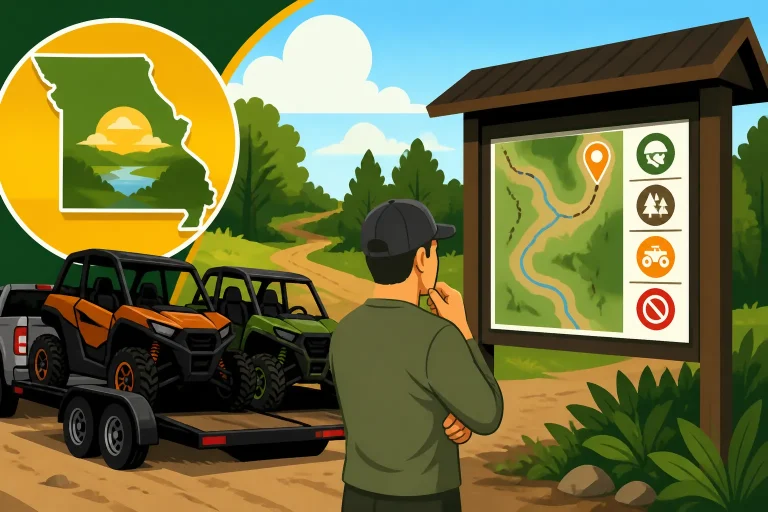
At the trailhead, read the information board before unloading. Check for route designations, closures, equipment requirements and any instructions about showing the permit. For a practical overview of what may be checked, see What Gets Checked at a Forest Trailhead.
Do not assume a phone photo is enough
Digital access can be convenient, but a photo of a permit may not satisfy a display rule. If the system requires the original permit or a specified display, follow that instruction. Make the permit easy to produce without handling your phone while riding.
The same principle applies to trail maps. A saved map can be useful when cell service is poor, but it should be current and clear enough to distinguish authorized routes from closed or non-motorized routes. You can keep a paper backup or an offline map as a practical safeguard. If you purchase a map case or storage accessory through Amazon, check that it can be secured to your machine without blocking controls or creating a snag hazard.
Planning a Mark Twain Forest ride
A little preparation prevents the most common permit mistakes: buying the wrong access product, arriving with an ineligible machine or discovering a closure after a long tow.
Plan around the destination, not just the forest name
“Mark Twain National Forest” is too broad a destination for permit planning. Pick the specific trail system or riding area first. Then check its current access rules, permit terms, operating dates and vehicle limits.
Use the official forest or recreation information for current details. Do not assume that a general road map identifies routes open to ATVs. A route can be a public road, a closed road, a non-motorized trail or a route with restrictions that a standard map does not show.
Check the whole trip, including the approach
A permit for a forest riding area does not necessarily authorize you to ride every segment between your lodging, campsite, fuel stop and trailhead. Plan how you will get the machine to the trail. If it will be trailered, confirm parking and staging arrangements. If any part of the trip involves public roads, check the rules for that road and the vehicle category.
Avoid using a trail permit as an excuse to ride a shoulder, county road or connecting track that is not designated for your machine. If you need road access, check the applicable state and local rules separately.
Bring the right documents and practical supplies
Before leaving, make sure you have:
- The permit or proof of purchase in the required format
- Any state paperwork that applies to your machine
- Current trail information and a map that covers the riding area
- A charged phone and a backup navigation plan
- Basic tools and recovery equipment suited to your machine
- Water, weather-appropriate clothing and first-aid supplies
- A plan for fuel, especially if the route is remote
Amazon can be one place to compare practical items such as a first-aid pouch or compact tool roll, but make sure the contents suit the machine and the ride rather than buying a generic kit and assuming it is complete. For trail maps, use current official information as the source of route status; retail maps and user-created tracks can be useful aids but may not reflect closures.
Recheck conditions before unloading
When you reach the staging area, read posted information before riding. Confirm that your route is open, your vehicle fits the rules and your permit covers the location. If a sign conflicts with an older map or an online note, do not ride past the sign while you try to sort it out.
If you are riding with a group, make sure everyone understands the route boundaries and permit arrangements. A lead rider’s permit does not necessarily satisfy the requirements for every machine or rider in the group. Verify whether each vehicle needs its own authorization or whether the current permit terms handle group use differently.
Common misunderstandings and a quick decision guide
A few assumptions cause most avoidable problems. The safest approach is to treat each type of authorization as specific to its purpose and each trail as subject to its current rules.
“I have a Missouri decal, so I am covered”
A state decal and a forest access permit are different things. A decal may address state requirements, but it does not automatically pay for or authorize use of a particular national forest trail. Check both where applicable.
“I bought the forest permit, so I can ride anywhere in the forest”
No. The permit applies under its stated terms and does not open every road or trail. Stay on routes designated for your vehicle and obey signs and closures.
“The forest permit works at the state park too”
Do not assume that. State parks and private riding areas have their own access systems. Confirm the permit required at each destination, even if the places are close together.
“My home-state registration is enough”
Registration from another state does not necessarily substitute for a forest permit. It also does not automatically settle Missouri title, registration or decal questions. Verify reciprocity and forest access separately.
“The trail looks wide enough”
Visual judgment is not a reliable substitute for the stated vehicle limit. Check the route’s rules and measure your machine as directed. A UTV may fit on one trail and be prohibited on another.
“The route is closed, but I can go around”
A closure applies to the affected route. Riding around a barrier can cause damage and may put you on an unauthorized trail. Turn back and use an approved route instead.
If you are uncertain about the permit or trail status, use this short checklist before riding:
- Identify the exact Mark Twain riding area.
- Confirm that the trail is open on your planned date.
- Check that the permit covers that area and your vehicle.
- Verify any width, equipment, passenger or operating restrictions.
- Confirm how the permit must be carried or displayed.
- Check separate Missouri paperwork and any road-use rules.
- Read the trailhead signs before unloading and follow them throughout the ride.
A forest permit is most useful when you treat it as one specific piece of a larger access plan. Match it to the right trail system, keep up with closures and follow the rules for your machine. That gives you a much better chance of spending the day riding the route you planned rather than sorting out avoidable paperwork or trail-access problems at the gate.
Disclaimer
This article is for general informational purposes only and does not constitute professional advice. Laws, prices and regulations vary by location and change over time. Consult a qualified professional for guidance on your specific situation.