Are ATVs Street Legal in Missouri?
It can be incredibly frustrating to own an ATV or a UTV in Missouri, ready for adventure, only to wonder if you can legally take it down the county road to the next trail, or even just to the corner store for a cold drink. The rules around riding these machines on public roads are often misunderstood and can feel like a confusing maze. This guide aims to demystify Missouri’s laws regarding the street legality of ATVs and UTVs, providing clear answers so you can ride confidently and within the law.
The Core Question: Are ATVs Street Legal in Missouri?
This is perhaps the most common question riders have, and unfortunately, the answer isn't a simple "yes" or "no" for all machines. Missouri law differentiates significantly between what it defines as an "all-terrain vehicle" (ATV) and a "recreational off-highway vehicle" (ROV), which is what most people typically call a UTV or side-by-side. Understanding these distinctions is crucial before you even think about putting tires on pavement.
The Short Answer for ATVs
For traditional ATVs—those designed for a single rider or, in some cases, two riders in a straddle seating position—the short answer is a resounding no, they are generally not street legal in Missouri. The state's statutes define ATVs in a way that typically excludes them from being registered, titled, or operated on public roadways, with very limited exceptions. These machines are purpose-built for off-road use, and that's largely where the state intends for them to stay. They lack many of the safety features and design elements required for traditional road-going vehicles, like turn signals, full lighting packages, or even suspension systems designed for sustained highway speeds.
This can be a tough pill to swallow if you just want to connect a couple of trails or run a quick errand. The temptation to just "chance it" can be strong, especially in rural areas where you might see others doing it. However, the legal definition of what Missouri counts as an ATV often comes down to its width and seating arrangement, and these machines simply don't fit the mold for general road use. While you'll need to understand [What Missouri Counts as an ATV] for titling and decal purposes, that doesn't translate to road legality.
UTVs and the "Special Permit" System
Now, here's where things get a bit more nuanced and hopeful for those who own UTVs, also known as side-by-sides or ROVs (Recreational Off-Highway Vehicles). Unlike ATVs, Missouri law provides a pathway for UTVs to be operated on public roads, but it’s not a blanket allowance. Instead, it relies on a special permit system that must be enacted at the local level—meaning by your city or county.
This system acknowledges that UTVs often have features closer to traditional vehicles, like steering wheels, foot pedals, roll bars, and seatbelts. If your local municipality has passed an ordinance allowing it, you might be able to obtain a special permit to operate your UTV on certain public roads within their jurisdiction. However, it's not a free-for-all. These permits come with specific conditions, limitations, and often a geographical restriction, such as the famous "3-mile rule," which we'll dive into shortly. It’s also important to remember that this local permit does not apply statewide; a permit from one county or city typically doesn't grant you permission to ride in another. This is a common point of confusion for riders moving between different areas.
Navigating Missouri's Road-Use Exceptions and Permits
Even with the general "no" for ATVs and conditional "yes" for UTVs, Missouri law carves out some specific exceptions and permit processes that every owner should know. These aren't loopholes but rather carefully defined circumstances under which you might legally operate your machine on a public road.
Agricultural and Industrial Use Exemptions
One of the most significant exemptions allows both ATVs and UTVs to be operated on public roads for legitimate agricultural or industrial purposes. This isn't about joyriding; it's about practical necessity for people working the land or managing industrial sites. For example, a farmer might use an ATV to check fence lines on property that straddles a county road, or to move equipment between fields. An industrial worker might need to cross a short stretch of pavement to access different parts of a large facility.
There are, of course, rules. This exemption generally applies from sunrise to sunset, emphasizing its work-related nature. The machine must be operated on the shoulder or as close to the right side of the road as practicable. Importantly, this exception is typically for crossing highways or traveling short distances on county or municipal roads to access private property or connect parts of a farm. It’s not an excuse to take your machine on a prolonged scenic tour. [Missouri's Agricultural Highway Exception] provides more detail on how this works. You'll often see farmers doing this, using their machines as tools to get the job done efficiently. Remember, if you’re questioned, you should be able to articulate a clear, legitimate agricultural or industrial purpose for your presence on the road.
The City/County Special Permit for UTVs
For UTV owners, the special permit system is the primary route to legal road use. This isn't something issued by the state Department of Revenue directly for road use, but rather by individual cities and counties. They have the authority to pass ordinances that allow ROVs (UTVs) to be operated on their public streets and highways. This means that whether you can ride your UTV on the road often depends on exactly where you are in Missouri. Towns like Lake Ozark, Harrisonville, and others have famously adopted these ordinances, while many others have not.
To obtain one of these permits, you'll typically need to apply through the local police department or sheriff's office. The process usually involves filling out an application, providing proof of ownership and insurance, and having your UTV inspected to ensure it meets the local safety requirements. There's almost always a fee involved, and these fees vary by locality, but the money generally stays within the local jurisdiction, often helping to fund local enforcement or road maintenance. One crucial aspect of many of these ordinances is the "3-mile rule," which states that a permitted UTV can only be operated within a three-mile radius of the operator's residence or farm. This isn't universal, but it's a common stipulation that limits recreational cruising to very local areas. It's a key distinction to understand, as [Why the 3-Mile Rule Is ROVs Only] emphasizes. Always check with the specific city or county clerk's office or police department for their exact ordinance and application process, as they can differ significantly.
Understanding the Specific Requirements for Road-Legal UTVs
Once a city or county has an ordinance in place and you've secured a permit, your UTV isn't just free to roam. There are very specific equipment and operator mandates that must be met to ensure both your safety and the safety of others on the road. Failing to meet these can result in citations, even with a valid permit.
Equipment Mandates for Permitted UTVs
A UTV operating under a special permit on Missouri roads must be equipped with several critical safety features. These typically include:
- Headlamps and Tail Lamps: Your UTV must have functional headlamps that emit a white light and tail lamps that emit a red light, both visible from a specified distance. These must be on when operating on public roads.
- Brake Lights: Red brake lights must illuminate when the brakes are applied.
- Turn Signals: While not always explicitly required by state statute for ROVs, many local ordinances will demand functional turn signals, both front and rear, for visibility. Always check your local ordinance.
- Horn: A working horn is a must for signaling other drivers or pedestrians.
- Roll Bars and Seatbelts: These are typically factory-installed on UTVs and are crucial for occupant safety. Most ordinances require that all occupants be properly restrained with seatbelts and that the UTV has a factory or equivalent roll-over protective structure (ROPS). For those looking to upgrade their safety features or customize their ride, companies like SuperATV offer a range of aftermarket roll cages and harness systems designed to enhance occupant protection beyond stock.
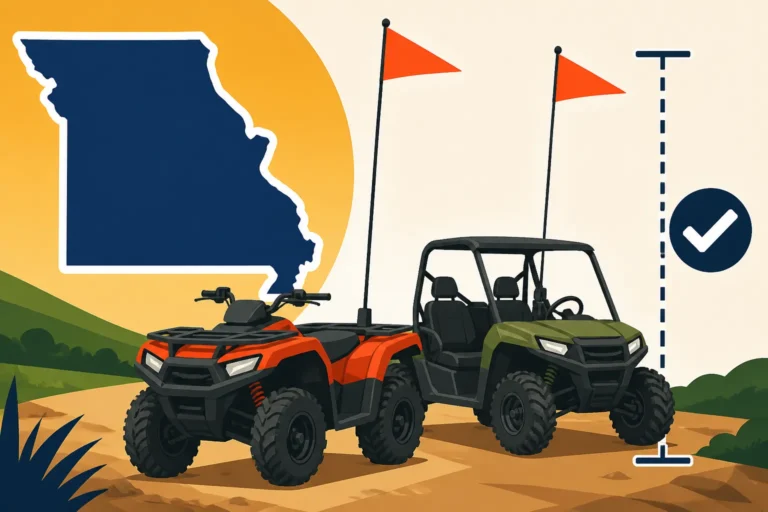
- Safety Flag: This is a distinctive requirement. Your UTV must display a safety flag, usually orange or red in color, that extends at least seven feet above the ground when mounted on the machine. This flag must be at least 30 square inches in size and constructed of a highly visible day-glow material. This is to make your lower-profile UTV more visible to other motorists, especially over hills or around blind corners. You'll find many suitable flags and flag mounts from accessory providers like SuperATV if you need one.
These equipment requirements are not optional. They are designed to bring the UTV closer to the safety standards expected of other vehicles sharing the road. A law enforcement officer stopping you will definitely be checking for these items, even if you have a valid permit.
Driver and Passenger Rules
Operating a permitted UTV on public roads also comes with specific rules for the operator and any passengers:
- Driver's License: The operator of a permitted UTV on public roads must possess a valid operator's or chauffeur's license. This means you can't have an unlicensed driver, regardless of age, operating the UTV on public streets, even if they're otherwise allowed to ride off-road. [An Operator's or Chauffeur's License in Missouri] is a prerequisite.
- Passenger Rules: UTVs are designed for multiple passengers, and if your machine has factory-installed seats and seatbelts for more than one person, those seating positions can be occupied, provided all passengers are properly restrained. This is a key difference from ATVs, which generally prohibit passengers unless specifically designed and factory-equipped for two riders. Always make sure everyone is buckled up.
- Helmet Laws: For riders under the age of 18, a helmet is required when operating an ATV or UTV on public lands, and often, by extension, on public roads where allowed. While adults over 18 are not generally mandated to wear helmets on public roads in Missouri, it is always a wise safety precaution, especially on an open-air vehicle. These rules are distinct from those in state parks, where [Missouri Helmets for Riders Under 18] apply to anyone under 18.
Understanding these rules is about more than just avoiding a ticket; it's about ensuring everyone's safety when sharing the road with larger, faster vehicles.
Penalties and Pitfalls of Illegal Road Use
The desire to ride your ATV or UTV on public roads can be strong, but the consequences of doing so illegally in Missouri can be severe. It’s vital to understand the potential penalties and common pitfalls to avoid costly mistakes.
Consequences of Riding Illegally
Operating an ATV or UTV on a public road where it is not permitted, or without the necessary local permit and equipment, can lead to serious legal ramifications. The most common penalty is a citation, which in Missouri can often be classified as a Class C Misdemeanor. While a misdemeanor might not sound as serious as a felony, it can still carry fines, court costs, and potentially even jail time, depending on the severity of the offense or if it's a repeat violation. Fines for such infractions can quickly add up, easily reaching into the hundreds of dollars.
Beyond direct fines, there's the risk of your machine being impounded. If law enforcement deems your operation illegal or unsafe, they have the authority to tow and store your ATV or UTV, adding towing and storage fees on top of any legal penalties. Recovering an impounded vehicle can be a significant hassle and expense. Furthermore, if you're involved in an accident while illegally operating on a public road, your vehicle insurance might not cover damages, leaving you personally liable for repairs, medical bills, and any damages to other property or vehicles. [Missouri Fines for Illegal ATV Road Use] are not to be taken lightly, so always ensure you are riding legally.
The Importance of Local Ordinances
The biggest pitfall for UTV owners seeking street legality is the sheer variability of local ordinances. What's perfectly legal in one town or county might be strictly prohibited just a few miles down the road. This patchwork of rules means that ignorance of the specific local law is not a valid defense. You cannot assume that because your neighbor in a different county has a permit, you automatically can too, or that a permit from one city extends statewide.
Before you ever put your UTV on a public road, you absolutely must do your homework:
- Contact Local Authorities: Reach out to the city clerk's office, the police department, or the county sheriff's office in the specific jurisdiction where you intend to ride. Ask about their ordinances regarding ROV/UTV operation on public roads.
- Understand the Scope: Clarify the boundaries of the permit. Does it only apply within city limits? Does it cover county roads? Are there any time-of-day restrictions? Is there a mileage limit like the 3-mile rule?
- Verify Equipment Requirements: Ensure your UTV meets all the equipment mandates specified in that particular ordinance. As mentioned, SuperATV and other accessory companies offer many items that can help bring your machine into compliance, such as mirrors, turn signals, or robust lighting systems, but confirm what is needed locally first.
- Keep Proof Handy: If you do obtain a permit, always carry it with you, along with your driver's license, proof of insurance, and the machine's title. A phone photo of your documents might not be enough; having the physical papers in a waterproof bag is always best.
The complexity means that [Does a City Permit Work in the Next Town?] is almost always answered with a "no." Cities like Lake Ozark, Harrisonville, Union, St. James, and Lebanon have all implemented their own unique approaches to UTV road legality. What works in Eldon might not work in Grain Valley, for example. Taking the time to understand these hyper-local rules will save you a lot of headache, potential fines, and keep your riding experience safe and legal.
Comparing ATV and UTV Road Legality in Missouri
To help clarify the distinctions, here's a quick comparison of the general rules for ATVs and UTVs in Missouri regarding road use:
| Feature/Requirement | All-Terrain Vehicle (ATV) | Recreational Off-Highway Vehicle (UTV/Side-by-Side) |
|---|---|---|
| General Road Legality | No, generally not permitted on public roads. | Conditional Yes, permitted with local city/county special permit. |
| Agricultural/Industrial Use | Yes, permitted from sunrise to sunset for these purposes. | Yes, permitted from sunrise to sunset for these purposes. |
| State Permit System | No state-level road permit system exists. | No statewide road permit; permits are issued by local cities/counties. |
| Driver's License | Not applicable for road use, but required if operating under Ag/Industrial use on road. | Required (Operator's or Chauffeur's) for road use with permit. |
| Safety Flag (7ft) | Not generally required for ATVs on roads (but often for off-road parks). | Often Required for road use with local permit. |
| Headlamps/Tail Lamps | Not generally required for ATVs on roads (but recommended off-road). | Required for road use with local permit. |
| Turn Signals | Not generally required. | Often Required by local ordinances for road use. |
| Seatbelts/Roll Bars | Not typically factory-equipped with full roll bars and seatbelts for general road safety. | Required (factory or equivalent) for road use with permit. |
| Passenger Capacity | Generally single-rider, unless specifically designed for two with a straddle seat. Passengers often restricted. | Designed for multiple passengers, generally permitted with seatbelts. |
| 3-Mile Rule | Not applicable. | Common stipulation for local permits, limiting travel to within 3 miles of residence/farm. |
Disclaimer
This article is for general informational purposes only and does not constitute professional advice. Laws, prices and regulations vary by location and change over time. Consult a qualified professional for guidance on your specific situation.