Missouri Safety Flag Height
Navigating the specific rules for riding your ATV or UTV on Missouri roads can feel like deciphering a secret code, and one of the most common head-scratchers revolves around safety flags. It’s not just about having a flag; it's about having the right flag, at the right height, to ensure both your safety and compliance with the law. This guide will help you understand Missouri's specific requirements for safety flag height when your machine hits the pavement, ensuring you're visible and legal.
Why a Safety Flag is More Than Just Decoration on Missouri Roads
When you're riding your UTV or even your ATV (in very specific, permitted scenarios) on Missouri's public roads, visibility becomes paramount. Cars, trucks, and even larger agricultural equipment are sharing that space, and their drivers might not be expecting to see a smaller off-road vehicle. This is precisely why Missouri has a specific regulation about the height of your safety flag. It's not just a suggestion; it's a critical safety measure designed to make sure you can be seen over dips in the road, around blind corners, and above the roofs of other vehicles.
Imagine you're cresting a small hill on a county road, and a car is approaching from the opposite side. If your machine is low to the ground and your flag is too short, that driver might not see you until you're right upon them, leaving little time to react. The flag acts as an early warning system, giving other motorists those precious extra seconds to spot your presence, even if they can't yet see the machine itself. This rule is a testament to the state's focus on preventing accidents and keeping everyone on the road as safe as possible.
Missouri's Seven-Foot Safety Flag Rule Explained
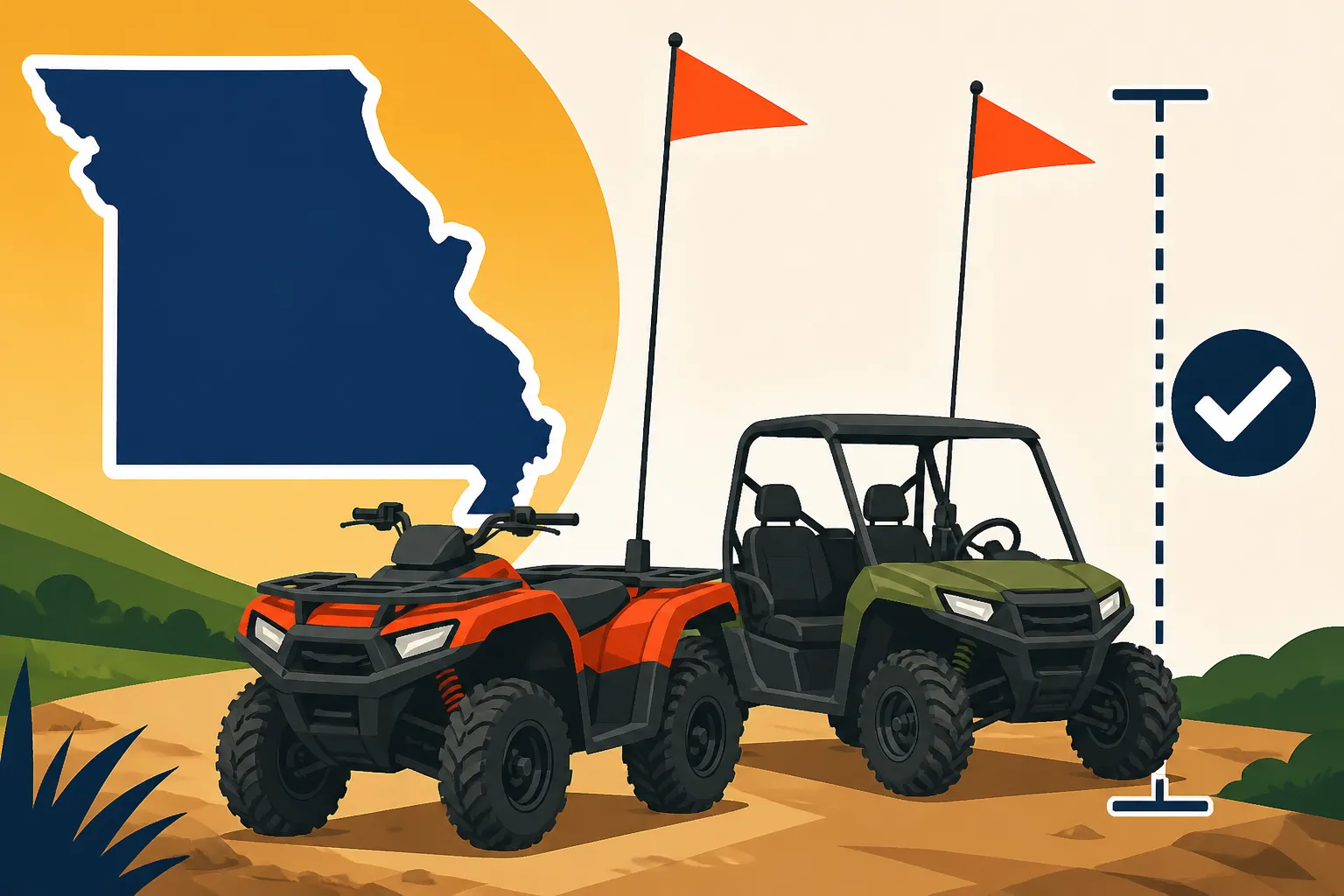
Missouri law specifies a minimum height for safety flags when certain off-road vehicles are operated on public roadways where permitted. For a recreational off-highway vehicle (ROV) – which is what the state often calls a side-by-side or UTV – to be legally driven on approved public streets, it must be equipped with a safety flag that extends at least seven feet above the ground. This isn't just the flag pole; it's the tip of the flag itself, measured from the ground up to its highest point. This strict measurement ensures maximum visibility, allowing your machine to be seen from a greater distance and over typical road obstructions.
The flag itself also has particular requirements beyond just height. It needs to be a "day-glow orange" color and possess at least [30 Square Inches of Day-Glow] of surface area. This isn't about style; it's about contrast and visibility, especially during daylight hours. The bright, fluorescent orange color stands out against most natural and man-made backgrounds, drawing the eye of other drivers. Together, the height and the specific color work in tandem to create an unmistakable visual signal of your presence.
Who Needs to Fly a Seven-Foot Flag?
It's important to understand that this seven-foot flag rule primarily applies to UTVs and ROVs that are operating under specific conditions that allow them on Missouri roads. For instance, if you're taking advantage of [Missouri's 3-Mile Rule for Side-by-Sides] to run a quick errand, or if your local city or county has passed an ordinance allowing UTVs on their streets with a special permit, then this flag requirement kicks in. Your side-by-side, even if factory-equipped with a roll cage and seatbelts, needs that tall, bright flag to meet the visibility standards for road use.
Traditional ATVs, or "quads," generally face much stricter limitations regarding road use in Missouri. While some towns might have unique ordinances, the blanket state rules are much more restrictive for ATVs than for UTVs/ROVs. So, if you're riding a quad on an approved trail system, a flag is still a great idea for trail etiquette and safety, but the specific seven-foot height mandate is typically tied to street-legal ROV operation. Understanding [Why Missouri Splits ATVs, UTVs and ROVs] helps clarify these different applications.
The Logic Behind the Height Requirement
Why seven feet? It’s not an arbitrary number. This height is designed to ensure that the flag is visible over common obstacles and vehicles you might encounter on Missouri roads. Think about an oncoming sedan, SUV, or even a pickup truck. A flag shorter than seven feet might be obscured by the roofline of these vehicles, or by roadside brush, small hills, or parked cars. By demanding seven feet, the state aims to place your flag in a clear line of sight for most other drivers, effectively extending your visible presence on the road.
This requirement also plays a role in safety at intersections and during turns. If your UTV is turning onto a road, that high flag can be seen by cross-traffic sooner, giving them more time to react. It's an extension of your vehicle's profile, making a relatively small machine loom larger in the visual field of another driver, especially one who might be distracted or simply not looking low enough to spot the vehicle itself. A Missouri deputy performing [What a Missouri Deputy Checks on a Road-Legal ROV] will certainly be looking for this flag.
Achieving and Maintaining the Correct Flag Height
Meeting the seven-foot flag requirement involves more than just buying a tall pole; it requires careful installation and regular checks. The measurement is from the ground to the tip of the flag, so you need to factor in your UTV's ground clearance and where you mount the flag. Most riders choose to mount flags to the roll cage or the cargo bed, using brackets designed for stability.
Choosing the Right Pole and Mount
When selecting a flag pole, look for durable materials like fiberglass or reinforced plastic that can withstand wind, trail vibrations, and potential impacts from low-hanging branches if you also use your machine off-road. Many aftermarket companies, including SuperATV, offer a variety of flag poles and mounting solutions specifically designed for UTVs. You can find everything from rigid poles that provide maximum height to flexible whips that can bend without breaking, which is a nice feature if you frequently ride through wooded areas or need to store your machine in a garage with a low ceiling.
Consider quick-release mounts if you plan to remove your flag frequently, for instance, when trailering your UTV or parking it in a garage. These allow you to easily detach the pole while leaving the base bracket securely attached to your vehicle. Always ensure your mount is robust enough to keep the flag pole stable at road speeds. A wobbly flag pole is not only annoying but could also pose a safety hazard if it were to break or detach.
Installation Tips for the Seven-Foot Mark
- Measure on Level Ground: Park your UTV on a flat, level surface when measuring.
- From the Ground Up: Place the flag pole in its mount, extend the flag fully, and measure from the ground to the highest point of the flag. This includes any flex or bend in a whip-style flag.
- Secure Mounting: Make sure the mounting bracket is securely fastened to your roll cage, bumper, or cargo bed. Use appropriate hardware and consider thread locker to prevent bolts from vibrating loose.
- Consider Future Modifications: If you plan on adding a lift kit or larger tires to your UTV, remember that this will affect your ground clearance and potentially your flag height. Always re-measure after significant modifications.
- Visibility, Not Just Height: While height is key, also ensure the flag isn't obscured by any part of your machine, cargo, or passengers. It needs a clear line of sight from all directions.
It's also worth noting that while the flag is crucial, other [Missouri Lighting Requirements for ROVs] and [Roll Bar and Seat Belt Rules for an ROV] are equally important for safe and legal operation on roads. Always check the full list of requirements when getting a [Missouri Special Permit for Road Use].
Where the Rules Change: Parks, Private Land, and Reciprocity
While the seven-foot flag rule is specific to road use in Missouri, it’s important to remember that safety flag requirements can vary wildly depending on where you ride. Missouri state parks, for example, have their own set of rules, and you might find that [Why a State Park Flag Rides a 72-Inch Mast] (which is six feet) is the standard there, sometimes with specific requirements for flag size and color. This means the flag you use for authorized road travel might not meet the criteria for a state park, or vice versa.
Understanding the Differences
| Riding Location | Minimum Flag Height (from ground) | Flag Color | Flag Area (minimum) | Primary Applicable Machine | Notes |
|---|---|---|---|---|---|
| Missouri Public Roads | 7 feet | Day-glow Orange | 30 square inches | ROV/UTV | Applies when operating legally under permit/ordinance |
| Missouri State Parks | 72 inches (6 feet) | Day-glow Orange | 64 square inches | ATV/UTV | Check specific park rules, can vary slightly |
| Private Land | No state mandate | Recommended | Recommended | All | Landowner rules may apply, always ride safe |
| National Forests | Varies by district | Recommended | Varies by district | All | Always check specific Forest Service regulations |
This table highlights the need to always check the specific rules for your intended riding area. You can't assume that what's legal on a county road will also be legal on a designated trail system. The purpose of the flag might be visibility everywhere, but the exact specifications can differ.
Implications of Non-Compliance
Operating an ROV on an authorized Missouri road without meeting the seven-foot flag height requirement, or without the proper day-glow orange flag, could lead to a citation. [Missouri Fines for Illegal ATV Road Use] can add up, and beyond the financial penalty, you're putting yourself and others at increased risk. A deputy has the discretion to pull you over if your flag doesn't meet the legal standard, and they are trained to look for these specific safety measures.
Beyond fines, the greater risk is a collision. The safety flag is there to prevent accidents, not just to satisfy a legal loophole. Investing in a good quality flag and mount, like those from SuperATV, and taking the time to ensure it meets the legal height, is a small price to pay for peace of mind and enhanced safety for everyone on the road. Always err on the side of caution when it comes to visibility; it could save a life.
Navigating the Streets: Additional Considerations for Visibility
While the flag height is a primary concern, a comprehensive approach to visibility on Missouri roads involves several other factors. Remember, your UTV is a smaller vehicle sharing space with much larger ones, and blending in is not an option when safety is at stake.
Lighting and Other Visual Cues
Beyond the flag, ensure all your vehicle's lights are functional and clean. This includes headlamps, tail lamps, and brake lights. [Missouri Lighting Requirements for ROVs] stipulate that if you’re operating on public roads, your UTV must have at least one headlamp and one tail lamp, both of which must be on. These lights work in conjunction with your safety flag to ensure you're seen in varying light conditions, from the bright glare of midday to dusk and dawn. Always double-check your turn signals as well, if your UTV is equipped with them for road use.
Another crucial aspect is your attire. While not a specific legal requirement for adult riders, wearing brightly colored clothing can significantly enhance your visibility. Fluorescent colors like yellow, green, and orange naturally draw the eye, making you stand out even more. Some riders even opt for reflective gear, especially if there's any chance they'll be on the road near dusk or dawn.
Driver Awareness and Road Permits
Remember, the ability to operate an ROV on certain Missouri roads is often contingent on having a valid [An Operator's or Chauffeur's License in Missouri] and potentially a special permit issued by local authorities. [Where to Get a Missouri ATV Road Permit] can vary, but generally, it involves applying through your local city hall or county sheriff's department. These permits often come with a list of rules that go beyond just the flag, covering everything from speed limits to permissible hours of operation and insurance requirements.
Even with the correct flag and all your paperwork in order, always practice defensive driving. Assume other drivers don't see you. Make eye contact if possible, use hand signals, and maintain a safe following distance. Your safety flag is an excellent tool, but it's just one part of a larger strategy to keep you safe and legal on Missouri's diverse road network. By understanding and adhering to these regulations, you're not just avoiding a ticket; you're actively contributing to a safer environment for yourself and everyone else sharing the road.
Disclaimer
This article is for general informational purposes only and does not constitute professional advice. Laws, prices and regulations vary by location and change over time. Consult a qualified professional for guidance on your specific situation.