Missouri Reciprocity With Kansas
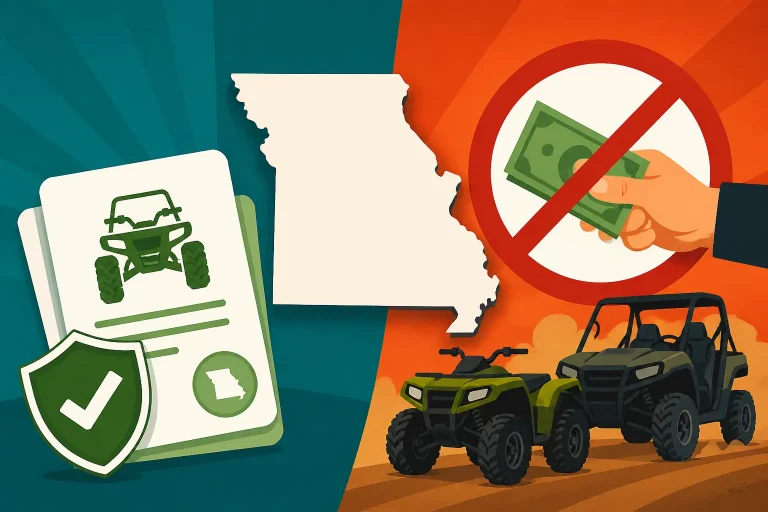
A Kansas ATV or UTV decal can make it tempting to assume your machine is covered when you cross into Missouri. The catch is that registration, road-use permission, and access to a particular trail system are separate things. Here’s what Kansas riders should check before unloading in Missouri, and how to avoid mistaking an out-of-state decal for a Missouri riding permit.
A Kansas decal does not automatically cover Missouri trails
For recreational riding at a Missouri off-road riding area, plan to get the permit that the specific area requires. A Kansas registration, decal, or other proof of status should not be treated as a substitute for a Missouri site permit unless the land manager explicitly confirms that it is accepted.
That distinction matters because “reciprocity” can mean different things. A state might recognize another state’s vehicle credential for one purpose, but that does not necessarily grant access to a state park trail, a designated national forest riding area, or a private park. The rules may depend on where you ride, what kind of machine you bring, and whether the riding area requires its own permit.
Missouri does not use one universal trail pass that covers every public riding area. State park ORV facilities and designated U.S. Forest Service riding areas have their own requirements. A permit for one system does not automatically work at another, and an out-of-state credential should not be assumed to replace either one. For the broader picture, see Missouri ORV Reciprocity With Other States and Riding Missouri With an Out-of-State Decal.
| What you have | What it may establish | What it does not automatically establish |
|---|---|---|
| Kansas registration or decal | A credential issued under Kansas rules | Permission to ride every Missouri trail |
| Missouri ATV title or registration decal | A Missouri vehicle credential when applicable | Entry to a park or designated riding area |
| Missouri state park ORV permit | Access under the rules of the participating park | Access to a national forest or private riding park |
| Forest riding permit | Permission for the area and period it covers | A general permit for all Missouri public land |
| Road-use permit or local authorization | Limited road use where the rules allow it | Trail access or general street legality |
Think of these credentials as serving different jobs. A title or registration relates to the machine’s status under vehicle rules. A riding-area permit relates to where you may ride. Road use is a separate question again. Keeping those questions separate is the safest way to plan a cross-border trip.
A machine that is exempt from a particular Missouri title or registration system is not thereby exempt from a park’s access requirements. The same is true in reverse: buying a riding permit does not make a machine street legal. If your vehicle is a side-by-side, it is especially useful to understand the distinction because Missouri treats different types of off-highway machines differently. Why Missouri Splits ATVs, UTVs and ROVs explains why the machine’s category can affect which rules apply.
Missouri riding areas have separate permit systems
Before choosing a trail, identify who manages it. A Missouri state park, a national forest riding area, and a private park may each have different access rules. A Kansas credential does not erase those differences.
Missouri state park ORV areas
At Missouri state park ORV facilities, check the permit requirements for the specific park and type of machine. The required permit is tied to riding there; it is not a general statewide pass. A Kansas decal does not, by itself, prove that you have paid for or received the park’s required access permit.
The park may also set requirements beyond the permit itself, such as rules for machine dimensions, helmets, flags, sound, or passengers. Those details can vary by location and are worth checking before you load the trailer. Start with Do You Need a Permit for Missouri State Park Trails? and confirm the current rules with the park you plan to visit.
Do not assume that a permit purchased for one Missouri state park will cover another. Likewise, a permit for a state park does not automatically cover a forest riding area. Keep the permit information with the machine or accessible on your phone, and check whether the park requires a particular display or proof of purchase.
Designated national forest riding areas
A national forest is not one unrestricted OHV trail network. Riding is generally limited to places and routes where motorized use is allowed, and some designated riding areas require a separate permit. Check the rules for the specific trail system rather than assuming that a forest permit—or a Kansas decal—covers every road and trail in the forest.
For example, the Chadwick area has its own riding permit rules. A permit for Chadwick should not be taken as permission to ride at a state park or another forest area. See What the Mark Twain Forest ATV Permit Covers for details about the scope of that permit, then verify current instructions with the managing office or official permit source.
Also confirm that your machine is allowed on the trails you want to use. Width limits, trail closures, and other equipment rules can matter as much as permit status. A machine that is properly registered in Kansas may still be too wide for a particular trail or prohibited from a closed route.
Private riding parks
Private parks set their own admission and machine requirements. A Kansas registration or a Missouri public-land permit does not automatically cover entry to a private facility. Check that park’s rules directly, including whether it requires proof of ownership, insurance, a waiver, or a separate day pass.
If your trip includes more than one kind of riding area, plan for each one separately. A weekend that combines a state park and a private park may involve two different access systems, even though you are riding the same machine.
What Kansas riders should check before unloading
The easiest way to prevent a permit problem is to confirm the machine, location, and credential together. A quick check before departure is usually simpler than trying to sort it out at a trailhead.
- Identify the machine accurately. Determine whether it is an ATV, UTV, or another type of off-highway vehicle. Missouri’s categories can affect which requirements apply. Do not rely only on the name used in a sales listing or on a Kansas document.
- Choose the exact riding area. A town, park, or forest name may cover several different access points or trail systems. Confirm the precise location and who manages it.
- Look up that manager’s current permit instructions. Check whether the area requires its own permit, whether the permit is for each machine, and how to obtain or display it. Where to Buy a Missouri ORV Permit can help you understand the purchase process.
- Check machine restrictions. Confirm width limits, allowed vehicle types, sound requirements, safety equipment, and any age or supervision rules. A valid out-of-state credential does not override trail restrictions.
- Check road use separately. If reaching a trail involves riding on a Missouri road, do not assume a Kansas registration makes that legal. Road access can depend on the vehicle type, the road, and local or state rules. See Missouri Rules for a Visiting Rider for the separate visiting-rider questions.
- Check for closures and current notices. Weather damage, maintenance, or seasonal restrictions may close a trail even when you have the right permit. Check the area’s official notice before towing there.
- Keep proof handy. Have the permit confirmation and any relevant machine paperwork available. A phone photo can be useful for reference, but follow the riding area’s instructions for what proof it accepts.
These checks help distinguish three questions that are often mixed together: Is the machine properly documented? Is it allowed on this trail? Have you obtained the permit required to ride there? A “yes” to one does not guarantee a “yes” to the others.
Common assumptions that cause trouble
“My Kansas decal is current, so Missouri must accept it”
A current decal can be meaningful under Kansas rules without granting access to a Missouri riding area. Unless the Missouri land manager says an out-of-state credential satisfies its requirement, budget for the local permit and follow that area’s rules.
“A Missouri permit covers the whole state”
Missouri does not have one all-purpose ORV permit that automatically authorizes riding everywhere. A permit’s coverage depends on the place and system that issued it. Confirm where it is valid before relying on it for another destination.
“Registration and trail access are the same thing”
They are not. Registration or titling addresses a machine’s legal documentation. A recreational permit addresses access to a managed riding area. Road-use rules are separate again. For help sorting out those distinctions, see Does Missouri Honor Out-of-State Registration?.
“If the trail is on public land, I can ride it”
Public ownership does not mean every road, trail, or parcel is open to motorized recreation. A route may be closed to OHVs, limited to certain machine types, or subject to a permit requirement. Follow posted signs and current official maps rather than relying on a general map or an old trip report.
“I can settle the permit question when I get there”
Sometimes permits are available near a riding area, but availability, sales locations, and purchase methods can vary. Do not assume you can buy one at the gate or that cellular service will be available. Check the official instructions ahead of time, especially if you are traveling a long distance.
The practical takeaway for a Kansas rider is straightforward: treat Kansas documentation as Kansas documentation, and treat Missouri access permits as a separate requirement. Pick the Missouri riding area first, verify its rules for your exact machine, and obtain the permit that area requires. That approach avoids relying on informal assumptions about reciprocity and makes it easier to spot other restrictions before the trip.
Disclaimer
This article is for general informational purposes only and does not constitute professional advice. Laws, prices and regulations vary by location and change over time. Consult a qualified professional for guidance on your specific situation.