Does a Farm Lease Carry Riding Rights?
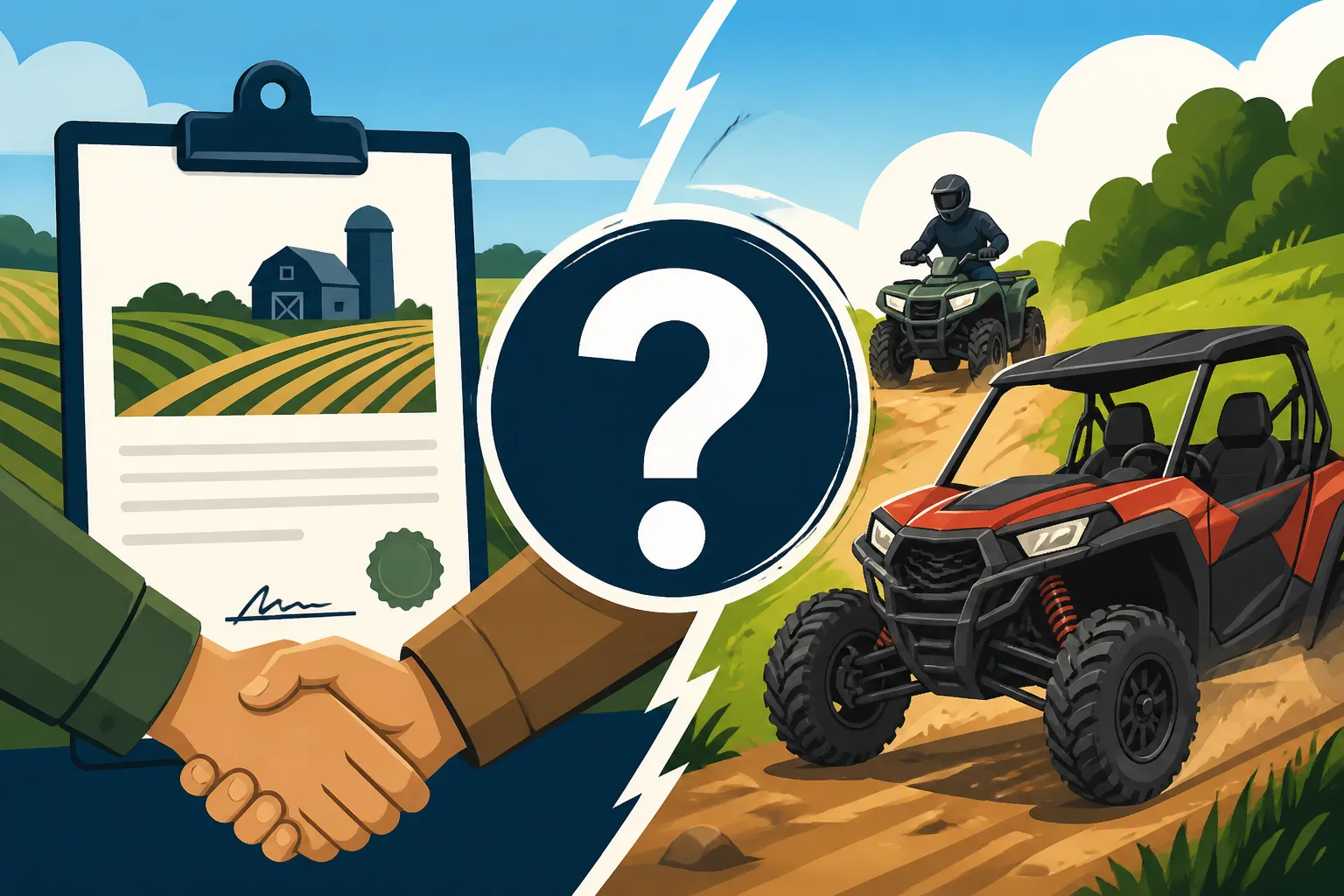
A farm lease does not automatically give a tenant—or the tenant’s guests—the right to ride ATVs or UTVs across the property. In Missouri, the answer usually depends on the lease language, who controls the land, and what the owner has authorized. Check those points before unloading a machine, especially if riding would cross crop fields, pasture, woods, or a neighbor’s land.
A farm lease is not automatically permission to ride
A farm lease gives a tenant certain rights to use land, but those rights are defined by the agreement and the arrangement with the landowner. A lease for growing crops or grazing livestock may not include recreational riding. Even if the tenant has permission to use farm roads for work, that does not necessarily mean the tenant or visitors can ride there for recreation.
The key question is not simply whether the property is a farm. It is whether the person giving permission has authority to allow this kind of riding, and whether the lease permits it.
For example, a tenant may have permission to drive a tractor over a field to plant or harvest crops. That work-related access does not automatically extend to taking an ATV through the same field for fun. The owner may also have reserved some uses, such as hunting, timber work, or access for another tenant.
Likewise, an owner’s casual “that’s fine” may not settle the issue if the lease gives another person control of the property or limits recreational use. If the tenant controls the leased acreage, the tenant may be able to authorize riding within the scope of the lease—but should not assume that authority covers every guest, route, or type of use.
Before riding, confirm:
- Who is authorized to allow recreational use: the owner, tenant, farm manager, or another party.
- Which specific land is included in the lease.
- Whether the lease limits vehicle use to farm operations.
- Whether the proposed route crosses property not covered by the lease.
- Whether guests, children, or organized groups are included in the permission.
- Whether riding is allowed only at certain times or under particular conditions.
If the lease is silent, silence is not a reliable substitute for permission. Ask the landowner or the person with control of the property and get the answer in writing. For broader guidance on permission for private ground, see Missouri Landowner Permission Requirements and Written Permission From a Missouri Landowner.
What to check in the lease and permission
Read the agreement for terms about access, vehicles, recreation, guests, liability, and damage. A lease may mention “farm use,” “agricultural purposes,” “roads and lanes,” or “tenant access” without saying anything about recreational ATV riding. Those phrases can describe a narrower use than an all-purpose right to ride.
Look for provisions that address:
- Permitted use: Does the lease authorize recreational activity, or only farming and related work?
- Vehicles: Does it identify tractors, farm trucks, ATVs, UTVs, or other vehicles?
- Access routes: Are use rights limited to lanes, farm roads, or a particular part of the property?
- Guests: Can the tenant invite riders, or is access limited to the tenant and farm workers?
- Damage and upkeep: Who repairs ruts, broken fences, damaged crops, or gates left open?
- Insurance and responsibility: Does the lease assign duties for injuries or claims?
- Other users: Does the owner retain access or grant use to hunters, neighbors, contractors, or other tenants?
- Term and revocation: When does permission begin and end, and can it be changed?
A practical written permission should identify the people allowed to ride, the machines covered, the approved route or area, and any restrictions. It can also spell out whether riding is allowed in fields, woods, or only on established lanes; whether passengers are allowed; and who is responsible for closing gates and reporting damage.
Keep the permission specific. “You can ride the farm” may leave important questions unanswered if the property includes multiple fields, leased parcels, shared roads, or land near livestock. A simple written note, text, or signed addendum can help clarify the arrangement, but the form should fit the lease and the parties’ intentions. For a lease with unclear or conflicting terms, consider asking a qualified Missouri attorney to review it before riding.
| Situation | What to confirm before riding |
|---|---|
| Tenant wants to ride for recreation | The lease allows recreational use or the owner has clearly authorized it |
| Tenant wants to invite friends | Permission covers guests, not just the tenant |
| A route crosses another leased field | The person controlling that field has approved access |
| Riding would pass through crops or pasture | The route and timing are approved, and livestock or crops can be protected |
| An organized group is involved | The owner has authorized the group, its size, and the activity |
| The lease says “farm use” only | Ask whether that includes recreational riding; do not assume it does |
Written permission does not replace safe, respectful use. Stay on approved routes, avoid crops and livestock, close gates, and do not change fences or block farm operations. If the owner or tenant gives a restriction—such as avoiding wet ground or staying out during planting—treat it as part of the permission.
Private farm access is different from public-land permits
A farm lease concerns permission to use private property. It does not by itself grant access to a public trail, state park, national forest, conservation area, or a road where riding is restricted. Public-land access has its own rules and may require a permit, compliance with trail limits, or use of designated routes. See Missouri Rules for Riding Private Property alongside Missouri Rules for Riding Public Land to keep those situations separate.
The reverse is also important: having a Missouri ATV registration decal, title, or permit for a particular public riding area does not give you permission to cross a private farm. Those documents serve different purposes. A decal or public-area permit is not a landowner’s authorization.
A farm lane can also raise a separate question if it connects to or runs along a public road. Permission to ride on private land does not automatically make the adjoining road legal for an ATV or UTV. Before using a road, shoulder, or crossing, check the rules that apply to that route. The general overview Missouri Rules for Riding a County Road can help identify why private-land permission and road-use rules should not be treated as the same thing.
If you are planning to ride with a club, charity, or larger group, get explicit approval for the event rather than relying on permission intended for one tenant or a few family members. Group size, parking, noise, trail wear, emergency access, and liability may all affect what the owner is willing to allow. A landowner’s approval for private acreage does not automatically satisfy any separate permit requirements that may apply to an organized use of public land. See Missouri Rules for an Organized Ride for that distinction.
Also confirm exactly where the leased land ends. Farm boundaries can be difficult to recognize on the ground, particularly where fields, woods, and lanes meet. A route that appears continuous may cross a neighboring parcel. Ask for a map or walk the route with the owner or tenant, and do not rely on a fence line or familiar trail unless the authorized person confirms it.
A practical way to settle the question before riding
When lease language is unclear, take a short, careful approach rather than trying to infer permission from past practice.
- Read the lease. Search for terms related to recreation, vehicles, access, guests, liability, and permitted use. Note any limits on the tenant’s right to allow others onto the property.
- Ask the person with authority. If the lease gives the tenant control of access, ask the tenant. If it reserves recreation or access decisions to the owner, ask the owner. When unclear, get agreement from both.
- Describe the plan. Say who will ride, what machines they will use, where they intend to go, and whether the ride is recreational, farm-related, or a group event.
- Get the permission in writing. Ask for confirmation that riding is allowed and record the boundaries, routes, dates, guest rules, and any safety or property-care conditions.
- Check neighboring and public routes. Make sure the approved path stays on the leased property and does not use a road or public area without the required authorization.
- Follow the limits and stop if they change. Respect requests to avoid a field, close a gate, pause riding during farm work, or leave the property.
A tenant who wants to use a machine for actual farm work should still clarify what the lease and owner allow. The fact that the ride supports a farm task may matter to the parties’ arrangement, but it does not erase restrictions on the tenant’s authority, guests, routes, or equipment. Keep the distinction clear between operating a machine as part of the farm’s work and taking it out for recreation.
If permission is denied or the parties disagree, do not ride while the question is unresolved. A friendly assumption can turn into a conflict over crop damage, livestock, access, or responsibility for an injury. Clear approval protects the relationship as well as the land.
Disclaimer
This article is for general informational purposes only and does not constitute professional advice. Laws, prices and regulations vary by location and change over time. Consult a qualified professional for guidance on your specific situation.