Missouri ORV Permits Explained
Missouri does not have one off-road permit that opens every trail. The permit you need depends on who manages the land, what kind of machine you ride, and whether you are a resident or visitor. This guide explains the main permit systems, how they differ from registration, what reciprocity does and does not cover, and what to check before you unload.
What a Missouri ORV permit does
An off-road vehicle permit is permission to ride in a particular place under that land manager’s rules. It is not a universal pass for Missouri trails. A permit bought for a state park, for example, does not automatically authorize riding in a national forest, on a conservation area, or on a private trail.
The word “permit” can refer to different things. It might mean a day-use authorization for a state park riding area, a trail permit for a national forest route, or a local permit that lets a qualifying vehicle use certain streets. Before paying, identify the exact place you intend to ride and the agency or owner responsible for it.
A permit also does not take the place of other paperwork or permissions. Depending on the machine and situation, you may still need to address:
- The machine’s title or state decal requirements
- A park or forest permit for the riding area
- Written permission to ride on private property
- A city or county permit for an authorized road route
- Insurance or equipment requirements that apply to road use
- The riding area’s rules on machine width, passengers, helmets, sound, or flags
It helps to think of these as separate questions: Is the machine properly documented? Is this kind of machine allowed on this land? Do I have the right permit for this particular trail? Do I meet the safety and equipment rules? A “yes” to one does not settle the others.
| Where you plan to ride | Permit or permission to check | What it generally covers | What it does not automatically cover |
|---|---|---|---|
| Missouri state park ORV area | The park’s ORV permit | Riding at the specified park or area under its posted rules | National forest trails, other parks, or public roads |
| Mark Twain National Forest trail system | The applicable forest or trail permit | Use of the designated trail system covered by the permit | State park trails, closed routes, or unrestricted off-trail riding |
| Private riding park | The operator’s admission, waiver, or permit requirements | Use of that private property under its terms | Public land or neighboring property |
| Private farm or other private land | Landowner permission | The permission specifically granted by the owner | Public trails or road access beyond the property |
| A city or county street route | The local permit and any state-law requirements | Only the routes and uses authorized by the applicable rules | General trail access or permission in another municipality |
| Conservation or other public land | The managing agency’s rules | Only uses specifically allowed at that location | A general right to operate an ATV or UTV on public land |
For a broader overview of where permits apply, see [Missouri Rules for Riding Public Land]. If your trip includes only state park trails, Do You Need a Permit for Missouri State Park Trails? can help you focus on that system.
The main places and permit systems
Missouri riders commonly encounter separate permit systems at state park ORV areas and in the Mark Twain National Forest. Private parks and local road permits are separate again. The fact that all of these involve off-road vehicles does not make their permits interchangeable.
Missouri state park ORV areas
State park ORV areas have their own admission and operating requirements. A permit may be tied to a particular park, riding period, or vehicle category. Check the park’s current instructions before leaving home, including how the permit must be obtained and displayed.
Park rules can also set limits that are independent of the permit itself. A machine may need to fit the area’s width limit, and the rider may need to meet rules for helmets, flags, sound levels, spark arresters, age, supervision, or passengers. Buying a permit does not waive those requirements.
Mark Twain National Forest
The Mark Twain National Forest has designated riding areas and trail systems with their own requirements. A forest permit is not the same as a state park ORV permit. The permitted trail, vehicle type, date range, and purchase method all matter. The forest’s rules also determine where a machine may travel; a permit is not permission to ride off a designated route.
Chadwick is a prominent example of a managed riding area in the forest. Other trail locations, including Sutton Bluff, may have their own access details and restrictions. Read the current information for the exact trailhead you plan to use. What the Mark Twain Forest ATV Permit Covers explains the forest permit in more detail, while Sutton Bluff Permit Requirements is useful if that is your destination.
Private parks and private land
A privately operated riding park sets its own admission process, operating hours, waivers, and machine rules, subject to applicable law. A state park or forest permit does not substitute for the private operator’s requirements.
For ordinary private land, ask the owner directly and get clear permission before unloading. Confirm which parcel you may use, whether passengers are allowed, where you may ride, and whether you may cross gates, lanes, or neighboring ground. A verbal invitation to use one field should not be treated as permission to roam the surrounding property. See [Missouri Rules for Riding Private Property] and Missouri Landowner Permission Requirements for more on that distinction.
City and county road permits
A local road permit addresses road use, not trail access. Missouri’s rules for certain road use depend on vehicle type and location, and a city or county may have its own ordinance or permit process. A permit from one town does not automatically authorize riding in another town or on a county road outside the issuing jurisdiction.
A route that connects to a trailhead can be especially easy to misunderstand. Confirm that each segment is authorized, including the road leaving the parking area, the route through any town, and the road or crossing that reaches the trail. For the broader road-use picture, see Missouri Special Permit for Road Use and Which Permit You Need to Ride a County Road.
State park permits and what to check
A state park permit is useful only when it matches the park and the riding activity. Before buying, check the park’s official information for the specific ORV area, the type of machine you plan to bring, the permit period, and the current payment and display instructions. Details can change, so do not rely on an old receipt, a previous season’s advice, or a friend’s permit as proof that your trip is covered.
Confirm the park and machine category
Start with the destination, not the permit price. Missouri has more than one place where off-road riding is offered, and rules can differ between them. Check whether the area accepts ATVs, UTVs, or both, and whether it has a machine-width limit. A side-by-side that is too wide for a particular trail does not become eligible because its owner bought a permit.
Ask whether the permit is issued per machine, per rider, or another way. The answer may depend on the permit type. Do not assume one permit covers every machine on a trailer, or that a permit can be transferred from one vehicle to another. Follow the park’s instructions for identification and display.
Check the riding-area rules separately
A park’s permit is only one part of the entry requirements. State park riding areas may have equipment and conduct rules that differ from rules for a public road or forest trail. Depending on the location, the rules may address:
- Maximum vehicle width
- Helmet use and supervision of young riders
- Passenger limits
- Safety flags and flag dimensions
- Spark arresters
- Noise limits
- Riding only on designated routes
- Staging-area speed and behavior
- Hours, seasonal closures, or temporary trail closures
Do not assume a highway flag or a street-legal setup meets a park’s separate flag or equipment standard. Likewise, a machine that is quiet enough for ordinary use may still need to meet a designated sound limit at the park entrance. If your equipment is close to a limit, check the park’s measurement method and standard before making the drive.
Buy through the stated channel
A park may offer permits through an online process, at a park office, or through another authorized channel. The availability of one method can vary by location and date. Read the official purchase instructions before departure, especially if you plan to arrive outside normal office hours.
Keep the confirmation where you can access it, and follow directions on whether to display a permit on the machine, carry it, or show it on a phone. A screenshot can be a useful backup when a trailhead has poor service, but it should not replace any required physical display. If a phone is your only copy, save the confirmation offline and make sure the screen is readable.
Park permits may be nonrefundable or restricted to the selected riding period. Treat the purchase as a final trip decision: verify the location, date, vehicle type, and cancellation terms before paying. For current costs and purchasing details, use the official park information rather than an older post or a third-party summary. [Missouri State Park ATV Permit Cost] provides a starting point for understanding the cost topic, but confirm current figures and terms with the park.
Don’t mistake a state decal for a trail permit
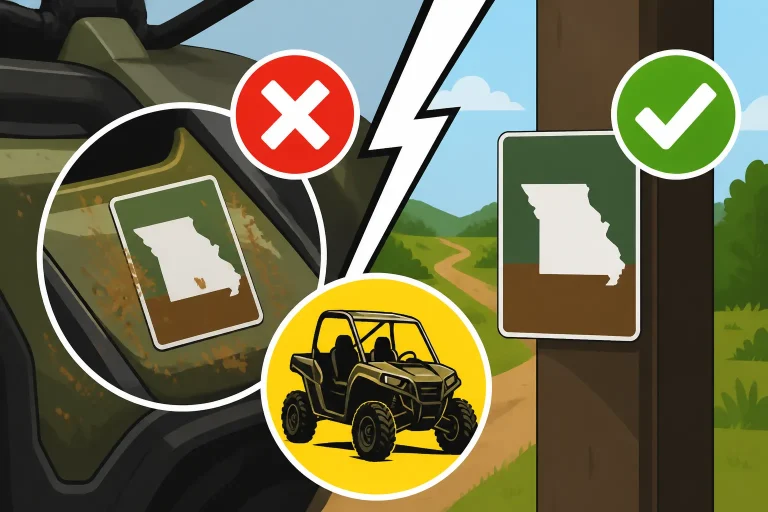
A title, registration, or decal is a different kind of requirement from a riding-area permit. A decal associated with Missouri’s ATV system does not by itself provide trail access at a state park. And a park permit does not replace a title or other paperwork that applies to the machine.
The same distinction matters if you have a UTV. Missouri’s treatment of ATVs, utility vehicles, and recreational off-highway vehicles is not identical in every context. A vehicle may have no state registration decal requirement under one system and still need a park permit to ride at a managed area. Learn the difference in Why Missouri Splits ATVs, UTVs and ROVs and Does Your Decal Cover the Park Trail Permit?.
Mark Twain National Forest permits
Forest permits are tied to the forest’s designated riding system, not to every road or trail on federal land. The first step is to identify the trail area and its current status. A map showing a route does not necessarily mean it is open to your machine today; temporary closures, maintenance, weather damage, and seasonal rules can affect access.
Know which trail system you are visiting
Chadwick and Sutton Bluff are not interchangeable destinations. They have different trail layouts and may have different width restrictions, access points, and operating notices. Check the specific trail system, not simply “Mark Twain National Forest,” when confirming your permit.
Machine width deserves particular attention. A machine accepted at one trail area may not fit another area’s gate or permitted trail standard. Measure the vehicle as the land manager directs, including any accessories that affect its widest point. Do not rely on the manufacturer’s nominal width if mirrors, tires, racks, or other equipment change the actual measurement.
Confirm the permit period and purchase method
Forest permits may be offered for different durations or through different authorized sellers. The available options, prices, and purchase channels can change. Check the current forest or recreation-site instructions before setting out. If purchasing online, confirm that you selected the right trail system and date range.
Some riders arrange the permit before the trip; others buy through a local seller near the trailhead. Either way, do not assume the nearest convenience store carries permits or that a store’s hours match your arrival time. If the official instructions identify an online system, follow that process and retain proof of purchase. Where to Buy a Missouri ORV Permit and Missouri ORV Permit Online cover the practical purchase question.
An online receipt is not an extension of the permit’s coverage. It only documents the authorization you purchased. Check what vehicle or trail system it applies to, whether it is valid for the dates you plan to ride, and whether a physical tag or other display is required.
Stay on the routes the permit allows
A trail permit does not give blanket permission to ride on forest roads, closed trails, roads marked for other uses, or unmarked ground. Follow the signs and the current trail map. At a junction, do not assume the route ahead is open merely because the trail you came from is open.
If you encounter a closed gate, closure sign, washout, or barricade, turn around and use an authorized route. Riding around a closure can damage a trail, create a safety risk, and lead to enforcement. A route that appears passable is not necessarily open.
Permits and current conditions are separate checks. A paid permit does not guarantee every trail will be open when you arrive. Review notices before loading, then read the trailhead board again on arrival. For trip planning around closures, see Checking a Missouri Trail Notice Before You Load and Reading the Trailhead Board Before You Unload.
Keep the permit available
Follow the forest’s directions for displaying or carrying proof. Save an online receipt offline if you may lose cell service, and keep any physical permit secure from mud and water. A small dry pouch can protect paperwork; Amazon is one place riders may look for a basic document pouch, but the pouch itself does not meet any permit requirement. The important part is that an officer can inspect the actual permit and that it is valid for the ride.
A phone screen is handy, but plan for a dead battery, a cracked screen, or a signal-free trailhead. Keep the purchase confirmation accessible without a connection, and consider carrying a paper backup if the issuer provides one. Do not alter, share, or reuse another rider’s permit unless the official terms clearly allow it.
Reciprocity for visitors and out-of-state machines
“Reciprocity” can mean two different things, and mixing them up causes trouble. One question is whether Missouri recognizes an out-of-state registration or decal for a visiting machine. Another is whether a permit bought in another state gives access to a Missouri riding area. The answers may differ.
Out-of-state registration is not a trail pass
A registration or decal issued by another state may be relevant to legal operation or documentation, but it does not automatically buy access to a Missouri state park trail or a Mark Twain National Forest riding area. The land manager’s permit requirement still needs to be checked.
Likewise, a Missouri permit does not automatically make an out-of-state machine properly documented under the laws that apply to it. Keep the machine’s paperwork with you and confirm whether the state’s rules apply differently to a visitor, a resident, or a machine kept in Missouri for an extended period. Does Missouri Honor Out-of-State Registration? and Missouri ORV Reciprocity With Other States address these issues in more detail.
Do not assume another state’s permit transfers
A permit from a neighboring state, a private club, or a national riding organization should not be treated as a Missouri permit unless the relevant Missouri land manager explicitly recognizes it. Trail permits are often location-specific. Even when two systems accept similar vehicle types, their permits can cover different places, dates, and trail networks.
If you regularly travel between states, make a destination-by-destination checklist. For each riding area, confirm:
- Whether the area is open to your type of machine.
- Whether a permit is required, and who issues it.
- Whether the permit is valid for the date and vehicle you selected.
- Whether your home-state registration or decal must be carried.
- Whether there are separate noise, flag, width, helmet, or passenger requirements.
- Whether any road segment between your lodging, staging area, and trail is legally usable.
This small amount of checking prevents the common mistake of arriving with the right machine and the wrong authorization.
Visitors should check resident status carefully
A visitor staying for a weekend is not necessarily treated the same as a person who has moved to Missouri and keeps a machine there. Registration and titling rules can turn on residency, ownership, where the vehicle is kept, and how it is used. A temporary visit does not answer every paperwork question by itself.
If you have recently moved, bought a machine across the border, or plan to leave it at a Missouri property, review the state’s title and decal rules as well as the trail permit rules. Registering an ATV After Moving to Missouri is relevant to a new resident, while Missouri ATV Registration for a Nonresident focuses on visitor and nonresident issues.
Buying the right permit and preparing for the ride
The safest way to buy a permit is to work backward from the trip. Identify the land manager, machine, route, and dates first. Then use the official instructions for that exact place. This avoids paying for an authorization that covers a different trail or a different kind of vehicle.
A practical permit-check process
- Name the exact destination. Write down the park, forest trail system, private park, or local road route. “Somewhere in the Ozarks” is not specific enough to determine the permit.
- Identify the machine. Confirm whether it is an ATV, UTV, ROV, or another vehicle category as the land manager defines it. If width is restricted, measure the actual machine.
- Check whether riding is open. Look for current closures, operating hours, seasonal restrictions, and trail notices.
- Find the official permit requirement. Use the park, forest, county, city, or private operator’s current information.
- Confirm the permit’s coverage. Check the location, dates, vehicle category, and whether the permit is tied to a particular machine or owner.
- Read the purchase and display instructions. Know whether you must show a receipt, attach a tag, carry a paper permit, or keep proof on a phone.
- Review equipment and rider rules. Verify width, helmets, supervision, flags, sound limits, spark arresters, passengers, and any other site-specific conditions.
- Keep a backup. Save the permit offline, carry machine paperwork as appropriate, and take a photo of any physical tag or receipt for your records.
Budget for more than one permit system
A multi-day trip can involve several separate costs. You might pay a state park riding fee one day, a forest permit on another day, and an admission charge at a private park during the same trip. Road permits, if applicable, are another category. Do not budget on the assumption that a single purchase covers the entire vacation.
Fees and purchase terms can change. Before committing, check the current official information for each area. A general page or old receipt may help you understand the system but should not be the final word on current charges, refund rules, or permit availability.
If you ride often, compare the actual days and places you expect to use with any longer-duration permit offered by that system. Do not assume there is an annual pass that works statewide; one system’s longer-term option may be limited to one area, while another may offer only short-term permits. The most useful comparison is based on your real destinations, not the number of days you hope to ride.
Prepare gear that helps you comply
Gear does not create permission, but it can help you meet the rules and avoid preventable problems. Before a trip, check the park’s flag specification rather than buying a mast based on a highway rule. A flag or mast sold for another riding area may not satisfy a state park’s height or visibility requirement. Amazon may be a convenient place to compare replacement flag components, but verify the dimensions and construction against the official site rules before ordering.
For an online permit, a phone mount or a weather-resistant pouch can help keep proof accessible, but avoid placing a device where it blocks controls or the rider’s view. A printed copy stored in a sealed bag is a useful backup if the permit issuer allows paper proof. Amazon may also carry basic waterproof storage options; choose a size that keeps the document legible and secure rather than relying on a loose paper slip in a pocket.
Pack practical safety items as well: appropriate helmets, eye protection, gloves, water, a first-aid kit, and tools suited to your machine and route. On a remote forest trail, fuel range and cell coverage can matter as much as the permit. None of this replaces the posted requirements, but it makes it easier to follow them and respond if conditions change.
Check again on the day of the ride
Conditions can change between the time you buy a permit and the time you reach the trail. Heavy rain, maintenance, fire danger, or other events can close a route or alter access. Check the latest notice before loading, and read the signs at the staging area even if you already checked online.
If the area is closed, do not treat a paid permit as a reason to ride anyway. Contact the land manager for current options, including whether a different area is open or whether the permit has any refund or rescheduling provision. Do not assume a permit can be moved to another park or trail system.
Common permit mistakes and how to avoid them
Most permit problems come from treating similar-looking systems as one. A few clear distinctions make planning much easier.
Assuming a state park permit works in the forest
It generally does not. State parks and national forest trail systems are managed separately, so each may require its own authorization. Verify the precise land manager for every riding day.
Treating a decal as trail access
A title, registration, or decal deals with the machine’s documentation under an applicable state system. It is not a general trail admission ticket. Confirm both the paperwork rules and the land manager’s access rules.
Buying before checking machine width
Width limits can be strict, particularly at trail systems with narrow gates or trails. Measure the machine as directed, including accessories that widen it. If the machine is near the limit, ask the manager how it measures before you purchase a permit or make the drive.
Relying on a friend’s advice from a previous trip
Rules, fees, sellers, hours, and trail conditions can change. A friend’s experience is helpful context, but it is not a substitute for the current instructions from the park or forest. This is particularly important when your vehicle differs from theirs.
Assuming a road permit opens a trail
A local permit may authorize a limited street route, while trail access is controlled separately. Do not ride from a road onto a trail, across a neighboring parcel, or through a town just because one segment is authorized. Confirm each part of the route.
Assuming every public parcel allows ATVs
Public ownership does not mean motorized riding is allowed. Some public lands may prohibit ATV use entirely or allow only particular roads and routes. Follow the managing agency’s rules, and do not use a permit from one site as evidence that another public area is open.
Paying without saving proof
Online purchase confirmations can be hard to retrieve where cell service is weak. Save the document offline, keep a backup if allowed, and know how to show it. If the permit is a physical tag, attach it exactly as instructed.
Leaving permit questions until arrival
A closed office, sold-out permit, poor signal, or unclear trailhead notice can derail a ride. Confirm the purchase channel and office hours in advance. If a key detail remains unclear, contact the land manager before loading rather than guessing at the gate.
A simple rule for Missouri riders
Match the permit to the property. State park access, forest trail access, private-land permission, and local road use are separate permissions. Then check the machine and rider rules for that exact location. If you are bringing an out-of-state machine, verify registration and visitor requirements independently; do not assume reciprocity replaces a site permit.
For each trip, keep a short record of the official permit page, purchase confirmation, trail map, current closure notice, and any relevant machine paperwork. That record makes it easier to answer questions at a trailhead and helps you catch a mismatch before you leave home. When a rule or fee is unclear, ask the agency or owner responsible for the land. They can confirm whether your permit, machine, and planned route fit the current requirements.
Disclaimer
This article is for general informational purposes only and does not constitute professional advice. Laws, prices and regulations vary by location and change over time. Consult a qualified professional for guidance on your specific situation.