Missouri Rules for Riding a Closed Trail
A trail that looks passable is not necessarily open to ATVs or UTVs. In Missouri, closures can protect riders, wildlife, public land, or trail conditions, and a permit does not give you permission to ignore them. Here’s how to recognize a closure, what to do when you encounter one, and how to avoid turning a planned ride into a citation or a safety problem.
What a Closed Trail Means in Missouri
A trail is closed when the land manager or property owner has restricted use of it. The restriction may apply to a specific section, a whole route, a riding area, or a particular type of vehicle. It can be temporary or long-lasting, and it may apply even when the trail looks dry, familiar, or easy to ride.
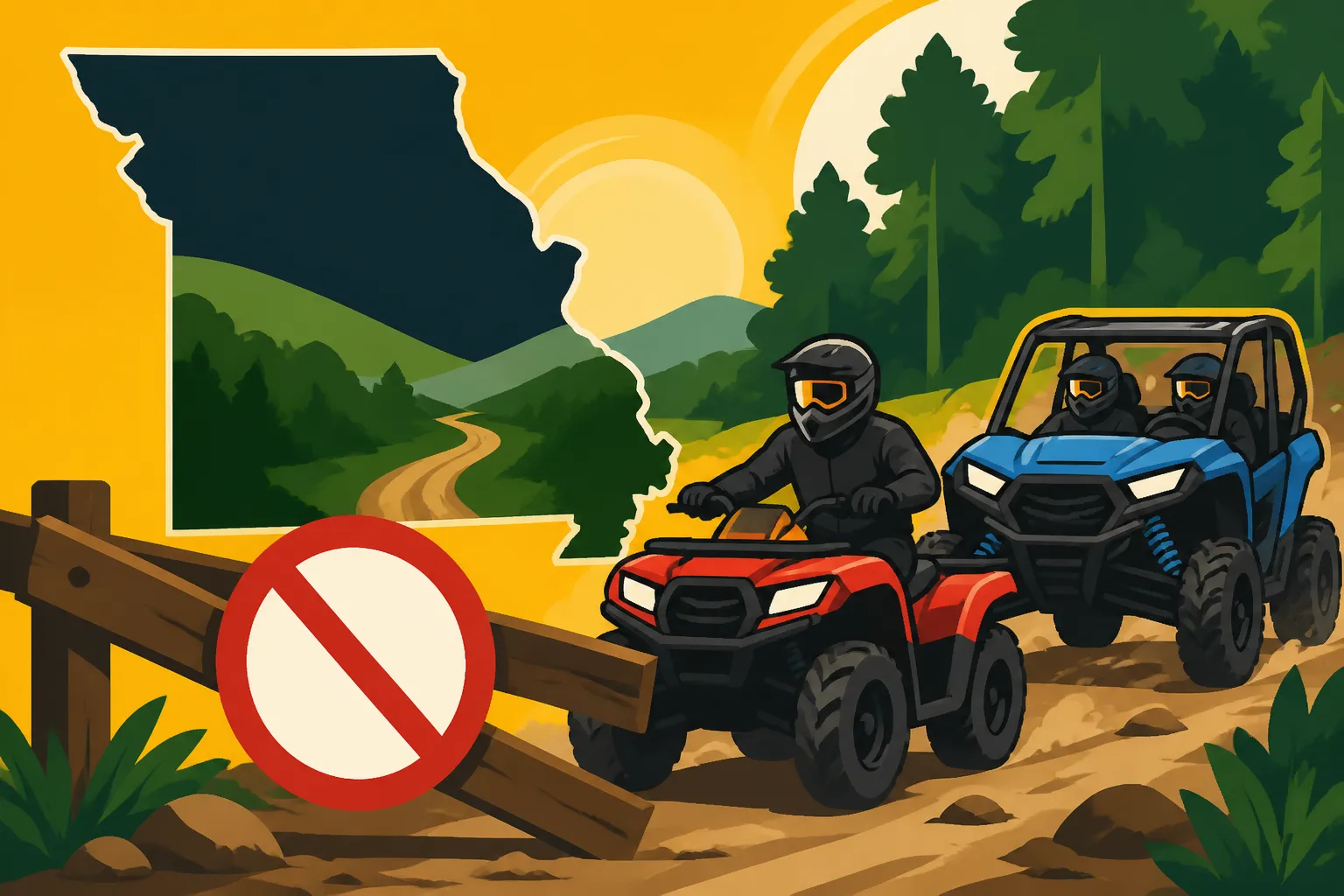
Closures can be marked in different ways: a sign, gate, barricade, rope, flagging, map notice, or an official announcement. A route can also be closed through a posted rule or order even if the marking is easy to miss. If a sign says a trail is closed, don’t assume you can proceed because another rider has gone through, because the barrier is open, or because your machine can safely make it across.
The rules depend on who manages the land. A state park, national forest, conservation area, county road, private riding park, and private property owner may each set different access rules. A permit for one place does not automatically authorize riding somewhere else, and a general registration decal is not a substitute for permission to use a trail. For a broader overview of public-land access, see Missouri Rules for Riding Public Land.
A closure can apply to all motorized vehicles or only some. For example, an area may remain open to hikers or bicycles while motorized use is prohibited. A route may permit one class of vehicle but not a wider machine, or the rule may limit use to designated trails. Read the sign and any posted map as a whole rather than assuming that “open” means open to every vehicle and activity.
| What you encounter | How to treat it |
|---|---|
| A sign that says the route is closed | Do not ride past it, even if the trail appears passable |
| A gate or barricade across the route | Treat it as a stop point; do not go around or move it |
| A notice closing only part of a trail system | Stay on routes confirmed as open and follow the marked boundary |
| A trail that is muddy, washed out, or damaged but not signed | Do not assume it is safe or authorized; check current notices and avoid causing damage |
| A route used by other riders despite a closure | Other riders’ conduct does not change the closure |
| A map or online notice that conflicts with a sign on the ground | Stop and confirm with the land manager before proceeding |
The practical rule is simple: when you have good reason to believe a trail is closed, don’t use it until you have confirmed that it has reopened. If the situation is unclear, choose an open route instead of trying to interpret the restriction in the most permissive way.
Why Trails Close and How to Check Before You Ride
A closure isn’t always a permanent ban. Managers may close a route to repair erosion, clear storm damage, protect a sensitive area, manage logging or other work, or reduce risk during unsafe conditions. Some trails close seasonally or during particular activities. A trail may reopen once the reason for the restriction has passed, but it is the land manager—not a rider’s judgment—that determines when that happens.
Closures also help protect the trail network. A single ATV or UTV cutting around a gate can widen a path, damage vegetation, create new ruts, or direct water into the wrong place. When many riders do the same thing, a temporary restriction can become a longer closure. A route that looks firm at the entrance may be saturated farther along or may cross a damaged section that cannot be seen from the trailhead.
Check more than one source
Before loading your machine, check current information from the agency or owner responsible for the riding area. A map you saved months ago, a social media post, or a friend’s report may not reflect a recent storm, maintenance closure, or changed boundary. Begin with the official trail notice or site information, then check any updates posted for the riding area.
If you ride in a national forest, use the relevant forest or ranger district information. Rules and conditions can vary by area, and a national forest permit does not make a closed trail available. [Missouri Rules for Riding a National Forest] explains the broader access context. For state riding areas, check the park’s current trail information and any posted notices at the entrance or staging area.
A useful pre-ride routine is:
- Identify the exact area and land manager for the trails you intend to ride.
- Check the manager’s current closure notices, maps, and access instructions.
- Confirm that your machine is allowed on the routes you plan to use.
- At the trailhead, read the signs and map before unloading or starting the ride.
- If a sign or barrier conflicts with what you expected, stop and ask the manager rather than riding through.
Even when the official information says a trail is open, conditions can change. A storm may wash out a crossing, a tree may block the route, or maintenance work may begin after you checked the map. Notices at the entrance and on-the-ground signs matter. See Missouri Trail Closures to Check First and Checking a Missouri Trail Notice Before You Load for related planning steps.
Treat signs and barriers as authoritative
A sign at the trail entrance can be easy to overlook when unloading, checking gear, or following a group. Make a deliberate stop to read the trailhead board and any signs along the route. A trail may have a specific restriction that is not obvious from the main entrance. Reading the Trailhead Board Before You Unload can help make that check part of your arrival routine.
If a sign is damaged, partly obscured, or seems inconsistent with an official map, don’t use the uncertainty as a reason to pass it. Take a photo of the sign if useful, note the trail or location, and contact the managing office for clarification. A ranger or land manager may be able to tell you whether a route is closed, whether the sign is outdated, or which alternative route is open.
A gate can also be closed for a reason even if it is not locked. Don’t move it, lift it, or ride around it. The same applies to a rope, temporary barricade, or other visible boundary. A gap beside a barrier does not imply permission to pass. If you believe the barrier has been left in error, report it and use another route until the manager confirms access.
What Riders Should Do When They Reach a Closure
When you reach a closure, stop before the sign, gate, or barrier. Don’t ride up to it at speed, try to squeeze through, or send another rider ahead to see what is beyond it. Pause somewhere safe, keep the trail entrance clear, and decide on a legal alternative.
If the notice explains that only one section is closed, follow the posted detour or use another route that is clearly open to your vehicle. Do not create your own detour across vegetation, a field, a creek bank, or an unmarked track. Riding around a closure often causes more damage than the route itself and can lead to a separate problem for leaving the designated trail. [Missouri Rules for Riding Off the Trail] covers why staying on authorized routes matters.
If the closure leaves you uncertain about how to return, don’t continue deeper into the area. Turn around using the route you came in on if it is safe and permitted, or contact the manager for directions. Avoid blocking the trail while you make a call, and keep other riders informed without encouraging them to bypass the restriction.
Don’t move or bypass a closure
A rider may be tempted to move a branch, lift a rope, open a gate, or pass through a gap. Resist that temptation. A barrier is there to control access, and changing it can create a hazard for other visitors or interfere with management work. A trail may also be closed because staff, contractors, emergency responders, or wildlife researchers are using the area.
Going around the barrier does not make the route a permitted detour. It can take you into a restricted zone, onto private land, or into a part of the trail system where your vehicle is not allowed. It may also leave tracks that encourage others to follow. Even if the ground appears solid, the action can damage the area or put you in conflict with the land manager’s rules.
Don’t rely on another rider’s confidence as proof that a trail is open. A person may have misunderstood the sign, may be on a different type of vehicle, or may be riding where they shouldn’t. A group leader has no special authority to overrule a closure. Every rider is responsible for following the rules that apply to that machine and that route.
If you find an unmarked hazard or obstruction
A downed tree, washed-out crossing, or fresh damage is not automatically a formal closure, but it is a reason to stop and assess safety. Don’t force the machine through a crossing that could shift, hide a deep hole, or carry fast water. Don’t cut, drag, or remove an obstruction unless the land manager has authorized it. Contact the manager with the location and a clear description, then follow their directions.
If you can safely turn around without leaving the designated route, do so. If another route is available, use it only if it is clearly open and suitable for your machine. A detour that seems convenient may lead onto a road, private property, or a trail with a different width limit or permit requirement.
A phone photo or GPS location can help communicate where the problem is, but don’t put yourself at risk to collect one. Keep a safe distance from unstable ground, floodwater, damaged structures, and active work areas. If there is an immediate danger to someone, contact emergency services; for routine trail conditions, report the problem to the land manager.
Permits, Enforcement, and the Risks of Riding Anyway
A permit grants only the access described by the relevant rules. It does not override a closure, authorize off-trail travel, or transfer between unrelated riding areas. A state park trail permit, a forest permit, a local road permit, and a vehicle registration decal serve different purposes. Confirm what each one covers before you ride. Missouri ORV Permits Explained offers more detail about permit systems.
Riding a closed trail can bring enforcement consequences, but the exact outcome depends on where you are, who manages the land, what rule applies, and what happened. Possible responses can include being told to leave, having a violation documented, or receiving a citation. Additional consequences may apply if the conduct damages property, involves trespass, ignores a separate restriction, or creates a safety risk. Don’t assume that a closure is merely advisory because no one is standing nearby.
State parks and national forests may have different enforcement processes and rules. A state park ranger and a forest officer may assess conduct under the rules that apply to their area. For context, see What a State Park Ranger Can Cite You For and What a Mark Twain Forest Officer Cites Riders For. These broader topics are not a substitute for checking the specific notice or asking the agency about the rule in question.
A permit also may not protect you from responsibility for damage. If a machine tears up wet ground, breaks a barrier, or damages a crossing, the land manager may treat the damage separately from the decision to enter a closed route. A closure often exists precisely because ordinary use could cause harm or create unsafe conditions. Turning back is usually the least costly and least disruptive choice.
If an officer or ranger stops you
Stay calm, stop where directed, and follow lawful instructions. Keep your hands visible and avoid sudden movements. Be respectful and factual. If you misunderstood a sign, explain what you saw without arguing that the closure should not apply. Don’t claim that a permit gives you a right to continue if the route is marked closed.
If you receive a citation or written notice, read it carefully and keep a copy. Note the date, location, trail name, signs you observed, and any instructions you received. Photos can help preserve what was visible, but don’t alter or remove a sign or barrier. If you want to contest a citation, use the process explained in the notice and seek qualified advice if needed.
If you think a closure sign is incorrect or outdated, raise that question with the managing office after you have left the restricted area. A mistaken sign can be corrected through the land manager; riding through it on the assumption that it is wrong can create a separate enforcement issue. The safest response to a confusing closure is to stop, document the concern from a safe place, and ask for clarification.
Planning a Ride Without Getting Caught by a Closure
A little preparation makes closures easier to handle. Before the trip, identify more than one open route or riding area, especially if you’re traveling a long distance. Check the machine’s width and class against the area’s rules, confirm permit requirements, and make sure everyone in the group understands that the route may change if a closure appears.
Keep the essentials accessible: a current map, the trail manager’s contact information, a charged phone, and any required permits. A phone map can be helpful, but service may be limited in some areas and downloaded maps may not show recent closures. Don’t depend on a screen alone. The posted information at the entrance and along the route remains important.
For group rides, set expectations before leaving the staging area. Agree that any rider can call a stop when a closure or hazard appears. The group should turn around together rather than splitting up or pressuring someone to continue. If the group is large, designate a leader and a sweep rider, but make clear that neither can authorize entry to a closed trail.
It can help to use a quick decision check when something looks uncertain:
- Is there a sign, gate, barrier, or official notice restricting access?
- Does the restriction apply to the route, area, vehicle type, or time of use?
- Is the alternate route clearly marked open and legal for this machine?
- Can you confirm the answer with the land manager?
- If you can’t confirm it, can you safely turn back or choose another area?
If any answer leaves real doubt, don’t proceed. A detour, a shorter ride, or a change of destination is better than risking a citation, damaging land, or getting trapped in unsafe conditions.
Respecting closures also helps keep trails available for future riding. Riders who stay on designated open routes make it easier for land managers to distinguish responsible recreation from damage or unauthorized use. Report broken signs, open gates that appear to have been damaged, and hazards through the appropriate management channel. Avoid posting unverified claims that a closed trail is open; inaccurate information can send other riders into the same problem.
A closure can be inconvenient, particularly when the ride has been planned around one route. But the safest approach is consistent: verify conditions before departure, read every notice at the site, and turn around when a trail is closed. A permit is permission to use designated areas under their rules—not permission to cross a boundary those rules have closed.
Frequently Asked Questions
Can I ride around a closed-trail sign if there is room beside it?
No. A gap beside a sign or barrier does not mean the trail is open. Stay on the authorized route and contact the land manager if you believe the closure is a mistake.
Does an ATV or UTV permit let me use a closed trail?
No. A permit applies only to the access it authorizes. It does not cancel a posted closure or allow you to ride outside designated routes.
What if a trail looks open on my map but is closed at the entrance?
Follow the on-site closure and confirm the status with the land manager. Maps and notices can become outdated, while signs may reflect a recent change.
Can I use another route as a detour?
Only if that route is clearly open and permitted for your machine. Don’t make a new track through vegetation, private property, or an unmarked area.
Disclaimer
This article is for general informational purposes only and does not constitute professional advice. Laws, prices and regulations vary by location and change over time. Consult a qualified professional for guidance on your specific situation.