Missouri Fines for Riding Without a Permit
A Missouri ATV or UTV rider can face a citation for using a public riding area without its required permit, but there is no single statewide “no permit” fine for every place. The consequences depend on where you ride, what kind of permit that site requires, and whether other rules were broken. Here’s how to sort out the permit system before unloading.
What riding without a permit means in Missouri
“Permit” can mean different things in different places. Missouri does not issue one general trail permit that automatically covers every public riding area. A permit for a state park does not necessarily cover a national forest trail, and a registration decal is not a substitute for a site’s off-highway vehicle permit.
The first question is not simply whether you have a permit. It is whether the land you are riding on allows your machine and requires a permit for that use. Some public areas have designated motorized trails with their own permit rules. Other public land may prohibit ATVs and UTVs altogether or allow motorized use only on certain roads. Private property generally does not use the same public trail permit systems, but you need the landowner’s permission and must follow other applicable laws.
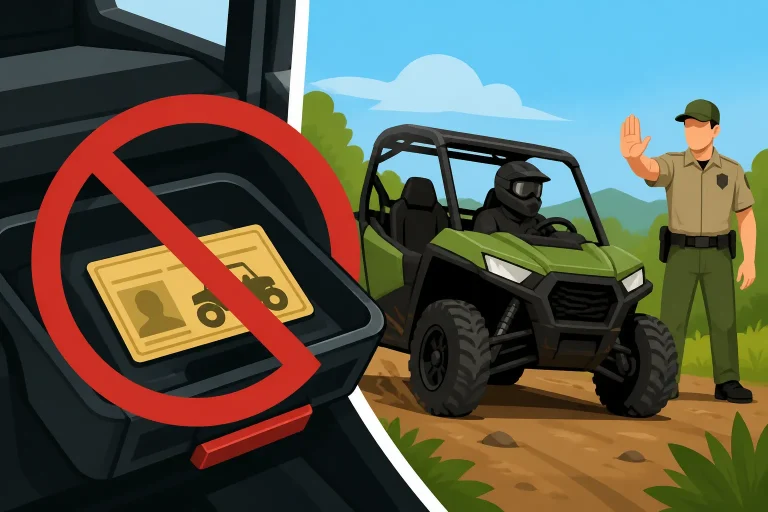
The practical risk of riding without a required permit is that an authorized officer or site employee may stop you, check your machine and permit, and issue a citation or direct you to leave. The precise consequences depend on the location and the violation. A missing permit is also different from riding on a closed trail, going off the designated route, or using a machine that does not meet the site’s requirements. Those may be treated as separate violations.
A permit is not the same as registration
Missouri’s ATV registration system and public-land riding permits serve different purposes. A state registration decal does not generally replace a park or forest permit. Likewise, buying an off-highway vehicle permit for a particular riding area does not automatically take care of registration or make a machine legal for road use.
Before a ride, check each requirement that applies:
- Registration or decal: Whether the machine needs Missouri registration depends on the machine’s classification and the state’s rules. See Missouri ORV Permits Explained for the distinction between registration and riding-area permits.
- Site permit: A park or forest may require its own permit for the machine using its trails.
- Land access: The area must be open to that kind of vehicle and to the type of riding you plan to do.
- Machine limits: Width, noise, safety equipment, and other conditions may apply at a particular trail system.
- Road-use rules: A trail permit does not automatically authorize riding on a public road.
A rider can have a current decal and still be missing the permit required at a particular riding area. The reverse can also be true: a site permit does not necessarily resolve a separate registration requirement.
The land matters
The same ATV can be treated differently depending on where it is ridden. A designated state park trail, a national forest route, a county road, a conservation area, and a private trail are not interchangeable places with one shared set of rules.
For example, riding on a designated trail at a state riding area may require a site permit, while riding on a public road may be governed by road-use restrictions and local rules. A national forest may have its own permit and trail-opening conditions. Some public lands do not allow general ATV recreation at all. A permit does not give a rider permission to use a place that is closed to ATVs.
That is why “I have a permit” is not always a complete answer during a roadside or trailhead check. The relevant questions include which agency manages the land, what route you are on, whether it is open, and whether your permit covers that machine and use. Missouri Rules for Riding Public Land offers a useful starting point for separating access rules from permit rules.
Where a permit may be required and why one permit may not cover another
Missouri riders commonly encounter separate requirements at state park riding areas and on designated motorized routes in Mark Twain National Forest. Those systems are not a universal pass for every trail in the state. Requirements can also differ by site, vehicle type, dates of operation, and trail conditions.
| Where you plan to ride | What to check before unloading | Why one permit may not be enough |
|---|---|---|
| A Missouri state park riding area | The park’s current permit rules, vehicle limits, operating conditions, and trail status | The permit applies to that park system, not automatically to other public riding areas |
| A designated Mark Twain National Forest route | The applicable forest permit, route designation, closures, and machine requirements | Forest permits and route rules are separate from state park requirements |
| A county or city road | Whether road use is allowed and whether a local permit or other conditions apply | A trail permit does not grant road access |
| A conservation area or other public land | Whether ATV or UTV use is permitted at all | Many public lands have restrictions beyond a permit requirement |
| Private property | The owner’s permission and any relevant safety or local rules | Public-land permits generally do not replace permission from the owner |
State park riding areas
State park riding areas have their own access and operating requirements. A rider should check the specific park’s rules rather than assuming that a vehicle decal, a permit bought elsewhere, or a previous visit covers the next ride.
Some park requirements concern more than payment. A machine may need to meet width, sound, lighting, or other conditions. Riders may also have to comply with helmet, flag, passenger, supervision, and speed rules. A permit does not override those requirements.
Before leaving home, confirm that the riding area is open and that your vehicle is eligible. Park access can be affected by closures or operating conditions, and a permit purchase does not guarantee that every trail will be available. The details in [Missouri State Park ATV Permit Cost] and Does Your Decal Cover the Park Trail Permit? can help clarify how the park permit differs from a registration decal.
Mark Twain National Forest routes
The forest system is separate from the state park system. A rider heading to a designated forest route should verify the applicable permit, which roads or trails are open to the machine, and any local restrictions. Do not assume that a permit bought for a state park works in the forest or that a forest permit allows travel on any nearby road.
Forest access also depends on designated routes and current closures. A route shown on an older map may have changed status or may be temporarily closed. Riding beyond a permitted route can create a separate problem even if the rider has paid for the correct permit. What the Mark Twain Forest ATV Permit Covers explains the forest permit’s scope, while Missouri National Forest ATV Permit is relevant when planning a forest ride.
Roads and trails are different systems
A permit for an off-road trail does not make an ATV or UTV legal on a public road. Road access may depend on state law, the type of machine, the road, and any local authorization. Similarly, a road-use permit or local ordinance should not be treated as permission to enter a managed riding trail without its required site permit.
This distinction matters when the route to a trailhead includes a road. Riders sometimes plan the trail portion carefully but assume they can use a nearby road to connect trails, reach fuel, or get back to a trailer. Check road rules separately and do not use a trail permit as proof of road authorization. For a separate issue, see Which Permit You Need to Ride a County Road.
Visiting riders and out-of-state registration
An out-of-state decal or registration may be relevant to whether a visiting machine meets a registration requirement, but it should not be assumed to replace a Missouri riding-area permit. Reciprocity and trail access are separate questions. Before traveling, confirm both whether Missouri recognizes the visitor’s registration for the intended use and whether the destination requires its own permit.
A nonresident should also check the land manager’s requirements for vehicle class, route access, and proof of payment. Keeping a home-state decal visible does not necessarily answer whether the rider has purchased the correct permit for that particular site. Missouri ORV Permit for a Visitor and Does Missouri Honor Out-of-State Registration? address these separate questions.
What fines and other consequences can follow
There is no single fine amount that applies every time someone rides without a permit in Missouri. The legal and practical consequences depend on the land manager, the place, the exact conduct, and the rules that apply there. A claim that every unpermitted ride brings the same fixed fine is too broad to be reliable.
A rider may be stopped and asked to show a permit or other proof of authorization. If the required permit is missing, an officer or authorized employee may issue a citation or require the rider to stop riding or leave the area. The matter may then be handled under the applicable state, local, or federal rules. Any fine, court costs, or other consequences should be confirmed with the agency that manages the land or the court handling a citation.
The cost of the permit is not a dependable estimate of the penalty for failing to buy it. A site permit may have a relatively straightforward purchase process, but a citation can involve a separate enforcement process. Conversely, not every interaction results in the same outcome. The specific conduct, the governing rule, and the decision of the enforcing authority all matter.
A missing permit can be only one violation
If a rider lacks a required permit and is also on a closed trail, off a designated route, or operating a noncompliant machine, each issue may be addressed separately. Other examples of conduct that could create additional trouble include:
- Riding somewhere ATVs or UTVs are not allowed.
- Ignoring a posted closure or an officer’s direction.
- Exceeding a site’s machine-width or sound limit.
- Failing to meet required safety equipment rules.
- Carrying passengers where they are prohibited.
- Riding on a public road without the necessary authority.
- Entering private land without permission.
A permit does not cure those other violations. Nor does buying a permit after being stopped necessarily erase the fact that the rider entered or used the area without one. If a citation identifies more than one alleged violation, read each item separately rather than assuming it all refers to the missing permit.
For example, a rider who lacks the right permit and travels onto a closed route may face a different situation from someone who has the correct permit but accidentally cannot display proof at a checkpoint. The rules and evidence can differ. Missouri Fines for Riding a Closed Trail and [Missouri Rules for Riding Off the Trail] explain why route status and riding location matter independently of permit payment.
State and federal land can involve different enforcement
A state park and a national forest are managed under different systems. The authority responsible for enforcement, the applicable rule, and the process for resolving a citation may therefore differ. Do not assume that a consequence described for one location applies at another.
If an officer gives you a citation, use the instructions on the document to identify the issuing authority, the alleged violation, and the response process. Ask the relevant agency or court about current requirements and deadlines. If the citation is unclear or could affect your legal rights, consider getting advice from a qualified professional instead of relying on an informal explanation from another rider.
A park employee’s instruction to stop or leave may also be an immediate access issue, separate from any later citation process. Follow lawful directions while you clarify the permit or trail rule. Arguing at a gate or continuing to ride after being told to stop can make a manageable mistake more serious.
A receipt or phone screen may help, but plan for poor signal
If a permit is bought online, save the confirmation and any permit details in a place you can access without a reliable cell connection. A screenshot can be useful when a trailhead has weak service, but do not assume a screenshot alone meets every site’s display or identification requirements. Follow the instructions issued with the permit and carry any required physical item.
Keep the permit information associated with the correct machine and visit. If traveling with several vehicles, check whether each one needs its own permit or whether the site offers a different arrangement. The key is not merely having a payment record somewhere in the group; it is being able to show that the permit applies to the vehicle and use being checked.
If you cannot find proof, contact the permit seller or land manager before riding. Do not assume that a bank transaction, an old permit, or a friend’s confirmation will satisfy an officer. In particular, never rely on another rider’s permit unless the land manager’s terms expressly allow that use.
How to avoid a no-permit citation
The simplest way to avoid a permit problem is to identify the land manager before you load the machine. A trail name or nearby town is not always enough: adjoining parcels can have different owners, rules, and permit systems. Check the exact riding area and the route you intend to use.
- Identify who manages the riding area. Determine whether it is a state park, national forest, local road, conservation area, private facility, or other property.
- Confirm that your machine is allowed. Check vehicle type, width limits, designated routes, and any other machine restrictions.
- Check whether a permit is required. Use the land manager’s current instructions rather than relying on an old receipt, a forum post, or a permit from another location.
- Check trail status close to the ride. Look for current closures and operating notices. A paid permit does not make a closed trail open.
- Buy the correct permit before riding. Follow the site’s instructions about dates, machine identification, display, and proof of purchase.
- Keep the proof accessible. Save the confirmation offline if permitted, and carry any physical permit or documentation the site requires.
- Check separate rules. Review safety equipment, passenger, speed, noise, age, and road-use conditions as applicable.
This process is more reliable than asking whether “Missouri requires a permit,” because that question can mean several things. The answer depends on where the ride takes place and what activity is planned.
Check the current rules, not an old trip plan
Permits, operating hours, and trail conditions can change. A person who rode the same area previously may remember an older system or a route that is no longer open. Before each trip, verify current instructions with the official land manager or permit seller. If a rule is unclear, ask before riding rather than trying to settle it at the trailhead.
Pay special attention to whether the permit is valid for the intended date and vehicle. A receipt for a past visit, a permit for a different park, or a permit for a different kind of machine may not provide authorization. Also confirm whether a registration decal is separately required; it is easy to confuse the two systems when planning a multi-day ride.
If the area is closed, do not ride around a barrier or assume another route is an acceptable substitute. Find an open, authorized area instead. Paying for a Permit and Finding the Trails Closed covers the frustration of a closure after payment, but the safe response is still to respect the closure and check for another permitted destination.
What to do if you are stopped
Stay calm, stop where directed, and provide the information requested. If you have a permit, show its proof in the form the site accepts. If you do not, do not claim that a permit from another system applies unless you have confirmed that it does. Ask which rule or permit requirement is involved and whether the officer can identify the relevant notice or citation process.
If you receive a citation, keep the document and record the basic details while they are fresh: the location, date, route, vehicle, and permit information you had. Follow the response instructions on the citation. Questions about payment, a hearing, or a challenge should go to the issuing authority or court named on the document. Do not ignore a citation because you think the permit should have covered the ride.
If you discover the mistake before riding, stop and resolve it first. Contact the land manager, purchase the appropriate permit if available, or choose a place where you can confirm access. That short delay is preferable to risking a citation, being turned away, or having a ride cut short.
Frequently Asked Questions
Is there one statewide fine for riding an ATV without a permit in Missouri?
There is no single fine amount that reliably applies to every riding area and situation. The consequence depends on the land, the permit rule, and the conduct involved. Confirm current enforcement and penalty information with the agency responsible for that location.
Does my Missouri ATV decal count as a park permit?
Not automatically. A registration decal and a site-specific trail permit serve different purposes. Check whether the riding area requires its own permit, even if your machine already has a Missouri decal.
Will an out-of-state registration replace a Missouri trail permit?
Do not assume so. Registration recognition and permission to ride a particular public area are separate questions. Check the destination’s permit requirements and the rules that apply to your home-state registration.
Can I get a permit after an officer stops me?
You can ask the land manager what options are available, but buying a permit after a stop does not necessarily resolve an alleged violation that already occurred. Follow the officer’s directions and any instructions on a citation.
Does a trail permit let me ride on nearby roads?
No. A trail permit does not automatically authorize road use. Check road access and local requirements separately before using a road to reach or connect riding areas.
Disclaimer
This article is for general informational purposes only and does not constitute professional advice. Laws, prices and regulations vary by location and change over time. Consult a qualified professional for guidance on your specific situation.