Missouri Landowner Permission Requirements
Getting permission to ride an ATV or UTV on private land in Missouri sounds simple until a pasture, farm lease, club trail or shared driveway enters the picture. The key is to get permission from the right person and be clear about where, when and how you may ride. That permission does not replace permits required on public riding areas.
What landowner permission covers in Missouri
If you plan to ride on private property, do not assume that owning a machine, knowing the landowner or seeing tire tracks means you have permission. Ask before entering and riding. A property owner’s consent can make access lawful, but it applies only within the limits the owner gives you.
Permission is about access to a particular property, not a general right to ride throughout the area. A landowner might allow you to use one field or trail but not another, permit riding on certain days, or restrict access to a particular machine or group. Treat those conditions as part of the permission, not optional suggestions.
Just as important, private-land permission is not a substitute for permission from someone else who controls the land. The person who lets you use a field may not control a road, easement, adjoining parcel, conservation area or public trail nearby. If the route leaves the property where you were invited, you need to confirm access for the next section too.
Permission is not a public-land permit
A landowner’s invitation applies to the land they control. It does not authorize riding on state-managed, federal, county or other public property. Public areas can have their own access rules, permits, operating limits and closures. Check the rules for the specific destination before loading up; Missouri ORV Permits Explained covers the separate permit question.
The reverse is also true: having a permit for a public riding area does not give you permission to cross private property to reach it. Plan a route that stays within authorized areas, and do not treat a public road shoulder, trailhead or gate as permission to ride onto neighboring land.
A useful way to separate the two questions is:
| Where you plan to ride | What to confirm |
|---|---|
| A friend’s farm or private acreage | Permission from the person who controls the land, plus any limits they set |
| A leased farm or rented hunting ground | Whether the lease allows ATV or UTV riding, and whether the person inviting you has authority to grant it |
| A club trail on private land | The club’s access rules and whether your membership or ride invitation covers that trail |
| A state or federal riding area | The area’s current access rules, permits, closures and machine restrictions |
| A route that crosses several properties | Permission for each parcel or a confirmed route with access rights |
These checks matter even when the machine will stay off public roads. Missouri Rules for Riding Private Property explains the private-land side of riding rules, while Missouri Rules for Riding Public Land addresses a different set of restrictions.
Permission is limited to the person and activity described
An invitation to ride does not automatically cover your whole group. If a landowner says you can ride, clarify whether that includes your passengers, family members, guests or other machines. Do not invite additional riders based on an assumption that the original permission extends to them.
The same applies to the activity. Permission to ride a designated trail may not include permission to:
- Cut across a planted field or pasture
- Make a new route or widen an existing one
- Ride through a creek, gate or farmyard
- Tow another machine or use a winch
- Camp, hunt, fish or collect firewood
- Bring a commercial guide, sponsor or paying group
- Leave the machine on the property overnight
If you are unsure whether a particular activity is included, ask. A short conversation before the ride is easier than trying to resolve a dispute after damage or a boundary crossing.
How to ask for permission and make it clear
A useful request is specific. “Can I ride here?” may leave important questions unanswered. Explain what you want to do, which machine you will bring, how many people are coming and when you expect to be there. If you plan to use a route that crosses more than one parcel, describe that route rather than asking about only the first field.
You do not need to make the conversation complicated. A practical request can cover:
- Who is riding: Give the number of riders and identify any guests or children.
- What is being used: Describe whether you plan to bring an ATV, UTV, trailer or other equipment.
- Where you will go: Ask which trails or areas are open and which areas are off limits.
- When you will arrive and leave: Agree on a time window and ask whether overnight parking or camping is allowed.
- What restrictions apply: Confirm speed expectations, gates, livestock, crops, noise, fires and any seasonal closures.
- How to handle a problem: Get a way to contact the owner or manager if a gate is damaged, an animal gets loose or a trail is blocked.
A written message can help both sides remember what was agreed. Written permission is particularly useful when several riders are involved, the route is not obvious, or the permission is limited to certain dates or areas. A text or email is not a replacement for a clear agreement, but it can record the main details.
Use ordinary language that answers practical questions. For example, ask whether permission covers a named group, a particular day, a specific trail and the machines you plan to bring. If the landowner changes the conditions, acknowledge the new limits before riding again.
Confirm who has authority to say yes
The person who opens a gate or lives nearby may not own or manage the property. A farm employee, caretaker, tenant, hunting guest or neighbor might not have authority to invite riders. If the person granting access is not the owner, ask whether they are authorized to do so.
This can be especially important on large properties, land held by a business or family, and ground managed by someone other than the title holder. When access depends on an organization or land manager, get permission through the person or group responsible for the property rather than relying on an informal assumption.
Do not treat silence as consent. If you leave a message and receive no reply, wait for an answer. A gate left open, an old trail, a worn path or a prior invitation does not necessarily mean access is still allowed.
Keep the permission easy to verify
If a neighbor, landowner or manager asks who you are or why you are there, be prepared to explain. Keep the relevant message accessible, especially if the rider who arranged permission is not with the group. Share the conditions with everyone going along before the ride begins.
That simple step prevents a common misunderstanding: one rider knows the landowner asked the group to stay on a certain route, while another takes a shortcut through a field. The person who arranged access should make sure the whole group understands the boundaries and restrictions.
Leases, clubs and group rides
A lease does not automatically mean every person connected to the property may ride an ATV or UTV there. The lease may grant particular rights to a tenant, specify permitted uses or limit motorized access. A hunting lease, farm rental or permission to use a barn might not include riding privileges.
If you are the tenant, read the agreement and ask the owner or manager before riding. If you are visiting someone who leases the land, ask whether the lease allows guests to ride and whether the tenant has permission to invite them. For more detail on this distinction, see Does a Farm Lease Carry Riding Rights?.
Club trails and shared access
A club may maintain a route across private property, but club membership does not necessarily give you access to every property connected to the club. Follow the club’s current instructions about which trails are open, when they are open and who may ride. If the club asks riders to stay on marked routes or obtain a separate authorization, do so.
Do not assume that a trail shown on an old map is still open. A landowner may change access, a route may be closed for work or weather, or a club’s agreement may apply only to organized rides. Check the current information with the club or property manager before heading out. Missouri Rules for Riding a Club Trail can help separate club access from general permission to ride.
Organized rides, rentals and commercial use
A landowner who agrees to let one person ride may not have agreed to host a large group, a paid event or a guided trip. Tell the owner if you plan to invite additional riders, collect money, advertise the ride, rent machines or provide a tour. These activities can change the scale and nature of the use, so get explicit approval rather than treating a small-group invitation as permission for an event.
Organizers should confirm who is responsible for checking access, communicating boundaries, managing arrivals and departures, and responding if conditions change. They should also ask whether the owner requires specific insurance or other safeguards. Rules that apply to an organized or commercial activity may differ from those for a private outing; Missouri Rules for an Organized Ride and Missouri Rules for a Commercial Guide are useful related reading.
A rental agreement is another separate issue. A rental provider’s permission to use its machine does not give you permission to ride on private land. Confirm that both the property owner and rental provider allow the planned use, and check whether the rental conditions restrict locations or activities. See Missouri Rules for a Rented Machine before taking a rented ATV or UTV onto a private route.
Protect the access and avoid preventable problems
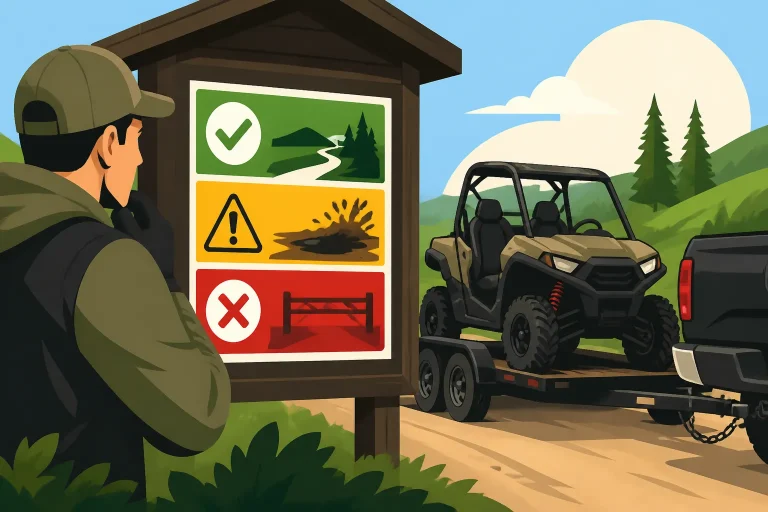
Good permission is only part of responsible riding. The way you use the land can affect whether access remains available to you and other riders. Stay on the route the owner approved, follow posted signs and close gates as directed. If you encounter livestock, stop and give the animals room; do not chase or crowd them.
Ask before riding after heavy rain or when the ground is soft. A machine can leave ruts, damage crops, disturb a drainage area or make a trail difficult for the owner to use. If a route has become muddy or blocked, do not create a new one around the problem without approval. Contact the owner and ask what to do.
Take care with these practical details:
- Boundaries: Use the route you were shown. Do not rely on a fence, tree line or visible track as proof of a property boundary.
- Gates and fences: Ask whether gates should be left open or closed, and never damage a fence to get through.
- Crops and livestock: Keep clear of planted areas and animals unless the owner has specifically approved a route through them.
- Noise and speed: Follow any limits the owner sets, particularly near homes, livestock or neighboring properties.
- Parking and trailers: Confirm where to unload and whether a vehicle or trailer may remain on the land.
- Other users: Yield to people working on the property and follow directions from the owner or manager.
- Changing conditions: If an owner closes a route or asks you to leave, stop riding and comply.
Permission can be withdrawn or changed. If the owner says the route is closed, do not keep using it because you were allowed there earlier. Ask whether another route is available or whether access may resume later. Do not argue that past access created a permanent right.
Do not assume a private route connects to a public road
A private trail may end at a public road, but that does not necessarily mean you can ride on the road or use it to connect to another property. Road-use rules and land-access permission are separate matters. If your planned route includes a road, check whether the machine may use that road and whether the route is permitted. Are ATVs Street Legal in Missouri? is a starting point for the road-use question.
Likewise, do not ride along a neighbor’s field edge, ditch or utility corridor to avoid trailering between properties unless you have permission for that route. A convenient connection is not the same as an authorized one.
If permission is unclear
If you cannot confirm who controls the property, where the permitted route runs or whether your group is included, pause the ride. Contact the landowner, manager or club and ask. If you cannot get a clear answer, choose another place to ride.
Keep any written agreement or message with your ride information, but do not treat it as a universal permit or as permission to ignore signs, closures or new instructions. For public riding areas, check the area’s own requirements separately. For private ground, keep the agreement narrow and specific: the right people, the right property, the right route and the agreed time.
The most reliable approach is straightforward: ask before entering, confirm the exact scope, tell every rider the limits and leave the property as agreed. That protects your access, respects the landowner’s control and reduces the chance that a simple ride turns into a boundary or trespass dispute.
Disclaimer
This article is for general informational purposes only and does not constitute professional advice. Laws, prices and regulations vary by location and change over time. Consult a qualified professional for guidance on your specific situation.