Missouri Counties That Allow ATVs on Roads
It's incredibly frustrating, isn't it? You've got your ATV or UTV, you want to get from your house to the back forty, or maybe just cross a short stretch of road to a neighbor's property, but you're constantly worried about whether you're breaking the law. Missouri's rules for ATVs and UTVs on public roads are notoriously complex and can feel like a moving target, changing from one county line to the next. This guide will walk you through understanding how local jurisdictions in Missouri can, and often do, create their own ordinances to allow off-road vehicles on certain public roads, and how you can figure out what applies where you ride.
The Patchwork Quilt of Missouri Road Laws for ATVs and UTVs
When it comes to riding your all-terrain vehicle (ATV) or utility vehicle (UTV) on public roads in Missouri, many riders assume a blanket "no" is the only answer. And while that's largely true at the state level, the reality on the ground is far more nuanced, creating a confusing patchwork quilt of regulations that can leave even seasoned riders scratching their heads. It’s like trying to navigate a maze where the walls keep shifting.
State Law as a Starting Point: Generally No
Missouri state law generally restricts ATVs and UTVs from being operated on public roads and highways. This is the fundamental rule you start with. Your typical ATV, designed for off-road trails and fields, isn't considered a "street-legal" vehicle in the same vein as a car or truck. This restriction is in place for safety reasons, as these machines often lack the traditional safety features (like turn signals, headlights designed for road use, or windshields) and stability characteristics needed for safe integration with regular traffic. However, there are a few very specific, limited exceptions laid out in state statute. For example, [Missouri's Agricultural Highway Exception] allows for agricultural use during daylight hours for short distances, and some specific scenarios for industrial or utility work. But for general recreational use or commuting, state law is a firm no-go.
This is why you don't typically see ATVs and UTVs with traditional license plates and registrations for road use from the state. For ATVs, you might be familiar with the three-year decal issued by the Missouri Department of Revenue, which is for off-road use and identification, not for street legality. If you're wondering [Why Missouri Does Not Register Side-by-Sides], it's because UTVs don't even get that decal; they exist entirely outside the state's ATV registration system, further complicating their status on public roads.
The Power of Local Ordinances
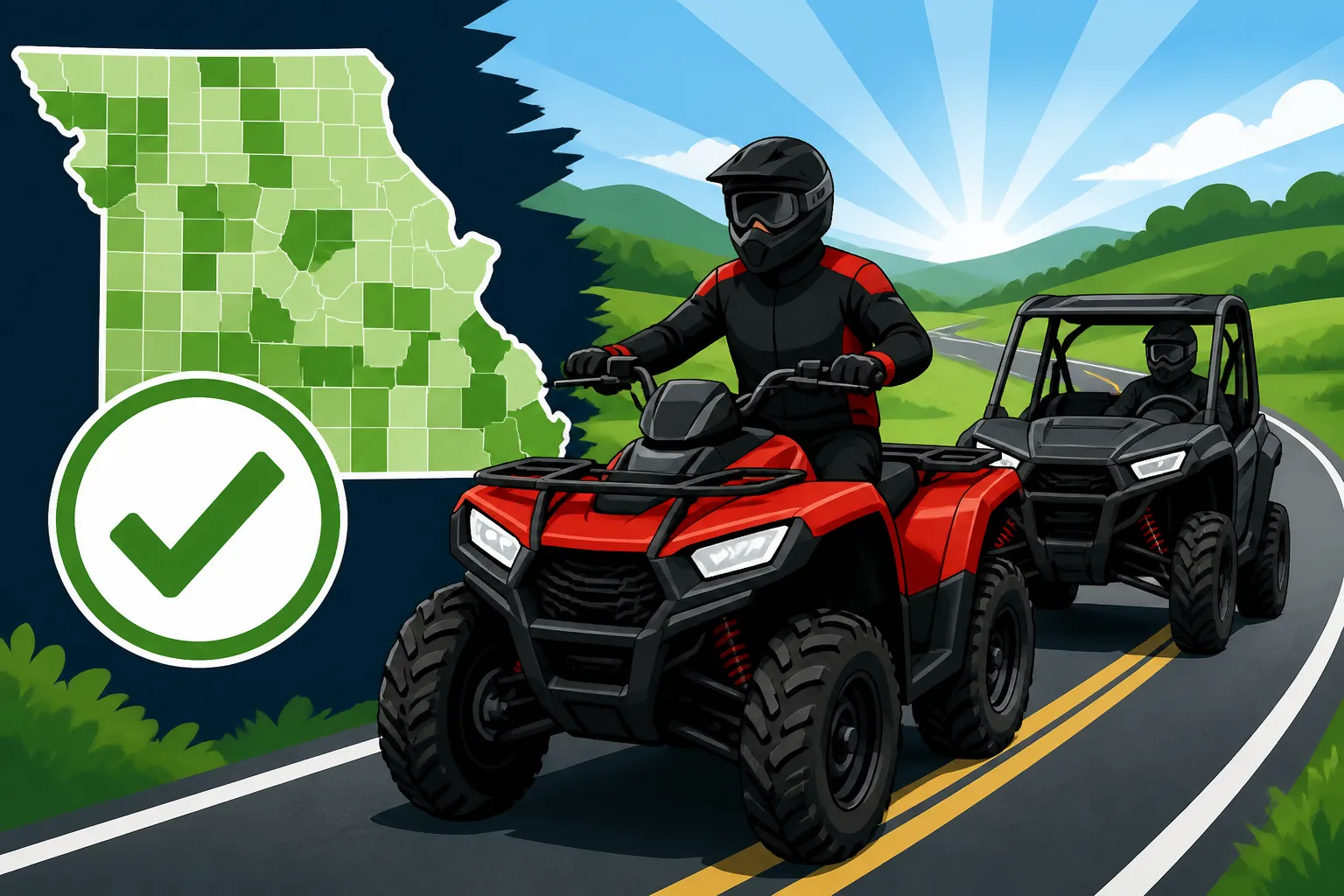
Here's where the waters get a bit murky, and where the "patchwork quilt" truly begins. While the state says "no" to general road use, it also gives counties and cities the power to create their own ordinances that can override or provide exceptions to the state's general prohibition within their specific jurisdictions. This means a county commission or a city council can vote to allow ATVs, UTVs, or Recreational Off-Highway Vehicles (ROVs) on certain public roads within their boundaries.
This local control is a double-edged sword. On one hand, it provides flexibility for communities where off-road vehicles are a vital part of daily life, whether for farm work, accessing remote properties, or simply enjoying the outdoors. On the other hand, it means there's no single, easy answer for riders across the state. What's legal in Harrisonville might be illegal just a few miles down the road in another county or city. It creates a critical responsibility for every rider: you must know the local laws for every area you plan to ride in.
How to Find Out if Your County Allows Road Use
Given the localized nature of these laws, the biggest challenge for Missouri ATV and UTV riders is simply figuring out what's allowed. There's no statewide map or central database that conveniently shows you every county or city ordinance. It requires a bit of detective work, but knowing the right steps can save you a lot of grief – and potential fines.
Contacting Local Authorities
The most reliable way to determine if a specific county or city allows ATV or UTV road use is to go directly to the source. Don't rely on hearsay or what someone told you on a forum; laws change, and interpretations vary.
- County Sheriff's Office or County Clerk's Office: For county roads, your first call should be to the county sheriff's department or the county clerk's office. The sheriff's office enforces the laws, so they'll know exactly what the local ordinances permit or restrict. The county clerk's office maintains records of all county ordinances, so they can direct you to the official language of any relevant laws. Be prepared with specific questions: "Does [County Name] County allow UTVs on county roads?" "Are there specific times or zones?" "What are the requirements for operating them on roads?"
- City Police Department or City Clerk's Office: If you're looking to ride within city limits (even just crossing a street), you need to contact the city police department or the city clerk's office. Many cities have their own specific ordinances, which might be more restrictive or, surprisingly, more permissive than the county. For instance, you might find that [Lake Ozark's 45 mph Streets] are open to UTVs under certain conditions, while a neighboring small town might not allow them at all.
- Official Websites: Many counties and cities now publish their ordinances online. A quick search on the county or city government's official website (look for sections on "ordinances," "code of ordinances," or "motor vehicles") might yield the answers you need. However, always confirm with a phone call, as websites can sometimes be out of date.
Common Requirements for Road-Legal Machines
If a county or city does permit road use for ATVs or UTVs, they invariably come with a list of requirements to ensure safety and accountability. These aren't just suggestions; they are often mandatory and carry penalties if not met.
| Requirement | Typical Purpose | Example Equipment Needed |
|---|---|---|
| Driver's License | Ensures operator competence | Standard operator's or chauffeur's license |
| Insurance | Provides financial protection in case of accident | Proof of liability insurance |
| Safety Flag | Increases visibility to other drivers | [Missouri's 7-Foot Safety Flag] with orange pennant |
| Lighting | Visibility during low light or night | Headlamps, tail lamps, brake lights |
| Brake Lights | Signals slowing or stopping to traffic | Functioning rear brake lights |
| Mirrors | Allows operator to see traffic behind | Rearview mirror (and side mirrors) |
| Seatbelts/Roll Bar | Operator and passenger protection | Factory-installed or aftermarket |
| Decal/Permit | Local authorization to operate on roads | County or city-issued road permit/decal |
Many of these requirements can be met with aftermarket accessories. For example, if your UTV doesn't have factory-installed turn signals, a company like SuperATV offers turn signal kits that can help you meet local requirements. Similarly, SuperATV provides a range of mirrors, lights, and flags that are essential for making your machine road-ready. Remember, if your machine is over [Missouri's 50 Inches Wide or a Straddle Seat] classification for a traditional ATV, it's likely considered a UTV or ROV, which often have slightly different requirements for road use.
Navigating County-Specific Rules and Exceptions
It’s crucial to understand that even when a county or city opens its roads to ATVs and UTVs, it’s rarely a free-for-all. There are almost always specific conditions, limitations, and designated areas. The details matter, and overlooking them can lead to a citation.
Understanding the "Three-Mile Rule" and Other Provisions
One of the most common provisions you'll hear about for UTVs on roads in Missouri is the "three-mile rule." This rule, found in some local ordinances, generally permits a UTV to operate on public roads for a maximum distance of three miles from the owner's residence or farm, often for purposes of farm work or accessing property. However, it's vital to remember that this isn't a statewide rule that automatically applies everywhere; it's a provision that local jurisdictions can adopt in their own ordinances. So, even if you've heard about the three-mile rule, you must verify if your specific county or city has adopted it. [Why the 3-Mile Rule Is ROVs Only] is another critical distinction, as it typically applies to UTVs/ROVs, not traditional ATVs.
Beyond the three-mile rule, local ordinances might include other specific provisions:
- Designated Roadways: Some ordinances might only allow ATVs/UTVs on specific county or city roads, often excluding state highways or major thoroughfares. They might designate certain gravel roads or less-trafficked routes.
- Daylight Hours Only: Many permits restrict road use to daylight hours, similar to the [Missouri Agricultural Use From Sunrise to Sunset] exception. This is a common safety measure.
- Speed Limits: Local permits will often impose specific speed limits for ATVs/UTVs on roads, usually much lower than the posted speed limit for cars.
- Operator Age and Licensing: While a [Missouri Rider Under 16 Cannot Register] an ATV, local ordinances will almost always require operators on public roads to possess a valid driver's license (usually an operator's or chauffeur's license, not just a learner's permit).
- Passenger Restrictions: Some ordinances might restrict passengers or specify that only machines designed for multiple passengers can carry them. On public roads, [Passengers Barred on a Missouri ATV] is a common state-level rule that local ordinances may or may not relax for UTVs.
Equipping Your Machine for Road Use
To comply with county and city ordinances, your machine will need to be properly equipped. This often goes beyond basic factory features.
- Visibility: Beyond the mandatory [Missouri Safety Flag Requirements] (often a minimum of 7 feet from the ground with 30 square inches of orange or red-orange material), good lighting is key. This includes functional headlights, taillights, and brake lights. Some ordinances might even require turn signals, which are often aftermarket additions. Consider bright LED lights for better visibility, especially if you're riding at dusk or dawn.
- Mirrors: A rearview mirror is almost universally required, and side mirrors are often a good idea for increased situational awareness, especially with longer UTVs.
- Horn: A working horn is a safety device for alerting other drivers or pedestrians.
- Tires: While not always specified, using tires suitable for mixed terrain (road and off-road) can improve handling and safety on paved or gravel surfaces compared to aggressive mud-specific tires.
- Maintenance: Regular maintenance is crucial. Ensure your brakes are in excellent condition, all lights are working, and your machine is generally roadworthy. A machine breaking down on a public road is not only inconvenient but also a hazard.
You might find that getting all these components together can feel like a mini-project. Companies like SuperATV specialize in aftermarket parts and accessories, offering everything from full street-legal kits to individual components like safety flags, mirrors, and LED light bars, making it easier to meet the various requirements outlined in local ordinances. Don't forget to keep [Keeping Paperwork in a Dry Bag] on your machine, including your permit, proof of insurance, and driver's license, in case you're stopped by law enforcement.
Beyond County Roads: City Ordinances and Highway Crossings
While many riders focus on county roads, the rules within incorporated city limits are often distinct. And the ability to cross state highways is another critical, and often misunderstood, aspect of legal ATV/UTV road use.
The Importance of City-Specific Rules
Just like counties, cities in Missouri have the authority to pass their own ordinances regarding ATV and UTV use on their streets. This means that even if a county allows road use, a city within that county might still prohibit it, or have different, stricter requirements. For example, [Harrisonville's Police Department Permit] indicates that specific cities may require their own permits, issued directly by their police department, and these permits will come with their own set of rules and fees.
You might encounter situations where:
- Specific Streets Only: A city ordinance may designate only certain streets as open to UTVs, typically lower-speed residential or commercial access roads.
- Permit Fees: Cities often charge a fee for their special permits, which helps cover administrative costs and potentially local enforcement. [Why the Permit Money Stays Local] means these fees are not usually part of state revenue.
- No Reciprocity: A permit from one city or county rarely grants you permission to ride on the roads of an adjacent city or county. Each jurisdiction is its own entity, and you must adhere to its specific rules. This is why [Does a City Permit Work in the Next Town?] is almost always answered with a no.
Always, always check with the local city police department or city clerk's office before riding your ATV or UTV on city streets. A quick phone call could save you a hefty fine.
Safely Crossing State Highways
One of the most common questions riders have is about crossing state highways (like U.S. routes or state routes). Even if your county or city allows ATVs/UTVs on local roads, state highways generally remain off-limits, with very few exceptions.
- Direct Crossing: Missouri state law does allow for direct crossing of a highway or interstate, but it must be done at approximately a 90-degree angle to the roadway, at a place where it's safe to do so, and after yielding to all oncoming traffic. You cannot ride along the highway, even on the shoulder. This is often the only legal way to get from one section of county or private land to another if a state highway divides them.
- Agricultural Exceptions: As mentioned, [Missouri's Agricultural Highway Exception] permits limited use of state highways for agricultural purposes during daylight hours for short distances. This is a very narrow exception and does not apply to recreational riding.
- No Riding on Shoulders: Do not assume that riding on the shoulder of a state highway is permissible. It is generally not. The shoulder is still considered part of the highway right-of-way, and operating an ATV or UTV there can result in a citation.
- Visibility is Key: When making a permissible highway crossing, maximum visibility is paramount. Your safety flag should be flying high, and your lights should be on. Make sure you have a clear line of sight to oncoming traffic in both directions.
Understanding the difference between state, county, and city jurisdiction is critical. Your local county might have opened up its roads, but that doesn't automatically mean you can drive your UTV down a state highway to get there. Always exercise extreme caution and err on the side of safety and legality when interacting with state roadways. Getting caught operating an ATV or UTV illegally on a public road in Missouri can result in a [Class C Misdemeanor in Missouri] and significant fines.
Disclaimer
This article is for general informational purposes only and does not constitute professional advice. Laws, prices and regulations vary by location and change over time. Consult a qualified professional for guidance on your specific situation.