Where You Cannot Ride Because a Town Never Voted
It can be incredibly frustrating to see fellow riders enjoying their ATVs and UTVs on public roads in some parts of Missouri, while in your own community, or even just a few miles down the highway, it feels like an unspoken rule that you absolutely cannot. This guide will cut through the confusion and explain precisely why this patchwork of regulations exists, focusing on the critical role (or lack thereof) of local town votes in determining where you can and cannot legally ride your machine on Missouri's streets.
The Missouri Road Question: Not a Simple Yes or No
Let's be real: the idea of just hopping on your ATV or UTV and cruising down a Missouri street like you would a car is, for the most part, a pipe dream. Missouri law generally prohibits the operation of off-road vehicles on public roadways. This isn't just some suggestion; it's the default legal stance. So, if you've ever felt that pit in your stomach wondering if you're breaking the law by even crossing a street, you're not wrong to be concerned. The state has a broad prohibition, and it's up to individual cities and counties to create specific exceptions.
This creates a real headache for riders. You might live in a town that has embraced UTVs on its streets, issuing permits and even laying out specific routes. Then, you drive five miles to the next town over, and suddenly, those rules vanish because that town never bothered to pass its own ordinance. It’s a classic case of local control, which means constant vigilance on your part. You can't just assume.
Why Local Ordinances Are Key
The entire framework for allowing ATVs or UTVs on local streets in Missouri hinges on one thing: a local government (city or county) voting to allow it. Without a specific, publicly adopted ordinance or resolution, the general state prohibition stands firm. This means that if your town has never held a vote, never passed a bill, and never issued a formal declaration, then riding your machine on its public roads is, by default, illegal. It's not about what's not forbidden; it's about what is expressly permitted.
Many towns simply haven't gotten around to it, or perhaps they've discussed it and decided against it. Either way, the outcome for you, the rider, is the same: no road access. This isn't to say your machine is useless; Missouri offers fantastic off-road opportunities, like those found at [St. Joe State Park's Sand Flats in Missouri] or [Finger Lakes State Park in Missouri]. But for road use, local legislation is the gatekeeper.
Missouri's Core Statutes and Exceptions
Even with the possibility of local ordinances, it's crucial to understand the state-level rules that form the foundation. Missouri's statutes (specifically Chapters 304 and 300 of the Revised Statutes of Missouri) broadly define off-road vehicles and restrict their use on public streets and highways. This is where the core prohibition comes from. These laws are designed to keep vehicles not traditionally considered "street legal" off the main thoroughfares for safety and traffic flow reasons.
However, even the state recognizes a few very specific, limited exceptions to this general rule. These are not blanket permissions to joyride; they are narrow allowances for particular circumstances, primarily related to agricultural or industrial work, or for very brief transit.
The Agricultural and Industrial Use Exemptions
One of the most common misunderstandings revolves around the "farm use" exception. Yes, Missouri law does allow ATVs and UTVs to be operated on public roads for agricultural purposes. But this isn't a free pass. It's typically restricted to daylight hours (sunrise to sunset) and usually within a certain radius of the operator's farm property. For example, a farmer might use their UTV to move hay bales from one field to another across a county road. Similarly, industrial use on private premises might allow for temporary road crossing if absolutely necessary to move equipment.
The key takeaway here is that "agricultural use" means just that: actively engaging in farming or related activities. It doesn't mean you can take your machine out for a Sunday drive just because you own a few acres. If you're using your quad to ride to the local convenience store for a soda, that's not agricultural use, even if you just finished baling hay. Always remember that [Why Missouri Has No Farm Sales Tax Break] for ATVs, which might make you think there's a blanket farm exemption for everything, but there isn't for road use.
Crossing a Highway Safely
Another limited exception allows for the crossing of highways. This is strictly for crossing from one side of a highway to the other, usually when no other reasonable access exists. You must do so at a 90-degree angle to the highway, and you cannot ride along the highway. It's a quick dash across, not a journey down the shoulder. This is often seen in rural areas where farms are bisected by state routes, and the farmer needs to access fields on both sides. This rule is about practical necessity, not recreational convenience.
A Missouri deputy or state trooper observing prolonged travel on a highway, even for a short distance, will likely view it as a violation. This isn't a loophole; it's a very specific, brief transit allowance.
The Infamous 3-Mile Rule and Why It's Limited
Now, let's talk about the "3-mile rule" because it causes a lot of confusion and often leads to people thinking their traditional ATV is street legal when it isn't. Missouri does have a specific provision (RSMo 304.033) that allows for the operation of "Recreational Off-Highway Vehicles" (ROVs), often called side-by-sides, on certain public roads. The rule permits an ROV to be driven on a highway within three miles of the operator's home, or within three miles of the property where the ROV is owned or kept.
However, and this is critical, this rule applies ONLY to Recreational Off-Highway Vehicles. It does not apply to traditional ATVs. This distinction is paramount, and misunderstanding it can lead to a hefty ticket. So, if you're on a quad with a straddle seat and handlebars, the 3-mile rule is not for you, regardless of how close you are to your house.
Understanding Recreational Off-Highway Vehicles
So, what exactly is an ROV in Missouri's eyes? Generally, it's a multi-wheeled vehicle with a non-straddle seat (like a car), a steering wheel, seatbelts, and a roll bar or similar enclosure. Think of machines like Polaris RZRs, Can-Am Mavericks, or Honda Pioneers. These are distinct from ATVs, which are defined by their straddle seat and handlebars, designed for a single rider or sometimes a passenger seated behind the driver. The state law explicitly differentiates between them, recognizing that ROVs often have more car-like safety features. This is why you'll often hear about [Missouri's 3-Mile Rule for Side-by-Sides] but not for quads.
The logic behind this distinction is largely rooted in safety. ROVs typically offer more protection in a rollover and have passenger restraints, making them slightly more akin to conventional vehicles in certain aspects, though they are still far from being considered street legal everywhere.
Strict Conditions for the 3-Mile Rule
Even if you have a bona fide ROV and are within the 3-mile radius of your home or property, there are stringent conditions you must meet to legally use this exemption. These aren't suggestions; they are requirements:
- Licensed Driver: The operator must possess a valid operator's or chauffeur's license. No learner's permits for this.
- Insurance: The ROV must be covered by liability insurance. This is a big one, as many off-road policies don't automatically cover road use. You'll need to check your specific policy.
- Lights: The machine must be equipped with headlights, taillights, and brake lights, all of which must be operational.
- Safety Equipment: It must have a roll bar or similar roll-over protective structure, and seatbelts for all occupants, which must be worn.
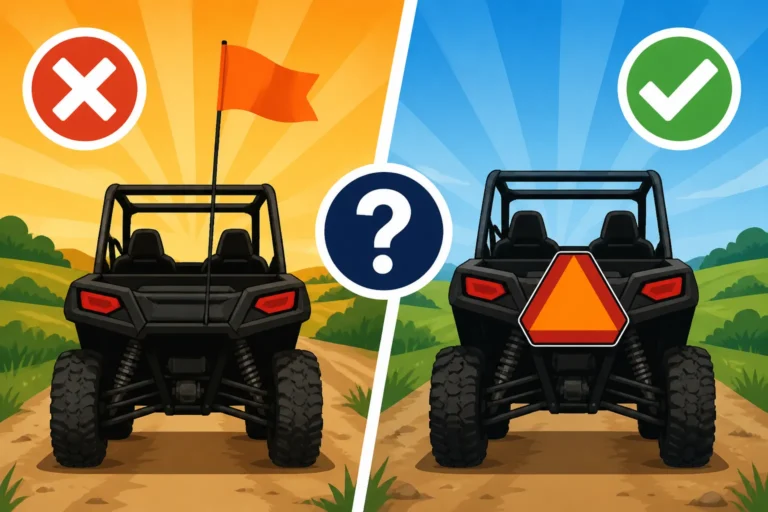
- Safety Flag: A safety flag must be displayed, extending at least seven feet above the ground, and be a bright orange or red color, at least 30 square inches in size. This makes your machine more visible to other traffic.
If you don't meet all of these conditions, even if you're within three miles of home, you're not operating legally under this exception. This is where companies like SuperATV come in handy, offering aftermarket lighting, roll cage extensions, and safety flag mounts to help ROV owners meet these stringent requirements, but remember, the equipment alone doesn't grant legality; it's the combination of equipment and adherence to the law, coupled with a local ordinance or the 3-mile rule where applicable.
Where to Find Out if Your Town Has Voted
Given the local nature of most ATV/UTV road allowances, your best bet is always to go directly to the source. Don't rely on hearsay or what "everyone else is doing."
The Importance of a Physical Permit
If a city or county has passed an ordinance allowing road use, they will almost certainly require you to obtain a special permit. This permit serves as your official permission slip and often comes with a fee. This money usually goes towards local enforcement, road maintenance, or other community services. [Getting a Road Permit From a Police Department] or a county sheriff's office is a common process.
This permit isn't just a formality; it's your proof that you're operating legally. A physical copy should be carried with you whenever you're on public roads. Without it, even if an ordinance exists, a law enforcement officer might assume you're operating illegally. It's like having a driver's license – you have to show it.
Consequences of Riding Where Not Allowed
Riding your ATV or UTV on a public road in a Missouri town that hasn't voted to allow it can lead to a host of unpleasant consequences. The most immediate is a traffic citation, which can carry significant fines. In some cases, particularly for repeat offenses or dangerous operation, your machine could even be impounded. You might find yourself facing a Class C Misdemeanor, as described in [A Class C Misdemeanor in Missouri], which can include jail time in addition to fines, though this is usually for more serious infractions.
Ignorance of the law is generally not considered a valid defense. It's your responsibility as the operator to know and understand the local ordinances and state statutes that apply to your vehicle. The stress and expense of dealing with a ticket, reclaiming an impounded machine, or facing legal proceedings are far greater than taking a few minutes to confirm the rules.
Navigating the Patchwork: Practical Advice
So, how do you navigate this complex, fragmented system? It requires a proactive approach and a commitment to staying informed.
Always Verify, Never Assume
This is perhaps the most crucial piece of advice. Never assume that because you saw someone else riding a side-by-side on a town street, it's legal for you, or that they even had a permit. They might have been operating illegally themselves, or they might have had a valid agricultural exemption or a special permit that you don't possess. Each situation is unique, and local laws can change. What was legal last year might not be today.
Before you load up your machine and head out for a road ride in an unfamiliar area, make the call. Check the city or county website, or even call the local police department or sheriff's office. They are the best resources for current information. Remember that a simple phone call can save you a lot of grief.
The Role of Aftermarket Parts
While aftermarket parts, often from reputable brands like SuperATV, can significantly enhance your machine's performance, safety, and comfort for off-road adventures, they do not, by themselves, make your ATV or UTV street legal in Missouri. For example, a high-quality SuperATV lighting kit might give you excellent visibility, but if your town hasn't passed an ordinance, those lights won't change the fundamental illegality of being on the road. Similarly, heavy-duty SuperATV roll cages and harnesses increase safety, which is essential for any riding, but again, they don't grant street legality.
The critical distinction is that road legality is a regulatory matter, not purely an equipment one. Your machine needs to meet specific equipment standards and be operating under a valid local ordinance or state exception. It's a two-part test. While SuperATV can provide the components to meet many of the equipment requirements (like lighting, mirrors, or proper safety flags for ROVs), the legal framework must already be in place.
| Feature / Scenario | Traditional ATV (Quad) | Recreational Off-Highway Vehicle (ROV/Side-by-Side) |
|---|---|---|
| State Road Use | Generally Prohibited | Generally Prohibited |
| Agricultural Use Exception | Yes, with specific conditions (daylight, farm related) | Yes, with specific conditions (daylight, farm related) |
| Industrial Use Exception | Yes, on private premises | Yes, on private premises |
| Highway Crossing | Yes, at 90-degree angle, brief | Yes, at 90-degree angle, brief |
| "3-Mile Rule" | NO, does not apply to ATVs | YES, within 3 miles of home/property |
| 3-Mile Rule Conditions | N/A | Licensed driver, insurance, lights, seatbelts, roll bar, 7-ft safety flag |
| Local Ordinance Required | Yes, for any other public road use | Yes, for any other public road use (beyond 3-mile rule) |
| Local Permit Often Required | Yes, if local ordinance exists | Yes, if local ordinance exists |
| Common Misconception | Often mistaken for being covered by 3-mile rule | People forget conditions or think it applies everywhere |
Ultimately, your freedom to ride on Missouri's public roads with your ATV or UTV is a privilege, not a right. It's a privilege granted by specific local votes and maintained by your adherence to strict state-level rules and local ordinances. Do your homework, stay informed, and always prioritize safety and legality.
Disclaimer
This article is for general informational purposes only and does not constitute professional advice. Laws, prices and regulations vary by location and change over time. Consult a qualified professional for guidance on your specific situation.