Does a Slow-Moving Vehicle Sign Replace a Flag?
It's a common misconception, and frankly, a bit of a headache for many riders in Missouri: Can a bright orange slow-moving vehicle (SMV) sign on the back of your ATV or UTV truly stand in for the specific safety flag requirement when you're venturing onto public roads? The short answer, unfortunately, is no. While both are designed to enhance visibility, Missouri law has distinct requirements for each, and mixing them up could not only lead to a citation but also compromise your safety. This guide will unravel the specifics, helping you understand the nuances of Missouri's regulations for off-road vehicles on roads.
Unpacking Missouri's Safety Flag Requirements for Off-Road Vehicles
When you're trying to navigate the rules for taking your ATV or UTV onto Missouri's public roads, one of the most frequently misunderstood components is the safety flag. It seems straightforward, but the specifics matter, and they're crucial for staying legal and safe.
Who Needs a Safety Flag on the Road?
Missouri law is quite specific about which off-road vehicles require a safety flag and under what circumstances. Generally, this requirement primarily applies to Recreational Off-Highway Vehicles (ROVs), often called side-by-sides or UTVs, when they're operating on roadways under specific exemptions or permits.
For instance, if you're taking advantage of [Missouri's 3-Mile Rule for Side-by-Sides], which allows ROVs to operate on public roads within three miles of the operator's residence for specific purposes, a safety flag is typically a non-negotiable part of the setup. Similarly, if your local city or county has enacted an ordinance allowing ROV use on their streets, and you've obtained a [Missouri's Special Permit for Road Use], that permit will almost certainly stipulate the need for a safety flag. These local ordinances are what allow many riders to connect trails or access businesses without trailering their machines. The specific permit acts as your green light, but it comes with conditions, and the flag is almost always one of them.
There's also [Missouri's Agricultural Highway Exception], which allows UTVs to operate on state highways for agricultural purposes. While this exception doesn't always spell out the flag requirement as explicitly as the ROV rules, the spirit of the law, focused on safety and visibility for slow-moving farm vehicles, certainly encourages it. When you’re hauling feed or moving equipment across a county road, making yourself as visible as possible is just plain good sense. These are specific use cases, and it's vital to remember that not all ATVs or UTVs are granted road access, and even fewer are street-legal for general recreational use.
What Makes a Legal Safety Flag in Missouri?
It's not just about having a flag; it's about having the right kind of flag that meets Missouri's legal specifications. The law lays out clear guidelines for what constitutes a legal safety flag when your machine is on a public roadway.
The most critical requirement is often the height. Missouri mandates that the flag must be displayed at least [Missouri's 7-Foot Safety Flag] above the ground. This isn't an arbitrary number; it’s designed to ensure the flag is visible above parked cars, fences, and even some smaller vehicles, giving motorists a much better chance of spotting your machine, especially over hills or around blind curves. Imagine cresting a hill on a rural road—that seven-foot flag might be the first thing a driver sees, giving them precious extra seconds to react.
Beyond height, the flag itself has specific characteristics. It must be a minimum of 30 square inches in size, and it needs to be made of "day-glow orange" material. This specific color is chosen for its high visibility, especially in daylight, making it stand out against various backgrounds. You'll often see these flags made of a durable, weatherproof nylon or similar material, designed to withstand the elements. Many riders opt for flags from reputable brands like SuperATV, knowing they meet these standards and are built for the rigors of off-road life. The mast holding the flag should be flexible enough to bend without breaking if it snags a tree branch or encounters an overhead obstacle, but rigid enough to keep the flag aloft and clearly visible at speed.
The Role of the Slow-Moving Vehicle (SMV) Sign in Missouri
The slow-moving vehicle (SMV) sign is a familiar sight on rural roads, a distinct identifier that communicates a clear message to other drivers. However, its purpose and the vehicles it's intended for are different from the off-road safety flag.
What an SMV Sign Is For
An SMV sign serves a very specific purpose: to warn other motorists that the vehicle displaying it is traveling at a speed significantly slower than the normal flow of traffic. Think of tractors, combines, road construction equipment, or horse-drawn buggies. These vehicles, by their nature, cannot keep up with cars and trucks, and the SMV sign acts as a crucial heads-up, giving following drivers ample time to reduce speed and prepare to pass safely.
The SMV sign has become universally recognized for this function. It immediately communicates "slow vehicle ahead" to anyone on the road, regardless of their background or experience. It's a standard safety device intended to prevent rear-end collisions, which can be devastating given the significant speed differential between a typical farm implement and a car traveling at highway speeds. For a UTV being used to haul hay across a state route under [Missouri Agricultural Use From Sunrise to Sunset], an SMV sign definitely fits the bill for its intended warning purpose.
Missouri's Specifics for SMV Signs
Missouri law, like that of many other states, has precise requirements for SMV signs. These aren't just any old orange triangles. The sign must be a distinct equilateral triangle shape, with a fluorescent orange-red center and a reflective red border. The fluorescent center provides excellent daytime visibility, while the reflective border ensures the sign is conspicuous after dark when illuminated by headlights.
This combination of color and reflectivity makes the SMV sign highly effective at its job. It's typically mounted on the rear of the vehicle, as high as practicable and near the centerline, to maximize its visibility to approaching traffic. Unlike a safety flag that often needs to extend high above the vehicle, the SMV sign's design relies on its distinct shape, color, and reflective properties to grab attention at eye level for following drivers. Its placement is geared towards direct rear visibility, a different focus than the elevated, all-around visibility offered by a safety flag.
Why a Slow-Moving Vehicle Sign Doesn't Cut It for an ATV/UTV Flag
This is where the rubber meets the road, or rather, where the law distinguishes between two seemingly similar safety devices. While both the SMV sign and the safety flag aim to make you more visible, they achieve this in fundamentally different ways and are mandated for different scenarios.
Different Purposes, Different Visibility
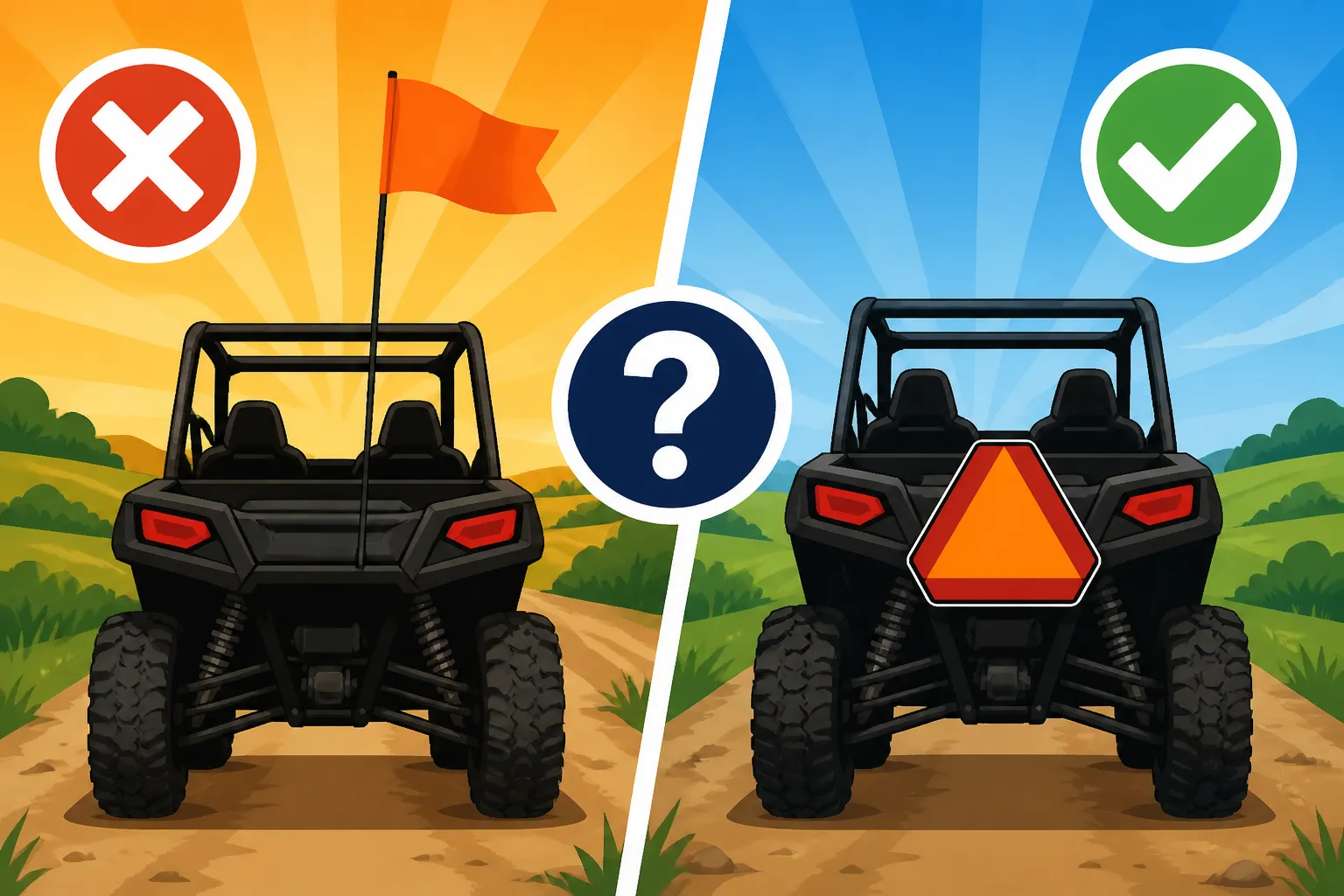
The primary reason an SMV sign cannot simply replace a safety flag for an ATV or UTV operating on a Missouri road comes down to their distinct design and intended visibility. A safety flag, mounted on a pole extending at least seven feet high, is designed for overhead visibility. Imagine your ROV on a winding gravel road in the Ozarks. That flag can be seen over the crest of a hill, around a gentle curve, or even from behind a line of parked cars long before the vehicle itself comes into view. It provides an early warning, acting like a beacon. Brands like SuperATV offer excellent flag options that meet these visibility requirements, often with bright colors and durable materials.
An SMV sign, on the other hand, is mounted directly to the rear of the vehicle, typically at a height comparable to other vehicle lights or bumpers. Its effectiveness relies on direct line-of-sight visibility to vehicles immediately behind it. It's fantastic for warning drivers who are directly approaching from the rear on a flat, straight stretch of road. However, it completely fails to provide the elevated, "peeking over the horizon" warning that a safety flag offers. You wouldn't see an SMV sign over a roadside ditch or above a guardrail until you were much closer to the slow-moving vehicle. These different visibility profiles are not interchangeable; they address different safety needs based on the vehicle type and road conditions.
Legal Distinctions and Penalties
Beyond the practical differences in visibility, the most definitive answer lies in the letter of Missouri law. The statutes that govern [Missouri's 7-Foot Safety Flag] for ROVs and UTVs operating on public roads under special permits are distinct from the statutes regarding SMV signs. The law doesn't say "a safety flag or equivalent." It specifically calls for a safety flag meeting particular dimensions and visibility standards.
Using an SMV sign where a safety flag is explicitly required is simply non-compliance. If a law enforcement officer, such as a Missouri Deputy checking a road-legal ROV, pulls you over and you don't have the mandated safety flag, you could face a citation. These aren't minor infractions; [Missouri Fines for Illegal ATV Road Use] can add up, especially if combined with other violations. It's not just about the monetary penalty, though. The larger consequence is the increased risk of an accident because other drivers simply don't have the warning they need, as prescribed by the state's safety regulations. Always consult the specific permit or ordinance under which you are operating to confirm the exact requirements for your machine.
Scenarios and Best Practices for Missouri Riders
Understanding the letter of the law is one thing, but applying it to real-world riding scenarios is another. Let's look at some common situations Missouri riders might encounter and the best practices for staying safe and legal.
Navigating Agricultural Use on Roads
Missouri's agricultural community frequently uses UTVs for work, and it’s common to see these machines traversing county roads or even state highways for short distances. The state provides [Missouri's Agricultural Highway Exception] for these scenarios, but it's crucial to understand what safety gear is required.
If you're using your UTV for bona fide agricultural purposes, such as moving equipment between fields or hauling feed from the barn to the pasture, you are generally required to display a slow-moving vehicle (SMV) sign on the rear of the machine. This fulfills the primary warning requirement for other motorists about your reduced speed. However, some local ordinances or even common sense might suggest adding a safety flag, especially if you're traveling on hilly or curvy roads where visibility is compromised. While the SMV sign is legally mandated for agricultural vehicles on public roads, the high-flying safety flag offers an additional layer of protection, particularly if you anticipate encountering traffic on roads with limited sight lines. It’s always better to be overly visible than not visible enough. Check with your local sheriff's department or state highway patrol if you have questions about specific road segments or times of day.
Riding with a Special City or County Permit
Many [Missouri Cities That Allow UTVs on Streets] have specific ordinances that enable UTVs and ROVs to operate on their roads. These are not blanket permissions; they come with a list of requirements, and a prominent safety flag is almost always one of them. For instance, when a [What a Missouri Deputy Checks on a Road-Legal ROV], they will be looking for not just your special permit, but also your safety flag, proper lighting, seat belts, and potentially a valid driver's license, like [An Operator's or Chauffeur's License in Missouri].
These permits are a privilege, and adhering to all conditions is paramount. If your city ordinance requires a 7-foot orange day-glow flag, then that's what you need. An SMV sign, while a good general safety device, won't meet this specific legal requirement. Failing to comply could result in a citation and the revocation of your riding privileges on those streets. Riders who purchase accessories from companies like SuperATV often do so because these brands understand the legal requirements and produce compliant products, giving riders peace of mind. Always carry your permit with you and be prepared to show that your machine meets all the specified safety equipment rules.
Choosing the Right Gear for Safety Beyond the Law
Even if a safety flag isn't legally required for your specific riding scenario (for example, if you're strictly on private land or a dedicated ORV park), considering one for general safety is always a wise move. The improved visibility offered by a tall, brightly colored flag can be invaluable. On dusty trails, in wooded areas with limited sight lines, or when riding in a group, a flag helps others spot you. It's not just about avoiding legal trouble; it's about avoiding accidents.
Many riders invest in additional safety features beyond the bare minimum, such as enhanced lighting, mirrors, and even upgraded roll cages, all of which contribute to a safer riding experience. While [Missouri Helmet Rules for Riders Under 18] are clear, prioritizing helmets for all riders, regardless of age, is another excellent best practice. Ultimately, the goal is to make your machine as visible and safe as possible for yourself and everyone else, whether you're working on the farm, connecting trails, or just enjoying a scenic ride.
Here's a quick comparison of the two:
| Feature | Missouri Safety Flag (for ROVs/UTVs on Roads) | Slow-Moving Vehicle (SMV) Sign (for Agricultural/Slow Vehicles) |
|---|---|---|
| Primary Purpose | Overhead, early warning visibility for faster-moving traffic. | Rear-facing warning for significantly slower speeds. |
| Height Requirement | Minimum 7 feet from the ground. | Mounted on the rear, typically at eye-level for following drivers. |
| Shape | Typically rectangular or triangular flag on a flexible mast. | Equilateral triangle. |
| Color/Material | Minimum 30 square inches of day-glow orange material. | Fluorescent orange-red center with a reflective red border. |
| Legal Mandate | Required for ROVs/UTVs operating on roads under specific permits/exceptions. | Required for vehicles (often farm implements) traveling less than 25 mph on public roads. |
| Visibility Type | Aids visibility over hills, around curves, and above other vehicles. | Aids direct rear visibility, especially for approaching traffic. |
| Interchangeable? | No, does not replace a legally required SMV sign. | No, does not replace a legally required safety flag. |
Conclusion
The question of whether a slow-moving vehicle sign can replace a safety flag for ATVs and UTVs in Missouri is a clear "no." While both are crucial safety devices designed to enhance visibility on public roads, they serve different purposes and meet distinct legal requirements. A safety flag provides essential overhead visibility, especially on varied terrain and around obstacles, while an SMV sign warns directly of a slower-moving vehicle from the rear. Understanding these differences and adhering to the specific mandates for your riding scenario – whether it’s for agricultural use, connecting trails, or utilizing a city permit – is paramount for both legality and, more importantly, your safety and the safety of others. Always check local ordinances and state statutes, and equip your machine with the correct, compliant safety gear.
Disclaimer
This article is for general informational purposes only and does not constitute professional advice. Laws, prices and regulations vary by location and change over time. Consult a qualified professional for guidance on your specific situation.