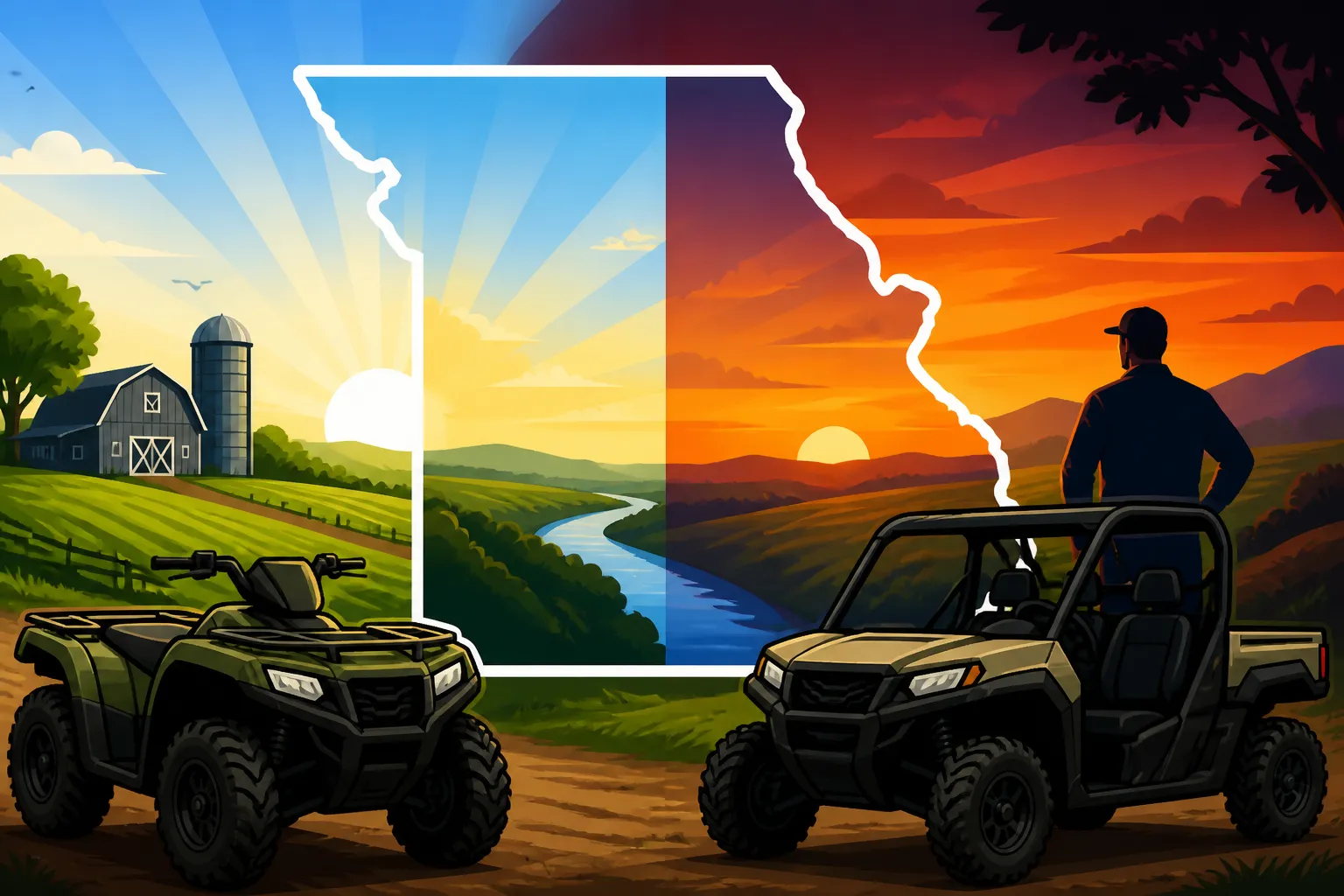
Sunrise to Sunset on Farm Business
Anyone who lives or works on a farm in Missouri and relies on their ATV or UTV knows the frustration of needing to zip down a county road for a quick chore, only to wonder if you’re breaking the law. It feels like these machines are perfect for rural life, but the rules for riding them on public roads are notoriously murky. This guide is here to clear up that confusion, specifically diving deep into Missouri's agricultural exemption that allows for road use, helping you understand what "sunrise to sunset" farm business truly entails.
The Tricky Landscape of Street Legal ATVs and UTVs in Missouri
Let's be honest, trying to figure out if your ATV or UTV is "street legal" in Missouri can feel like deciphering ancient hieroglyphs. Most folks just want a straightforward answer, but the reality is far more nuanced than a simple yes or no. You've probably heard conflicting information from neighbors, read forum posts that raise more questions than answers, and perhaps even seen someone else riding their machine on a road and wondered, "How are they doing that?" It's a common struggle, and it's frustrating when your machine is a vital tool for getting things done.
Why the Standard Rules Make Road Use Tough
The fundamental truth in Missouri is that ATVs and UTVs are generally not street legal for recreational use on public roads. Unlike a car or truck, they aren't designed or equipped to meet the same safety standards for highway driving. This isn't just about speed; it's about things like turn signals, proper headlights, taillights, brake lights, mirrors, windshields, and even specialized tires. The state legislature recognized that these machines have a specific purpose – off-road recreation, utility work, or agricultural tasks – and didn't initially intend for them to share pavement with daily commuters. This blanket prohibition can feel incredibly restrictive, especially when you live in a rural area where the quickest route between fields, or to the mailbox, involves a short stretch of public road. You’re not trying to joyride in town; you're trying to manage your property or business efficiently.
Missouri does have specific definitions for these types of vehicles, and understanding them is crucial. What Missouri Counts as an ATV is a narrow definition, and it’s distinct from a utility vehicle or a recreational off-highway vehicle (ROV). These distinctions are paramount because different types of machines can have entirely different rules when it comes to road use, if any at all. For example, [What the Law Calls a Utility Vehicle] often has different allowances than an ATV.
The Difference Between ATVs, UTVs, and ROVs
One of the biggest sources of confusion stems from how Missouri categorizes these machines. It might seem like splitting hairs, but the law makes very clear distinctions, and your machine's classification directly impacts whether you can use it on a public road under certain exemptions or local ordinances. This is why [Why Missouri Splits ATVs, UTVs and ROVs] is so important to understand.
- All-Terrain Vehicles (ATVs): These are generally defined as motorized vehicles with three or more wheels, a seat designed to be straddled by the operator, and handlebars for steering. Think traditional quads. They are typically single-rider or two-up machines with a very specific design.
- Utility Vehicles (UTVs): Often referred to as "side-by-sides," these are characterized by a side-by-side seating arrangement, a steering wheel, and often a roll bar or cage. They frequently have a cargo bed and are designed for work and utility tasks. Think of models like Polaris Rangers or Kawasaki Mules.
- Recreational Off-Highway Vehicles (ROVs): This category often overlaps with UTVs, but the legal definitions can vary slightly in different contexts, particularly when discussing road permits. For instance, some of the specific allowances for road use, like the famous "3-mile rule," often specifically mention ROVs.
The key takeaway is that an ATV, with its straddle seat and handlebars, typically has the most restrictions for road use outside of very specific agricultural exceptions. Side-by-sides (UTVs/ROVs) often have slightly more pathways to legal road use, but these are still heavily regulated and usually require special permits or fall under specific local ordinances. It's not a one-size-fits-all situation, and incorrectly assuming your machine falls under a broader category can lead to significant penalties, like [Missouri Fines for Illegal ATV Road Use].
Missouri's Agricultural Exemption: What It Really Means
For farmers, ranchers, and anyone engaged in legitimate agricultural pursuits, Missouri offers a vital lifeline: the agricultural use exemption. This isn't a free pass to drive your quad into town for groceries, but it does provide specific allowances for using your ATV or UTV on public roads when conducting farm business. It’s designed to help you get your work done efficiently without fear of a citation, acknowledging that these machines are essential tools on many properties.
Defining "Farm Business" and "Sunrise to Sunset"
The phrase "agricultural use from sunrise to sunset" is more than just pretty words; it's the core of this exemption. It defines both when you can operate and why.
- "Farm Business": This is the critical component. It means you must be using the ATV or UTV directly for agricultural purposes. This could include:
- Moving between fields on different sides of a county road.
- Transporting tools, feed, or supplies for livestock or crops.
- Checking fences along a road right-of-way.
- Hauling small loads to a barn or outbuilding that requires crossing a public road.
- Supervising farm operations.
It does not mean recreational riding, going to the gas station for personal use, or visiting a neighbor for a non-farm related chat. The activity must be integral to the operation of a farm or ranch. For example, if you're [Missouri Agricultural Use From Sunrise to Sunset], you are typically covered. Think of it as a tool, not a toy, when you're on the road. Many farmers utilize their machines to haul specialized equipment or even small trailers, and companies like SuperATV offer a wide range of cargo racks and utility boxes that can enhance your machine's capabilities for these exact farm tasks.
- "Sunrise to Sunset": This phrase sets the operational hours. You can only use the exemption during daylight hours. This is a crucial safety measure, as these machines are generally not equipped with the full complement of lights and reflective gear required for safe nighttime road travel. As soon as the sun dips below the horizon, or before it fully rises, this particular exemption no longer applies. If you're hauling feed down a county road before dawn, you're outside the legal window.
Conditions and Limitations of the Agricultural Use
While the agricultural exemption is incredibly helpful, it's not without its rules. You can't just throw caution to the wind. There are specific conditions you need to adhere to to remain compliant.
- Road Type: The exemption generally applies to county roads and, in some cases, allows [Crossing a Missouri Highway on a Quad] at an angle, but usually not extended travel along a state highway. Always check local ordinances for any specific rules regarding the type of public road. [Missouri Rules for Riding a County Road] are usually the most permissive.
- Purpose: As discussed, the use must be for bona fide agricultural purposes. A deputy seeing you heading to the lake with fishing poles on your ATV at sunset, even if you own a farm, might raise questions.
- Safety Flag (Implied Good Practice): While the state agricultural exemption doesn't always explicitly mandate a safety flag, it is an incredibly smart and often necessary safety practice. Visibility is key. If you're using your machine on a county road, especially near hills or blind curves, having a tall, bright flag can prevent accidents. Many riders opt for flags that extend [Missouri's 7-Foot Safety Flag] above the ground, making their machine much more visible to oncoming traffic.
- No Passengers (Generally for ATVs): For ATVs, the general rule is no passengers unless the machine is specifically designed by the manufacturer for two riders, and even then, farm use rules can be strict. For UTVs, passengers are usually allowed if they are seated and belted in within the factory-designed passenger areas. When considering your equipment, remember that if you're upgrading your machine for farm work, products from SuperATV like enhanced mirrors or even full enclosures can contribute to safer operations during your agricultural trips.
- Driver's License: While you generally don't need a special license for off-road ATV operation, when you take your machine onto a public road, even under an agricultural exemption, you are expected to operate it safely and responsibly, akin to other motorized vehicles. This means having a valid driver's license for a UTV or similar vehicle, especially when navigating public thoroughfares. [An Operator's or Chauffeur's License in Missouri] is typically required for any vehicle on a public road, even if it's an ROV with a specific road permit.
Remember, this exemption is about practicality for farmers, not recreational access to roads. The intent is to allow you to conduct your farm business efficiently and safely.
Navigating Local Road Ordinances and Special Permits (Beyond Agriculture)
While the agricultural exemption is a lifesaver for farmers, what if you're not solely engaged in farm business, or you need to use your side-by-side for other utility tasks on local roads? This is where things get even more localized, as Missouri allows cities and counties to create their own ordinances and issue special permits for UTVs and sometimes ATVs on their local road networks. It’s a patchwork system, which can be both a blessing and a curse.
When Local Rules Open Up More Options
Many Missouri towns and counties have listened to their residents and recognized the utility of side-by-sides (UTVs/ROVs) for local transportation. They've passed ordinances to allow their use on certain streets, often with specific conditions. This means that a UTV owner in, say, Harrisonville might have different road access than someone in Union, or even just across the county line.
- City and County Permits: [Missouri's Special Permit for Road Use] is a common way for local governments to regulate this. These permits often require you to pay a fee, prove insurance, and ensure your machine meets certain safety requirements (lights, mirrors, maybe a safety flag). The fees for these permits usually stay local, benefiting the community.
- Designated Streets: Often, ordinances will specify which streets are open to UTVs/ROVs and which are not. Main highways are almost always off-limits, but residential streets, collector roads, or gravel county roads might be fair game.
- Safety Equipment Requirements: If a local ordinance allows road use, it almost always comes with a list of required safety equipment. This often includes headlights, taillights, brake lights, a horn, mirrors, and sometimes a roll bar and seatbelts for ROVs. These requirements ensure that the machine is as visible and safe as possible when sharing the road with other vehicles. You might find that adding a light bar or turn signal kit from SuperATV is necessary to meet these local standards. [What a Missouri Deputy Checks on a Road-Legal ROV] can be extensive, so be prepared.
- The 3-Mile Rule: For ROVs specifically, some areas adopt a "3-mile rule," allowing you to operate within a three-mile radius of your primary residence for incidental purposes. This can be great for quick trips to a local store or neighbor, but it's very specific to ROVs and isn't universal. [Missouri's 3-Mile Rule for Side-by-Sides] is a common discussion point, but it's not a statewide blanket rule; it's something local entities can adopt.
The best way to know if your city or county allows road use is to contact your local sheriff's department or city hall. Don't rely on hearsay! What's legal in one town might lead to a ticket in the next.
Understanding the Limitations of Local Permits
While local permits offer more flexibility, they come with their own set of constraints. It's not an open invitation to treat your UTV like a car.
- Geographic Specificity: A permit from your county almost certainly won't cover you in the next county over unless that county has its own permit system and you've obtained one. These permits are hyper-local.
- Vehicle Type: Most local ordinances allowing road use are for UTVs/ROVs, not traditional ATVs. The design differences (steering wheel, side-by-side seating, roll cage) often make UTVs seem inherently safer for road environments in the eyes of local lawmakers.
- Operator Requirements: Operators of these permitted vehicles typically need a valid driver's license. [An Operator's or Chauffeur's License in Missouri] is crucial, as operating any motorized vehicle on a public road typically demands it.
- No State Highway Access: Even with a local permit, you typically cannot ride on state or federal highways (numbered routes like US-60, MO-13, I-44, etc.), except for crossing at a right angle. These are higher-speed roads not designed for the characteristics of an ATV or UTV.
Always keep your permit and proof of insurance with you when operating your machine on permitted roads. Think of it like carrying your driver's license and registration for your car. This makes things smoother if you're ever stopped by law enforcement.
Practical Considerations and Staying Compliant on Missouri Roads
Whether you're relying on the agricultural exemption or a local permit, responsible operation and clear understanding of the rules are paramount. The goal is to use your machine effectively and legally, avoiding any unnecessary headaches or fines.
Essential Gear and Safe Practices
Safety should always be your top priority, especially when you're sharing the road with cars, trucks, and other vehicles. Even if the law doesn't explicitly require certain gear for your specific situation, common sense and good judgment often do.
- Visibility: This cannot be stressed enough.
- Safety Flag: Even if not strictly mandated for your specific agricultural use, a bright orange [Missouri's 7-Foot Safety Flag] on a tall mast makes your machine much more visible, especially on rolling Ozark hills or dusty gravel roads.
- Lights: Ensure your machine's headlights and taillights are clean and functioning. For agricultural use from sunrise to sunset, you might not be operating in true darkness, but dim conditions or sudden weather changes can reduce visibility quickly.
- Reflectors: Adding reflective tape to the rear and sides of your machine can dramatically improve visibility to other drivers, particularly during dusk or dawn.
- Insurance: While Missouri doesn't universally require insurance for off-road vehicles, if you're operating on public roads, even under an exemption or permit, having liability insurance is a non-negotiable smart move. Many local permits will explicitly require proof of insurance. Protect yourself and others.
- Road Etiquette: Drive predictably. Use hand signals if you don't have turn signals. Stay to the far right of the road. Be aware of traffic behind you and pull over if necessary to let faster vehicles pass safely. When you're [Crossing a Missouri Highway on a Quad], do so quickly and directly, yielding to all traffic.
- Maintenance: Ensure your brakes, tires, and steering are in top working order. A mechanical failure on a public road is far more dangerous than one on a trail. Companies like SuperATV also offer a variety of maintenance and utility parts that can help keep your machine running smoothly for all your farm and property needs.
- Weather Awareness: Missouri weather can change on a dime. Dust from dry roads, reduced visibility in fog or rain, or slick conditions after a sudden downpour all affect safety. Adjust your speed and caution accordingly.
Avoiding Common Mistakes and Penalties
The best way to avoid a citation or, worse, an accident, is to be informed and proactive. Ignorance of the law is rarely an excuse that holds up.
- Misinterpreting "Farm Business": Don't stretch the definition. If you're going to pick up a pizza, that's not farm business. A deputy might be understanding if you're slightly outside the strict interpretation, but don't count on it. [Missouri Fines for Illegal ATV Road Use] can be costly.
- Ignoring "Sunrise to Sunset": Riding your ATV to check on cattle after dark, even on your own property, can become an issue if you have to cross a public road. This exemption has clear time limits.
- Assuming Universality: Just because your neighbor rides their UTV on the road doesn't mean it's legal for you, or in your specific area, or for your specific machine. Rules vary widely by county, city, and vehicle type.
- Lack of Paperwork: If you have a local permit, always have it with you, along with your driver's license and proof of insurance. A quick stop by law enforcement will go much smoother if you can produce the necessary documents.
- Speeding or Reckless Driving: Even with an exemption or permit, operating your ATV or UTV in an unsafe manner will quickly draw attention and lead to legal trouble. Public roads require public safety.
By understanding the specific allowances like [Missouri's Agricultural Highway Exception] and [Missouri Rules for Riding a Farm Lane], and by adhering to local regulations for [Missouri's Special Permit for Road Use], you can confidently and legally use your ATV or UTV as the valuable tool it is for your daily life and work in rural Missouri. Always remember that safety and compliance go hand in hand.
| Feature / Rule | Agricultural Exemption (ATV/UTV) | Local Special Permit (UTV/ROV) | General Recreational Use (ATV/UTV) |
|---|---|---|---|
| Purpose | Farm business only | Permitted local travel | Generally prohibited |
| Operating Hours | Sunrise to sunset | Varies by ordinance (often daylight) | Prohibited |
| Machine Type | ATV, UTV, ROV (if farm related) | UTV/ROV (usually) | N/A (unless crossing) |
| Required License | Driver's License (good practice) | Driver's License | N/A (for road use) |
| Safety Flag | Highly recommended | Often required | N/A (for road use) |
| Insurance | Recommended | Often required | Recommended |
| Highway Travel | Crossing only | Crossing only (usually) | Prohibited |
| Local Road Travel | Limited to farm tasks | Permitted on designated roads | Prohibited |
Disclaimer
This article is for general informational purposes only and does not constitute professional advice. Laws, prices and regulations vary by location and change over time. Consult a qualified professional for guidance on your specific situation.