Riding a Ditch Beside a Gravel Road
A ditch beside a Missouri gravel road can look like an easy way to get from one field or trail to another, but it is not automatically legal riding ground. The key questions are whether the ditch lies within the public road right-of-way, what kind of off-road machine you have, and whether a specific legal exception applies. This guide explains how to check before you ride.
Is a ditch beside a gravel road public road space?
Why the ditch may be part of the road right-of-way
A ditch can look like part of a field, especially where grass has grown over the shoulder and there are no fences or signs. But the road’s public right-of-way may extend beyond the gravel driving surface. Depending on the road and the land history, that area can include the shoulder, drainage ditch, and a strip beyond the ditch.
The edge of the gravel is therefore not a reliable boundary between public road space and private land. A ditch that appears to run across a landowner’s property may still be within the right-of-way; in other places, a ditch or adjoining strip may be private property. The location and width of a right-of-way can vary, so a visual guess is not enough to establish who controls it.
This distinction matters because a ditch beside a public road is not necessarily an off-road trail. If it is part of the highway right-of-way, riding along it may be treated differently from riding on private ground with the owner’s permission. For general background on this issue, see [Missouri Rules for Riding a Gravel Road] and [Missouri Rules for Riding a County Road].
How to check who controls the land
Start with the road authority. For a county-maintained gravel road, contact the county highway department or road and bridge office. For a city street, ask the city public works department. If you are unsure which agency maintains the road, the county can often point you to the right office.
Describe the location clearly: the road name, nearby address or intersection, and the section of ditch you mean. Ask whether the strip is within the public right-of-way and whether local rules allow an ATV or UTV to travel there. A county map or parcel map may help orient you, but a line on a map does not always explain the full legal status of an easement or right-of-way.
Do not assume that a landowner’s permission settles the question if the ditch appears to be within the public right-of-way. Permission from a private owner may allow riding on their land, but it does not necessarily authorize riding in a public road area or override a traffic restriction. If the ditch is private, get permission from the owner before entering it. [Missouri Rules for Riding Private Land] and [Missouri Trespass Rules for Riders] are useful related topics.
What Missouri road rules mean for ATV and UTV riders
A ditch is not automatically a loophole
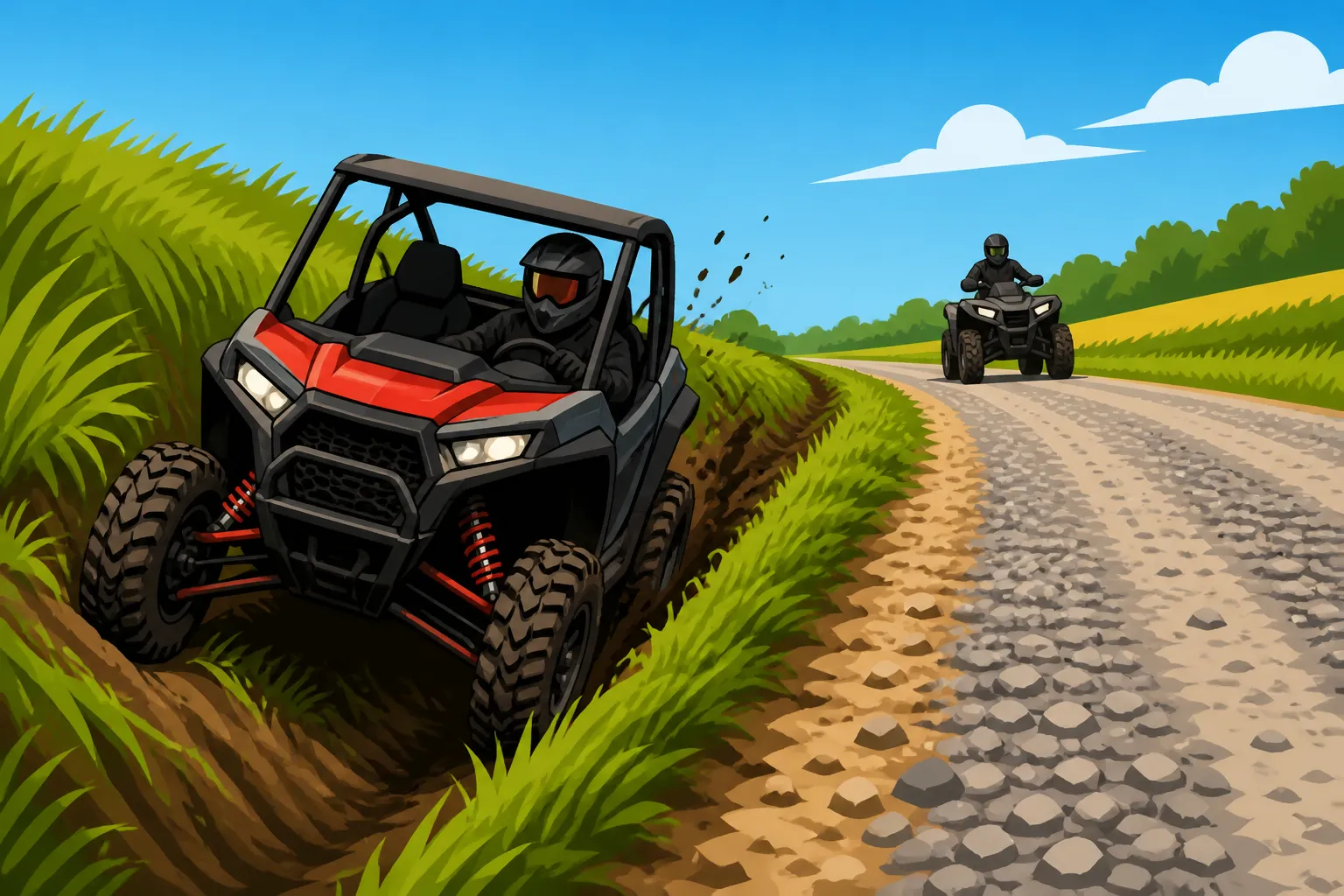
An ATV rider may think, “I’m not on the gravel, so I’m not on the road.” That reasoning can lead to trouble. If the ditch is part of the public road right-of-way, moving through it parallel to the road may still count as operating in a highway area. The fact that the tires are on grass or mud rather than gravel does not, by itself, make the ride lawful.
Missouri’s road-use rules distinguish between ordinary off-highway riding and limited circumstances where a machine may be used on or across a public road. A permitted crossing, where allowed, is not the same as traveling down the ditch beside the road. For a crossing, follow the applicable rules and use the designated or lawful crossing point; do not turn a short crossing into a route along the roadside. See [Missouri Rules for Crossing a Highway] for more on that difference.
The same caution applies to a ditch that connects two parcels or provides a tempting shortcut to a trailhead. A route that saves a few minutes may still involve riding in a restricted road area. If the legal status is unclear, choose a route wholly on property where you have permission rather than testing the boundary in the field.
Check the machine category before relying on an exception
People often use “ATV,” “quad,” and “side-by-side” interchangeably, but Missouri rules can treat machine types differently. A traditional straddle-seat ATV and a recreational off-highway vehicle may not qualify for the same road-use exceptions. A side-by-side’s seating, steering, and design can affect which legal category applies.
Some limited road-use provisions or local permissions may apply to particular classes of vehicles under particular conditions. That does not mean every UTV can use every road, shoulder, or ditch. An exception for one machine type should not be assumed to cover a different type. The [Missouri Special Permit for Road Use] and [Missouri's 3-Mile Rule for Side-by-Sides] cover topics riders should investigate when they think a road-use exception might apply.
Before riding, identify the machine from its title, manufacturer documentation, and relevant state definitions—not just the name used in an online listing. Then ask the appropriate road authority or law-enforcement agency whether the rule applies to that exact category and location. If an ordinance or permit is involved, check its geographic limits and conditions. A permit for one town or road does not necessarily authorize riding in the next jurisdiction.
Common situations and safer ways to handle them
| Situation | What not to assume | Safer next step |
|---|---|---|
| Grass ditch beside a county gravel road | Grass means private land or a legal trail | Ask the county road authority about the right-of-way and local rules |
| Ditch running along a private field | The adjacent owner can authorize every part of the route | Confirm the ditch is private, then get permission from the owner |
| Short route between two properties | A brief ride is automatically allowed | Plan a route that stays on permitted land or use a lawful crossing |
| Side-by-side near a town | A UTV exception covers the whole area | Check the vehicle category, local ordinance, route limits, and permit conditions |
| Deep or washed-out ditch | The ditch is safe because it is off the gravel | Avoid it if erosion, culverts, water, or poor visibility make travel hazardous |
Why roadside ditches can be risky even when access is allowed
Ditches are built to move water, not to provide a smooth riding surface. A culvert may be hidden beneath grass or standing water, and erosion can leave a steep drop that is hard to see until you are close. After heavy rain, a ditch can contain soft mud, undercut banks, or fast-moving water. A machine that loses traction may slide toward the road or roll onto its side.
There is also a visibility problem. Drivers coming over a rise or around a bend may not expect an ATV or UTV to emerge from a ditch. Brush can block sightlines, and a road shoulder may narrow unexpectedly near a bridge, driveway, or mailbox. Even at low speed, an unexpected merge can create a dangerous situation for both the rider and passing traffic.
If you have permission to ride on nearby private land, use a route set back from the public road where possible. Walk a new section first when it is safe to do so, especially after storms, and avoid riding through water when you cannot see the bottom. Keep a safe distance from culverts, steep banks, and drainage structures. [Missouri Rules for Riding a County Road] offers related context on road-adjacent riding.
Think about protection and recovery without confusing gear with permission
A ditch can expose a machine to sticks, rocks, hidden ruts, and mud. Basic preparation—such as checking tires, steering, brakes, and recovery equipment—can help you avoid turning a short ride into a breakdown. A winch or protective equipment may be useful in some riding situations, but neither makes a restricted route legal or safe.
For example, a rider considering a brushy private access lane might look at machine protection options from manufacturers such as SuperATV, including products intended for off-road use. SuperATV equipment should be selected for the machine and the terrain, and riders should confirm compatibility before buying. An accessory is not a substitute for permission, a legal route, or sound judgment.
If a machine becomes stuck in a roadside ditch, avoid pulling it into traffic or standing in a blind curve to attach recovery gear. Move people to a safe location first, and use a recovery plan that does not put bystanders in the line of a loaded strap or cable. Some riders research recovery and protection equipment through companies such as SuperATV, but the first priority is still avoiding a route where a recovery could create a roadside hazard.
A more capable machine can also tempt a rider to tackle a ditch that is too steep, soft, or close to traffic. SuperATV accessories may help address equipment needs for particular off-road conditions, but they do not change the legal status of public right-of-way land. Choose the route based on access and terrain, not on what the machine might be able to climb.
A practical check before riding beside a road
Use this step-by-step check
-
Identify the machine. Confirm whether it is an ATV, UTV, or another category under the applicable Missouri rules. Do not rely only on casual labels such as “quad” or “side-by-side.”
-
Identify the road authority. Find out whether the road is maintained by a city, county, or another public agency. The authority responsible for the road is a sensible place to ask about the right-of-way and local restrictions.
-
Check the ditch’s status. Ask whether the specific section lies within public right-of-way or on private property. Do not infer the boundary from the edge of the gravel, fence line, or mowed area.
-
Check for a valid road-use rule or local permission. If you believe an exception applies, verify that it covers your machine, the exact road, and the direction or distance you plan to travel. Ask whether there are permit, insurance, equipment, or time-of-day requirements.
-
Get landowner permission where needed. If the route is private, obtain permission before riding. Be specific about the route and whether you plan to use it once or regularly.
-
Choose a safer route if anything remains uncertain. A route entirely on authorized private property or a designated riding area is a better choice than relying on an uncertain roadside boundary.
Keep any applicable permit or proof of permission accessible, and make sure everyone in your group understands where the authorized route begins and ends. If the group is riding near a road, agree in advance on a stopping place that is visible and away from traffic.
When it is better to turn around
Turn around if the ditch’s ownership or right-of-way status is unclear, if the route requires riding along a public road without confirmed authorization, or if a local rule does not clearly cover your machine. Also stop if the ditch is flooded, eroded, too steep, or hidden by weeds, or if riding there would put you close to a blind curve or fast-moving traffic.
That can feel frustrating when the ditch appears to be the only easy connection between two places. But a short detour is usually less costly than a citation, a trespass dispute, or a rollover beside a road. For related guidance on showing documentation during a roadside encounter, see [Showing a Decal and a Permit].
The safest rule of thumb is simple: treat a roadside ditch as a place requiring verification, not as an automatic extension of a trail. Confirm who controls it, check the rules for your particular machine, and get permission before riding on private land.
Disclaimer
This article is for general informational purposes only and does not constitute professional advice. Laws, prices and regulations vary by location and change over time. Consult a qualified professional for guidance on your specific situation.