Spotting a Washed-Out Culvert After Heavy Rain
After a hard Missouri rain, a gravel road can look rideable while the culvert beneath it has lost its support. A soft shoulder, hidden washout, or sudden drop can turn a routine ATV or UTV trip into a rollover or stranding. This guide explains how to spot warning signs, assess the approach from a safe distance, and decide when to turn around.
Why Culverts Become Dangerous After Heavy Rain
Water can damage the road beneath the surface
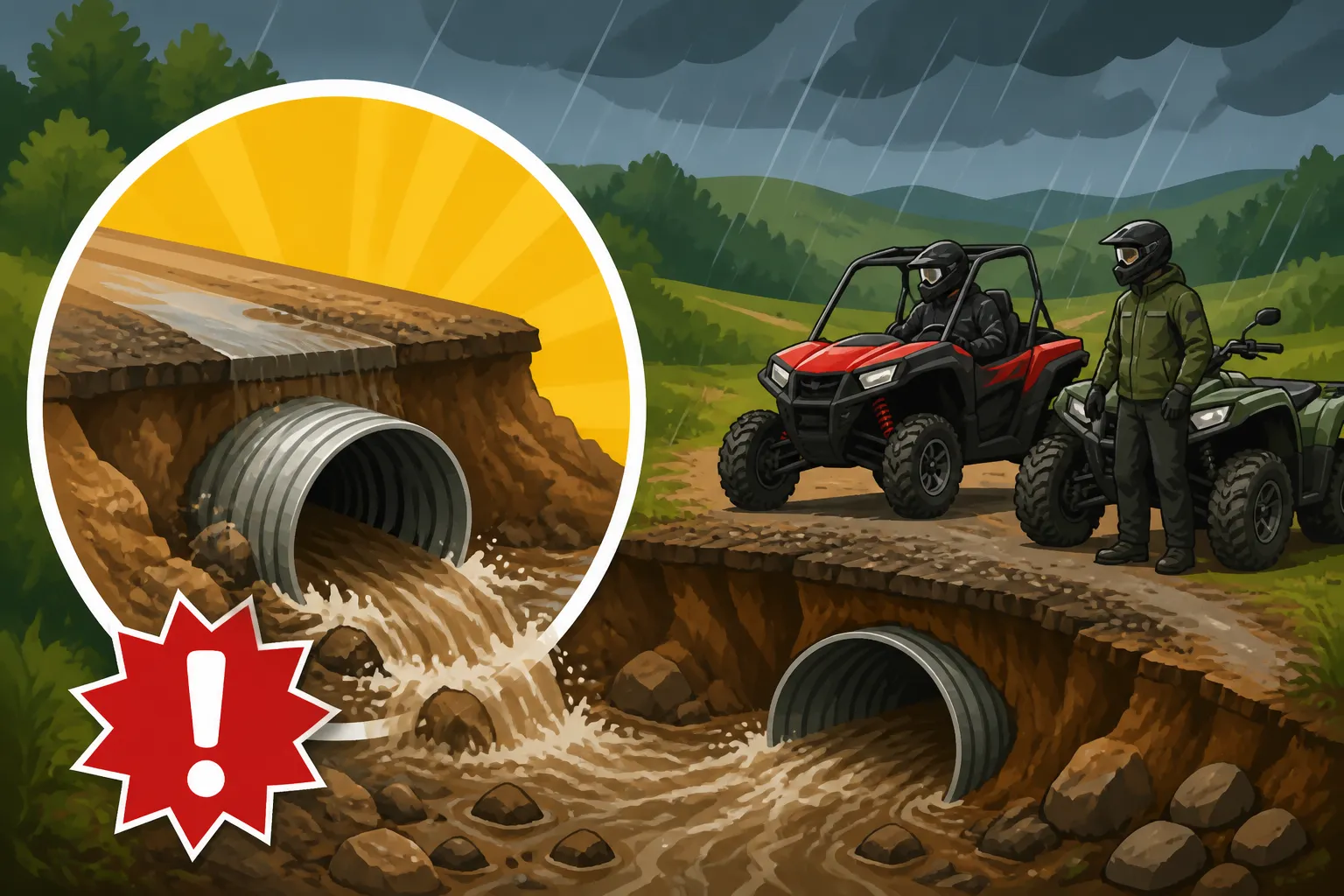
A culvert carries water under a road, but heavy rain can push more water through it than the pipe or surrounding ground can safely handle. Water may also flow over the road, cut around the pipe, or enter through a weak seam. The result can be a void beneath gravel or pavement that looks mostly intact from above.
In Missouri’s rolling countryside and Ozark hollows, a road can funnel runoff from a wide area into one low crossing. A short cloudburst uphill may send a fast surge toward a culvert even after rain has eased where you are. Near a creek or drainage channel, the water may be muddy and swollen enough to hide the road edge, the pipe opening, and debris caught against it.
The most deceptive situation is a surface that appears firm but has lost support underneath. Your tires may cross the intact-looking top before the ground gives way. A quad can drop a wheel into a hole; a side-by-side may slide toward a weakened shoulder or tip if one side sinks. Don’t use a successful walk across—or another rider’s fresh tracks—as proof that the crossing is safe.
Know the difference between a puddle and a structural warning
A puddle on a road is not automatically evidence of a failed culvert. But standing water can conceal a rut, a broken edge, or a gap that you cannot judge from the cab. Muddy water also makes depth and current difficult to read. If you can’t see what your tires would contact, treat the crossing as unknown rather than assuming it is shallow.
Watch for water following an unusual route. A stream coming out of the road shoulder, a new channel beside the pipe, or water bubbling up through gravel may indicate that runoff is moving through or around the roadbed. A fresh line of silt, exposed soil, or scattered gravel downstream can show where water has been cutting away material.
A sudden change in the crossing deserves caution even if the road is familiar. The last time you rode there, the culvert may have been clear and the shoulder firm. After a storm, debris can block an opening and redirect water, or the road may have eroded since your previous visit. For broader wet-weather riding precautions, see [Missouri Riding After Heavy Rain] and [Spotting a Washed-Out Culvert After Heavy Rain].
Warning Signs to Look For Before You Approach
Read the road from a distance
Slow down well before the low point, stop on solid ground, and look at the whole crossing. Check the uphill side for runoff paths and the downhill side for fresh erosion. If you see a deep rut, a collapsed edge, a pile of branches, or water spilling over the road, do not ride closer just to get a better look.
Compare the road surface on both sides of the culvert. A dip, raised hump, fresh crack, or uneven strip across the road may suggest that material has shifted. Pay attention to the shoulders, too. A washout often begins beside the traveled surface, where water can sneak around the culvert and remove the supporting soil. On a narrow road, the usable track may already be too close to a weakened edge.
Look for signs of recent repair or temporary warning markers, but don’t treat their absence as reassurance. Rural roads may not be inspected immediately after every storm. A property owner, road crew, or local authority may not yet know that a culvert has failed. If you are on a route involving public roads, check [Missouri Rules for Riding a Gravel Road] and make sure your planned route is lawful; a culvert hazard does not make an otherwise restricted road open to ATV or UTV use.
Use visible clues, not a test ride
A safe inspection means observing from a stable spot—not driving onto the crossing, revving across it, or walking out over a soft edge. From where the ground is firm, look for a pipe opening that is blocked, crushed, exposed, or surrounded by freshly disturbed soil. Debris lodged against the entrance can create a backup and push water over or around the road.
Listen as well as look. A sudden rush of water under the road, gurgling through a new opening, or water moving through the shoulder can be a reason to back away. Sound alone cannot tell you exactly what has failed, but it can add to the picture. If the water is high, flowing quickly, or carrying branches and sediment, stay well clear of the channel and do not try to cross on foot.
The table below is a practical screening aid, not a way to certify that a crossing is safe. When several signs appear together—or you simply cannot see the road edge or culvert opening—choose another route.
| What you notice | Why it matters | Safer response |
|---|---|---|
| Water covers the road or hides its edges | You cannot judge the surface, depth, or current | Stop on firm ground and turn around |
| A fresh channel runs beside the culvert | Water may have eroded support around the pipe | Keep back from the shoulder and avoid the crossing |
| A dip, crack, or uneven section has appeared | The roadbed may have shifted or lost material | Do not drive over it to test its strength |
| The culvert opening is blocked by branches or debris | Water may be backing up or diverting around the road | Do not attempt to clear it from a hazardous position |
| Soil is slumping or the edge is crumbling | The visible surface may be unsupported | Back away and report the hazard to the responsible party |
| You cannot see a safe, firm route across | Uncertainty itself creates risk | Choose another route, even if it adds time |
What to Do When You Find a Suspected Washout
Stop early and keep the machine on firm ground
Approach slowly enough to stop before the low area. If you have already reached the crossing, avoid sudden steering or braking near a soft edge. Move back only if the ground behind you is clearly stable; don’t reverse blindly along a narrow shoulder or toward a drop. If turning around would require entering soft ground, stop and reassess from the safest position available.
Keep passengers and bystanders away from the edge. A person standing near a weakened shoulder adds weight to ground that may already be compromised. Don’t send someone ahead to probe the water with a stick, and don’t ask another rider to cross first. A person on foot may be unable to detect a cavity beneath a thin surface, while a machine crossing can trigger a collapse without warning.
If the crossing is on a public road, report the hazard to the agency or local authority responsible for that road. If it is private property, notify the landowner or manager. When you share information, describe the road or trail location as clearly as possible and explain what you observed: for example, water running around the culvert, a fresh hole at the edge, or a blocked pipe opening. Don’t enter a closed or barricaded area to get a better description.
Reroute instead of trying to recover the shortcut
A washed-out culvert is not a good place to use a winch as a substitute for stable ground. Pulling a machine toward a damaged edge can place extra force on the roadbed and put the operator or bystanders in a dangerous position. Recovery gear is useful for certain situations, but it cannot make an undermined crossing sound. Even equipment such as a winch or protective accessories from SuperATV should not be treated as a reason to attempt a crossing whose support you cannot verify.
Look for a route that stays on firm, permitted roads or trails. Don’t bypass the washout by riding through someone’s field, down a drainage ditch, or along a creek bank unless you have permission and the route is safe and lawful. A detour that seems harmless can damage property, create erosion, or take you onto land where riding is not allowed. Review [Missouri Landowner Permission Rules] if your alternative route would cross private ground.
If a machine becomes stuck near a culvert, avoid pulling it from the damaged side or standing in line with a loaded strap or cable. Keep people clear, assess whether the ground itself is shifting, and call for appropriate help if recovery could put anyone at risk. For general planning around wet routes, [Missouri Trail Conditions Before You Ride] can help you think through what to check before unloading.
Planning Safer Rides After Missouri Storms
Make a post-rain route plan before you unload
Before heading out after a storm, check the forecast and any available trail or road notices. A sunny break does not mean a drainage crossing has settled. Runoff can continue moving through low areas after rain stops, and a culvert may remain blocked or undermined until someone inspects and repairs it. If your route crosses several hollows, creeks, or low gravel roads, assume conditions can vary from one crossing to the next.
Build a turnaround point into your plan. Agree with your riding group that anyone can call off a crossing when water, erosion, or road damage makes it uncertain. This matters on a group ride, where riders can feel pressure to follow the person in front. A clear “we turn around if we can’t see a firm route” rule makes the decision easier before you are tired, wet, or running low on daylight.
Carry a charged phone, let someone know your route, and avoid relying on cell service in remote hollows. A map can help you identify alternatives, but it won’t show a new washout. If your intended path includes public riding areas, check for closures before leaving and read posted notices when you arrive. [Missouri Trail Closures to Check First] and [Missouri Rules for Riding a Closed Trail] are useful reminders that a route’s usual status may not reflect conditions after a storm.
Inspect your machine and gear without overestimating what they can do
Before riding, check tires, brakes, lights, and steering so the machine responds predictably on wet gravel. Mud can hide sharp rock and branches, while slick surfaces lengthen stopping distance and make a turn more difficult. Leave extra room between machines, especially when visibility is limited by bends, brush, or a steep approach.
A winch, suitable recovery points, protective gear, and basic tools can help with some trail problems, but they do not make a washed-out road safe. SuperATV makes accessories riders may consider when preparing a machine for off-road use; whatever equipment you choose, learn how it works on stable ground and inspect it before the ride. Don’t anchor to a damaged culvert, a loose tree, or an object that could shift under load.
After the ride, note hazards you encountered and share them with the appropriate land manager, road authority, or property owner. That small follow-up can help prevent another rider from arriving at the same crossing without warning. For additional precautions on uneven wet routes, [Spotting a Washed-Out Culvert After Heavy Rain] is the key reminder: if the surface, edges, or water flow leave you uncertain, stop on solid ground and choose another way.
Disclaimer
This article is for general informational purposes only and does not constitute professional advice. Laws, prices and regulations vary by location and change over time. Consult a qualified professional for guidance on your specific situation.