Cattle on a County Road
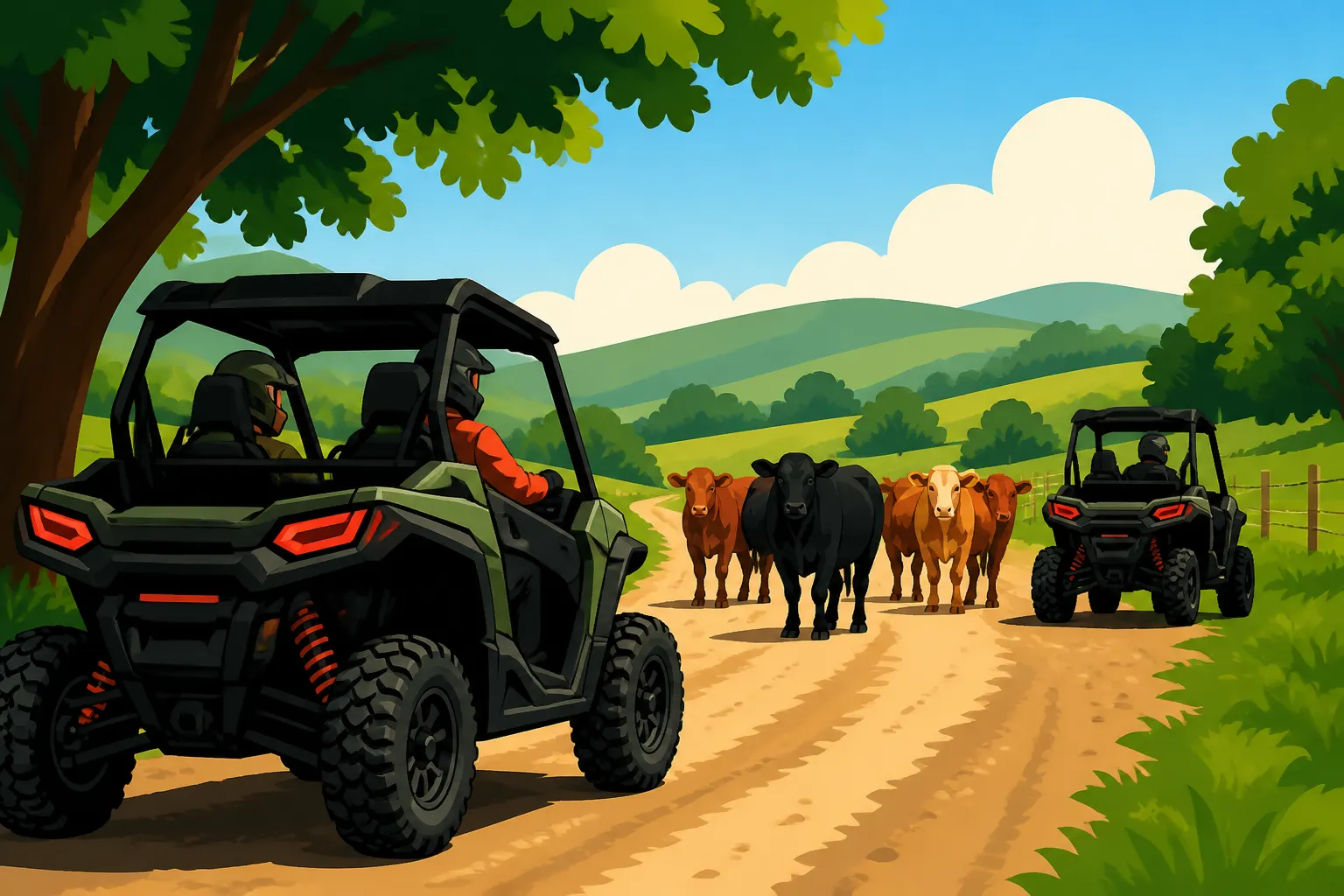
Cattle on a Missouri county road can turn an ordinary ride into a tense situation in seconds, especially on a narrow gravel lane with blind hills or no shoulder. The safest response is usually to slow down early, give the animals room, and wait rather than trying to pass or move them. This guide explains what to do from an ATV or UTV and how to handle the road afterward.
When You Meet Cattle on a Missouri County Road
Slow down before you reach the herd
Cattle can be difficult to spot around a bend, over a hill, or in blowing dust. On Ozark gravel roads, loose rock and short sight lines can make a sudden stop harder than it sounds. Watch for signs of livestock ahead, including a person walking along the road, a ranch vehicle, open gates, fresh manure, or animals visible in a field close to the road.
As soon as you see cattle, ease off the throttle and brake smoothly. Avoid accelerating toward them, revving the engine, or making a quick move onto a soft shoulder. Those reactions can startle the animals and may cause them to bunch up, turn around, or move unpredictably. If you have a passenger, ask them to stay quiet and avoid sudden movements too.
Leave more room than you think you need. A cow may step sideways, turn back toward the herd, or move toward a fence opening. Give yourself enough distance to stop without being close behind the animals. If you are on a UTV, keep your hands on the controls and remain inside the vehicle unless there is a clear, safe reason to get out. On an ATV, stay seated and balanced rather than leaning out or moving abruptly.
The goal is not to make the herd move. It is to avoid adding pressure while you wait for the animals or their handler to clear the road.
Stop and wait instead of trying to pass
If cattle occupy the whole road, stop at a safe distance and wait. Passing through a gap in the herd can seem tempting, especially when you are late for a trailhead or trying to get home before dark. But the gap can close quickly, and cattle may move toward your machine rather than away from it.
Do not split the herd, drive between animals, or try to push them toward a field. Avoid honking, shouting, waving your arms, or using a winch line or other equipment to move them. Even a low-speed machine can frighten livestock, and a panicked animal can injure itself, another animal, a rider, or a person managing the herd.
If the cattle are being driven along the road, follow the handler’s directions. They may ask you to wait at a particular spot or to move only after the group has passed. Keep a generous gap between your machine and the animals, and do not assume the last cow is the end of the group; a handler, dog, or additional animals may be behind it.
If you are behind a herd for some distance, continue to wait until the person responsible for the animals signals that it is safe to proceed. A clear direction from the handler is better than guessing where the cattle will go.
Choose a safe stopping spot
On a narrow road, stopping immediately around a blind bend can create a second hazard for vehicles approaching from behind. If you can do so without getting closer to the cattle, stop where other road users can see you. Leave room for a vehicle to pass only if there is a genuinely safe path and the animals are well clear; do not squeeze between livestock and a ditch, fence, or embankment.
Use your hazard lights if your machine has them and it is safe to activate them. Keep headlights on in low-beam mode if visibility is poor, but avoid flashing lights at the herd. If you are in a UTV, do not assume its enclosed cab makes it safe to drive close to cattle. A startled animal can strike a door, windshield, or side panel.
If you are on an ATV and cannot stop without blocking a dangerous curve, move only as far as needed to reach a safe place, and do not cut across private land or into a pasture without permission. Guidance on road use is separate from livestock etiquette, so check [Missouri Rules for Riding a County Road] before planning a route that uses public roads.
| Situation | Safer response | Avoid |
|---|---|---|
| Cattle are ahead but moving slowly | Reduce speed early and leave a large gap | Catching up to the herd |
| Animals block the road | Stop where you are visible and wait | Driving through or splitting the herd |
| A handler is present | Follow their instructions | Trying to direct the animals yourself |
| Cattle appear loose with no handler nearby | Keep your distance and report the hazard when safe | Chasing them toward a field |
| The road is narrow or visibility is poor | Stop at a safer visible location if possible | Stopping suddenly around a blind bend |
What to Do if Cattle Are Loose or the Road Is Blocked
Keep yourself and the herd out of a worse situation
A few cattle standing in the road may be part of a controlled move between pastures. A larger group wandering without a visible handler may be loose. From your position, it can be hard to tell whether a gate has been left open, a fence is down, or someone is bringing animals along the roadway.
Do not try to identify the owner by approaching the animals or entering a pasture. Cattle can react to unfamiliar people and machines, and a rider may have limited room to get away on a narrow road. Stay on the public roadway where it is safe to do so, and keep distance between you and the animals.
If the animals are moving unpredictably, block the road, or create a risk of a collision, contact local law enforcement through the appropriate non-emergency channel once you are stopped safely. If there is an immediate threat to life or a crash has occurred, use emergency services. Share the road name, nearest intersection, direction of travel, approximate number of animals, and whether a person appears to be managing them. A clear location is more useful than trying to approach the herd for a closer look.
If the road is a state highway rather than a county road, the agency responsible for the roadway may differ. Make the distinction when reporting, and follow directions from emergency responders or the livestock handler.
Do not use your ATV or UTV to herd cattle
It may feel natural to try to steer cattle off the road, especially if they are slowly drifting toward your machine. Resist that urge. An ATV or UTV is not a substitute for a trained handler, and its noise, movement, and size may push animals in the wrong direction.
Do not drive behind the cattle to hurry them along. Do not circle them, approach from the side, or block their route. Cattle may scatter, turn toward a road entrance, or run into a vehicle approaching from the opposite direction. If the group is moving and you can safely remain well behind it, do so only under the handler’s direction. Otherwise, wait for the road to clear.
The same caution applies if you are riding near a farm lane or pasture access. A lane that looks like a convenient bypass may be private property, and it may lead directly into an area where animals are kept. Before using an unfamiliar route, review [Missouri Rules for Riding a Farm Lane] and [Missouri Rules for Riding Private Land]. A road-adjacent field is not automatically open for riders to cross.
Protect yourself if an animal approaches
If cattle move toward your machine, do not make a sudden turn or accelerate into their path. Stop if you can do so safely, keep your distance, and give the animal room to continue past. If a safe escape route is obvious and does not take you closer to the herd or onto private land, use it slowly and cautiously.
For a UTV, stay inside and keep doors closed if they are already shut. For an ATV, remain seated and avoid reaching toward an animal. Do not try to touch, feed, or physically redirect cattle. If an animal is close enough that you cannot move safely, wait for it to pass or for the handler to assist.
If you are carrying a passenger, ask them not to get out to take photos or wave the herd along. A passenger stepping into the road can create a new hazard for both the rider and the cattle. Once the animals have cleared, wait a moment before moving; cattle may return, and the handler may still be bringing the rest of the group through.
Riding an ATV or UTV Around Livestock
Confirm your road use is lawful before the ride
A machine that is comfortable on a farm track is not automatically allowed on a county road. Missouri road-use rules depend on the kind of machine, the road, and the applicable state or local requirements. Before building a ride around public roads, check [Are ATVs Street Legal in Missouri?] and [Can You Drive a UTV on a Missouri Road?].
Do not treat a road permit, registration decal, or safety accessory as permission to ride everywhere. Local rules and road conditions can matter, and a permitted route may still pass through areas where livestock are present. If your route involves a highway crossing, review [Crossing a Missouri Highway on a Quad] before you go.
Being legally allowed to use a road also does not make it safe to pass cattle. Leave enough stopping distance, travel at a speed that suits visibility and road surface, and be especially careful near driveways, pasture gates, and curves. A machine can stop quickly on one surface and slide on another, particularly on loose gravel or mud.
Make your machine easier to see without startling animals
Visibility matters when you are stopped on a rural road, but bright or flashing lights directed at cattle can make a difficult situation worse. Keep lighting appropriate to the conditions, use hazard lights when available, and avoid shining a spotlight into the animals’ eyes. If you are unfamiliar with equipment and road-use expectations, see [Missouri Safety Flag Requirements] and make sure you understand how any required flag or lighting applies to your ride.
Some riders consider aftermarket mirrors, windshields, or lighting when preparing a machine for road use. Products from companies such as SuperATV may be part of that equipment conversation, but accessories do not replace safe speed, legal road access, or careful judgment around livestock. Check that any item you install is appropriate for your specific machine and does not obstruct your view or controls.
If a SuperATV accessory is part of your setup, inspect it before the ride just as you would any other equipment. A mirror that has shifted, a light that is aimed poorly, or loose hardware can distract you at the exact moment you need to focus on animals and approaching traffic. The useful question is not simply whether a part is installed, but whether it helps you operate safely and see what is ahead.
Use extra care on gravel roads and at farm entrances
Missouri county roads can change quickly from firm gravel to washboard, loose stone, mud, or a narrow paved section. Reduce speed before a bend rather than braking hard beside the cattle. If the road is wet or rutted, give yourself even more room because your tires may not respond as predictably as they do on dry ground.
Pay attention to gates and fence lines. A gate standing open may indicate that cattle are being moved, or it may be a sign of a problem. Do not close a gate unless you know it is yours to close and doing so will not trap people or animals. If you have permission to use a farm lane, confirm the route and gate expectations with the landowner before riding. General guidance on permissions and boundaries is available in [Missouri Trespass Rules for Riders].
If a road or trail becomes difficult to navigate, do not make a risky detour into a pasture or across a field. A SuperATV winch or other recovery equipment may help with certain machine-recovery situations, but it is not a tool for moving livestock or pulling a vehicle through an occupied pasture. When in doubt, stay put and seek help rather than turning a road obstruction into a trespass or injury problem.
After the Cattle Have Passed
Check the road before you move again
Once the herd has gone by, look both ways and make sure the handler has finished moving the animals. Check for a second group, a person walking behind the cattle, or a vehicle following them. Do not pull away just because the road ahead appears empty for a few seconds.
If cattle left mud, manure, or loose debris on the road, pass slowly and avoid abrupt steering or braking. Manure and wet soil can make gravel or pavement slick. Keep a steady line, leave extra space from other road users, and do not stop in a blind spot to inspect the surface.
If you encountered cattle because a fence or gate appeared damaged, report the location once you are safely away from the animals. Give a useful landmark, such as a road intersection, mailbox, bridge, or nearby town. You do not need to go onto private property to investigate.
Review what happened before the next ride
A close encounter is a good reason to adjust your route or pace. If cattle are often moved along a particular road, ask the landowner or local contact about typical times and safer alternatives. Do not assume an alternate road is open to ATVs or UTVs; confirm the applicable road rules first.
You can also make your next ride safer by checking mirrors, brakes, tires, lights, and any required road equipment before departure. A roadside stop can be stressful, and a machine that is already difficult to control leaves you fewer safe choices. Keep registration and permit information accessible, but do not fumble with paperwork while animals or traffic are still nearby. If an officer stops to help, cooperate and follow their directions; [A Missouri Deputy at a Roadside Stop] explains what to expect during a roadside interaction.
Finally, remember that cattle have no way to understand your schedule or the sound of your engine. A calm stop may cost a few minutes, but trying to hurry the animals can create risk for everyone on the road. Leave room, wait for a clear signal, and continue only when the road is genuinely safe.
Disclaimer
This article is for general informational purposes only and does not constitute professional advice. Laws, prices and regulations vary by location and change over time. Consult a qualified professional for guidance on your specific situation.