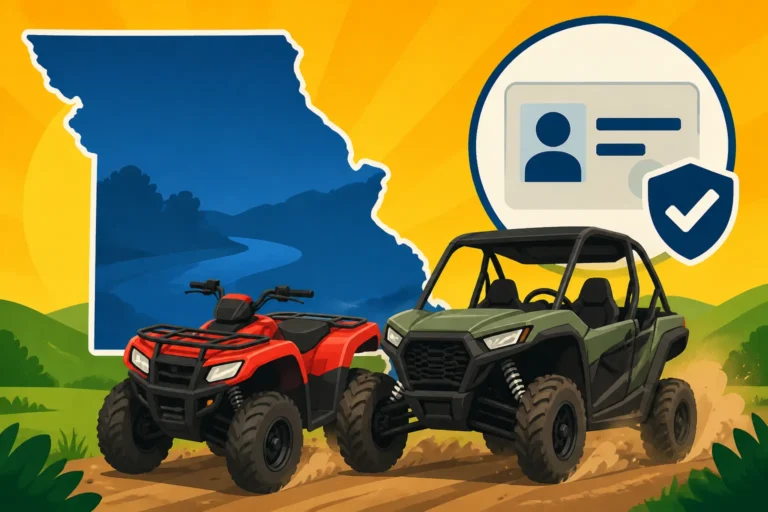
Headlamps On for a Road Trip
Ah, the open road! There's something undeniably appealing about hopping on your ATV or UTV and heading down the road, whether it's just to the neighbor's house or to reach a distant trail. But let's be real, the rules around taking your off-road machine onto public roads in Missouri can feel like navigating a dense, overgrown trail system without a map. It's frustrating when you just want to understand what's allowed and what's not, especially when you see others doing it and you're left wondering if you're missing something crucial. This guide is here to clear up that confusion, offering a realistic look at when your headlamps can legally illuminate Missouri asphalt and what you absolutely need to know to stay out of trouble.
The General Rule: Why Most ATVs Stay Off Missouri Roads
Let's start with the hard truth that can often catch folks off guard: for the most part, your standard ATV or UTV isn't designed or legally permitted for general public road use in Missouri. It's not because the state doesn't want you to have fun, but rather due to a combination of safety concerns and how these vehicles are legally classified. It's a common misconception that if a machine can go fast enough, it should be allowed on the road, but the law sees things a bit differently.
Imagine you've just bought a shiny new quad, eager to explore. You might think, "Well, it has lights and a horn, what's the big deal?" The big deal is that traditional ATVs and many UTVs just don't meet the rigorous safety and equipment standards set for vehicles sharing the road with cars, trucks, and motorcycles. Things like turn signals, specific brake light requirements, and even crash-worthiness standards are often missing, and for good reason—they're built for dirt, not asphalt.
What Missouri Defines as an ATV vs. UTV
Understanding the specific definitions is your first and most crucial step in figuring out if your machine has any hope of legally hitting the road. Missouri law makes a clear distinction, and this is where a lot of confusion stems from. An "all-terrain vehicle" or ATV, by Missouri's definition, generally means a motorized vehicle manufactured and used exclusively for off-highway use, weighing 1,500 pounds or less, 50 inches wide or less, and having three or more wheels designed to travel on unpaved surfaces, and having a seat designed to be straddled by the operator. Think of your traditional quad here.
Then we have "utility vehicles" (UTVs) and "recreational off-highway vehicles" (ROVs), which often get lumped together but have important differences in how the state treats them, especially concerning road use. A UTV might be thought of as a workhorse, often with a cargo bed and designed for utility tasks. An ROV, on the other hand, is built more for recreation, featuring side-by-side seating, a steering wheel, and roll-over protection. These are your typical "side-by-sides." The legal distinctions matter immensely when it comes to road use. For a deeper dive, check out [Why Missouri Splits ATVs, UTVs and ROVs] and [What Missouri Counts as an ATV].
The "No Go" Zones for Standard ATVs
So, if your machine fits the traditional ATV definition—under 1,500 pounds, 50 inches wide, and with a straddle seat—then generally speaking, you cannot operate it on any public street or highway in Missouri. Period. This includes state highways, county roads, and city streets, unless a very specific and limited exception applies (which we'll get into shortly).
This can be a real bummer if you live in a rural area and just want to take your quad a quarter-mile down the road to check the mailbox or help a neighbor. It's not about being a killjoy, it's about the law, and deputies and police officers will enforce it. Operating an ATV illegally on a public road can result in fines and even have your machine impounded. It's a risk most folks don't want to take, especially when there are clear rules to follow.
Exceptions to the Rule: When Your Machine Can Hit the Pavement
Now, for the good news! While the general rule is "no ATVs on roads," Missouri does offer some very specific and limited exceptions, mostly for UTVs and ROVs, and under strict conditions. These aren't blanket permissions, but rather narrow allowances that require you to meet certain criteria, often involving special permits, specific equipment, or a particular purpose for your travel. This is where your dream of "headlamps on for a road trip" might just become a reality, albeit a very localized one.
The Agricultural Highway Exception
If you're involved in farming, there's a specific carve-out in Missouri law that might allow your UTV or even an ATV to be operated on public roads for agricultural purposes. This isn't for joyriding; it's strictly for getting work done. Imagine needing to move hay bales from one field to another across a county road, or taking tools to a different part of your farm. This exception recognizes the practical needs of the agricultural community.
However, it's not a free-for-all. The vehicle must be used solely for agricultural purposes, such as planting, harvesting, feeding livestock, or other farm-related duties. There are also specific time restrictions, typically limited to [Missouri Agricultural Use From Sunrise to Sunset], and the machine must be operated in a safe manner. It's crucial to understand that this exception doesn't apply to recreational riding, even if you live on a farm. You can't just run to town for groceries using this rule. For more details on this, look into [Missouri's Agricultural Highway Exception].
City and County Ordinances
This is perhaps the most exciting and evolving area for UTV and ROV owners looking to get on the road. Missouri state law allows individual cities and counties to pass ordinances that permit the operation of UTVs or ROVs on their public roads. This means that while state law generally restricts them, your local government can create a legal pathway for you. This is why you might see UTVs zipping around in one town but not another, even if they're just a few miles apart.
Many towns, especially those with an influx of recreational visitors like Lake Ozark, or those in more rural counties, have adopted such ordinances. They recognize the economic benefit and the convenience these machines offer. For instance, cities like Lake Ozark, Harrisonville, and St. James have enacted rules, often requiring permits, specific equipment, and adherence to speed limits. To find out if your area or a destination you plan to visit allows it, you'll need to contact the specific city or county government. This is a critical step because what's legal in one town won't necessarily be legal in the next. It’s definitely worth researching [Missouri Cities That Allow UTVs on Streets] and [Missouri Counties That Allow ATVs on Roads] if you're looking for places to ride. The process for local governments opening up roads to UTVs is clearly outlined in [How a City Ordinance Opens a Street to UTVs].
Missouri's Special Permit for ROVs (The 3-Mile Rule)
This is a specific state-level exception that has opened up some avenues for recreational off-highway vehicles (ROVs), which are your side-by-sides, but generally not traditional ATVs. This rule, often called the "3-mile rule," allows an individual to obtain a special permit from the Missouri Department of Revenue to operate their ROV on state and county roads for short distances.
The permit essentially allows you to travel on roads within a three-mile radius of your primary residence, and it's intended for practical purposes, like getting to a nearby gas station, accessing a trail, or visiting a neighbor. It's not a license for cross-county touring. To qualify for this permit, your ROV must meet specific equipment requirements, including headlamps (hence the "Headlamps On for a Road Trip" theme), taillamps, a brake light, a horn, a rearview mirror, and a safety flag. You also need a valid driver's license. This permit is distinct from local ordinances and addresses a specific need, particularly for those living in rural areas who rely on their side-by-side for short errands. For more details, consult [Missouri's Special Permit for Road Use] and [Missouri's 3-Mile Rule for Side-by-Sides]. It’s important to understand [Why the 3-Mile Rule Is ROVs Only] and how it differs from ATV use.
Here's a quick comparison of general road legality for different machine types in Missouri:
| Feature/Machine Type | Traditional ATV (Straddle Seat) | UTV (Utility Vehicle) | ROV (Recreational Off-Highway Vehicle, Side-by-Side) |
|---|---|---|---|
| General Road Use | Generally NOT permitted | Generally NOT permitted | Generally NOT permitted |
| Agricultural Exception | Limited use for farm work | Limited use for farm work | Limited use for farm work |
| City/County Ordinance | RARELY, almost exclusively for UTVs/ROVs | YES, if local ordinance exists | YES, if local ordinance exists |
| MO 3-Mile Permit | NO, does not apply to ATVs | NO, does not apply to UTVs | YES, if specific equipment met, driver licensed |
| Required Equipment | N/A (for road use) | Varies by ordinance | Headlamps, taillamps, brake light, horn, mirror, flag |
| Driver's License | N/A (for road use) | Varies by ordinance | YES (for 3-mile permit) |
Essential Gear and Safety Considerations for Road-Legal Machines
If you're lucky enough to live in an area with an ordinance or qualify for the 3-mile rule, your "headlamps on for a road trip" dream starts with making sure your machine is properly equipped. It's not just about having lights; it's about having the right lights and other safety features to be visible and safe on public roads. Remember, you're sharing the road with much larger, faster vehicles, so visibility and crash protection are paramount.
Lighting and Visibility
This is non-negotiable for road travel, even for short distances. Your ROV or UTV must have functioning headlamps, taillamps, and a brake light. These aren't just for seeing where you're going; they're primarily for being seen by others. Imagine driving at dusk or on a cloudy day – without proper lighting, you're practically invisible. You'll want bright, reliable headlamps, especially if you're navigating country roads where deer are abundant. Many riders opt to upgrade their factory lighting for better visibility, and aftermarket options like those from SuperATV can provide robust, bright LED light bars or replacement headlamps that significantly enhance your presence on the road.
Beyond standard lighting, Missouri also requires a visible safety flag for ROVs operating under the 3-mile rule or some local ordinances. This flag must be a certain size and color, and crucially, it needs to be mounted at least [Missouri's 7-Foot Safety Flag] high from the ground. This ensures that your vehicle is visible over cars and other obstacles, especially on hills or around curves. It’s a small detail that makes a huge difference in your safety profile. Ensure your flag pole is sturdy and can withstand wind at road speeds. Understanding [Why a Road Flag Must Fly 7 Feet Up] is key.
Driver Requirements and Passenger Rules
Just because your machine is technically allowed on the road doesn't mean just anyone can operate it. For ROVs using the 3-mile permit, the operator must possess a valid driver's license. This isn't a learner's permit situation; it's a full, unencumbered license. This rule ensures that anyone operating an ROV on public roads has demonstrated basic driving competence. Unfortunately, this means that even if your teenager is an ace off-road rider, they cannot drive the ROV on public roads if they don't have a valid driver's license. For specific details on licensing, see [Missouri Driver's License Rules for ROVs].
Passenger rules are another critical point. While many UTVs and ROVs are designed for multiple passengers with side-by-side seating, traditional ATVs are generally single-operator machines. Attempting to carry a passenger on a single-seat ATV on a public road, even under an agricultural exception, can lead to a citation. Make sure your machine is actually built for two if you're planning on carrying a passenger where permitted. Familiarize yourself with [Missouri Passenger Rules on an ATV].
Roll Bars, Seat Belts, and Helmets
Safety equipment is paramount. Most ROVs and UTVs come standard with roll-over protection structures (ROPS) and seat belts, which are absolutely essential for any road use. If your machine is older or modified, ensure these components are in excellent working order and meet manufacturer specifications. Upgrading seat belts to multi-point harnesses can offer additional safety, especially on rougher country roads. SuperATV, for instance, offers various seat belt options and even cage components for enhanced protection.
When it comes to helmets, Missouri's law for ATVs and ROVs generally states that riders and passengers under the age of 18 must wear a DOT-approved helmet when operating on public land or permitted roads. For adults 18 and over, helmets are not strictly mandated for ROV road use under the 3-mile rule or some city ordinances, but they are always a smart choice. Your head is worth protecting, and a helmet provides a crucial layer of defense in the event of an accident. It’s better to be safe than sorry, especially given the varying speeds and unpredictable nature of public roads. Double-check [Missouri Helmet Rules for Riders Under 16] for youth riders.
Navigating the Maze: Permits, Penalties, and Practical Advice
So, you've got your UTV or ROV equipped, you understand the rules, and you're ready to explore. But before you turn on those headlamps and hit the road, there are a few more practical steps and considerations to keep in mind. Navigating the administrative side of things—getting permits, understanding potential fines, and planning your route—is just as important as having the right safety gear.
Obtaining Local Permits
If you're relying on a city or county ordinance, getting the necessary permit is your first step. This usually involves visiting the local police department or county sheriff's office. You'll likely need to bring proof of ownership, your driver's license, and proof that your machine meets all the required safety equipment standards (lights, mirrors, flag, etc.). There will often be a nominal fee, and the permit might need annual renewal.
It’s not enough to assume; you must actively seek out the correct permit. The specific requirements and costs can vary widely from one jurisdiction to another, so don't assume what works in one town will work in the next. Call ahead or check the specific city/county website. For example, [Where to Get a Missouri ATV Road Permit] provides general guidance, but the specifics come down to the local agency, whether it's [Getting a Road Permit From a Police Department] or a different office. Remember, these permits are typically for local use within that specific city or county and do not extend to neighboring jurisdictions unless those also have their own ordinances and permits.
Understanding the Penalties
Operating an ATV, UTV, or ROV on public roads without meeting the legal requirements or having the proper permits can lead to significant penalties. These aren't just minor infractions; they can range from fines to having your machine towed and impounded. A Class C misdemeanor, for example, can carry a fine. The cost of retrieving an impounded vehicle, plus the fine, can quickly add up to hundreds, if not thousands, of dollars. It's a costly lesson nobody wants to learn.
Furthermore, if you're involved in an accident while operating your machine illegally on a public road, your insurance coverage might be voided, leaving you personally liable for damages. This is a very real financial risk. Always ensure you are fully compliant with the law to avoid these serious consequences. Be aware of [Missouri Fines for Illegal ATV Road Use] before you even think about bending the rules.
Planning Your Road Trip
Even with all the legal boxes checked, a "road trip" on your UTV or ROV in Missouri requires thoughtful planning. First, map out your route carefully, ensuring that every segment of your journey falls within an approved jurisdiction or the 3-mile radius of your special permit. Do not stray onto roads where your machine isn't permitted. It’s also wise to research road conditions. Side-by-sides are not built for sustained high speeds, and while they might be capable of a certain speed, it might not be comfortable or safe on busier roads.
Consider the time of day you'll be riding. Early mornings or late evenings might mean less traffic but also reduced visibility, even with good headlamps. Always carry your driver's license, your machine's title or registration, and your road permit. Keep them in a waterproof bag, perhaps in a secure storage box. Lastly, drive defensively. Assume that other motorists might not see you, especially given the smaller profile of your machine compared to a car. Maintain appropriate following distances, signal your turns, and respect all traffic laws. Enjoy the ride, but always prioritize safety and legality!
Disclaimer
This article is for general informational purposes only and does not constitute professional advice. Laws, prices and regulations vary by location and change over time. Consult a qualified professional for guidance on your specific situation.