Missouri Rules for Riding a Gravel Road
It's incredibly frustrating when you just want to take your ATV or UTV out for a spin, perhaps to get to a favorite fishing spot, check some fence lines, or simply enjoy a scenic route, only to be riddled with anxiety about whether you're even allowed on that gravel road. Many of us have felt that hesitation, wondering if a quick trip down a county lane will land us in hot water with the law. This guide is here to untangle the complexities of Missouri's rules for riding your off-road machine on those inviting gravel roads, helping you ride with confidence and stay on the right side of the regulations.
The Core Challenge: General Road Legality in Missouri
Let's be real, the first thing many of us wonder is, "Can I even ride my quad on the road at all?" The simple answer, for most ATVs, is generally "no" without specific local permits or exceptions. UTVs and side-by-sides, however, have a slightly different pathway thanks to specific state statutes. It's not as straightforward as just having a title or registration; Missouri draws a clear distinction between how these machines are typically used and the requirements for operating them on public roadways. This distinction is crucial because what might be legal for a UTV in one county could be completely off-limits for an ATV in the same spot, or vice versa in a different locale. You really have to dig into the nuances, and that's what makes it so confusing for riders across the state.
Why ATVs and UTVs Aren't Like Cars
When you buy a car, you title it, register it, get plates, and insurance, and you're good to go on just about any public road. But ATVs and UTVs? They're designed for off-road environments, and Missouri's state laws reflect that primary purpose. While you do need to get your ATV titled and a decal for it from the Missouri Department of Revenue, that decal doesn't grant you street-legal status in the same way a car's license plate does. In fact, one of the common frustrations is discovering that while your ATV technically has a form of "registration" through its decal, it still can't just cruise down a paved highway or even a gravel road without jumping through additional hoops. This system often leaves riders scratching their heads, wondering why they pay fees if they can't use their machines more broadly.
For UTVs and Recreational Off-Highway Vehicles (ROVs), the situation is a bit different. Missouri doesn't require these machines to be titled or registered at the state level like ATVs. That often leads people to assume they're completely unregulated for road use, but that's a dangerous assumption. Instead, their road legality is primarily governed by specific state statutes and, more importantly, by local ordinances. This means that while you might not have a state decal for your side-by-side, you still need to be very aware of what your particular city or county allows, or you could face some hefty fines. If you're wondering if you can legally take your side-by-side out on those country roads, you'll definitely want to read our guide, [Can You Drive a UTV on a Missouri Road?].
The Importance of Local Ordinances
This is where the rubber meets the road, quite literally, for many riders. While state law lays out some baseline definitions and exceptions, it largely defers the decision of allowing ATVs and UTVs on local streets and gravel roads to individual cities and counties. This creates a patchwork of regulations across Missouri. What's legal in Harrisonville might be illegal in Lebanon, and what flies in Cass County might get you a ticket in Reynolds County. It means you can't just assume that because you saw someone riding an ATV on a gravel road last weekend in a different part of the state, it's okay for you to do the same where you live or ride.
Before you even think about putting tires on a public gravel road, your absolute first step should be to check with the local city hall or county sheriff's department. Many municipalities have passed specific ordinances allowing UTVs and sometimes ATVs on their local roads, often requiring a special permit, certain equipment, and sometimes even insurance. Without these local rules in place, operating your machine on those roads, even if they're just sleepy gravel lanes, is typically illegal. It's a hassle, absolutely, but it's the only way to be sure you're not breaking the law.
Distinguishing Between ATVs, UTVs, and ROVs for Road Use
Missouri law defines these machines in ways that significantly impact their eligibility for road use. An "all-terrain vehicle" (ATV) is generally defined as a motorized vehicle designed for off-highway use, 50 inches or less in width, with an unladen dry weight of 1,500 pounds or less, traveling on three or more low-pressure tires, and having a seat designed to be straddled by the operator. Think of your traditional quad or three-wheeler.
"Utility vehicles" (UTVs) and "recreational off-highway vehicles" (ROVs) are generally wider than 50 inches, can weigh more than 1,500 pounds, and typically feature side-by-side seating, steering wheels, and roll bars, similar to a small car. The distinction is not just academic; it dictates which state statutes apply and, therefore, which local ordinances are even possible. For example, specific provisions in Missouri law allow counties and cities to pass ordinances for ROVs to operate on their roads, often under what's known as the "3-mile rule," which allows operation within three miles of the operator's residence for specific purposes. This pathway generally isn't available for ATVs under state law, making it significantly harder to get an ATV legally on a gravel road unless it falls under an agricultural or emergency exception. Understanding these differences is the first step in navigating the rules, as we explore further in [Are ATVs Street Legal in Missouri?].
Navigating County Gravel Roads with a Permit
For many side-by-side owners, and in some rare cases for ATVs, the key to legally riding on local gravel roads lies in obtaining a special permit from the local governing body. This isn't just a suggestion; it's often a strict requirement that, if ignored, can lead to fines and headaches. It’s important to remember that these permits are typically local and aren't universal across the state. Just because you have one for your home county doesn't mean it's valid in the next county over. Always double-check.
The Special Permit: Your Golden Ticket
Many Missouri counties and cities have adopted ordinances that allow for the operation of UTVs or ROVs, and sometimes even ATVs, on their local gravel and paved roads within their jurisdiction. To take advantage of these ordinances, you'll almost always need a special permit issued by that specific local government. These permits are essentially a local authorization slip, signaling that you've met their specific conditions for road use.
The requirements for these permits can vary widely, but they commonly include:
- Proof of Ownership and Identity: Standard stuff, showing the machine is yours and who you are.
- Machine Inspection: Some localities might require a safety inspection to ensure your machine meets their specific equipment standards for road use.
- Proof of Insurance: This is a big one. Many local ordinances demand proof of liability insurance, often similar to what's required for a motor vehicle. This is critical for protecting yourself and others in case of an accident.
- Payment of a Fee: There's usually a nominal fee to cover the administrative costs of issuing the permit.
- Compliance with Equipment Rules: This often means having things like a safety flag, working headlights and taillights, brake lights, mirrors, and sometimes turn signals or a horn. Brands like SuperATV offer a huge range of aftermarket accessories that can help you meet these requirements, from mirrors to turn signal kits, making it easier to equip your machine properly.
When you secure this permit, it's not just a piece of paper; it's your official local permission to operate, often subject to specific times of day (e.g., sunrise to sunset) or certain types of roads. Failing to carry it with you while riding on a public road, even a gravel one, could be considered operating without a permit, leading to citations. For more information on what these permits might cost, see [Missouri Special Permit Cost for ATVs].
What the Permit Requires of Your Machine and You
Beyond the permit itself, the local ordinance will outline what equipment your ATV or UTV must have to be considered road-ready. While a street-legal kit isn't always explicitly mandated by state law for UTVs on local roads, many cities and counties will require equivalent features. Common requirements include:
- Headlights and Taillights: These must be functional and often need to be on during operation, especially during dawn or dusk. Missouri law for ROVs on public roads specifically mentions the need for headlamps and tail lamps.
- Brake Lights: Crucial for signaling stops to other traffic, even if that "traffic" is just another farmer's pickup on a dusty gravel road.
- Mirrors: Typically, at least one rearview mirror is required. Some ordinances may specify two, similar to cars.
- Safety Flag: Often, a bright orange or red safety flag, mounted on a pole that extends at least 7 feet from the ground, is a requirement. This makes your machine more visible over rises and around curves on those hilly gravel roads. Our guide [Missouri Safety Flag Requirements] has more details.
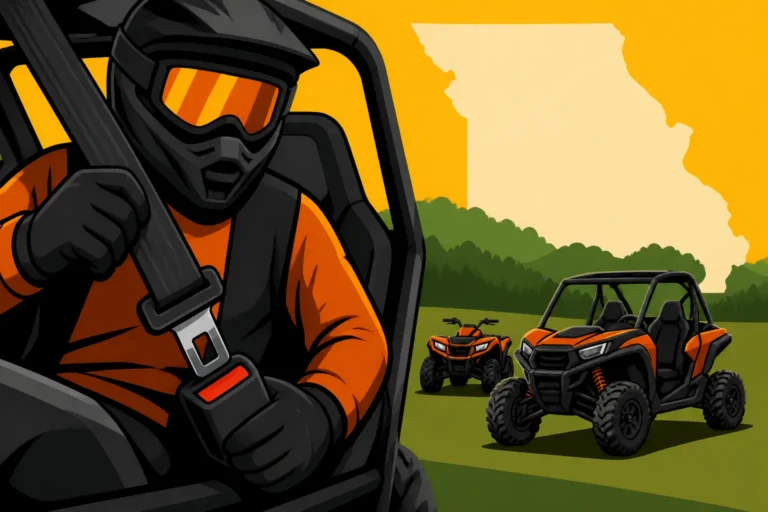
- Roll Bar and Seat Belts: For UTVs and ROVs, if the machine came equipped with these from the factory, they must be functional and used by all occupants. This goes hand-in-hand with safety.
- Driver's License: The operator usually needs to possess a valid driver's license (not just an ATV safety certificate). This is key to operating any motorized vehicle on public roads, even unpaved ones. Our article [Missouri Driver's License Rules for ROVs] delves into this more.
For the rider, the requirements are equally important. You must adhere to the rules about speed limits (often lower than for cars on these roads), passenger limits (usually only as many as there are factory seats and seat belts), and time of operation. It's not a free-for-all; it's a privilege granted by local authorities.
Where to Obtain a County Road Permit
So, you're convinced you need one of these permits – great! But where do you actually go to get it? This is another point of variation, as it depends entirely on the local government that issued the ordinance.
- County Sheriff's Office: In many counties, particularly rural ones, the sheriff's office or the county clerk's office will be the issuing authority. They often have the application forms and can conduct any necessary inspections.
- City Hall/Police Department: If you're looking to ride on gravel roads within city limits (or county roads covered by a city ordinance), the city hall or local police department is usually the place to start.
- Online Resources: Some forward-thinking counties or cities might have information and even downloadable application forms available on their official government websites. This is always a good first check.
The best approach is to call ahead. A quick phone call to the county sheriff's non-emergency line or the city clerk's office will usually point you in the right direction. Just explain that you're an ATV or UTV owner looking to understand the local rules for riding on gravel roads and inquire about any necessary permits. Don't be afraid to ask specific questions about required equipment, fees, and the application process. For a more general overview of where to find these permits, check out [Where to Get a Missouri ATV Road Permit].
The "Agricultural Exception" and Other Specific Rules
While the special local permit covers recreational or general use, Missouri law also provides specific exceptions for ATVs and UTVs used in certain contexts, particularly for agriculture. These aren't blanket permissions, however, and still come with their own set of rules and limitations. It's easy to misunderstand these exceptions, leading to potential legal trouble if you're not careful.
Using Your Machine for Farm Business
Missouri Revised Statute 304.030 carves out a significant exception for off-road vehicles used in agricultural operations. This means if you're using your ATV or UTV for bona fide farm business, such as checking crops, hauling tools, moving livestock, or performing other farm tasks, you might be able to operate it on a public roadway, including gravel roads. This is a crucial distinction for many rural Missourians who rely on their machines daily.
However, this exception isn't a free pass for joyriding. The key phrase is "bona fide agricultural purposes." You can't just slap a shovel in your UTV bed and call it farm work if you're really heading to your buddy's house for a barbecue. The law typically specifies that such operation must be:
- Between sunrise and sunset: Nighttime operation for agricultural purposes is generally not covered unless specifically permitted by local ordinance with appropriate lighting.
- For the purpose of farming: This includes moving between fields, to market, or to a farm supply store for necessary items directly related to the farm.
- Equipped with a slow-moving vehicle emblem: If you're on a public road, your machine usually needs to display a reflective orange slow-moving vehicle triangle on the rear, similar to a tractor.
It's also important to note that this exception doesn't necessarily override specific local ordinances that might impose additional requirements, such as a permit or insurance, even for agricultural use. Always check with your local authorities. This area can be confusing, so we have a dedicated article: [Missouri Rules for Agricultural Road Use].
Crossing a Highway: Brief and Direct
Even if you're generally restricted from riding your ATV or UTV on a particular road, Missouri law does often allow for quick, direct crossings of certain highways. This is typically permitted when you need to get from one section of private property to another, or from a private drive to a field across the road.
The key here is "direct and brief." You can't ride down the highway for a mile and then cross. It means pulling up to the edge, checking for traffic, and crossing as directly and safely as possible to the other side. This exception is designed to facilitate access to land, not to enable road travel. It's crucial to exercise extreme caution when performing such a maneuver, as you're sharing the road with much larger, faster vehicles. Signaling your intentions clearly and making eye contact with drivers, if possible, is vital. Remember, this is about crossing, not riding on the road. For more details on this specific scenario, take a look at [Missouri Rules for Crossing a Highway].
Rules for Children and Passengers on Roads
When it comes to operating ATVs or UTVs on any public road, including gravel ones, the rules concerning age and passengers become even more stringent than for off-road riding. These are designed for public safety, given the increased risk of interacting with other vehicles and road hazards.
- Minimum Age for Operators: Generally, to operate an ATV or UTV on a public road, even under a local permit, the operator must hold a valid driver's license. This typically means being at least 16 years old. This overrides the lower age limits that apply to off-road riding on private land or in designated parks. You cannot have a child operating the machine on a gravel road if they do not have a driver's license, even if they're supervised.
- Passenger Rules: For ATVs, the general rule in Missouri is that they are designed for one rider only. Carrying a passenger on an ATV on a public road, including a gravel one, is typically illegal and extremely dangerous, even if that passenger is a child. There are very limited exceptions for agricultural use where a passenger is "necessary," but this is rare and heavily scrutinized.
- UTV/ROV Passengers: UTVs and ROVs, with their side-by-side seating and seat belts, are designed for multiple occupants. If you're operating a UTV on a gravel road under a local permit, you can generally carry as many passengers as there are factory-installed seats and seat belts, and all passengers must be properly belted in. However, the age of minor passengers might still be a concern if specific local ordinances have additional rules about child restraints or supervision.
Ignoring these rules can lead to serious fines and endanger lives. Always prioritize safety and adherence to the law, especially when children are involved. Our article [Missouri Passenger Rules on an ATV] offers more information on this.
Staying Safe and Legal on Missouri's Gravel Roads
Riding on gravel roads, even when permitted, presents a unique set of challenges compared to dedicated trails or paved roads. It's not just about obeying the law; it's about being prepared for the environment and for sharing space with other road users. A little preparation and awareness can go a long way in ensuring a safe and enjoyable ride.
Essential Safety Gear and Machine Preparation
Before you even turn the key, make sure you and your machine are ready for the gravel.
- Personal Protective Equipment (PPE): Helmets are always a good idea, regardless of age, but Missouri law requires helmets for ATV/UTV riders under the age of 18 when operating on public roads or in state parks. This includes those gravel roads. Eye protection, gloves, long sleeves, and sturdy boots are also highly recommended for all riders. A loose rock kicked up by a passing vehicle or your own tires can cause serious injury. Check out [Missouri Helmet Law for Riders Under 18] for more details.
- Machine Maintenance: Gravel roads are tough on machines. Ensure your tires are properly inflated (consider slightly lower pressure for better grip on loose gravel, but don't go too low for road speeds), brakes are in top condition, and all lights are working. Inspect your suspension for any wear and tear that might be exacerbated by washboard surfaces. Check your fluid levels and make sure your spark arrester is in good shape to prevent fires, especially during dry seasons.
- Visibility Enhancements: Beyond the legally mandated flag, think about other ways to make yourself seen. Brightly colored clothing, reflective tape on your machine, and keeping your headlights on (even during the day, if allowed by your permit) can significantly improve your visibility to other drivers, especially on dusty or curvy roads.
- Appropriate Tires: While knobby off-road tires are great for mud, they can be a handful on hard-packed gravel, especially if it’s loose or wet. If a significant amount of your riding will be on gravel roads, consider tires with a more road-friendly tread pattern, or at least be extra cautious with your existing ones.
Common Mistakes and How to Avoid Fines
Riders often find themselves in trouble not because they're intentionally breaking the law, but because they're unaware of specific regulations or make assumptions.
- Assuming State Registration is Enough: As discussed, your state ATV decal does not grant you blanket permission to ride on public roads. That's a crucial misunderstanding that leads to many tickets.
- Ignoring Local Ordinances: The biggest mistake is not checking with local authorities. A city or county has the final say on most local road use for ATVs and UTVs. What's legal on one side of a county line might be illegal on the other.
- Lack of Required Equipment: Forgetting to install a safety flag, not having working lights, or lacking mirrors can all lead to citations, even if you have a valid permit. Brands like SuperATV can be a great resource for getting the right equipment to ensure you meet these requirements.
- Speeding or Reckless Operation: Even on quiet gravel roads, speed limits apply, and reckless driving can put you and others in danger. Operating an ATV or UTV like it's a closed course on a public road is a surefire way to attract law enforcement's attention and receive a hefty fine.
- Operating Outside Permit Hours: Many permits specify operating only between sunrise and sunset. Riding at night, even with lights, when your permit doesn't allow it, is a violation.
- Not Carrying Your Permit: Having the permit isn't enough; you need to have it on your person or in your machine while riding. Keep it in a waterproof bag with your other important documents.
- Ignoring Passenger Rules: Overloading an ATV or carrying too many passengers in a UTV beyond its factory seating capacity (or carrying children without proper restraints) is a serious safety violation and can result in significant penalties.
By understanding and adhering to Missouri's specific rules, obtaining the necessary local permits, and prioritizing safety, you can confidently enjoy the vast network of gravel roads the state has to offer. Ignoring these rules, however, can result in significant financial penalties. For a full breakdown of potential consequences, you can read [Missouri Fines for Illegal ATV Road Use].
| Aspect | ATV on Gravel Road (General) | UTV/ROV on Gravel Road (General) | Agricultural Use Exception |
|---|---|---|---|
| State Registration/Title | Required (Title & Decal) | Not Required (State Level) | Required (Title & Decal for ATV) |
| Local Permit | Generally NOT available | Often Required | May still be required locally |
| Driver's License | Required (if permitted) | Required | Required |
| Helmet (Under 18) | Required | Required | Required |
| Safety Flag | Often Required (if permitted) | Often Required | Often Required (SMV emblem) |
| Lights (Head/Tail/Brake) | Often Required (if permitted) | Often Required | Required |
| Mirrors | Often Required (if permitted) | Often Required | Not always specified |
| Seat Belts (UTV/ROV) | N/A | Required and used | Required and used |
| Passenger Limits | 1 rider only (exceptions rare) | Per factory seating/belts | 1 rider, unless necessary for farm work |
| Time of Operation | Per permit | Per permit | Sunrise to Sunset |
| Primary Authority | Local ordinance (rarely allows) | Local ordinance (more common) | State statute (with local checks) |
Disclaimer
This article is for general informational purposes only and does not constitute professional advice. Laws, prices and regulations vary by location and change over time. Consult a qualified professional for guidance on your specific situation.