Missouri Rules for Riding a Farm Lane
It’s a common sight in rural Missouri: a farmer on an ATV or UTV, cruising down a gravel lane or even a paved road, moving between fields or checking on livestock. For many of us who live and work the land, these machines are indispensable tools, not just recreational toys. But the line between private property and public thoroughfare can get blurry, and the rules about where you can legally operate your ATV or UTV for farm-related tasks are often misunderstood, leading to headaches and potential citations. This guide will help you navigate Missouri's specific regulations for using your off-road machine on farm lanes and public roads when engaged in agricultural activities, ensuring you stay on the right side of the law while getting your work done.
Understanding What a "Farm Lane" Means in Missouri Law
When we think of a "farm lane," our minds often conjure images of a dirt track winding through a field, perhaps leading to a distant barn or pasture. In the context of Missouri law, however, the term "farm lane" isn't a strict legal definition that automatically grants all ATVs and UTVs free rein. The crucial distinction lies in whether that lane is considered private property or a public road, even if it’s unpaved, unmarked, and seldom used by non-farm traffic. This distinction changes everything about what you can and cannot do on your machine.
Private Farm Lanes: Your Property, Your Rules (Mostly)
If a lane is entirely contained within your private property, or shared with a neighbor under a private agreement and not maintained by any public entity (like the county or state), then it's generally considered a private farm lane. On your own land, or land where you have explicit permission from the landowner, you have a lot more leeway with your ATV or UTV. You don't need a state decal or special permit to operate it here, and the rules about helmets, passengers, and other equipment typically don't apply, though common sense and safety should always prevail.
However, even on private land, you still need to adhere to general safety principles. For instance, while Missouri doesn't have a state-mandated safety course, it's always wise to practice safe riding habits, especially if you're supervising younger riders. Remember, the peace of mind that comes from knowing you're operating safely and legally, even on your own property, is invaluable.
Public Roads That Look Like Farm Lanes
This is where the confusion often sets in. Many rural roads, especially those that are gravel, unimproved, or dead-end at a farm, might feel like private farm lanes. But if they are maintained by the county or state, even minimally, they are considered public roads. This means that Missouri's regular rules for operating ATVs and UTVs on public roads come into play, with some very specific exceptions for agricultural use. Ignoring this distinction can quickly lead to trouble, as a seemingly quiet rural road is still subject to the same traffic laws as a bustling highway when it comes to vehicle classification. A deputy won't care if you call it your "back forty shortcut"; if the county maintains it, it's a public road.
Specific Rules for ATVs on Missouri Farm Lanes and Public Roads for Farm Use
For ATVs (All-Terrain Vehicles) specifically, Missouri has pretty clear-cut rules. Generally, ATVs are not street legal for routine road use. However, there are significant allowances for agricultural purposes. It's vital to understand these exceptions, as they are often limited in scope and duration.
Crossing Public Roads for Farm Business
Missouri law makes a clear distinction when it comes to merely crossing a public road versus traveling on it. An ATV can legally cross any public road that isn’t an interstate highway, as long as it’s done at an angle of approximately 90 degrees to the direction of the road and the operator yields to all oncoming traffic. This allows farmers to move their machines from one field to another, even if a public road separates them. This is often the case when you have land on both sides of a county road. For instance, imagine you’re moving your herd from a pasture on the west side of County Road ZZ to a different field on the east side. Your ATV can be used to direct cattle across the road, provided you cross directly and safely. This exemption is not for joyriding or taking a scenic detour; it's strictly for crossing. For more details on this, you might find our article on [Missouri Rules for Crossing a Highway] helpful.
Limited Travel on Public Roads for Agricultural Purposes
This is the big one for farm use. Missouri law permits ATVs to be operated on public roads for agricultural purposes during daylight hours, specifically from sunrise to sunset. This exception is not a blanket allowance for riding an ATV on any public road at any time. It's quite specific:
- Agricultural Use Only: The operation must be directly related to farming, such as hauling feed, checking fences, moving equipment, or tending to livestock. It cannot be for recreational purposes.
- Daylight Hours: You can only use the ATV on the public road between sunrise and sunset. Riding at night, even for farm work, generally falls outside this specific exemption, unless other specific local ordinances allow it for UTVs with proper lighting.
- Short Distances: While not explicitly defined by a specific mileage, the intent is for short distances required to access different parts of a farm or adjacent properties for agricultural work. It's not for traveling long distances to the nearest town for supplies.
- Machine Requirements: The ATV must meet certain specifications to qualify as an ATV under Missouri law, generally being under 1,500 pounds dry weight, less than 50 inches wide, and designed to be ridden straddle-seat. Machines wider than this are usually considered UTVs or ROVs, with different rules. You might be interested in [Missouri Rules for a Machine Over 50 Inches].
- Decal Not Required for this Specific Use: Interestingly, while Missouri titles ATVs, it doesn't register them in the traditional sense like cars. Instead, ATVs typically get a three-year decal for off-road recreational use on state-managed trails. However, for agricultural use on public roads under this specific exemption, a decal from the Department of Revenue is not explicitly required by the statute, as the primary purpose is utilitarian, not recreational. Still, it is crucial to always have your title with you as proof of ownership if stopped. Our guide on [Why Missouri Issues a Decal and Not a Plate] explains this system further.
It’s worth noting that if your ATV is carrying tools or equipment to assist with farm tasks, like a sprayer or a small utility trailer, this activity is clearly within the spirit of "agricultural purposes." Many farmers rely on robust cargo racks and attachments, often sourced from companies like SuperATV, to make their machines even more functional for daily farm chores.
UTV and Side-by-Side Rules for Agricultural Use in Missouri
Utility Terrain Vehicles (UTVs) and side-by-sides, often called ROVs (Recreational Off-Highway Vehicles) by the state, have slightly different rules than ATVs, especially regarding road use. Their design, often with roll cages, seatbelts, and steering wheels, makes them more akin to small cars, which has led to different legislative approaches.
Agricultural Highway Exception for UTVs and ROVs
Just like ATVs, UTVs and ROVs are generally permitted to cross public roads at a 90-degree angle for agricultural purposes. This remains consistent across both machine types. The key difference lies in sustained travel on public roads. Missouri law specifically provides for an "agricultural highway exception" for UTVs/ROVs, similar to ATVs, but often with more clarity on equipment.
A UTV or ROV can be operated on a public road for agricultural purposes during daylight hours (sunrise to sunset) without a special permit from a city or county. This is incredibly beneficial for farmers. Think of it: you're moving a sprayer that’s too heavy for your pickup, or transporting fencing supplies to a distant pasture, and that pasture is two miles down a county road. This exception allows you to do that legally. This is detailed in [Missouri Agricultural Use From Sunrise to Sunset].
However, this exception comes with responsibilities:
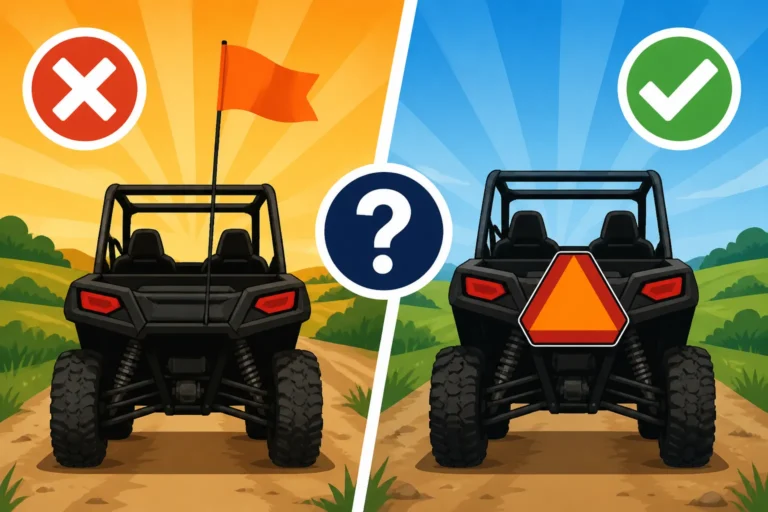
- Safety Equipment: When operating a UTV/ROV on a public road for agricultural use, the machine should ideally have working headlights, taillights, brake lights, and turn signals, even if not explicitly mandated for all agricultural use under this specific exemption, it's a strong recommendation for safety and to avoid any ambiguity with law enforcement. The machine also needs a visible orange flag, typically at least seven feet high from the ground, for increased visibility. This becomes particularly important on roads with higher speeds or limited visibility.
- Operator License: The operator of a UTV/ROV on a public road, even for agricultural use, should hold a valid operator's (driver's) license. This is a crucial difference from some ATV allowances.
- Speed Limits: While not always explicitly stated, common sense dictates that the UTV should be operated at a safe speed, generally not exceeding 30 mph or the posted speed limit, whichever is lower, to ensure the safety of both the operator and other road users.
- Insurance: While Missouri doesn't generally mandate insurance for off-road vehicles, operating on public roads, even for farm use, makes having liability insurance highly advisable. Should an accident occur, you'll be glad you're covered.
What About the 3-Mile Rule and City/County Permits?
You might have heard about Missouri's "3-mile rule" or special city/county permits for UTVs. These are primarily for recreational or general transportation use, not specifically tied to agricultural exemptions, though they can certainly apply to a farmer making a quick trip into town. The "3-mile rule" allows UTVs/ROVs to operate on public roads within a 3-mile radius of the operator's home, provided the local municipality has passed an ordinance allowing it and the machine meets certain safety requirements (e.g., lights, mirrors, safety flag). This rule is separate from the agricultural exemption, which applies specifically to farm-related travel and often without the need for a local permit.
If you are just going from your house to a neighbor's farm for some help, and that neighbor is within three miles, you could potentially use the [Missouri's 3-Mile Rule for Side-by-Sides] if your local jurisdiction allows it. However, for strictly agricultural tasks, the broader "agricultural highway exception" generally covers your bases from sunrise to sunset.
Here's a quick comparison of general rules for agricultural road use:
| Feature | ATV (Agricultural Road Use) | UTV / ROV (Agricultural Road Use) |
|---|---|---|
| Purpose | Agricultural operations only | Agricultural operations only |
| Operating Hours | Sunrise to sunset | Sunrise to sunset |
| Operator's License | Not explicitly required by state statute for agricultural use, but good practice. | Valid operator's (driver's) license recommended / often expected. |
| State Decal/Reg. | Not required for this specific agricultural road use. | Not required for this specific agricultural road use. |
| Crossing Public Roads | Yes, at 90 degrees, yield to traffic. | Yes, at 90 degrees, yield to traffic. |
| Road Travel | Yes, for short distances related to farm work. | Yes, for short distances related to farm work. |
| Safety Flag | Not explicitly mandated, but highly recommended for visibility. | Highly recommended for visibility (often 7 ft high). |
| Lights | Not explicitly mandated, but highly recommended for visibility. | Headlights, taillights, brake lights recommended. |
| Seatbelts/Roll Cage | N/A (straddle seat design) | Yes, if equipped, must be used. |
| Local Permits | Not required for state agricultural exemption. | Not required for state agricultural exemption. |
Note: Always verify local ordinances as cities and counties may have additional rules or restrictions, even on roads that feel rural.
Navigating the Gray Areas: Private vs. Public and Safety Considerations
The distinction between a truly private farm lane and a public road can sometimes be a blurry one, especially in areas with very low traffic or poorly maintained county roads. When in doubt, it’s always best to err on the side of caution and assume you are on a public road and follow those regulations.
Verifying Road Status
How do you know if that lane leading to your back forty is truly private or a public road?
- County Maps: Check with your county recorder's office or highway department. They maintain maps showing all public roads. If it’s on their map, it's public.
- Maintenance: Who maintains the road? If the county occasionally grades it, adds gravel, or clears snow, it's almost certainly public.
- Easements/Access: Does the public have a legal right of way to use the road, even if they rarely do? This could be a public easement that makes it a public thoroughfare.
If you’re unclear, contacting your local county commissioner or sheriff’s department for clarification is a good first step. They can provide definitive answers for your specific location, potentially saving you a future headache.
Safety First, Always
Regardless of whether you're on a private farm lane or a public road under the agricultural exemption, safety should always be your top priority. These machines are powerful and can be unforgiving if not operated responsibly.
- Visibility: When on any public road, make yourself as visible as possible. Wear bright colors, use your headlights and taillights if equipped, and consider adding an orange safety flag, especially if your machine is small and could be hidden by dips or hills. Adding extra lighting or visibility accessories, like those found at SuperATV, can significantly enhance safety, especially during dusk or dawn operations.
- Slow Down: Public roads, even quiet farm lanes, can have unexpected obstacles, other vehicles, or livestock. Reduce your speed, especially around blind curves or hills.
- Passengers: While some UTVs are designed for multiple passengers with proper seating and seatbelts, ATVs generally are not. Most ATVs are single-rider machines, and carrying a passenger on a public road is usually prohibited and incredibly dangerous. Be sure to check [Missouri Passenger Rules on an ATV] and [Missouri Rules for a Passenger in a UTV] to ensure you're compliant and safe.
- Helmets: While Missouri does not require helmets for adults operating ATVs on private land or during agricultural road use, riders under the age of 18 are required to wear helmets. However, wearing a helmet is always a smart choice, regardless of age or legal requirement, as it offers crucial protection in an accident. You can learn more about [Missouri Helmet Law for Riders Under 18].
- Road Conditions: Farm lanes, whether private or public, can be rough, muddy, or dusty. Adapt your driving to these conditions. After heavy rains, some lanes might be impassable or dangerously slick. Always check the conditions before you head out. [Riding After a Week of Ozark Rain] has some useful tips.
Using your ATV or UTV for farm work is a practical and efficient way to manage your property, and Missouri law recognizes this utility. By understanding the distinctions between private and public roads, and adhering to the specific agricultural exemptions, you can confidently and legally use your machines to keep your farm running smoothly. Don’t just assume; know the rules.
Disclaimer
This article is for general informational purposes only and does not constitute professional advice. Laws, prices and regulations vary by location and change over time. Consult a qualified professional for guidance on your specific situation.