Does a City Permit Work in the Next Town?
It’s a common frustration for UTV owners in Missouri: you’ve gone through all the effort to get a special permit to ride your side-by-side on the streets in your hometown, enjoying the convenience and fun of cruising to the store or a friend’s house. But then you think about venturing just across the city limits into the next town over. Does that hard-won permit still apply? Can you keep rolling, or do you suddenly become a scofflaw just by crossing an invisible line? This is a question many riders grapple with, and unfortunately, the answer often isn’t as simple or convenient as we’d like. This guide will dive deep into Missouri's local UTV and ATV road regulations, explaining why your city permit usually stays put within its own boundaries, and what you can do to navigate the complex world of multi-town riding.
The Patchwork of Local Permits in Missouri
Navigating the rules for riding ATVs and UTVs on public roads in Missouri can feel like deciphering a riddle written by a dozen different authors. Unlike states with uniform statewide regulations, Missouri has taken a different approach, creating a dynamic and often confusing landscape where local jurisdictions hold a significant amount of power. This decentralized system is the very reason why your permit from one town rarely applies to its neighbor.
Why Local Rules Exist
Missouri's state laws are generally quite restrictive when it comes to operating off-road vehicles on public roads. Historically, ATVs and UTVs were seen strictly as off-highway machines, meant for trails, private land, or farm work, not for running errands downtown. This foundational stance from the state created a significant void for residents who wanted to use their machines for practical transportation or recreational cruising on local streets. Instead of implementing a sweeping statewide solution, the state effectively "delegated" the decision-making process to local governments.
What this means in practice is that the state doesn't prohibit cities and counties from allowing these vehicles on their roads; it simply doesn't create a broad allowance for them. This legislative framework gives individual municipalities and county commissions the flexibility to create their own ordinances to address the specific needs and desires of their communities. For example, while the state does have a specific [Missouri's 3-Mile Rule for Side-by-Sides] that allows certain recreational off-highway vehicles (ROVs) to operate within a limited radius of an operator’s residence under specific conditions, many cities have gone further, crafting ordinances that permit broader UTV and even ATV use, often requiring a local permit to do so. This local control is why you'll find such varied rules across the state, from towns that fully embrace UTVs on their streets to those that maintain a strict ban.
The Autonomy of Missouri Cities and Counties
The core of the issue lies in the concept of local autonomy. Each incorporated city and each county in Missouri operates as its own governmental entity, with the power to enact laws and ordinances specific to its jurisdiction. Think of it like a series of distinct properties, each with its own set of house rules. What's perfectly acceptable in one city, like [Riding Lake Ozark's Streets], might be strictly forbidden just a few miles down the road in another.
This autonomy means that a city council in one town might vote to allow UTVs on most city streets, setting specific hours of operation, speed limits, and equipment requirements. Meanwhile, the neighboring town's council might decide to maintain a ban, or perhaps only allow them on certain low-traffic roads. These decisions are often driven by local concerns, such as traffic congestion, road safety, population density, and even the preferences of local residents and law enforcement. The result is a veritable patchwork quilt of regulations, where boundaries are not just geographical but also legal. This can be incredibly frustrating for riders who live near a city limit and just want to pop over to the next town for gas or a bite to eat, only to discover their permit is meaningless there.
The Standard City Permit: What It Covers
When a Missouri city or county decides to permit the use of ATVs or UTVs on its public roads, it typically establishes a local ordinance detailing the requirements for operation and often institutes a permit system. This permit serves as official permission from that specific local government for you to operate your off-highway vehicle on their designated streets. These permits are usually issued by the local police department, city clerk's office, or sheriff's office. For instance, you might find yourself [Getting a Road Permit From a Police Department] in one town, and then applying at a different office in another.
A standard city permit will generally require a few key things: an application form, a permit fee (which can vary widely; see [Missouri Special Permit Cost for ATVs]), proof of vehicle ownership, and often proof of liability insurance. Beyond that, the ordinance will typically specify equipment requirements for your machine, which commonly include working headlights and taillights, brake lights, a horn, rearview mirrors, and sometimes a brightly colored safety flag. The operator will almost certainly need a valid driver's license, often an [An Operator's or Chauffeur's License in Missouri]. These permits are granted for use within the corporate limits of the issuing city or the boundaries of the issuing county. They are a local agreement, a contract if you will, between you and that specific municipality, outlining the conditions under which you can operate your machine on their public ways. It's a localized green light, not a universal one.
Navigating Borders: Does Your Permit Travel?
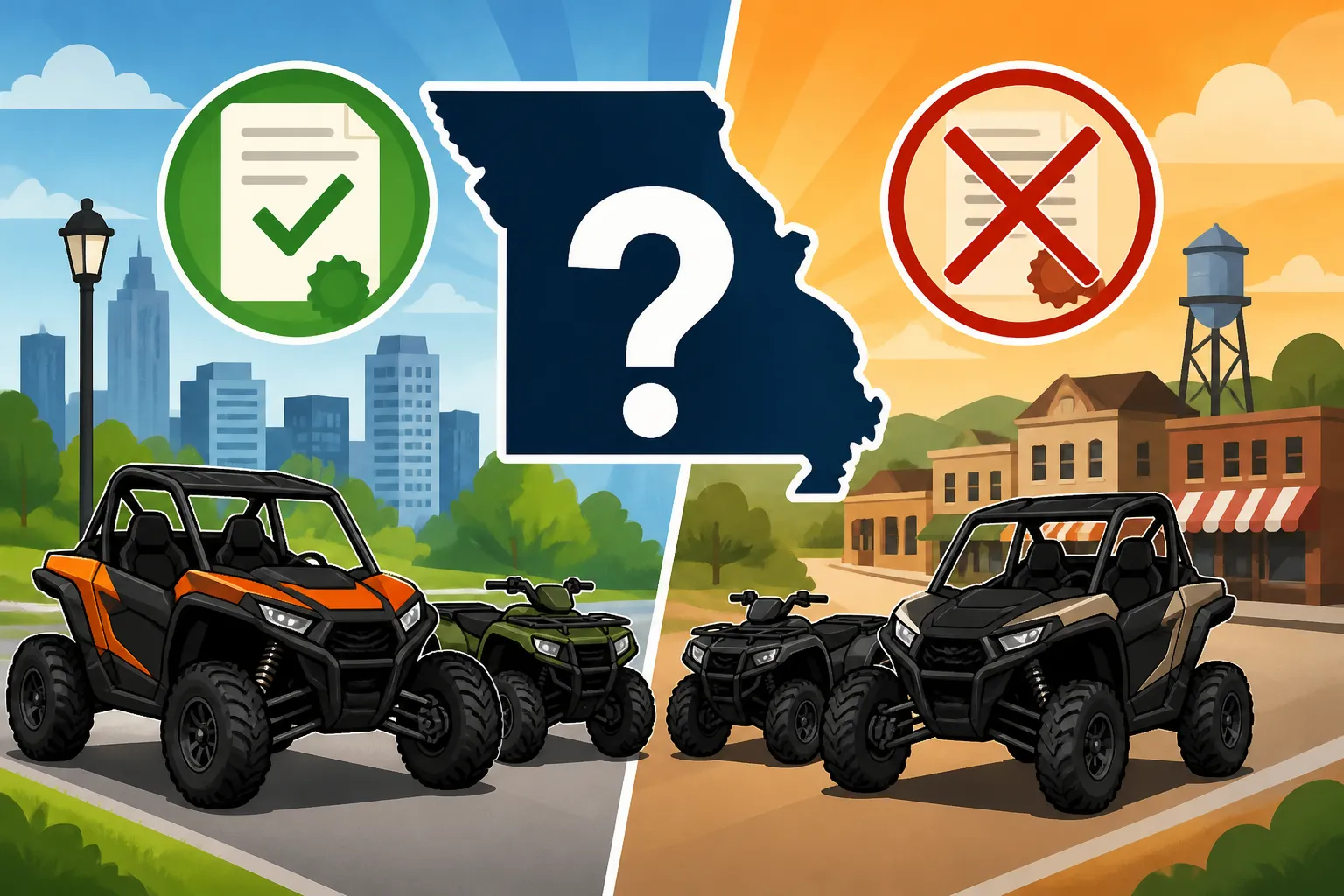
This is the burning question for many Missouri riders, and unfortunately, the straightforward answer, in most cases, is a resounding "no." The convenience of seamlessly transitioning from one town's streets to another's with a single permit is largely a fantasy born of wishful thinking rather than legal reality.
The Fundamental "No" (Mostly)
Let's cut right to the chase: generally speaking, a permit issued by one Missouri city or county for ATV or UTV road use does not automatically grant you permission to ride on the public roads of a neighboring city or county. Each local government is an independent entity, and the ordinances it creates, along with the permits it issues, are valid only within its own jurisdictional boundaries. When you obtain a permit from, say, the city of Harrisonville, that permit signifies that you are authorized to operate your UTV on Harrisonville's streets, subject to Harrisonville's specific rules. It doesn't mean you can cruise into the next town over, like Peculiar or Garden City, and expect the same privileges.
Think of it like a parking permit for a specific college campus or a fishing license for a particular state. They are localized permissions that don't magically extend their authority beyond their defined scope. Crossing a city limit sign often means you're entering a new legal jurisdiction with its own set of rules, and without a specific permit from that new jurisdiction, or without meeting a broader state exception like the 3-mile rule (which we'll discuss next), you could quickly find yourself facing [Missouri Fines for Illegal ATV Road Use]. The core reason is that the permit money often stays local (see [Why the Permit Money Stays Local]), and each city wants to maintain control over its traffic and safety regulations.
Inter-Jurisdictional Agreements (Rare but Possible)
While it's not the norm, it is theoretically possible for two or more neighboring cities or counties in Missouri to enter into inter-jurisdictional agreements to recognize each other's ATV/UTV road permits. This would involve a formal understanding, usually enacted through reciprocal ordinances, where City A agrees to honor City B's permits, and vice-versa. However, such agreements are exceedingly rare.
Why are they so uncommon? For starters, they require legislative action from all involved parties, meaning multiple city councils or county commissions would need to vote on and approve the terms. This can be a complex and time-consuming process, involving discussions about shared responsibilities, enforcement logistics, and potential liability issues. Furthermore, each jurisdiction might have slightly different equipment requirements, hours of operation, or permit fees, making standardization difficult. It’s far simpler for cities to manage their own permit systems independently than to coordinate a multi-jurisdictional reciprocity agreement. So, while the idea of a universal permit might sound appealing, don't hold your breath waiting for one to materialize across town lines. You're much more likely to encounter [Missouri Cities That Allow UTVs on Streets] individually than a network of them cooperating.
The 3-Mile Rule vs. Local Ordinances
It's crucial to understand the distinction between Missouri's statewide "3-mile rule" for certain recreational off-highway vehicles (ROVs) and local city or county permits. The state's [Missouri's 3-Mile Rule for Side-by-Sides] allows ROVs (which are side-by-sides generally defined by specific width and dry weight limits, and designed to carry passengers side-by-side) to operate on roads within a 3-mile radius of the operator's residence, for specific purposes like travel to and from service, gas, or other errands. This is a state law, not a local permit, and it applies statewide where not superseded by stricter local ordinances.
However, many local ordinances go beyond or operate in conjunction with this state rule. For example, a city might allow all UTVs (not just those that fit the specific ROV definition, which can be narrower than many popular models often accessorized with SuperATV components) to operate on its streets, for more general recreational or transportation purposes, provided they have a local permit. The 3-mile rule is limited in its scope (only ROVs, specific purposes, and a tight geographical radius), while a city permit can open up a wider range of roads for a broader definition of machines, for more general use, but only within that specific city's limits. It's vital for riders to know which rule they are operating under, as they are not interchangeable. A city permit might allow you to ride more freely within that city, but it doesn't extend the 3-mile state rule into the next town, nor does the 3-mile rule replace the need for a local permit if a city requires one for broader use.
Practical Strategies for Multi-Town Riding
Given the complex and localized nature of Missouri's ATV and UTV road rules, riders who wish to venture beyond their immediate community need a strategic approach. It's not about finding loopholes, but rather understanding and adhering to the specific regulations of each area you plan to traverse.
Researching Each Jurisdiction
This is, without a doubt, the single most critical step you must take before even contemplating riding your UTV or ATV into a neighboring town. You simply cannot assume that what is legal in your town is also legal next door. Every city and county in Missouri has the right to set its own rules, and those rules can vary wildly. While [Missouri Counties That Allow ATVs on Roads] are becoming more common, the specific terms will differ.
Before you roll across that city limit sign, take the time to do your homework. Start by checking the official website of the city or county you plan to visit. Look for sections on city ordinances, public works, or police department information. Many jurisdictions will have their specific UTV/ATV ordinances posted online, detailing everything from permit requirements and fees to required safety equipment and permitted hours of operation. If online information is scarce or unclear, don't hesitate to call the city clerk's office or the local police department (non-emergency line, of course). They are the ultimate authorities on what is permitted within their jurisdiction. Relying on word-of-mouth or outdated information from social media can lead to costly tickets and potential headaches. For example, the specific requirements of [Harrisonville's Police Department Permit] might be different from those in a neighboring rural county.
Here's a quick checklist of things to look for when researching a new jurisdiction:
| Feature | What to Look For |
|---|---|
| Permit Requirement | Is a local permit required to operate on public streets? What is the application process? |
| Permit Cost | What is the fee for the permit? Is it annual, bi-annual, or a one-time fee? |
| Eligibility | Are all ATVs/UTVs allowed, or only specific types (e.g., ROVs, machines under a certain width/weight)? Is there an age requirement for the operator? |
| Required Equipment | What safety features are mandatory? (e.g., headlights, taillights, brake lights, turn signals, horn, mirrors, safety flag). Many riders use parts from SuperATV to ensure their machines meet these diverse local requirements, which often exceed factory standards. |
| Operating Hours | Are there restrictions on when you can operate (e.g., daylight hours only, certain hours)? |
| Permitted Roads/Zones | Can you ride on all city/county roads, or only specific ones? Are state highways prohibited? Are there "no-go" zones? |
| Insurance | Is proof of liability insurance required for the permit? |
| Driver's License | Is a valid driver's license (e.g., operator's or chauffeur's) required? |
Getting Multiple Permits
If you've done your research and found that a neighboring city or county also allows ATVs or UTVs on its streets, but requires its own permit, then your only legal recourse for multi-town riding is to obtain a separate permit from each jurisdiction. This means navigating potentially different application processes, paying additional fees, and possibly outfitting your machine to meet varied equipment standards.
For instance, if you live in a town that issues its own permit and you frequently visit a friend in the next town over, and that town also has an ordinance, you would need two distinct permits. You'd carry your hometown permit while riding within its limits and then, upon entering the neighboring town, you'd need to have their permit ready to show local law enforcement. It's a bit like buying multiple fishing licenses if you plan to fish in different states; each jurisdiction demands its own specific authorization. While it can be a hassle, it's the only way to ensure you're riding legally and avoiding potential fines or impoundment of your machine.
Considering Trailers for Longer Journeys
For longer trips, or if you plan to visit multiple towns with vastly different or uncertain regulations, trailering your ATV or UTV is often the most practical and stress-free solution. Instead of trying to piece together a complex legal route through several jurisdictions, load your machine onto a trailer, tow it to your desired destination (or the nearest point where riding is permitted), and then unload to enjoy your ride.
This approach bypasses the headache of conflicting local ordinances entirely. It's particularly useful if you're heading to a specific riding area or a distant town that has clear, UTV-friendly rules, but the towns in between do not. For example, if you're driving to a designated off-road park like [St. Joe State Park's Sand Flats in Missouri], it's almost always easier and safer to trailer your machine rather than attempting to ride it on public roads all the way there, navigating numerous city and county limits. Trailering ensures you remain compliant with all laws, reduces wear and tear on your machine, and allows you to focus on the enjoyment of riding rather than constantly worrying about the next town's regulations.
What to Do When a City's Rules Are Unclear
Despite your best efforts, sometimes the ordinances or general information regarding ATV and UTV road use in a particular Missouri city or county can be ambiguous or difficult to find. In these situations, guessing or assuming is the riskiest path. Taking proactive steps to clarify the rules is crucial to avoid legal trouble.
Contacting Local Law Enforcement
When you find yourself scratching your head over local UTV or ATV regulations, the most reliable source of information is always the authority responsible for enforcing those rules: the local law enforcement agency. Pick up the phone and call the non-emergency line of the city police department or the county sheriff's office in the jurisdiction you're interested in.
When you call, be clear and concise. State that you own an ATV or UTV (specify which, as definitions can matter), and you're inquiring about the legalities of operating it on their public roads. Ask specific questions: Is a permit required? What are the equipment requirements? Are there any restricted roads or areas? Are there specific hours of operation? While you might occasionally get a dispatcher who isn't fully up to speed on every ordinance, they can usually direct you to the correct department or even transfer you to an officer who specializes in traffic or local regulations. Getting information directly from the source can save you a lot of grief and prevent you from unknowingly violating a local law.
Checking City Clerk Records
For the most official and comprehensive understanding of a city or county's regulations, delving into the records held by the city clerk or county recorder's office is an excellent strategy. Many municipalities now publish their full code of ordinances online, often searchable by keywords. Look for terms like "off-road vehicles," "utility vehicles," "recreational off-highway vehicles," "motorized vehicles," or even "traffic code."
Reading the actual text of the ordinance can provide specific details that might not be easily summarized elsewhere. This includes precise definitions of what constitutes an ATV or UTV in their eyes, the exact equipment requirements, the process for obtaining a permit, and any specific fines for non-compliance. Understanding the nuances of the written law is essential, as even small differences in wording can have significant implications for how and where you can ride. This is often where you'll find the detailed breakdown of requirements, such as whether a specific permit applies only to certain sized machines or if additional safety features like those offered by SuperATV are explicitly mandated.
Riding Responsibly and Safely
Regardless of whether you have a permit, are operating under the state's 3-mile rule, or are simply crossing a county road that permits UTVs, responsible and safe riding should always be your top priority. Operating an off-highway vehicle on public roads, even when permitted, introduces a new set of risks and responsibilities compared to riding on trails.
Always obey posted speed limits, which are often lower for UTVs on city streets than for cars. Yield to other traffic, pedestrians, and cyclists. Use proper hand signals or turn signals if your machine is equipped. Ensure your machine is in good working order, with properly functioning brakes, lights, and tires. Many riders choose to go beyond the minimum requirements, adding accessories like brighter LED lights, enhanced mirrors, or a louder horn from SuperATV to improve their visibility and safety in traffic. Remember, even with a permit, a UTV on a paved road will always attract more attention than on a trail, and local law enforcement will be looking for safe and compliant operation. Acting as a courteous and responsible driver not only keeps you safe but also helps foster a positive image for the entire off-road community, potentially influencing future local decisions about road access.
Disclaimer
This article is for general informational purposes only and does not constitute professional advice. Laws, prices and regulations vary by location and change over time. Consult a qualified professional for guidance on your specific situation.