Missouri’s Agricultural Highway Exception
It's a common dilemma for anyone living and working on the land in Missouri: you rely on your ATV or UTV daily to get from the barn to the back forty, check fences along the county road, or haul feed to cattle in a distant pasture. But then the fear creeps in – is it actually legal to take your off-road machine onto a public road, even for a short hop? The confusion is real, and the thought of getting pulled over for simply doing your farm chores can be incredibly frustrating. This comprehensive guide is here to untangle Missouri's specific "agricultural highway exception," giving you a crystal-clear understanding of when, where, and how your essential farm machine can legally travel on public roads without a full street-legal conversion or a city-issued permit.
Understanding Missouri's Agricultural Highway Exception
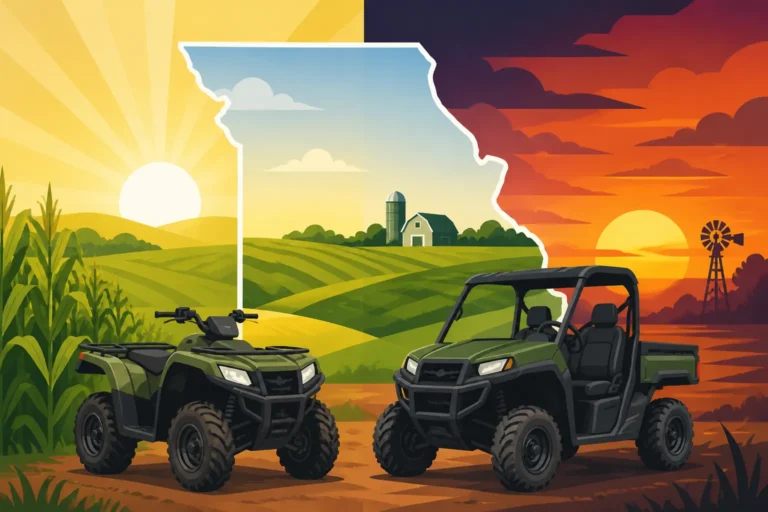
Missouri understands that ATVs and UTVs aren't just for recreation; they are vital tools for farmers, ranchers, and rural landowners. Because of this, the state has carved out a specific exception in its vehicle codes to allow these machines on public roads for bona fide agricultural purposes. It's not a blanket pass to go joyriding, but it is a recognition of the practical necessities of farm life. This exception means you don't need to go through the full titling and registration process for road use, nor do you need a special decal for operating on trails if your machine's primary function is agricultural work, though a title is still typically required for ownership proof.
What Defines "Agricultural Purpose" in Missouri?
When we talk about "agricultural purpose," it’s easy to immediately think of large-scale crop farming or massive cattle operations. However, Missouri's definition is often broader than just that. It encompasses a wide range of activities that are integral to farming, ranching, and even smaller, personal land management if it's genuinely agricultural in nature. This isn't just about planting corn or moving livestock; it extends to the daily, routine tasks that keep a farm running smoothly.
For instance, an "agricultural purpose" could mean hauling a small trailer full of fence posts across a county road to repair a pasture fence that borders a neighbor's property. It might involve carrying tools or supplies to a remote field where equipment needs maintenance, or checking on irrigation systems that span multiple parcels of land separated by a public thoroughfare. It also includes transporting feed or water to animals located in different sections of a farm, especially when those sections are divided by roads. The key here is that the activity must be directly related to the operation or maintenance of the farm or agricultural land. Simply driving your machine to a friend's house for coffee, even if they're also a farmer, wouldn't typically fall under this exception unless there's a specific, verifiable agricultural task involved in that journey. It's always about the intent of the trip.
Who Qualifies Under This Specific Exemption?
So, who exactly gets to take advantage of this exception? It's not for just anyone who owns an ATV or UTV. The intent is clearly focused on those actively involved in agricultural production and land management. Typically, this includes bona fide farmers, ranchers, and their employees who are using the machine as part of their job. If you own acreage and use your ATV to manage a small herd of cattle or maintain extensive pastures, you would generally qualify.
This exemption isn't necessarily limited to commercial, for-profit agricultural operations either. A landowner with a significant parcel that they manage for hay production, even if not selling it commercially, or someone maintaining a large garden plot where a UTV aids in tilling and hauling, could also fall under the spirit of the exception. The critical element is that the machine is an integral part of the agricultural process and not merely being used for recreational purposes on land that happens to be zoned agricultural. For instance, if you're taking your ATV to deer camp, even if the camp is on your farm property, that's recreational. If you're using it to spread mineral blocks for your cattle on that same property, that's agricultural. [Does a Pasture-Only Quad Still Need a Decal?] is a good question to ponder here; if it's exclusively agricultural and never on designated ORV trails, the decal might not be its primary need, but its road use needs to conform to this specific exception.
Navigating Public Roads: The How-Tos of the Exception
Understanding that you can use your farm machine on public roads for agricultural purposes is just the first step. The next is knowing how to do it legally and safely. There are specific guidelines around what kinds of roads you can use, and even when you can use them, which are crucial to avoid any misunderstandings with law enforcement. This isn't a free-for-all; it's a narrowly defined privilege that demands careful adherence to the rules.
Permitted Roadways and Distance Limitations
Under Missouri's agricultural highway exception, you're generally allowed to operate your ATV or UTV on state and county roads. This is invaluable for farmers who often have land split by public roads or need to access fields that are a short distance away from their main farmstead. However, it's vital to understand that this isn't an invitation for extended travel. The law intends for these movements to be "for agricultural purposes," which inherently implies short distances directly related to the movement between farm properties or accessing portions of a farm.
You might be crossing a two-lane state route to get from your barn to a field on the other side, or driving a mile or two down a gravel county road to check on a different pasture. What the law doesn't permit is using the agricultural exception as a loophole to drive your UTV five miles into town for non-farm errands, even if you are a farmer. The trip must have a clear, direct, and verifiable agricultural purpose. While the statute doesn't specify an exact mileage limit, phrases like "short distances" or "between portions of a farm" are commonly interpreted. Therefore, if you're questioned, you need to be able to articulate the specific agricultural reason for your presence on that road. This is why [Missouri's Agricultural Highway Exception] is so important—it's not a free pass.
Time-of-Day Restrictions for Farm Machines
One of the most significant restrictions for agricultural machines on public roads, especially those not fully equipped with street-legal lighting, often revolves around the time of day. Generally, the agricultural highway exception is understood to permit operation "from sunrise to sunset." This rule is rooted in safety and visibility. ATVs and UTVs, particularly older models or those not outfitted for road travel, often lack the comprehensive lighting systems that make them highly visible in low-light conditions.
The "sunrise to sunset" guideline means you should avoid operating your farm machine on public roads during nighttime hours, including twilight periods just before dawn or after dusk. While an emergency might arise where you have to move a machine in the dark, that's usually considered an exceptional circumstance and not the rule. It’s always best to plan your movements during daylight hours to ensure maximum visibility for yourself and other drivers sharing the road. This also aligns with [Missouri Agricultural Use From Sunrise to Sunset] which emphasizes these time constraints for agricultural vehicles that may not have full lighting. If you anticipate needing to move your machine outside these hours, even for agricultural purposes, you might need to ensure it has adequate, legally compliant lighting and possibly an SMV sign, or consider trailering it.
Equipping Your ATV or UTV for Agricultural Road Use
Even with the agricultural highway exception, safety should always be your top priority when taking your ATV or UTV onto public roads. While the exception may waive some of the standard registration and titling requirements for road use, it doesn't waive common sense or the need for basic safety features. Operating any vehicle on a public road, regardless of its primary purpose, comes with inherent risks, and it’s your responsibility to minimize those risks.
Essential Safety Equipment Mandates
While the agricultural exception means you won't need full street-legal equipment like turn signals, a horn, and rearview mirrors in the same way a road-registered vehicle would, there are still critical safety features you absolutely should have. First and foremost, functional brakes, headlights, and taillights are non-negotiable. Even if you're only operating during the day, headlights can significantly improve your visibility to oncoming traffic, and taillights are crucial if there's any dust, fog, or if you accidentally extend your trip into dusk.
A slow-moving vehicle (SMV) sign is another absolute must-have. This distinctive orange triangle alerts other drivers that your machine will be traveling at speeds significantly lower than typical road traffic, giving them ample warning to slow down and pass safely. Mounting this sign prominently on the rear of your ATV or UTV can prevent dangerous close calls. While [Missouri's 7-Foot Safety Flag] is often associated with other forms of ORV road use or state park riding, a flag can also enhance visibility, especially in hilly terrain or when coming over crests where your machine might otherwise be obscured. Think about how you would want to be seen by a motorist rounding a bend, and equip your machine accordingly.
Identifying Your Machine for Law Enforcement
When operating an ATV or UTV under the agricultural exception, you won't typically have a license plate or a road registration sticker. However, this doesn't mean your machine is anonymous. Law enforcement officers will still need to verify ownership and ensure the machine isn't stolen. This is where your Vehicle Identification Number (VIN) comes into play. You should always know where your VIN is located on your machine and be able to present proof of ownership.
Carrying your ATV's or UTV's title or a copy of it, along with your personal identification, is highly recommended. While you won't be paying the typical Missouri ATV title cost or annual registration fees for road use under this specific exception, the title is proof that the machine legitimately belongs to you. If a law enforcement officer stops you, being able to clearly articulate the agricultural purpose of your trip and immediately provide proof of ownership for the machine can go a long way in resolving the situation quickly and without incident. Understanding [What Missouri Counts as an ATV] is also helpful, as it defines the machine type you're operating.
Avoiding Pitfalls: When Agricultural Use Crosses the Line
The agricultural highway exception is a valuable tool for Missouri's rural community, but it's not without its boundaries. Misinterpreting or abusing this exception can lead to fines, citations, and even more severe consequences. It's imperative to distinguish between legitimate farm-related travel and incidental personal use, as that distinction is what the law hinges upon. A casual misunderstanding could quickly turn into a legal headache.
The Fine Line Between Farm Work and Personal Errands
This is perhaps the trickiest part of the agricultural exception. The law is designed to allow movement for agricultural purposes. It is not designed to turn your UTV into a secondary commuter vehicle for personal errands, even if those errands are minor. Let's imagine you're a farmer needing a specific bolt for a tractor repair. Driving your UTV to the nearest hardware store might feel like it falls under an agricultural purpose. However, if that hardware store is five miles away, through a town, and you pick up groceries or personal items while you're there, an officer might view the primary purpose of the trip as personal, not agricultural.
The key is the primary intent and the directness of the agricultural need. If you're moving hay bales from one field to another across a county road, that's clearly agricultural. If you're using the UTV to drive your kids to the school bus stop down the road, even if you also happen to be driving past a field you own, that’s not agricultural. The "appearance" also matters. If you're hauling tools and feed, it looks like farm work. If you're hauling a cooler and fishing poles, it does not. Always err on the side of caution and consider if your trip's primary, undeniable purpose is directly related to your farm operations. Remember, [Does a Pasture-Only Quad Still Need a Decal?] is about its primary use—and road use must adhere to the ag exception’s purpose.
Consequences of Misinterpreting the Exception
Stepping over that fine line can lead to more than just a stern warning. If law enforcement determines that your use of an ATV or UTV on a public road does not fall under the agricultural highway exception, you could face a range of penalties. The most immediate consequence is often a citation for operating an unregistered or uninsured vehicle on a public roadway. This can come with significant fines and could potentially lead to your machine being impounded, causing considerable inconvenience and expense.
Beyond the immediate legal penalties, there can be serious insurance implications. Most ATV and UTV insurance policies are designed for off-road use or for machines properly registered for street use. If you have an accident on a public road while operating outside the scope of the agricultural exception, your insurance company might deny coverage, leaving you liable for damages, injuries, and legal fees. This risk alone should be enough to make you carefully consider every trip. [Missouri Fines for Illegal ATV Road Use] can add up quickly, especially if additional charges like reckless operation are tacked on. It's far better to ensure your travel genuinely fits the exception than to face these costly repercussions.
Comparing Agricultural Use to Other Missouri Road Rules
Missouri has a few different provisions that allow off-road vehicles onto public roads, and it's easy to get them confused. Understanding the agricultural highway exception requires knowing how it stands apart from other rules, like the 3-mile rule for ROVs or local city and county ordinances. Each rule serves a distinct purpose and has its own set of requirements and limitations. Thinking they are all interchangeable can lead to problems.
How It Differs from Missouri's 3-Mile ROV Rule
One of the most common sources of confusion for Missouri landowners is the difference between the agricultural highway exception and the "3-mile rule" for Recreational Off-Highway Vehicles (ROVs). These are distinctly separate provisions. The 3-mile rule (or often, the three-mile radius from your residence) is specific to ROVs – think side-by-sides – and comes with a very stringent set of requirements. For an ROV to qualify under the 3-mile rule, it must typically have an operator with a valid driver's license, proof of insurance, a seven-foot safety flag, headlights, taillights, seat belts, and a roll bar. It's also generally restricted to a three-mile radius from your residence, or specific areas where local ordinances permit it.
The agricultural exception, in contrast, applies to both ATVs and UTVs (which often fall under the ROV category for other purposes) and is driven by the purpose of the trip, not a strict distance from your home or specific equipment mandates. While safety equipment is advised for agricultural use, the full suite required for the 3-mile rule isn't necessarily mandated. Crucially, the agricultural exception isn't tied to your residence's location in the same way; it's tied to your farm property's needs. This means you could use the ag exception to drive your ATV two miles down the road to a separate field, even if that's five miles from your house. [Missouri's 3-Mile Rule for Side-by-Sides] and [Why the 3-Mile Rule Is ROVs Only] emphasize these critical distinctions and highlight why you can't just assume one rule covers all scenarios.
Local City and County Ordinances vs. State Agricultural Use
Beyond the 3-mile rule, many cities and counties across Missouri have adopted their own local ordinances to permit the use of UTVs (and sometimes ATVs) on their specific streets. These ordinances are often designed to allow recreational use or general transportation within city limits, often requiring a local permit, specific safety equipment, and sometimes proof of insurance and a valid driver's license. For example, some towns in the Lake of the Ozarks region have very specific rules allowing UTVs on their streets.
The key distinction here is that the state's agricultural highway exception generally operates independently of these local ordinances. If you are genuinely using your ATV or UTV for an agricultural purpose, the state exception should generally apply, even if the local municipality doesn't have an ordinance permitting UTVs on its roads, or if you don't meet the requirements of a local permit. The state exception provides a legal framework for farm work that isn't contingent on a city council vote. However, it's always wise to be aware of local rules, as they might affect how local law enforcement interprets your presence on the road. For instance, [A City or County Special Permit in Missouri] is a completely different mechanism from the agricultural exception. You're not typically applying for a city permit to move your cattle, and [Why a City Cannot Set Its Own Permit Price] shows that these local permits are specific to recreational or general use, not agricultural exemptions. [How a City Ordinance Opens a Street to UTVs] outlines a separate legal pathway entirely.
Best Practices for Missouri Farmers on Public Roads
Navigating public roads with your ATV or UTV, even under a legitimate agricultural exception, requires a proactive approach. Being prepared, understanding the nuances, and making smart choices about your machine can save you a lot of hassle and ensure your farm operations run smoothly without unnecessary legal complications. Think of it as a layer of prevention that goes a long way in proving your intent and ensuring safety.
Essential Documentation and Communication with Authorities
The best defense is often a good offense, and that means being prepared. Whenever you operate your ATV or UTV on a public road under the agricultural exception, it’s a good practice to carry essential documentation. This includes your personal identification (driver's license or state ID), proof of ownership for the machine (such as the original title or a copy), and any relevant insurance documents. Even if insurance isn't strictly mandated for this specific type of road use, having proof of general liability coverage for your machine can demonstrate responsibility and provide peace of mind in case of an unforeseen incident.
If you have multiple parcels of land or a complex farm layout, it might even be helpful to carry a simple map outlining your property and the route you're taking, or a brief, written explanation of the agricultural task you're performing. While not legally required, this kind of preparation can quickly diffuse a situation if you're stopped by law enforcement. Being able to calmly and clearly explain your purpose, supported by documentation, shows that you are operating within the spirit and letter of the law. Remember, [A Missouri Bill of Sale for an ATV] is a critical piece of ownership documentation.
Practical Upgrades for Enhanced Safety and Utility
While the agricultural exception doesn't demand a full street-legal setup, enhancing your farm machine with practical upgrades can significantly improve safety and utility when you're on public roads. These aren't necessarily about meeting a specific legal mandate, but about being a responsible operator and protecting yourself and others. For instance, adding additional reflective tape or strips to your UTV can make it far more visible, especially if you're ever caught out near dusk. Functional rearview and side mirrors are also incredibly valuable for monitoring traffic behind you and making safer turns or lane shifts, even on rural roads.
For durable and functional upgrades, many farmers turn to reputable aftermarket brands. SuperATV, for example, offers a range of high-quality accessories that can greatly benefit agricultural users. Installing a robust windshield from SuperATV can protect you from dust, debris, and insects, improving visibility and comfort during those essential trips between fields. Furthermore, SuperATV has excellent mirror kits that provide a much-needed increase in your field of vision, helping you spot other vehicles or livestock more easily. Consider adding a SuperATV horn to your machine for safety, allowing you to alert others when needed. For those who frequently cross dusty gravel roads or navigate varied terrain, upgrading to heavy-duty control arms or A-arms from SuperATV can also enhance the machine's durability and handling, ensuring it stands up to the demands of farm work and occasional road use. These enhancements make your machine safer and more effective, ensuring that your valuable tools from SuperATV are always ready for the job.
Agricultural Highway Exception vs. Other Road Use Provisions in Missouri
To truly grasp the agricultural highway exception, it's crucial to place it in context with other ways ATVs and UTVs might legally find themselves on Missouri roads. The state has several different pathways for off-road vehicles to use public thoroughfares, each with its own set of rules, limitations, and purposes. Understanding these differences can prevent confusion and ensure you're always operating within the correct legal framework.
The Landscape of Missouri ORV Road Use
Missouri's approach to allowing off-road vehicles on public roads is often described as a patchwork, which can be frustrating for owners trying to stay compliant. There isn't one universal rule for every machine or every scenario. Instead, there are specific provisions tailored to different types of machines (ATVs vs. UTVs/ROVs), different purposes (agricultural vs. recreational vs. general transportation), and different locations (state roads vs. local city streets). This complexity is precisely why a clear understanding of each provision, especially the agricultural exception, is so vital. It's not just about what your machine is, but also why you're on the road and where you are.
For instance, an ATV owner wanting to ride trails in a state park will need a specific park permit and follow state park rules, which often include helmet requirements for minors and flag height rules. A UTV owner wanting to drive around a town that has a local ordinance will need to get a local permit, carry insurance, and meet specific equipment requirements laid out by that town. The agricultural exception cuts across these, offering a focused allowance for farm operations on state and county roads, separate from recreational permits or specific ROV highway rules. The lack of a single, overarching "street legal" status for all off-road vehicles in Missouri necessitates this nuanced understanding.
Navigating Different Rules: A Comparative Overview
To help clarify the distinctions, let's look at how the agricultural highway exception compares to other common scenarios where ATVs and UTVs might be found on Missouri roads.
| Feature | Agricultural Highway Exception | Missouri 3-Mile ROV Rule | Local City/County Ordinances (UTVs) |
|---|---|---|---|
| Machine Type | ATVs & UTVs (for agricultural use) | ROVs (Side-by-sides) only | Typically UTVs, some may include ATVs |
| Purpose | Direct agricultural operations (hauling feed, checking fences) | Recreational, general transportation | Recreational, general transportation |
| Location | State & County roads (short distances between properties) | Within 3 miles of residence, or specific city/county areas | Specific city/county streets as designated by ordinance |
| Time Restrictions | Sunrise to Sunset (generally) | None specified by state (local ordinances may vary) | Varies by local ordinance |
| Driver's License | Not explicitly required by state for ag use, but recommended | Required (operator's or chauffeur's) | Varies by local ordinance (often required) |
| Insurance | Recommended (general liability) | Required (proof must be carried) | Varies by local ordinance (often required) |
| Safety Flag | Recommended (SMV sign required) | Required (7 feet high, 30 sq. inches day-glow) | Varies by local ordinance (often required) |
| Head/Tail Lights | Required (functional) | Required | Required |
| Turn Signals/Horn | Not explicitly required by state for ag use, but recommended | Required | Varies by local ordinance (often required) |
| Roll Bar/Seat Belts | N/A for ATVs; UTVs should have as designed | Required | Required (for UTVs/ROVs) |
| Permit/Decal | No specific "road use" permit/decal for ag exception | No state permit; local permit may be required if city allows | Required (local city/county issued) |
| Cost | No specific fee for the exception | No state fee; local permit fee may apply | Varies by locality (permit fees apply) |
This table clearly illustrates that the agricultural exception is a very specific allowance. It doesn't require the same level of street-legal conversion or permits as other road-use scenarios because its intent is solely to facilitate necessary farm work. Trying to use your ATV for general transportation under the guise of the agricultural exception would be a misuse, just as trying to use the 3-mile rule for an ATV would be incorrect, since [Why the 3-Mile Rule Is ROVs Only] applies.
Disclaimer
This article is for general informational purposes only and does not constitute professional advice. Laws, prices and regulations vary by location and change over time. Consult a qualified professional for guidance on your specific situation.