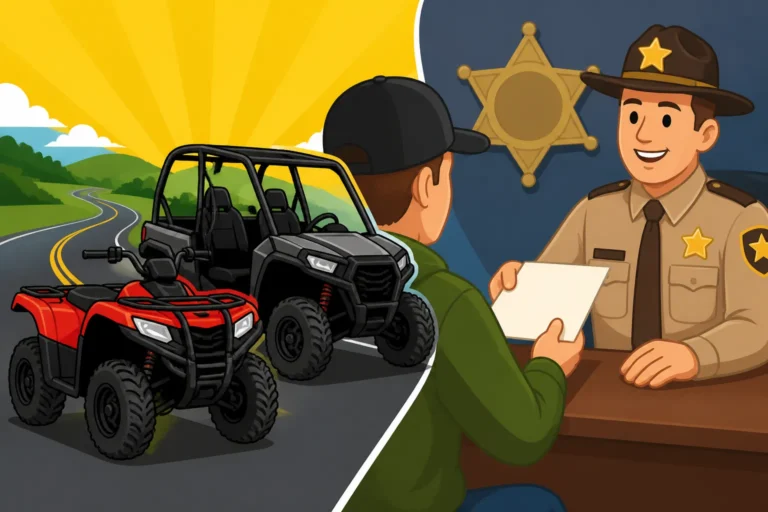
Missouri Driver’s License Rules for ROVs
It can be incredibly confusing trying to figure out what Missouri expects from you when you want to take your Recreational Off-Highway Vehicle (ROV) on public roads. You've invested in a machine that's perfect for trails and work around the property, but navigating the patchwork of state laws and local ordinances to understand driver's license requirements feels like a riddle. This guide will cut through the ambiguity, clearly explaining Missouri's driver's license rules for ROVs and what you need to know before you hit a paved surface.
The Core Rule: Operator's or Chauffeur's License
One of the biggest questions we hear from ROV owners in Missouri is whether they need a special license to drive their side-by-side on a public road. The straightforward answer is that Missouri does not issue a specific "ROV license." Instead, if you're operating an ROV legally on any public road, you are required to hold a valid Missouri operator's license, which is your standard driver's license, or a chauffeur's license. Think of it this way: if it's a vehicle on a public road, the person behind the wheel needs to be a licensed driver.
What Qualifies as an Operator's License?
An operator's license in Missouri is what most people commonly refer to as a regular driver's license. This is the license you obtain from the Department of Revenue that allows you to operate a passenger vehicle on the state's roads. It signifies that you've passed the necessary tests—written, vision, and driving—to demonstrate a basic level of competency and knowledge of traffic laws. When Missouri law refers to an "operator's license" for ROV use on approved public roads, this is exactly what they mean. It’s not some obscure permit; it’s the same license you use to drive your car or truck to the grocery store.
Why No Special ROV License?
The absence of a dedicated ROV license can be a relief for many, but it also sometimes adds to the confusion. Missouri's approach streamlines the process by treating legal ROV road operation under the umbrella of existing motor vehicle licensing laws. This means you don't have to go through an entirely separate application process or take a specialized driving test just for your side-by-side. The state's focus is on ensuring that anyone operating any motor vehicle on public thoroughfares has demonstrated basic driving competence. The assumption is that if you can safely operate a car, you possess the fundamental skills and knowledge to operate an ROV under the specific, limited conditions it's allowed on roads. This makes sense when you consider the relatively narrow circumstances under which ROVs are street legal.
Distinguishing Between ATVs and ROVs for Licensing
This is where many riders get tripped up, and it's a critical distinction in Missouri law. For licensing purposes, and indeed for all road use, Missouri draws a clear line between ATVs (all-terrain vehicles) and ROVs (recreational off-highway vehicles), which include side-by-sides. Generally, ATVs are not permitted on public roads in Missouri, except for very specific, narrow agricultural or emergency uses. Because ATVs are mostly restricted from roads, the question of an operator's license for an ATV on public roads rarely comes up in a legal context, beyond those limited exceptions.
However, ROVs – those machines with a steering wheel, roll bar, and side-by-side seating – have specific provisions in state law and local ordinances that can allow them on certain public roads. It's in these specific scenarios where the operator's license requirement for the driver of the ROV comes into play. If you're pondering [Are ATVs Street Legal in Missouri?], the answer is usually no, but for ROVs, there are exceptions, and with those exceptions comes the need for a valid driver's license. This distinction is crucial because treating an ATV like an ROV on public roads can lead to fines and legal trouble.
When an Operator's License Becomes Essential
So, you've got your standard Missouri driver's license. Great! But when exactly does it become a non-negotiable requirement for ROV use? It's not every time you start your engine. The need for an operator's license is tied directly to when and where your ROV is legally allowed on a public road. These specific situations are outlined in state statutes and amplified by local government actions, creating a defined framework for legal road operation.
Riding Under a City or County Ordinance
Many cities and counties across Missouri have taken the initiative to pass local ordinances that allow ROVs on their streets. This is a common way for communities, especially smaller towns or rural areas, to permit residents to use their side-by-sides for transportation within town limits. However, almost universally, these local ordinances come with a stipulation: the operator must possess a valid driver's license. For example, if you live in a town that has adopted such an ordinance, and you want to drive your ROV to the local hardware store or park, you must have your Missouri operator's license with you. This isn't just a suggestion; it's a legal requirement of the ordinance itself. Some localities may even have additional age requirements beyond the state's minimum age for a driver's license, so it's always critical to check the specific rules of your particular municipality. You might find information on [Missouri Cities That Allow UTVs on Streets] or [Missouri Counties That Allow ATVs on Roads] (which often apply to ROVs in practice) to get a sense of where these ordinances exist.
The 3-Mile Rule and Licensed Operation
Missouri state law includes what's commonly known as the "3-mile rule" for ROVs. This provision allows an ROV operator to drive their machine on a state highway for a distance of up to three miles, specifically for the purpose of gaining access to a designated riding area or their own property. This rule is designed to bridge short gaps between private land or trails and is a state-level exception to the general prohibition of ROVs on highways. Crucially, if you are utilizing this 3-mile rule, you absolutely must hold a valid Missouri operator's or chauffeur's license. This is not a situation where a provisional or learner's permit would suffice; the state expects a fully licensed driver behind the wheel when an ROV is on a state highway, even for a short stretch. This is one of the clearest instances where your standard driver's license is explicitly required by state statute for ROV operation. Understanding [Missouri 3-Mile Rule Explained] is key to navigating this aspect legally.
Agricultural and Industrial Exceptions
Beyond local ordinances and the 3-mile rule, Missouri law also provides specific exceptions for the use of ROVs for agricultural or industrial purposes. These exceptions generally permit ROVs to be operated on public roads for limited distances between fields, properties, or work sites. While these uses are often tied to specific daylight hours and safety equipment, the requirement for an operator's license usually still applies. For instance, if you're driving your side-by-side with a sprayer attached from one field to another across a county road, the law anticipates you, the operator, will have a valid driver's license.
These exceptions are designed for practical, essential work, not recreational joyrides. The intent is that even under these specific circumstances, the person operating the ROV on a public road is a competent, licensed driver who understands and adheres to traffic laws. It's a matter of public safety, ensuring that even vehicles used for legitimate work purposes on the road are under the control of a qualified individual.
Other Requirements for Road-Legal ROV Use
While having the correct driver's license is fundamental when operating an ROV on a public road in Missouri, it's far from the only requirement. Missouri has a layered approach to ROV road legality, meaning your machine itself must also meet certain criteria, and you, as the operator, must adhere to additional rules. Ignoring these other factors, even with a valid license, can lead to citations and penalties.
Insurance and Safety Equipment
Beyond your license, most legal road-use scenarios for ROVs in Missouri will require proof of financial responsibility, typically meaning vehicle insurance. When a local ordinance opens streets to ROVs, it almost always includes a clause mandating liability insurance, similar to what's required for a car. This is to protect all parties in the event of an accident. Furthermore, your ROV must be equipped with essential safety features. This includes seatbelts for all occupants and a roll bar or cage. Many riders consider upgrading their factory safety equipment for enhanced protection. Companies like SuperATV offer robust aftermarket roll cages, harnesses, and other safety accessories that can exceed stock specifications, providing greater peace of mind when venturing onto public thoroughfares. Checking your local ordinance for specific insurance minimums and required safety features is always a good idea. For a deeper dive, consider reviewing [Missouri ATV Insurance Requirement], though remember these typically apply to ROVs in the context of road-legal use.
Vehicle Equipment for Road Use
For an ROV to be considered street-legal under Missouri's specific rules or local ordinances, it must be equipped similarly to other motor vehicles regarding lighting and visibility. This usually means having functional headlights, taillights, brake lights, and turn signals. Your machine will also need a rearview mirror (or mirrors) to ensure proper visibility of traffic behind you. Additionally, state law, particularly for the 3-mile rule, often mandates a brightly colored safety flag mounted on a mast that extends at least seven feet above the ground. This flag, typically blaze orange, significantly improves the ROV's visibility to other motorists, especially on hills or around curves. Many ROV owners will look to brands like SuperATV for high-quality lighting kits, mirrors, and safety flags designed to meet these road-use requirements and enhance overall visibility.
Understanding Local Permits and Rules
Having a driver's license and correctly equipped ROV is a strong start, but it's crucial to remember that state law often delegates the ultimate decision on ROV road use to local jurisdictions. This means that even if you meet all state requirements, you might still need to obtain a special permit from your city or county to legally drive your ROV on their roads. These permits often come with an application fee and may require you to present proof of insurance, a valid driver's license, and verification that your ROV meets all equipment standards.
This patchwork of local rules can be frustrating. You might be able to ride legally in one town but not the next, or a county road might have different regulations than a state highway. Always check with the local police department or county sheriff's office for the most current information regarding permits, speed limits, and specific operational requirements. Ignoring these local nuances, even if you're fully licensed and your machine is equipped, can still result in a ticket. Learning about [Missouri Special Permit Cost for ATVs] (which often applies to ROVs) can help you budget for these additional requirements.
Here's a quick reference table to help clarify the key requirements for road-legal ROV use in Missouri:
| Requirement Category | Specific Element | Detail for ROV Road Use in Missouri |
|---|---|---|
| Operator Licensing | Driver's License | Mandatory: Valid Missouri Operator's or Chauffeur's License. |
| Vehicle Equipment | Headlights & Taillights | Required for visibility, especially after dark. |
| Brake Lights | Required for signaling stops. | |
| Turn Signals | Often required by local ordinances. | |
| Rearview Mirror(s) | Required for visibility of following traffic. | |
| Safety Flag | Required for state highway use (e.g., 3-mile rule), usually 7 feet high. | |
| Vehicle Safety | Seatbelts | Required for all occupants. |
| Roll Bar / Roll Cage | Required (standard on ROVs). | |
| Spark Arrester | Required on public lands, good practice generally. | |
| Operational Rules | Insurance | Mandatory, especially under local ordinances. |
| Local Permits | Often required by cities/counties for road access. | |
| Adherence to Traffic Laws | All standard traffic laws apply (speed limits, stop signs, etc.). | |
| Key Distinction | ATV vs. ROV | Licensing rules primarily apply to ROVs in specific road-legal contexts; ATVs generally cannot be road-legal. |
Navigating the rules for ROV road use in Missouri can feel like a maze, but understanding the driver's license requirements is a crucial first step. Remember, a standard Missouri operator's or chauffeur's license is your ticket to legally operating an ROV on approved public roads, whether under a local ordinance, the state's 3-mile rule, or for specific agricultural/industrial purposes. However, your license is just one piece of the puzzle. Always ensure your ROV is properly equipped with necessary safety features and lighting, and most importantly, confirm and abide by any local permits or specific ordinances in the areas you plan to ride. Being informed and prepared will help you enjoy your ROV safely and legally on Missouri's diverse landscape.
Disclaimer
This article is for general informational purposes only and does not constitute professional advice. Laws, prices and regulations vary by location and change over time. Consult a qualified professional for guidance on your specific situation.