Missouri Rules for Carrying a Firearm on an ATV
For many folks who love hitting the trails or heading out to hunt in Missouri on their ATV or UTV, carrying a firearm is a common consideration. Whether it's for personal protection, target practice, or the deer stand, the rules about having a gun on your quad can feel like a confusing thicket of state laws, local ordinances, and public land regulations. It's easy to worry you might be unknowingly stepping on a legal landmine. This guide aims to clear up that confusion, diving deep into Missouri's firearm laws as they apply to ATV and UTV riders, so you can ride with confidence and keep everything above board.
Understanding Missouri's General Firearm Laws on an ATV
Navigating the nuances of carrying a firearm on your ATV or UTV in Missouri starts with understanding the state's foundational firearm laws. These aren't special rules just for off-road vehicles; rather, they are the general principles that govern firearm possession and carry across the entire state, simply applied to the context of your machine. Before you even think about where to mount that scabbard, it's crucial to grasp these basic tenets.
Open Carry Versus Concealed Carry on Your Machine
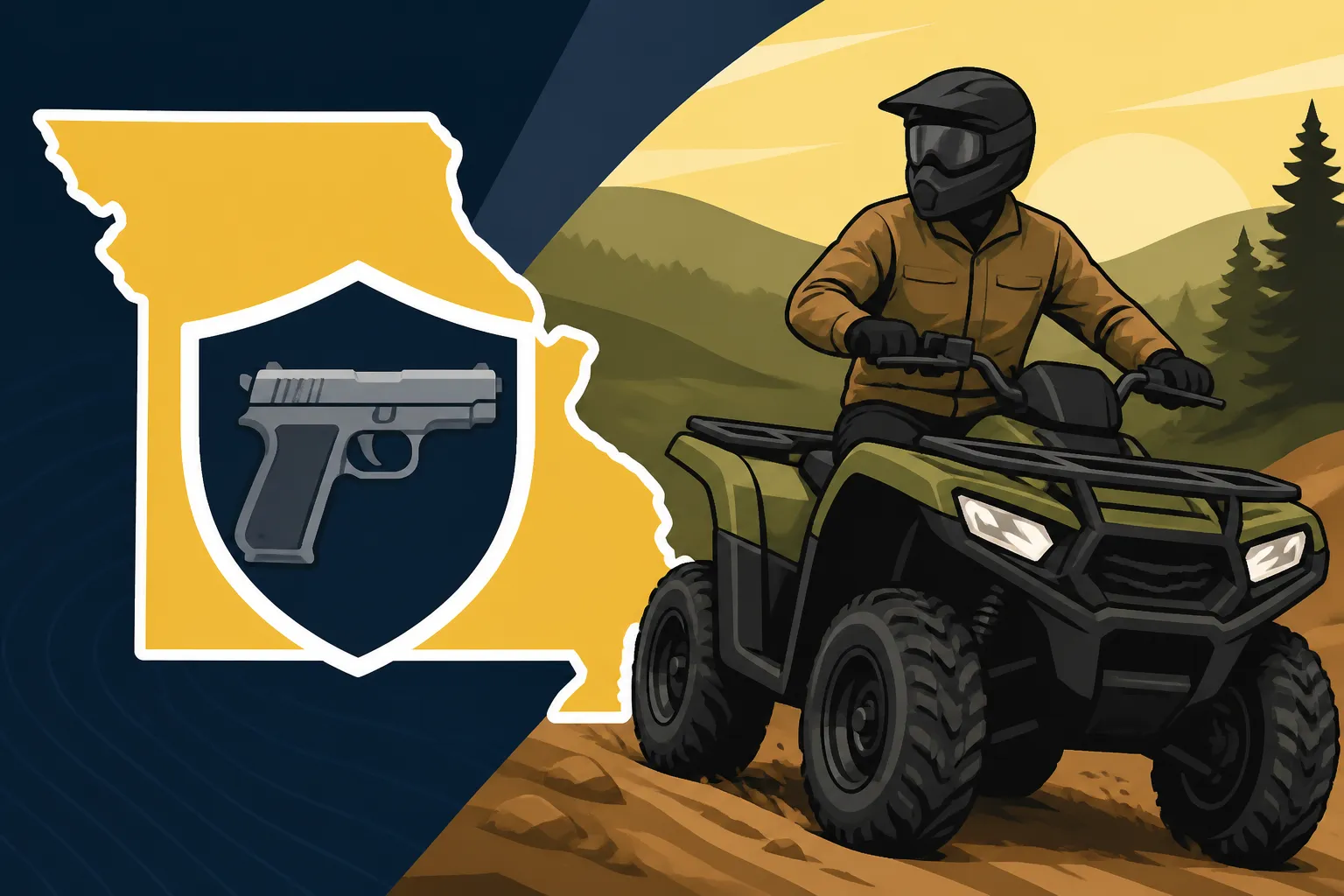
Missouri is widely recognized as an "open carry" state. What this means in practice is that if you are legally permitted to possess a firearm – meaning you aren't a prohibited person under state or federal law – you can generally carry that firearm openly without needing a special permit. On an ATV, open carry usually looks like a shotgun or rifle securely mounted in a visible scabbard along the side or rear of your machine, or a handgun holstered visibly on your person. There's no attempt to hide the firearm; it's right there for anyone to see.
However, the moment you decide to carry a firearm concealed, the rules shift. To carry a firearm concealed, meaning it's hidden from plain view, you typically need to possess a valid concealed carry endorsement (CCW permit). This applies whether you're walking down a street or riding your ATV. For instance, if you tuck a handgun under the seat of your UTV, stash it in a closed storage compartment, or even have a rifle wrapped in a tarp where it's not readily identifiable as a firearm, a law enforcement officer might consider that concealed. Without a CCW permit, doing so could lead to legal issues, even if you are on your own property. It’s always best to be clear about your intentions and understand the difference.
The Importance of Legal Possession
Before any discussion of how or where you carry a firearm on your ATV, the absolute bedrock rule is that you must be legally allowed to possess that firearm in the first place. Missouri's laws, like federal laws, prohibit certain individuals from owning firearms. This includes, but isn't limited to, convicted felons, individuals with certain domestic violence misdemeanors, and those adjudicated as mentally incapacitated. If you fall into any of these categories, possessing a firearm, regardless of how it's carried or where, is illegal and carries severe penalties.
This fundamental requirement applies universally, whether you're at home, at a shooting range, or out on the trail with your quad. There are no exceptions for ATVs or UTVs. Furthermore, while Missouri generally allows individuals 19 and older to openly carry a handgun, the federal minimum age for handgun possession is 18, and federal law prohibits licensed dealers from selling handguns to individuals under 21. For long guns (rifles and shotguns), the minimum age for possession is generally 18, though some exceptions might exist for minors under supervision. Always verify your eligibility to possess any firearm before you ever consider putting it on your machine.
Transporting Firearms on Private Versus Public Land
The freedom you experience riding your ATV or UTV across your own sprawling property often fosters a sense that the rules are the same everywhere. However, when it comes to carrying firearms, the lines blur considerably the moment you leave your private acreage and venture onto public land. Missouri's nuanced approach to firearm laws means that understanding the distinction between private and public areas is paramount for any responsible rider.
Riding on Your Own Private Property
When you're riding on land you own, or land where you have explicit permission from the landowner to be there and carry firearms, your rights regarding firearm possession are at their broadest. Generally speaking, on your own private property, you are permitted to carry a firearm openly or concealed, loaded or unloaded, as long as you are legally allowed to possess that firearm. This means if you want to ride your quad from your farmhouse to a back Forty for some target practice, with your hunting rifle openly mounted in a durable SuperATV gun scabbard, that's typically well within your rights. The same goes for a handgun carried concealed in a console box on your UTV – as long as you hold a valid concealed carry endorsement, it's generally permissible on your private ground.
This expansive freedom is precisely why many ATV and UTV enthusiasts initially assume a similar leniency applies across the board. They're used to the peace of mind that comes with knowing they're fully compliant with the law on their own turf. However, this private land freedom is a distinct privilege, and it's essential not to extrapolate these rules to public spaces without careful consideration. The moment you cross a property line onto public land, you're entering a different regulatory environment that demands a much closer look at specific rules. [Missouri Rules for Riding Private Land] offers further details on what is permissible when you're on your own acreage.
Navigating Public Lands: State Parks, Conservation Areas, and National Forests
This is where the topic of carrying firearms on your ATV or UTV becomes more complex and requires diligent homework. Public lands in Missouri, while generally respecting citizens' rights to bear arms, often come with specific, stricter regulations concerning how firearms can be transported, possessed, and, most importantly, discharged. These rules are designed to balance public safety, recreational use, and wildlife management, and they vary significantly depending on the type of public land.
State Parks and Historic Sites:
Missouri State Parks generally allow for the open carry of firearms by individuals legally permitted to possess them. However, the key distinction here is the discharge of a firearm. Shooting for hunting or target practice is almost universally prohibited within state parks and historic sites, except in rare, specifically designated shooting ranges, which are few and far between. This means while you might be able to transport your firearm on your ATV through a state park on a designated road (if ATVs are even allowed on that road), you cannot simply pull off the trail and start shooting. The focus in these areas is on passive recreation and preserving natural and historical resources. Always check the specific park's regulations before your visit. You can find more information on general rules for public recreation areas in [Missouri Rules for Riding a State Park Road].
Missouri Conservation Areas (MDC):
Missouri Department of Conservation (MDC) lands are often hunting grounds, so firearms are certainly permitted, but usually with very specific conditions, especially regarding their status on an ATV or UTV. When you are not actively hunting during an open season or target shooting in a designated range, firearms transported on an ATV or UTV on MDC land must typically be unloaded and cased. "Unloaded" generally means no round in the chamber, and often no magazine inserted or shells in the tube, depending on the firearm type. "Cased" implies it should be in a gun case, whether hard or soft, protecting it from the elements and making it clear it's not readily accessible for immediate use. These rules are in place to prevent poaching and ensure safety among various user groups. It's vital to consult the MDC's current hunting and trapping regulations or the specific area's usage rules, as these can change. Learn more about navigating these areas in [Missouri Rules for Riding a Conservation Area].
National Forests (e.g., Mark Twain National Forest):
Federal lands, such as the Mark Twain National Forest, operate under both federal and state laws, often leading to a blended set of regulations. In general, open carry of firearms is permitted in National Forests for those legally allowed to possess them. However, similar to MDC lands, there are specific rules for hunting, target shooting, and especially for transporting firearms on vehicles, including ATVs and UTVs. While you can typically transport a firearm through a National Forest on your machine, it should generally be unloaded and secured when not actively engaged in legal hunting or target shooting activities. Always consult the specific U.S. Forest Service regulations for the district you plan to visit, as they might have particular restrictions on vehicle use, designated hunting zones, or approved shooting areas. Details about general riding in these areas can be found in [Missouri's National Forest Riding].
Specific Rules for Hunting and Target Practice
For many Missouri ATV and UTV owners, the ability to carry a firearm on their machine is intrinsically linked to hunting season or an afternoon at the shooting range. However, this isn't a free-for-all. Missouri has very clear-cut rules about how firearms can be used in conjunction with off-road vehicles for these specific purposes, aiming to ensure ethical hunting practices and public safety. Failing to understand these distinctions can quickly turn a fun outing into a legal headache.
Hunting Regulations and Transport on an ATV
One of the most critical rules to understand in Missouri is that you cannot hunt from or harass wildlife with an ATV or UTV. This is a foundational principle of fair chase and wildlife conservation. Your machine is primarily for transportation to and from your hunting spot, not for pursuing game. This means you cannot shoot a deer, turkey, or any other game animal while you are actively sitting on your ATV or UTV, nor can you use it to chase animals.
When transporting a hunting firearm on your ATV or UTV to or from a hunting area, it generally must be unloaded. The definition of "unloaded" is crucial here: it typically means no round in the chamber and no magazine inserted for a rifle or handgun, or no shells in the tube for a shotgun. The firearm should also be securely stored, ideally in a case or a sturdy mount. While a durable gun scabbard from a company like SuperATV is excellent for protecting your firearm from brush and weather, you still need to ensure the gun itself is unloaded according to state and local regulations. The intent of these regulations is to prevent "road hunting" – the unethical practice of driving around looking for game to shoot from a vehicle. There are some very limited exceptions to the "unloaded" rule, such as for certain disabled hunters who obtain specific permits, but these are rare and require prior authorization. Always consult the current Missouri Department of Conservation (MDC) hunting regulations booklet before heading out. [Missouri Rules for Riding in Deer Season] further clarifies specific regulations during hunting season.
Carrying for Self-Defense While Riding
Missouri is a state that strongly supports self-defense rights, including the "Castle Doctrine" and "Stand Your Ground" laws. These principles extend to any place you are legally allowed to be, which includes public trails and roads where you are riding your ATV or UTV. This means that if you are legally carrying a firearm for self-defense purposes, whether openly or concealed with a valid CCW permit, those same self-defense laws apply if you find yourself in a situation where you need to protect yourself or others from imminent threat.
The key distinction for self-defense carry, compared to hunting transport, is that the firearm is typically carried loaded and readily accessible. If you possess a concealed carry permit, you can keep a handgun or even a smaller long gun concealed on your ATV or UTV, such as in a locked compartment or under a seat, as long as it aligns with your permit. If you choose to open carry for self-defense without a permit, the firearm must be visible. It’s important to practice responsible firearm handling and situational awareness. While the chances of needing to use a firearm for self-defense on a remote trail might be low, the right to carry one for that purpose is protected. However, remember that any discharge of a firearm in self-defense must be legally justifiable. You cannot just shoot because you feel vaguely threatened; there must be a real, imminent danger. For general legalities around ATVs, you might also find relevant information in [Missouri DWI Rules for ATV Riders] or [Missouri Open Container Rules on an ATV].
Practical Considerations and Avoiding Trouble
Beyond the letter of the law, there are practical steps every ATV or UTV rider carrying a firearm in Missouri should take to ensure safety, protect their gear, and avoid unnecessary encounters with law enforcement. Common sense and preparation go a long way in making your ride enjoyable and compliant. Thinking ahead about how you store, secure, and present your firearm can make all the difference.
Securing Your Firearm on the Machine
Properly securing your firearm on your ATV or UTV is paramount for several reasons. Firstly, it prevents accidental discharge. A firearm bouncing around in a cargo basket, unsecured, is a recipe for disaster. Secondly, it protects your valuable equipment from damage due to bumps, vibrations, dust, water, and mud – elements common on any Missouri trail. Finally, securing your firearm deters theft. An openly displayed, unsecured firearm can be an easy target for opportunistic thieves, especially if you step away from your machine for a moment.
There are numerous options for securing firearms specifically designed for ATVs and UTVs. Hard cases provide excellent protection from impacts and weather, often offering locking mechanisms for added security. Soft cases offer good protection from dust and scratches and are typically lighter. Perhaps the most popular solution for rifles and shotguns are specialized mounts and scabbards. Companies like SuperATV offer a range of products, from handlebar-mounted rifle grips to robust UTV gun racks that keep your firearm stable, protected, and easily accessible when needed, yet secure enough to prevent it from falling off on rough terrain. Choosing the right mounting system depends on your machine, your firearm, and your intended use, but investing in a quality solution is always a wise decision. Thinking about securing your firearm is similar to how you would keep other important documents safe, as discussed in [Where to Keep an ATV Title Safe at Home].
Interacting with Law Enforcement
If you are stopped by a law enforcement officer while riding your ATV or UTV with a firearm on board, transparency and respectful cooperation are your best allies. Missouri does not have a "duty to inform" law for citizens carrying firearms (meaning you aren't legally required to tell an officer you have a firearm unless they ask). However, from a practical standpoint, it is often wise to respectfully inform the officer that you have a firearm and where it is located, especially if it's openly carried or if they might stumble upon a concealed one during a routine interaction.
When an officer approaches, keep your hands visible and calmly explain that you have a firearm. Follow all instructions precisely and avoid making sudden movements. For example, you might say, "Officer, I have a legally carried firearm in a scabbard on my ATV, just want to let you know." Then, wait for their instructions. They might ask you to step away from the machine, or they might simply acknowledge it and proceed with the stop. Knowing your rights is important, but so is understanding that cooperation is key to a smooth interaction, even if you believe you are in the right. An officer may ask to see your valid concealed carry permit if you have a hidden firearm, or your identification.
Always Check Local Ordinances and Specific Area Rules
Even with a solid grasp of state law, it's crucial to remember that counties, cities, and specific parks or conservation areas within Missouri can impose their own, often stricter, rules regarding firearms. A state park might allow open carry but absolutely forbid any discharge of a firearm, even for target practice. A city that allows UTVs on its streets might prohibit open carry of firearms within city limits, or restrict it only to those with CCW permits. [Missouri Fines for Illegal ATV Road Use] highlights that local rules can carry significant penalties.
Before every trip, particularly to a new riding area, always do your homework. Check the website of the specific state park, conservation area, National Forest district, county sheriff's office, or city hall for any local ordinances or specific regulations pertaining to firearms. Look for posted signs at trailheads or park entrances that indicate "no shooting," "no hunting," or specific transport requirements. These local rules can sometimes override or add to state statutes, creating a patchwork of regulations. For instance, an organized ride might have specific safety rules regarding loaded firearms, as discussed in [Missouri Rules for an Organized Ride]. Never assume that because it's allowed in one public space, it's allowed in all.
| Scenario | Location | Firearm Status (Typical) | Carry Type (Permit?) | Notes |
|---|---|---|---|---|
| Self-Defense | Private Land (Own Property) | Loaded | Open or Concealed | Must be legal to possess firearm. |
| Self-Defense | Public Trail (With CCW) | Loaded | Concealed (Permit) | Open carry also allowed without permit if legal to possess. |
| Hunting (Transport to Stand) | MDC Conservation Area / National Forest | Unloaded & Cased | N/A | Check specific area rules; no hunting from machine. |
| Target Practice (Transport) | Private Land (Designated Range) | Unloaded or Loaded | Open or Concealed | Follow safe range practices; must be legal to possess. |
| General Transport (Non-Hunting) | County Road (connecting private lands) | Unloaded (recommended) | Open or Concealed | Loaded is legal open carry; unloaded and cased reduces risk. |
Disclaimer
This article is for general informational purposes only and does not constitute professional advice. Laws, prices and regulations vary by location and change over time. Consult a qualified professional for guidance on your specific situation.