Missouri Government Machines on Official Business
It can be incredibly confusing to understand Missouri's ATV and UTV laws when you see certain vehicles operating in ways that seem to contradict everything you've learned. Perhaps you've spotted a sheriff's deputy zipping down a county road on an ATV, or a park ranger patrolling a state park trail with a UTV, seemingly exempt from the usual rules about permits, flags, or even road access. This guide aims to clear up that confusion, diving deep into the specific allowances and regulations that govern how Missouri government machines operate when on official business, and how these differ from what civilian riders need to know.
Understanding "Official Business" for Government ATVs and UTVs in Missouri
When we talk about ATVs and UTVs being used by government entities in Missouri, we're not just talking about someone driving their personal quad to a government building for work. We're specifically referring to vehicles that are owned by the state, a county, or a city, and are being operated by an authorized employee or agent in the performance of their official duties. This distinction is absolutely crucial because it unlocks a completely different set of rules compared to what you or I, as private citizens, must follow.
Defining Government Use Cases and Their Importance
Think about the sheer variety of tasks that governmental bodies need to perform across Missouri. This isn't just about law enforcement. It extends to wildlife conservation, park maintenance, emergency response in rural or difficult-to-access areas, utility line inspections, and even agricultural research on state-owned land. In each of these scenarios, an ATV or a UTV isn't just a recreational toy; it's a vital piece of equipment, a tool essential for public service. For instance, a conservation agent might need to quickly access a remote part of a [Missouri Conservation Area] to investigate illegal hunting activity. A local fire department might use a UTV fitted with specialized equipment to reach a brush fire far off the paved road. Without these machines, and without the flexibility to use them on various terrains and sometimes on public roads, these critical functions would be severely hampered, if not impossible. The law recognizes this operational necessity by granting certain exemptions that facilitate these important duties.
Who Qualifies as a Government Operator
It's not just any government employee who can hop on an ATV and declare it "official business." Typically, the operator must be an employee, an agent, or a volunteer officially sanctioned by the governmental entity that owns the machine, and they must be actively engaged in a task directly related to their employment or duties. This could be a Missouri State Parks employee maintaining trails at [St. Joe State Park's Sand Flats in Missouri], a sheriff's deputy responding to a call on a gravel road in a rural county, or a Department of Natural Resources staff member inspecting water quality along a riverbank. The key is authorization and purpose. The machine must be government-owned, and the person operating it must be performing a legitimate, documented government function. This doesn't extend to, say, a city employee using a city-owned UTV to run personal errands during their lunch break. The "official business" clause is strict about the nature of the activity.
Distinguishing Official Business from Personal Use
The line between official and personal use is paramount. While a state park employee might use a UTV all day for park maintenance, they cannot then take that same UTV home for personal yard work, even if they're still technically "on the clock" in a broader sense. Missouri's statutes are designed to provide operational flexibility for government functions, not to offer free recreational opportunities or personal convenience for employees. Any use outside the scope of direct government duties would immediately negate the special exemptions. If a machine is being used for anything other than its intended governmental purpose, it then falls under the same rules and regulations that apply to any private citizen, including requirements for [Missouri's Special Permit for Road Use] or adherence to standard trail regulations. This strict delineation ensures accountability and prevents abuse of these necessary exemptions.
Specific Exemptions for Government-Owned Off-Road Vehicles
The most significant differences for government-owned ATVs and UTVs in Missouri come in how they're treated regarding registration, titling, and their ability to operate on public roads. These aren't minor tweaks; they're fundamental departures from what civilian riders experience, all designed to ensure public services can be delivered effectively.
Registration and Titling Differences for State and Local Machines
For the average Missourian, if you own an ATV, you absolutely need to get it titled and then acquire a three-year decal, whether you plan to ride it on trails or just on your private land. This process involves the Department of Revenue and comes with fees like [Missouri's $8.50 ATV Title Fee] and [Missouri's $10.25 Three-Year Registration]. However, for most governmental machines, this requirement is waived. State-owned ATVs and UTVs, as well as those belonging to counties and municipalities, are generally exempt from the titling and registration decal requirements. Why? Because these vehicles are typically tracked internally by their respective agencies, and the primary purpose of state registration is to identify ownership for tax and enforcement purposes for private citizens. When a machine is clearly marked as property of, say, the "Missouri Department of Conservation" or the "City of Springfield Parks Department," its ownership is already established. This exemption streamlines the administrative burden for public service agencies, allowing them to focus resources on their core missions rather than paperwork for every single off-road vehicle in their fleet.
Road Use Privileges for Law Enforcement and Emergency Services
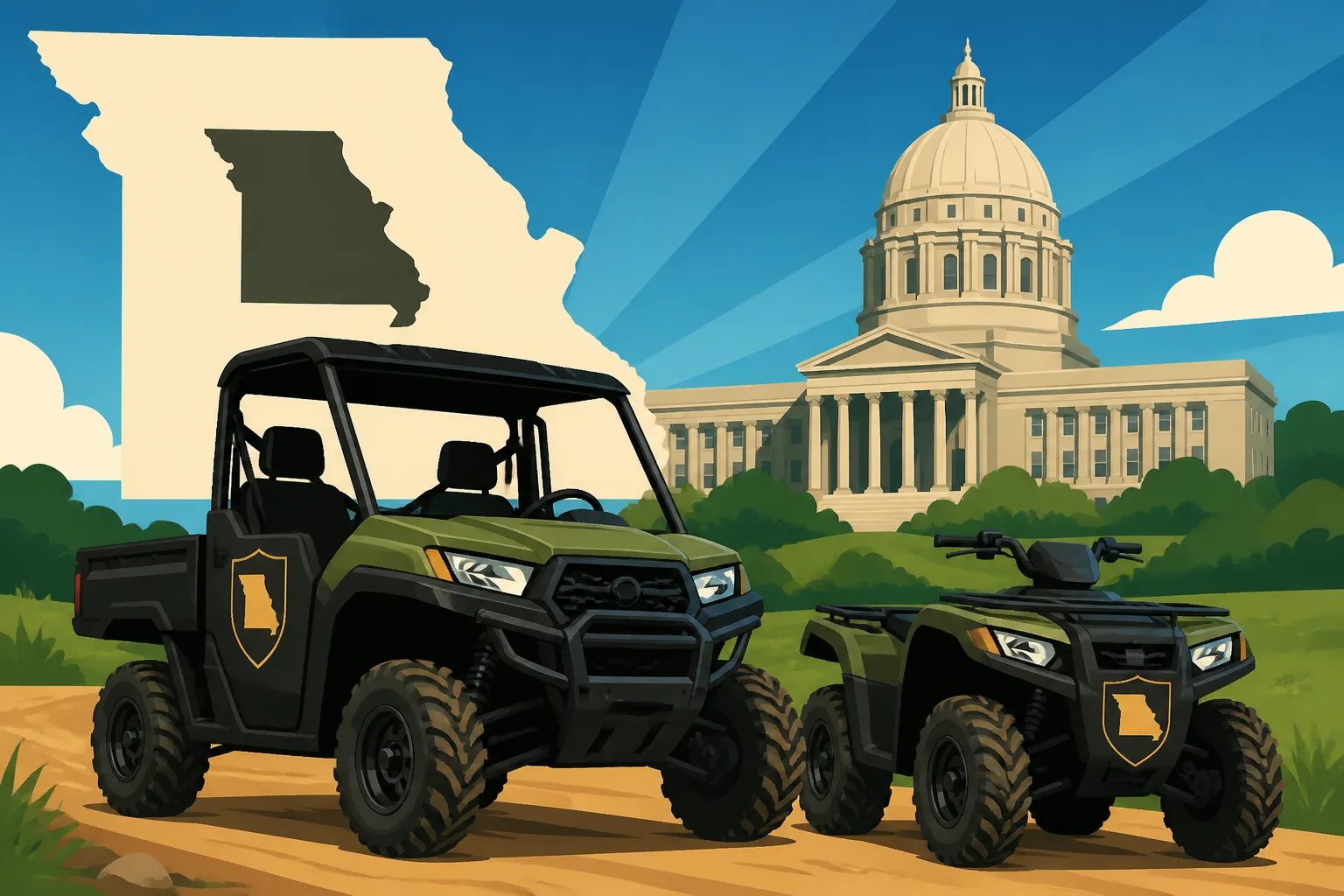
This is often where the biggest head-scratching moments happen for civilian riders. While you and I might be limited to [Missouri's 3-Mile Rule for Side-by-Sides] in approved municipalities, or need a special permit to operate on certain roads, law enforcement and emergency services have much broader latitude. A sheriff's deputy or a police officer, operating a police-issued ATV or UTV for official purposes, can typically traverse public roads without needing a special permit, a 7-foot safety flag, or even adhering to the usual width restrictions. These machines are often critical for patrolling parks, navigating congested events, responding to emergencies in areas inaccessible by larger vehicles, or performing search and rescue operations. Their ability to quickly move on and off public roads is essential for their operational effectiveness. The law essentially recognizes these vehicles as emergency apparatus, similar to how a police cruiser or an ambulance can bypass certain traffic laws when responding to a call. This isn't a blanket pass, though; operators are still expected to exercise due care and operate safely, but the procedural hurdles are significantly lowered.
Agricultural and Conservation Department Operations
Beyond law enforcement, Missouri also grants significant flexibility to machines used for agricultural and conservation purposes by government agencies. For example, the Missouri Department of Conservation frequently utilizes ATVs and UTVs to manage state-owned lands, monitor wildlife, perform habitat restoration, and conduct research. These activities often require crossing county roads or even short stretches of state highways to move between plots of land or access different sections of a conservation area. Similarly, state university extension services might use UTVs for agricultural research on college farms or experimental fields, necessitating road access. The [Missouri's Agricultural Highway Exception] that sometimes applies to private farmers can be seen as a parallel to this, but for government entities, the scope is often broader and less restrictive, particularly concerning the type of "agricultural implement" or "farm machinery" designation. These vehicles are deemed essential tools for managing Missouri's natural resources and supporting its vital agricultural sector, and their unimpeded movement for official business is critical.
Equipment and Safety Standards for Government Off-Road Machines
While government-owned ATVs and UTVs enjoy certain exemptions, it doesn't mean they're exempt from all safety considerations. In fact, due to their operational contexts, they often have enhanced safety and equipment requirements, some mandated by agency policy, others by practicality, to ensure the safety of the operator and the public.
Essential Safety Gear and Modifications for Public Service
Just like any responsible rider, government operators are typically required to wear appropriate safety gear, including helmets where mandated or prudent, eye protection, and sturdy footwear. However, beyond personal protective equipment, the machines themselves often feature specialized modifications. For example, a UTV used by a fire department for wildland firefighting might be equipped with a skid-mounted pump and tank, additional warning lights (like amber strobes), a siren, and heavy-duty suspension to handle the extra weight and rugged terrain. SuperATV, for instance, offers a range of heavy-duty suspension kits and cargo solutions that could be invaluable for government UTVs needing to carry specialized equipment or transport personnel over challenging landscapes. Law enforcement ATVs might have enhanced lighting, communication equipment, and specific storage for gear. These modifications are not just about convenience; they're about enabling the safe and effective performance of critical duties in potentially high-risk environments.
Visibility Requirements and Lighting for On-Road Operations
Even with exemptions, government ATVs and UTVs operating on public roads, especially during emergencies or at night, must maintain a high level of visibility. While a private citizen might need a specific [Missouri's 7-Foot Safety Flag] and distinct lighting to be road-legal in certain scenarios, government machines often achieve this through standard vehicle equipment, but sometimes augmented. Police and emergency UTVs will have flashing lights – typically red and blue for law enforcement, or amber for utility/maintenance vehicles – which clearly signal their presence and often, their official capacity. Even standard headlamps, tail lamps, and brake lights are crucial. For non-emergency operations, like a park ranger crossing a road, the vehicle itself being clearly marked with official insignia, combined with visible lighting, serves the purpose of alerting other motorists. The goal is to ensure that even with expedited road access, these machines do not become unexpected hazards for the general public.
When Standard Civilian Rules Still Apply
It's important to remember that these exemptions are specifically for official business. When a government employee is off duty, or using a personal ATV, or even a government-owned machine for a non-official purpose, the standard civilian rules apply. This includes adherence to speed limits, traffic laws, and any local ordinances that permit or restrict ATV/UTV use on roads. For example, if a conservation agent is on vacation and decides to ride their personal ATV at a designated ORV park like [Chadwick Motorcycle and ATV Use Area], they must comply with all park rules, purchase the necessary permits, and wear helmets if required for that specific riding area, just like any other private rider. The government ID or uniform does not grant universal immunity from all laws. Furthermore, even during official duties, operators are still held to a standard of care. Reckless operation, even by a government employee, would still be subject to disciplinary action and potentially legal consequences, demonstrating that the exemptions are for utility, not impunity.
The Rationale Behind Government Exemptions and Public Safety
The existence of special rules for government ATVs and UTVs isn't arbitrary; it's rooted in a pragmatic understanding of public safety and efficient governance. These exemptions allow agencies to meet their responsibilities effectively, especially when dealing with urgent situations or challenging terrain.
Facilitating Rapid Response and Access in Challenging Terrain
Imagine a search and rescue operation for a lost hiker deep in the Mark Twain National Forest, or a medical emergency at a remote campground that's only accessible via a narrow, muddy trail. In such scenarios, traditional vehicles like cars or even large trucks simply can't get the job done quickly enough, if at all. This is where the agility and off-road capability of government-operated ATVs and UTVs become indispensable. These machines can navigate rough terrain, cross shallow streams, and maneuver through dense brush, allowing first responders, law enforcement, or park personnel to reach critical locations swiftly. The exemptions from typical road and trail restrictions allow these agencies to prioritize saving lives, protecting property, and managing natural resources without bureaucratic delays. Think of how a [Missouri Deputy at a Roadside Stop] might use an ATV to pursue a suspect who flees into a wooded area, something a patrol car could never do.
Balancing Operational Needs with General Public Safety
While the exemptions are crucial for government operations, Missouri's framework still aims to balance these needs with the overall safety of the public. The underlying assumption is that government operators are trained professionals who understand their vehicles' capabilities and the inherent risks. For instance, while a police UTV might not need a special permit to drive on a city street, its operator is still expected to drive prudently, especially when not in an emergency. Agencies often have their own internal policies and training programs that go beyond state minimums, ensuring their personnel are competent and responsible operators. This internal oversight, combined with the clear identification of government vehicles, helps mitigate the risks that might otherwise arise from allowing specialized machines to operate outside typical civilian constraints. It's a system built on trust and necessity.
Public Perception and Responsible Government Operation
The sight of a government ATV or UTV operating on a road or trail where private machines are restricted can sometimes lead to public confusion or even frustration. "Why can they do that, but I can't?" is a common question. This is why responsible operation and clear communication are so important. Government agencies understand that their actions are under public scrutiny, and they strive to ensure their use of these exemptions is justifiable and transparent. When a conservation agent is driving a UTV on a county road, for example, it's typically for a specific, observable purpose like inspecting a wildlife area or responding to a call, not for personal convenience. By adhering to best practices, maintaining their vehicles, and operating with professionalism, government entities reinforce the public trust that these exemptions are indeed for the greater good. This also means that operators are familiar with the terrain, whether it's [Ozark Rock and Loose Chert] or dense forest trails, and operate within those limits.
Comparing Government Machine Use to Civilian Road Rules
It's helpful to draw a direct comparison between the rules governing government ATVs/UTVs and those applied to private citizens. This highlights why specific regulations exist for each group and clarifies the situations where they diverge.
Key Differences in Permitting and Licensing
For the average Missourian who wants to ride their side-by-side on approved city streets, they'll need to check local ordinances, potentially acquire a city or county [Missouri Special Permit Cost for ATVs], and ensure their machine meets specific requirements like proper lighting, a safety flag, and perhaps even insurance. They'll also need a valid driver's license. For government machines, these layers of permitting are often stripped away. A law enforcement officer operating a department UTV on official business, for instance, typically doesn't need to apply for a municipal permit for each trip. Their operational authority and the nature of their duties override these civilian permitting requirements. While the operator still needs to be qualified (e.g., holding a valid [An Operator's or Chauffeur's License in Missouri] for their duty vehicle), the bureaucratic hurdles are significantly reduced, allowing for immediate deployment when needed.
Restrictions That Still Apply to Government Operators
Despite the exemptions, government operators aren't given a completely free pass. They are still bound by a variety of restrictions, many of which are internal agency policies designed to promote safety and responsible use. Speed limits, for example, generally still apply to government vehicles unless they are actively engaged in an emergency response. While they might bypass a specific permit requirement, they cannot operate recklessly or endanger the public. They must also ensure their vehicles are mechanically sound and properly maintained. For instance, even a park ranger's UTV needs functional brakes and lights, and any aftermarket parts like those from SuperATV would need to meet agency standards for safety and durability. Furthermore, the "official business" clause is a significant restriction in itself; any deviation from this purpose means the exemptions no longer apply. This ensures that while flexibility is granted, it is not abused.
Scenarios Where Government ATVs Operate Alongside the Public
One of the most common situations where you'll see this interplay is at Missouri's state parks and conservation areas. Here, private citizens pay for [Missouri State Park ORV Permit Prices] and follow specific rules about trail access, hours, and sometimes even sound limits. Simultaneously, park rangers and conservation agents operate their government-owned ATVs and UTVs on those same trails, often performing maintenance, enforcing rules, or responding to incidents. The key difference here is the purpose of their operation. While a private rider is recreating, the government operator is working. Another scenario might be during community events or parades where law enforcement uses ATVs for crowd control or quick access. In these cases, both civilian and government vehicles share the space, but the government machines are operating under their official capacity, often with visual cues like official markings or emergency lights, signaling their distinct status and purpose.
Here is a quick comparison of general rules for private versus government-owned ATVs and UTVs in Missouri for road use:
| Feature | Private Civilian ATV/UTV (General) | Government ATV/UTV (Official Business) |
|---|---|---|
| Titling | Required (unless specific exemption) | Generally Exempt |
| Registration Decal | Required (3-year decal for ATVs, none for UTVs) | Generally Exempt |
| Road Use Permit | Often Required (City/County, [Missouri Special Permit Cost for ATVs]) | Generally Exempt for official duties |
| Driver's License | Required (appropriate class) | Required (appropriate class for operator's duty) |
| Safety Flag | Often Required ([Missouri's 7-Foot Safety Flag]) | Not specifically mandated, often integrated into warning lights |
| Lighting | Mandated (headlights, tail lights, brake lights) | Mandated (headlights, tail lights, brake lights, often warning lights) |
| Insurance | May be required for road use (local ordinance) | Agency-covered (self-insured or commercial policy) |
| Operational Purpose | Recreational, personal transport, agricultural (private) | Law enforcement, emergency, conservation, utility, agricultural (public) |
| Applicable Statutes | Primarily MO Revised Statutes Chapter 304, 301 | Chapter 304, 301 with specific exemptions for official vehicles, agency policies |
Disclaimer
This article is for general informational purposes only and does not constitute professional advice. Laws, prices and regulations vary by location and change over time. Consult a qualified professional for guidance on your specific situation.