Why Three Statutes Instead of One in Missouri
It can feel incredibly confusing when you see different types of off-road machines, all seemingly similar, operating under completely different rules on Missouri roads. You might spot a side-by-side cruising through a small town or crossing a county highway, while your trusty quad is strictly relegated to trailers or private land. This guide is here to untangle that knot of frustration, explaining precisely why Missouri's legal landscape for ATVs, UTVs, and ROVs on public roads is built upon three distinct statutes, rather than one simple blanket rule.
The ATV Conundrum: Missouri's Strict Approach to Quads on Roads
For many of us who grew up riding quads, the dream of simply hopping on and heading down the road to a neighbor's house or a local store feels like a natural extension of their utility. Yet, in Missouri, all-terrain vehicles (ATVs) face the most stringent restrictions when it comes to road use. It's a source of constant bewilderment for riders, especially those who see their neighbors on different types of machines enjoying local road access.
The Basic Ban: Why ATVs Are Generally Off-Limits
Missouri law defines an ATV fairly specifically: it's a motorized vehicle with three or more wheels, designed for off-highway use, having a width of 50 inches or less, dry weight of 1,500 pounds or less, and handlebars for steering, with a seat designed to be straddled by the operator. This definition is crucial because it immediately places ATVs into a category that is largely prohibited from operating on public roads, streets, or highways in the state. The lawmakers, it seems, view ATVs as inherently less suited for road travel due to their design – the straddle seat, narrower stance, and handlebar steering are seen as safety concerns when mixed with traditional road traffic.
This general prohibition means that if you own a typical quad, whether it's a sport machine or a utility model, you generally cannot ride it on paved or gravel public roads. This can be a huge headache for landowners who need to get from one field to another across a public road, or for recreational riders who want to access a trail system without trailering their machine everywhere. The law makes no distinction based on the rider's skill, the ATV's power, or even how safely you believe you can operate it on asphalt. It's a blanket rule that can feel quite unfair when other types of off-road vehicles are given more leeway. For more details on what Missouri considers an ATV, you can check out [What Missouri Counts as an ATV].
Limited Exceptions: Farm Use and Highway Crossings
While the general rule is "no ATVs on roads," Missouri law does carve out very specific, narrow exceptions. These aren't loopholes for joyriding; they are practical allowances for necessary tasks. The most common exception is for agricultural purposes. Farmers and those engaged in agricultural operations can use their ATVs on highways, but only for short distances and strictly for agricultural purposes between the hours of sunrise and sunset. This isn't about running errands to town; it's about moving between fields, checking fence lines, or hauling small loads related to farming. You’re typically expected to have a slow-moving vehicle emblem displayed, and the usage is meant to be minimal and functional.
Another common exception permits ATVs to cross a public road or highway. This is often necessary when a trail or private property is bisected by a road. However, these crossings must be done at approximately a 90-degree angle to the roadway, and the operator must yield to all oncoming traffic. You can't ride down the shoulder for a quarter-mile to find a better crossing spot; it's meant to be a direct transit across the road and nothing more. These exceptions highlight the state's intent: ATVs are seen as off-road tools, and their limited road use is only tolerated when absolutely necessary for specific, non-recreational purposes.
Understanding the "Utility Vehicle" UTV Statute
Moving beyond the traditional ATV, Missouri introduces a separate category for "utility vehicles" (UTVs). For many, the lines between a UTV and a "Recreational Off-Highway Vehicle" (ROV) can blur, leading to confusion about which rules apply. However, legally speaking, the distinction is significant, especially regarding road access.
Defining a Utility Vehicle in Missouri Law
A utility vehicle, as defined by Missouri statute, shares some characteristics with side-by-sides but has key differences that set it apart from ROVs in the eyes of the law. Generally, a UTV is a motorized vehicle that is not an all-terrain vehicle, is designed for off-highway use, and is typically used for utilitarian purposes rather than strictly recreational ones. Think of those workhorse machines often seen on farms, construction sites, or large properties. They usually have a cargo bed, a bench seat (or bucket seats), a steering wheel, and pedals like a car, but they are still designed to operate off-pavement.
The critical distinction often lies in how the vehicle is primarily designed and marketed. While many UTVs can be fun to drive, their core identity in Missouri law leans towards their working capabilities. This primary purpose informs why their road use is limited almost exclusively to specific, functional exceptions, much like ATVs, but with slightly broader strokes. This statutory definition means that while a UTV might look like a side-by-side that's allowed on certain city streets, if it falls under the "utility vehicle" definition, its road access is much more constrained. [What the Law Calls a Utility Vehicle] delves deeper into these definitions.
The Agricultural and Industrial Exceptions
Just like ATVs, UTVs have specific exceptions for agricultural use. Farmers can use their UTVs on public roads for agricultural purposes, from sunrise to sunset, to travel short distances between fields, carry tools, or move livestock. These machines are integral to modern farming, and the law acknowledges this by allowing their use where necessary for the operation of a farm. It's not uncommon to see a farmer on a UTV pulling a small trailer of hay bales across a gravel county road, and this usage is perfectly legal under this specific agricultural exception.
Beyond farming, Missouri law also provides an exception for industrial use. This means UTVs can be operated on public roads when used for industrial purposes, but typically only within the confines of an industrial complex or facility, or for short distances to access adjacent industrial property. For instance, a UTV might be used by maintenance crews to travel between buildings on a large factory campus, or by construction workers to move equipment around a job site that borders a public road. Again, the intent is purely utilitarian – these vehicles are tools, and their road use is tied directly to their job function, not for general transportation or recreation.
The Disabled Rider's Short-Distance Rule
Missouri law also includes a compassionate exception for disabled riders. A UTV can be operated on a public road for a short distance by a person with a mobility disability. This allows individuals who might not be able to operate a traditional automobile, or who need the specific features of a UTV for their mobility, to access necessary services or adjacent properties. The "short distance" aspect is key here; it's not a carte blanche to drive a UTV indefinitely on public roads. It’s about providing essential access for individuals who require it, acknowledging the UTV's role as a mobility aid in certain circumstances. This exception, like the others, emphasizes a functional, needs-based approach rather than general recreational use on public thoroughfares.
The Recreational Off-Highway Vehicle ROV Statute: The Path to Limited Street Legality
This is where the rules start to get a bit more nuanced and where most of the confusion, and indeed, the limited opportunities for legal road use, arise for side-by-sides. The Recreational Off-Highway Vehicle (ROV) statute in Missouri is the framework that allows some side-by-sides onto certain public roads, but it comes with a significant number of conditions and local variations.
What Qualifies as an ROV in Missouri
First things first: what is an ROV according to Missouri law? An ROV is a motorized vehicle that is not an all-terrain vehicle (ATV), a utility vehicle (UTV), a golf cart, or a motor vehicle. It's designed for off-highway use, has a width greater than 50 inches but no more than 67 inches, a dry weight of 2,000 pounds or less, non-straddle seating for two or more persons, and a steering wheel for steering control. Think of your typical two-seat or four-seat recreational side-by-side. The key here is the width, weight, seating arrangement, and steering wheel – these are the features that lawmakers decided made them potentially more suitable for certain road uses than ATVs.
Because they are wider and have traditional steering, they are seen as more stable and controllable than ATVs when interacting with road conditions. However, the "off-highway use" designation remains central; they are not classified as street-legal vehicles like cars or trucks. This means their road access is strictly limited by specific conditions and local ordinances, which we'll explore next. For more details, see [Recreational Off-Highway Vehicles and Missouri Titles].
The City and County Ordinance Option
This is the biggest differentiator for ROVs. Unlike ATVs and UTVs, which have very limited statutory exceptions for road use, ROVs can be legally operated on public roads if a city or county passes an ordinance specifically allowing it. This means that if you live in, or plan to ride through, a particular city or county, you must check their local laws. Just because one town allows ROVs on its streets doesn't mean the next town over does. This patchwork of regulations is a major source of frustration and requires riders to do their homework.
When a city or county passes such an ordinance, they typically set their own rules regarding permitted roads (e.g., speed limits, no state highways), operating hours, and often require a special local permit. These local permits usually involve an application process, a fee, and often proof of insurance. It's not uncommon for these ordinances to specify requirements like minimum age for operators and helmet rules for certain age groups, even if state law is different. [Missouri Cities That Allow UTVs on Streets] and [Missouri Counties That Allow ATVs on Roads] provide useful context for where these ordinances might exist.
The "3-Mile Rule" and its Specific Conditions
Even without a city or county ordinance, Missouri law offers a very specific, limited exception for ROVs: the "3-mile rule." This rule allows ROVs to be operated on county roads for a distance of no more than three miles from the operator's permanent residence or the private property on which the ROV is stored. This is a very narrow window designed for short trips to neighbors, mailbox, or local points of interest without venturing too far from home.
It's crucial to understand the limitations:
- County Roads Only: This rule does not apply to state highways or city streets unless those cities have their own specific ordinances.
- 3-Mile Limit: You cannot exceed three miles from your starting point. Going beyond that distance, even inadvertently, makes you immediately non-compliant.
- Specific Conditions: The ROV must be equipped with headlamps, tail lamps, a stop lamp, a horn, a mirror, and a safety flag (at least seven feet high with a 30-square-inch fluorescent orange flag). The operator must have a valid driver's license (not just a learner's permit), and passengers must wear seatbelts. The ROV also needs an orange safety flag, sometimes known as a whip flag, mounted at least seven feet high. This is a good opportunity to consider accessories from brands like SuperATV that offer various safety flags and lighting kits designed for such requirements. [Missouri's 3-Mile Rule for Side-by-Sides] explains this in detail.
This rule is a prime example of Missouri trying to balance convenience for rural residents with safety on public roads. It's a lifeline for some, but it requires strict adherence to all conditions.
Essential Equipment for Road-Legal ROVs
Whether operating under a local ordinance or the 3-mile rule, ROVs seeking road access in Missouri must meet specific equipment requirements designed to enhance safety and visibility. These aren't suggestions; they are legal mandates.
- Headlamps and Tail Lamps: Your ROV needs functioning headlamps that are on at all times when operating on a road, and tail lamps visible from a specified distance.
- Stop Lamp: A working brake light is essential to signal deceleration.
- Horn: An audible warning device is required for safety.
- Mirror: At least one rearview mirror is necessary.
- Safety Flag: As mentioned earlier, a fluorescent orange flag, at least 30 square inches, mounted at least seven feet above the ground, is critical for visibility. Many riders turn to aftermarket suppliers like SuperATV for sturdy flag mounts and bright, durable flags that meet these height and size requirements.
- Seatbelts and Roll Bar: ROVs are built with roll-over protection structures (ROPS) and seatbelts from the factory. These must be intact and utilized by all occupants.
- Operator's License: The operator must possess a valid driver's or chauffeur's license.
- Insurance: While state law doesn't universally require insurance for ROVs, many local ordinances do, and it's always a wise idea to carry liability insurance.
Meeting these requirements isn't just about compliance; it's about making your ROV as visible and safe as possible when sharing the road with other vehicles. Aftermarket parts from companies like SuperATV can help you ensure your machine is up to snuff with proper mirrors, lighting, and flag setups. [Missouri Safety Flag Requirements] outlines these rules.
Why Three Separate Statutes? Untangling the Legislative Logic
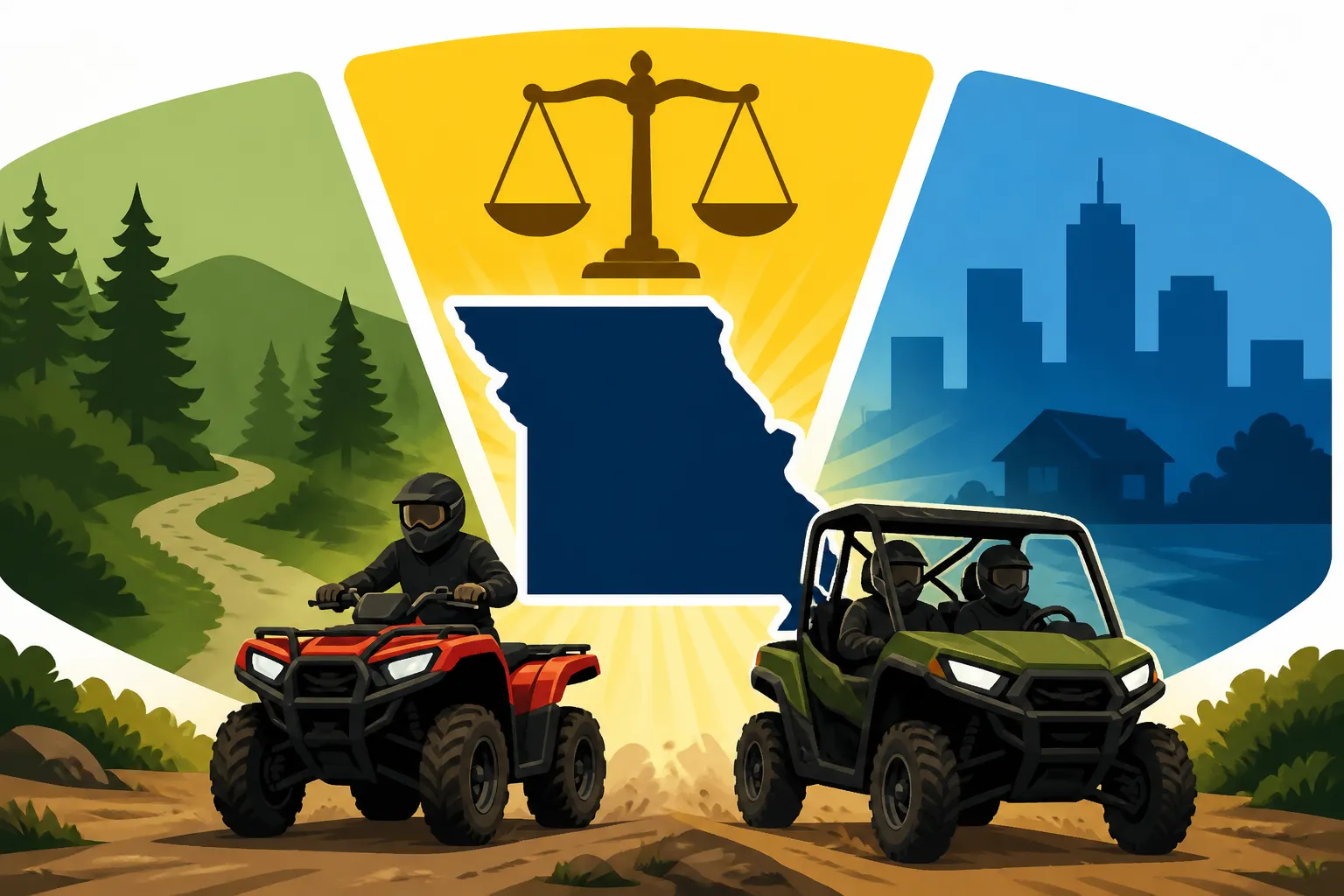
The existence of three distinct categories—ATV, UTV, and ROV—each with its own set of rules for road use, is not an accident. It's the result of legislative responses to evolving vehicle technology, changing recreational trends, and a desire to balance public safety with the varied needs of Missourians.
Historical Context and Vehicle Evolution
When ATVs first became popular, they were largely seen as purely off-road machines, designed for recreation or light utility on private land. Early laws reflected this, generally prohibiting them from public roads due to concerns about their stability, visibility, and lack of traditional safety features like seatbelts and roll cages. As time went on, manufacturers developed new types of vehicles. "Utility vehicles" emerged, more geared towards work than pure sport, often wider and with more car-like controls, making them essential tools for agriculture and industry.
Then came the "Recreational Off-Highway Vehicles" – the modern side-by-sides. These machines blended utility and recreation, offering more seating, comfort, and often greater capabilities than traditional ATVs, while still being distinctly off-road vehicles. Lawmakers found themselves in a position where the existing ATV laws didn't quite fit these newer, larger, and often more stable side-by-sides, but nor did they want to simply classify them as street-legal cars. This evolution of vehicles necessitated new, specific classifications and rules to address their unique characteristics and intended uses. This is why you have [Why Missouri Splits ATVs, UTVs and ROVs].
Addressing Different Use Cases and Safety Concerns
The three statutes reflect a nuanced understanding of how these different machines are used and the inherent safety characteristics of each.
- ATVs: With their straddle seats, handlebars, and typically narrower profiles, ATVs are generally considered the least stable on paved roads, especially at higher speeds or in traffic. The state's default position is strict prohibition, with very limited exceptions for essential, low-speed, short-distance utility. The primary concern is operator safety when mixing with traditional vehicles.
- UTVs: These machines are recognized for their utilitarian purpose. While they might share some design elements with ROVs, their legal classification often emphasizes their work-oriented function. This allows for specific agricultural and industrial exceptions, acknowledging their necessity for certain professions, while still generally keeping them off roads for recreational purposes.
- ROVs: Side-by-sides, falling under the ROV definition, bridge the gap. Their wider stance, roll cages, seatbelts, and steering wheels make them potentially safer for limited road use than ATVs. However, they are still fundamentally off-road vehicles. The separate statute for ROVs allows for conditional road access where safety provisions can be met, and where local communities deem it appropriate, giving them more flexibility than ATVs or UTVs, but with strict controls.
Essentially, each statute is a legislative attempt to categorize vehicles based on their design, primary function, and the perceived level of risk they pose on public roads, leading to tailored regulations rather than a one-size-fits-all approach.
The Role of Local Control in ROV Road Access
A significant reason for the complexity, particularly with ROVs, is the legislative decision to grant local control over their road access. Instead of a statewide mandate, Missouri allows individual cities and counties to decide whether ROVs can be driven on their local roads. This decentralized approach serves several purposes:
- Community Needs: It allows communities to tailor regulations to their specific needs, traffic patterns, and local culture. A rural county with mostly gravel roads and low traffic might be more amenable to ROV use than a densely populated city with high-speed arterial roads.
- Infrastructure: Localities can assess if their road infrastructure can safely accommodate ROVs alongside other vehicles.
- Responsiveness: Local governments can be more responsive to their constituents' demands, whether those demands are for more recreational access or for stricter controls due to safety concerns.
While this local control provides flexibility, it undeniably creates a confusing patchwork of laws for riders. It means you can't assume what's legal in one town is legal in another, sometimes even just across the county line. This local decision-making process is a critical piece of the "why three statutes" puzzle, as it defines where and under what conditions an ROV might become "street legal" in a very limited sense. [A City or County Special Permit in Missouri] further explains the intricacies of this local permitting.
Navigating the Nuances: Practical Advice for Riders
Understanding Missouri's three distinct statutes for ATVs, UTVs, and ROVs is the first step, but applying that knowledge in the real world requires careful planning and diligence. The last thing any rider wants is a citation, or worse, an accident, because they misunderstood the rules.
Knowing Your Machine's Classification
The very first and most critical step is to accurately identify whether your machine falls under Missouri's legal definition of an ATV, a Utility Vehicle (UTV), or a Recreational Off-Highway Vehicle (ROV). This isn't always as simple as it sounds, especially with manufacturers constantly innovating and blurring lines between categories. For instance, some manufacturers market their vehicles broadly as "side-by-sides," but depending on their exact dimensions and features, they might be classified as UTVs or ROVs under Missouri law, leading to different road use regulations.
Grab your owner's manual or measure your machine. Is it 50 inches wide or less, with a straddle seat and handlebars? You likely have an ATV. Is it wider, with a steering wheel and side-by-side seating, but primarily marketed and designed for work with a cargo bed? It might be a UTV. Is it wider than 50 inches but no more than 67 inches, with a steering wheel and non-straddle seating for two or more, designed for recreation? That's your ROV. Knowing your vehicle's specific legal classification is the foundation for understanding what you can and cannot do on Missouri roads. If you're unsure, consult the Missouri Department of Revenue or a legal professional familiar with ATV/UTV law.
Researching Local Ordinances
For ROV owners, the importance of researching local ordinances cannot be overstated. A statewide "street legal" status simply doesn't exist for ROVs in Missouri. Before you even think about taking your side-by-side on a public road, you absolutely must check with the specific city or county government responsible for that road.
- Start with the Source: Visit the official website of the city or county where you plan to ride. Look for municipal codes, ordinances, or transportation department information related to ROVs or off-road vehicles.
- Call the Experts: Don't hesitate to call the city clerk's office, the county sheriff's department, or the local police department. They are typically the best sources of up-to-date information on local regulations, permit requirements, and specific roads that may be open or closed.
- Understand the Conditions: If an ordinance exists, read it carefully. It will outline maximum speeds, operating hours, required equipment beyond state law, insurance mandates, and permit fees. Ignorance of the law is not a valid defense.
- Permit in Hand: If a permit is required, ensure you have it in your possession, along with proof of insurance and your driver's license, whenever you operate your ROV on public roads. [Where to Get a Missouri ATV Road Permit] can guide you.
Relying on hearsay or what you've seen others do is a risky gamble. Always verify the rules for yourself before you ride.
The Importance of Proper Equipment and Permits
Beyond knowing the rules, equipping your machine correctly and securing any necessary permits are non-negotiable. For ROVs seeking road access, the list of required equipment – headlamps, tail lamps, stop lamp, horn, mirror, safety flag, and seatbelts – is there for a reason: safety. These items significantly increase your visibility to other motorists and allow you to communicate your intentions more effectively. Don't cut corners here; your life and the lives of others could depend on it. Many riders choose to enhance their machines with robust aftermarket parts from trusted brands like SuperATV, ensuring their lighting, mirrors, and safety flags meet or exceed legal requirements for durability and performance.
Furthermore, if you're riding in an area with a local ordinance, obtaining the required special permit is essential. These permits are not just bureaucratic hurdles; they are often how local authorities ensure that only compliant and responsible riders are on their roads. Operating without a required permit can lead to fines, impoundment of your vehicle, and other legal penalties. Always budget for the permit fees and ensure your application is complete and accurate. Think of these permits and equipment as your license to share the road safely and legally, even if only for a short distance or within specific zones. [Missouri Special Permit Cost for ATVs] might offer some relevant figures for context.
By understanding the distinct legal definitions, researching local specifics, and ensuring your machine and documentation are in perfect order, you can confidently and responsibly navigate the nuanced world of Missouri ATV, UTV, and ROV road use.
Comparing Missouri's Off-Road Vehicle Classifications for Road Use
To help clarify the distinctions, here's a table summarizing the key aspects of Missouri's three off-road vehicle classifications regarding road use:
| Feature/Category | All-Terrain Vehicle (ATV) | Utility Vehicle (UTV) | Recreational Off-Highway Vehicle (ROV) |
|---|---|---|---|
| General Road Use | Generally prohibited on public roads, streets, and highways. | Generally prohibited on public roads, streets, and highways. | Prohibited unless specifically allowed by local ordinance or meeting the "3-mile rule" on county roads. |
| Key Characteristics | Straddle seat, handlebars, width ≤ 50 inches, dry weight ≤ 1,500 lbs, designed for off-highway. | Primarily designed for utilitarian purposes (e.g., cargo bed), non-straddle seating, steering wheel, wider than ATVs. | Non-straddle seating for 2+ persons, steering wheel, width > 50" but ≤ 67", dry weight ≤ 2,000 lbs, designed for off-highway. |
| Agricultural Use | Permitted for agricultural purposes, sunrise to sunset, short distances. | Permitted for agricultural purposes, sunrise to sunset, short distances. | No specific agricultural exception under the ROV statute; must fall under UTV definition or local ordinance. |
| Industrial Use | Generally not specifically allowed under industrial exceptions. | Permitted for industrial purposes, short distances within or adjacent to industrial property. | No specific industrial exception under the ROV statute; must fall under UTV definition or local ordinance. |
| Disabled Rider Use | Not explicitly mentioned in this specific context; general prohibition stands. | Permitted for short distances by persons with mobility disabilities. | No specific disabled rider exception under the ROV statute; must fall under UTV definition or local ordinance. |
| Local Ordinances | Not applicable; local ordinances cannot permit general ATV road use. | Not applicable; local ordinances cannot permit general UTV road use outside existing exceptions. | Cities/counties can pass ordinances allowing ROV use on their specific roads with conditions (e.g., permits, equipment). |
| "3-Mile Rule" | Not applicable to ATVs. | Not applicable to UTVs. | Applicable to ROVs on county roads only, within 3 miles of residence/storage, with specific equipment and operator license. |
| Required Equipment | N/A for road use (except slow-moving vehicle emblem for farm use). | N/A for road use (except slow-moving vehicle emblem for farm use). | Headlamps, tail lamps, stop lamp, horn, mirror, safety flag (7ft, 30 sq. in.), seatbelts, valid driver's license. |
Disclaimer
This article is for general informational purposes only and does not constitute professional advice. Laws, prices and regulations vary by location and change over time. Consult a qualified professional for guidance on your specific situation.