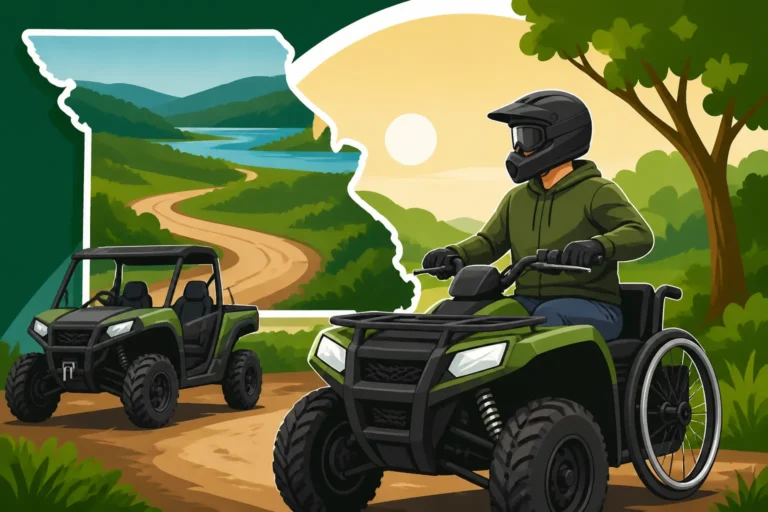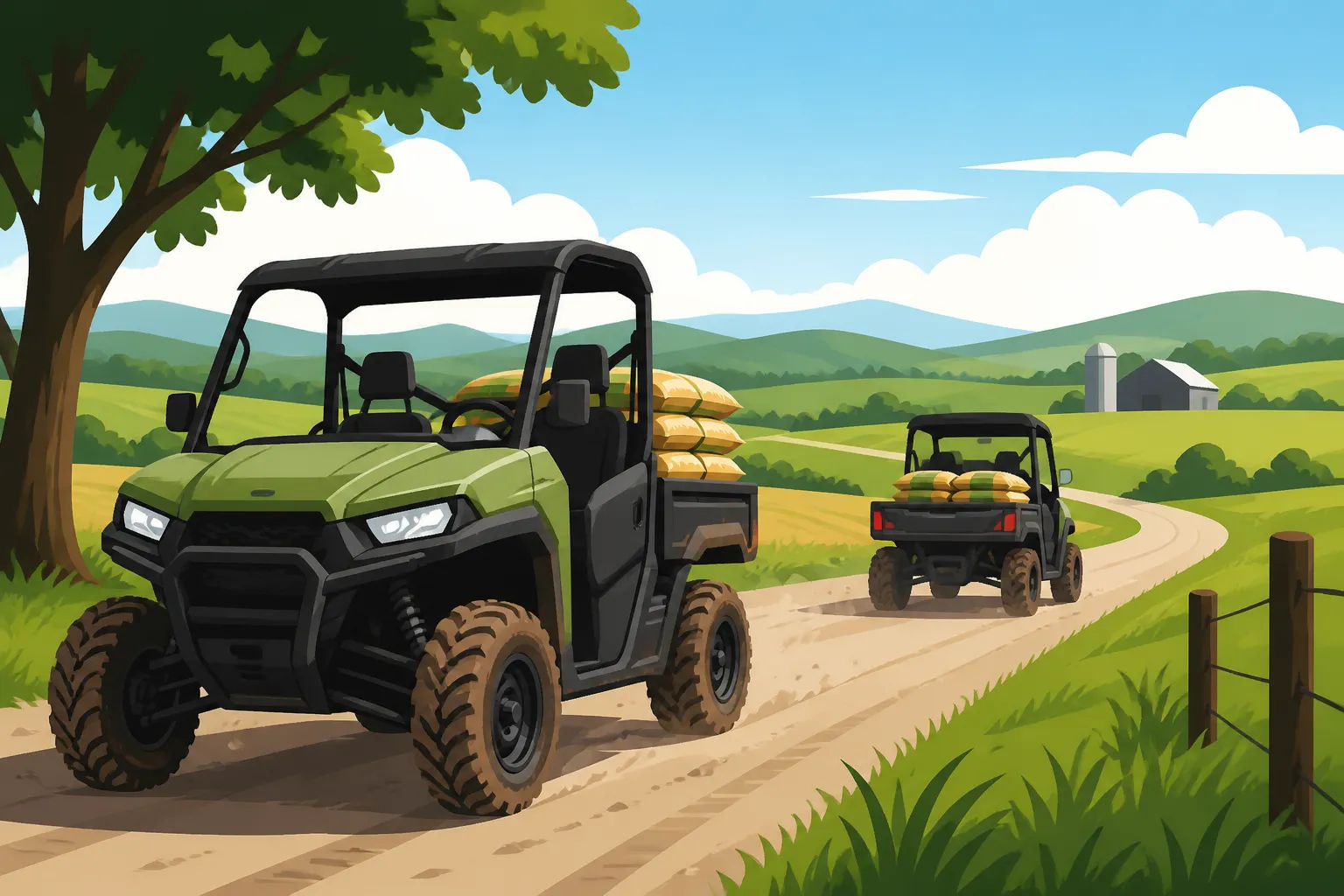
Hauling Feed Down a County Road
Anyone who lives or works on a farm in rural Missouri knows the struggle of needing to move feed, tools, or even just check on livestock a short distance down a county road. It often feels like you're stuck between needing to get the job done efficiently and navigating confusing laws about where your ATV or UTV can and cannot go. This guide will cut through that confusion, focusing on Missouri's specific allowances for using your off-highway vehicle for agricultural purposes on public roads, helping you haul that feed legally and safely.
Understanding Missouri's Agricultural Exemption for ATVs and UTVs
Missouri’s statutes recognize that farmers and ranchers rely heavily on ATVs and UTVs for daily operations. Unlike simply wanting to ride your machine down the street for fun, there's a specific, limited allowance baked into the law for agricultural use. It's a pragmatic approach to help rural residents conduct necessary business without jumping through every hoop required for standard vehicle registration.
This isn't about giving your quad free rein on every paved surface, nor is it a loophole for joyriding. Instead, it carves out a very particular set of circumstances where these machines are treated differently, acknowledging their essential role in farm life. You can think of it as a nod to the practicalities of working the land, rather than a broad invitation to cruise the highways.
What the Agricultural Exemption Actually Means
At its heart, the agricultural exemption means that if you're using your ATV or UTV for a legitimate farm-related purpose, the state makes allowances for you to operate it on public roads where you otherwise couldn't. This covers a wide array of activities that extend far beyond just hauling feed. Imagine needing to check a fence line that runs along a county road, transport seed to a distant field, move small pieces of equipment like a post-hole digger, or even gather scattered livestock that have wandered near a public right-of-way. These are all scenarios where your off-highway vehicle is a tool, not just a recreational machine.
The key here is the purpose of your travel. If you're carrying a sack of cattle cubes, a bale of hay, or a sprayer to treat a field, your intent is clear. If you're simply running into the nearest small town for a soda or to visit a friend, that's not considered agricultural use, even if you happen to live on a farm. The law is designed to facilitate farming operations, not personal errands.
The exemption applies to both ATVs and UTVs, provided they are genuinely being used for agricultural work. It's an understanding that a truck might be overkill or impractical for certain tasks, especially on rough farm tracks or wet pastureland. This flexibility is crucial for efficient farm management, allowing you to move quickly and effectively between different parts of your operation that might be separated by a public road.
When and Where You Can Use It
The agricultural exemption isn't boundless; it comes with specific conditions, primarily concerning the time of day and the nature of the travel. You're generally permitted to use your ATV or UTV for agricultural purposes on public roads only from "sunrise to sunset." This daytime restriction is a significant point and makes sense from a safety perspective, as off-highway vehicles are less visible and often lack the same lighting systems as conventional road vehicles. Attempting to haul feed after dark, even for farm work, could land you in hot water.
Another critical aspect is the idea of "short distances" or travel "necessary to the farm operation." This isn't an open invitation to drive your UTV miles down a state highway to the feed store. Instead, it's typically for moving from one field to another, accessing a remote part of your property, or reaching a specific point that requires brief use of a public road. The intent is to facilitate movement directly connected to the farm, not to provide a general transportation solution. If you need to cross a state route, Missouri law typically requires you to do so at a right angle and with extreme caution. For more on this, you might find [Crossing a Missouri Highway on a Quad] helpful.
The distinction between county roads and state routes is also important. County roads, often gravel or lightly traveled, are generally where this exemption is most applicable and commonly seen. State highways, with higher speed limits and greater traffic volume, present a different risk profile. While the exemption may technically apply to certain crossings or very brief stretches, using a state highway extensively for agricultural purposes on an ATV or UTV is usually discouraged and more likely to draw attention from law enforcement due to safety concerns.
Equipment and Safety Considerations for Agricultural Road Use
Even when operating under Missouri's agricultural exemption, safety should always be your top priority. Just because the law allows you to use your machine on the road for farm work doesn't mean the road conditions or other drivers will be forgiving. Taking proactive steps to ensure your machine is ready and you're visible can make all the difference.
It's easy to get complacent when you're just running down the road to move a few bales of hay, but accidents can happen quickly. Being prepared isn't just about avoiding a ticket; it's about protecting yourself, your passengers, and your valuable equipment. Think of it as operating on the defensive, knowing that you're sharing the road with vehicles that are much larger and faster.
Essential Safety Gear and Machine Readiness
When you're out hauling feed or moving equipment, visibility is key. Your ATV or UTV should have fully functional headlamps and tail lamps, even if you're only operating during daylight hours. Brightly colored clothing, or even a high-visibility vest, can make you more noticeable to other drivers. While not always explicitly mandated for this specific agricultural exemption, consider adding a slow-moving vehicle triangle or an orange safety flag, especially if you're traveling on roads with limited sight lines. A good resource for flag rules in other contexts is [Missouri's 7-Foot Safety Flag]. These simple additions significantly increase your presence on the road.
Beyond visibility, ensure your load is properly secured. Hauling feed means sacks, tubs, or bales that can shift or fall. Use sturdy tie-downs, not just old bungee cords that might snap. An unsecured load is not only dangerous if it spills onto the road but can also severely affect your machine's handling, making it difficult to steer or brake effectively. Overloading your ATV or UTV beyond its manufacturer's specified capacity is also a major risk, as it can strain the suspension, tires, and braking system, leading to mechanical failure at the worst possible moment.
For UTVs, always ensure that all occupants are wearing seatbelts and that the roll-over protective structure (ROPS) is intact and functional. These features are designed for your protection in case of an accident. Regular maintenance is also crucial: check your brakes, tire pressure, and ensure your steering is tight and responsive. A machine in good working order is a safer machine, especially when sharing the road with other traffic. If you're regularly hauling heavy loads, you might even consider aftermarket accessories like heavy-duty springs or cargo management systems from brands like SuperATV to enhance safety and capacity.
Insurance and Licensing for Farm-Related Road Use
When it comes to operating any vehicle on public roads, even under an agricultural exemption, liability insurance is a non-negotiable best practice. While Missouri's specific statutes for agricultural ATV/UTV road use might not explicitly mandate insurance in the same way they do for registered automobiles or other specific road-legal permits, an accident involving your machine on a public road could lead to significant financial liability if you're at fault. It's smart to have a policy that covers potential damage or injury to others.
Most ATV and UTV insurance policies can be tailored to include coverage for limited road use, especially for farm operations. It's worth a call to your insurance provider to discuss your specific usage and ensure you have adequate protection. Peace of mind knowing you're covered if the unexpected happens is invaluable, far outweighing the cost of a basic liability policy.
Regarding licensing, a valid driver's license is generally a good idea, if not a requirement, for anyone operating a motorized vehicle on public roads, even under an agricultural exemption. While an ATV used purely on private land might not demand a license, introducing it to a public roadway changes the dynamic. For recreational off-highway vehicles (ROVs) used under other road-legal provisions, an operator's or chauffeur's license is explicitly required. Although the agricultural exemption might be a separate carve-out, demonstrating you are a licensed, competent driver reinforces your responsible use of the road. It shows you understand the rules of the road and have passed the necessary tests to operate a motor vehicle. You can explore [Missouri Driver's License Rules for ROVs] for a deeper dive into licensing requirements for certain road-legal ORVs.
Distinguishing Agricultural Use from Other Road-Legal Options
One of the biggest sources of confusion for Missouri ATV and UTV owners is the myriad of different rules that sometimes allow these machines on public roads. It's easy to conflate the agricultural exemption with other provisions, but it's crucial to understand they are distinct, each with its own specific conditions and limitations. Thinking that one rule applies to all scenarios can quickly lead to trouble.
Missouri’s approach to off-highway vehicles on roads is not a "one size fits all" system. Instead, it’s a patchwork of specific allowances, designed for particular types of vehicles, specific purposes, or within defined geographical limits. Misunderstanding which rule applies to your situation is a common mistake that can lead to fines or worse.
Why This Isn't the "3-Mile Rule" or a Special Permit
Missouri has a widely discussed "3-mile rule" that allows Recreational Off-Highway Vehicles (ROVs) – which primarily means UTVs, not ATVs – to be operated on state roads within a three-mile radius of the operator's home, primarily for personal errands. This rule has a very specific scope: it's limited to ROVs, requires specific safety equipment (like seatbelts and roll bars), and is tied to a limited radius from your residence. The agricultural exemption, on the other hand, applies to both ATVs and UTVs, is based on the purpose of the trip (farm work), and isn't tied to a specific radius from your home. It’s about the activity, not the location or vehicle type in the same way. You can learn more about this specific rule in [Missouri's 3-Mile Rule for Side-by-Sides].
Furthermore, many cities and counties in Missouri have passed their own ordinances to permit the use of UTVs (and sometimes ATVs) on their local streets. These typically require a special permit, often issued by the local police department or sheriff's office, and come with their own set of rules regarding fees, safety equipment, and operating hours. This is an entirely separate mechanism from the state-level agricultural exemption. A farmer using their UTV to check cattle on a county road under the agricultural exemption does not need to apply for a city permit if they are not operating within that specific municipality's limits for general use. For more details on these local provisions, check out [Missouri's Special Permit for Road Use]. The agricultural exemption is a state-level allowance for a specific type of work, while local permits are about general recreational or commuter use within defined local boundaries.
What a Deputy Checks for on the Road
Imagine you're driving your UTV down a county gravel road, loaded with feed, heading to a pasture. A sheriff's deputy pulls you over. What are they looking for? Their primary concern will be ensuring your operation falls squarely within the bounds of the agricultural exemption and that you're doing so safely.
First and foremost, they'll want to see evidence of agricultural activity. This means having feed sacks, tools, sprayers, or other farm equipment visibly present. If your UTV bed is empty, or you're carrying non-farm related items, your claim of agricultural use will be less convincing. They'll also note the time of day – operating between sunrise and sunset is key. If it's well past dusk, you're likely violating the exemption.
The deputy will observe your operator's conduct. Are you speeding? Driving recklessly? Or are you operating the machine cautiously and appropriately for the road conditions and your load? They’ll also assess the machine type; it must clearly be an ATV or UTV, not some other type of off-highway vehicle not covered by the exemption. General machine safety, such as working lights and brakes, will also be checked. Finally, and perhaps most importantly, they will likely ask to see your driver's license and possibly proof of insurance. While the agricultural exemption may relax some rules, basic road safety and operator qualifications remain essential. Being polite, clearly explaining your purpose, and having your documents ready will go a long way in ensuring a quick and positive interaction.
Practical Tips for Hauling Feed Safely and Legally
Hauling feed, hay, or equipment with your ATV or UTV is a daily reality for many Missouri farmers. Doing it safely and legally not only prevents costly fines but also protects you and your machine. It’s not just about knowing the law; it’s about applying common sense and best practices to every trip.
Every time you load up, you're making decisions that affect your stability, control, and visibility. Taking a few extra minutes to prepare can save you hours of trouble or even prevent an accident. These machines are incredibly versatile on the farm, but their limits on public roads, even under an exemption, need to be respected.
Securing Your Load and Maximizing Capacity
When you're loading up feed, it's not enough to just toss it in the bed or on the racks. Proper load securement is critical. Use high-quality ratchet straps or heavy-duty tie-downs to firmly secure all items. Avoid relying solely on bungees, which can stretch, snap, or detach with bumps and vibrations. Distribute the weight evenly; putting all the heavy sacks on one side can severely impact your machine's balance and steering. For ATVs, balance the load across front and rear racks, keeping the heaviest items low and centered. For UTVs, utilize the bed space efficiently, and consider adding a bed mat to prevent items from sliding around.
Be mindful of your machine's weight capacity. Every ATV and UTV has a Gross Vehicle Weight Rating (GVWR) and specific cargo capacities for its racks or bed. Exceeding these limits can overtax the suspension, brakes, and engine, making the machine unstable and unsafe, especially on public roads. If you frequently haul substantial amounts of feed or heavy equipment, consider investing in accessories that enhance cargo management and stability. SuperATV, for example, offers robust cargo racks, bed extenders, and heavy-duty springs that can help manage heavier farm loads more safely and efficiently. These upgrades can make a real difference in how your machine handles with a full load, improving both safety and productivity. If your machine is rated for it, a small trailer can also be an excellent solution for larger loads, keeping the weight off your machine's suspension. You might want to read [Missouri Rules for Towing With a UTV] to understand the legalities of towing on public roads.
Staying Prepared and Avoiding Pitfalls
Being prepared means more than just loading your feed; it means having your paperwork in order and knowing your route. Always carry your valid driver's license and proof of insurance. While specific proof of insurance might not be explicitly mandated for the agricultural exemption itself, having it on hand is always a good practice and can prevent unnecessary delays or questions if you're stopped.
Before you head out, think about your route. Are you sticking to county gravel roads, or will you need to briefly cross a busier state highway? Identify any areas where your "agricultural use" might appear questionable, such as passing through a residential area far from your fields. The less ambiguity, the better your interaction will be with law enforcement. Always operate courteously, respecting speed limits and giving way to other traffic. Remember, you're sharing the road, and projecting a responsible image helps everyone.
Consider the capabilities of your machine for the tasks at hand. UTVs, with their larger cargo beds and often higher towing capacities, are generally better suited for hauling feed and equipment than most ATVs. If your work routinely involves heavy hauling over rough terrain, exploring upgrades that enhance durability and performance can be worthwhile. A SuperATV winch, for example, could be a lifesaver if you get stuck in a muddy field or ditch while making a delivery to a remote pasture. Additionally, for year-round farm work in Missouri's unpredictable weather, a SuperATV windshield and roof can protect both your cargo and yourself from sun, rain, or dust, allowing you to operate more comfortably and efficiently.
Agricultural Exemption vs. General Road Use Rules for UTVs
To further clarify the distinctions, let's look at a comparison between operating a UTV under the agricultural exemption and operating it under Missouri's general rules for permitted road use (like the 3-mile rule or local ordinances). This table highlights why understanding your specific situation is so critical.
| Criteria | Agricultural Use (UTV/ATV) | General Permitted Road Use (ROV/UTV) |
|---|---|---|
| Vehicle Type | Both ATVs and UTVs (if used for farm work) | Primarily ROVs (UTVs); ATVs generally excluded |
| Purpose | Strictly for agricultural operations (hauling feed, farm work) | Commuting, errands, recreational riding (where permitted) |
| Time of Day | Sunrise to sunset only | Varies by local ordinance; 3-mile rule is general |
| Permit Required | Generally no specific state permit for the exemption | Often requires a city/county permit, or state's 3-mile rule applies |
| Driver's License | Recommended; often required for public road operation | Required (Operator's or Chauffeur's) |
| Helmet | Generally not required for adults (recommended for safety) | Required for riders under 18; adults generally optional |
| Safety Flag | Not explicitly mandated for exemption (recommended for visibility) | Required (e.g., 7-foot mast for 3-mile rule, state parks) |
| Insurance | Highly recommended (liability coverage) | Often required by local ordinance or common practice |
This article is for general informational purposes only and does not constitute professional advice. Laws, prices and regulations vary by location and change over time. Consult a qualified professional for guidance on your specific situation.