Why Missouri Requires No Safety Course
Missouri riders often hear that no ATV safety course is required and assume that means there are no training rules—or that a course is pointless. Neither conclusion is quite right. Here’s what the lack of a statewide course requirement means, how it differs from permits and age rules, and when training is still a smart part of preparing to ride.
What Missouri’s lack of a statewide course requirement means
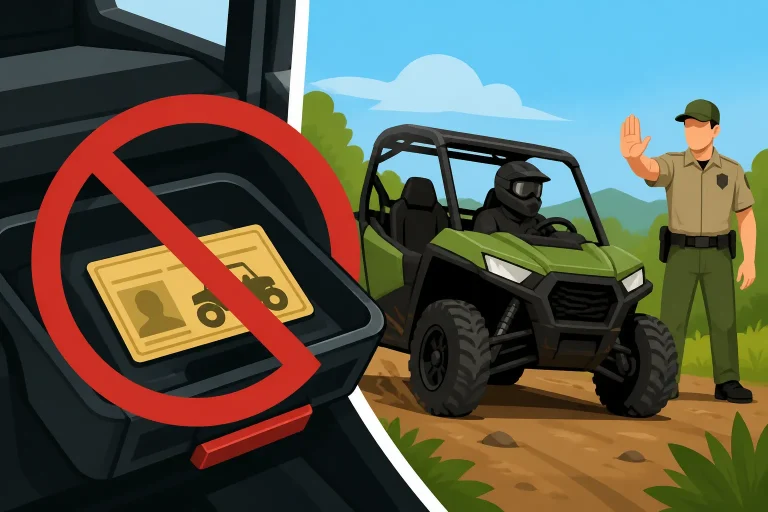
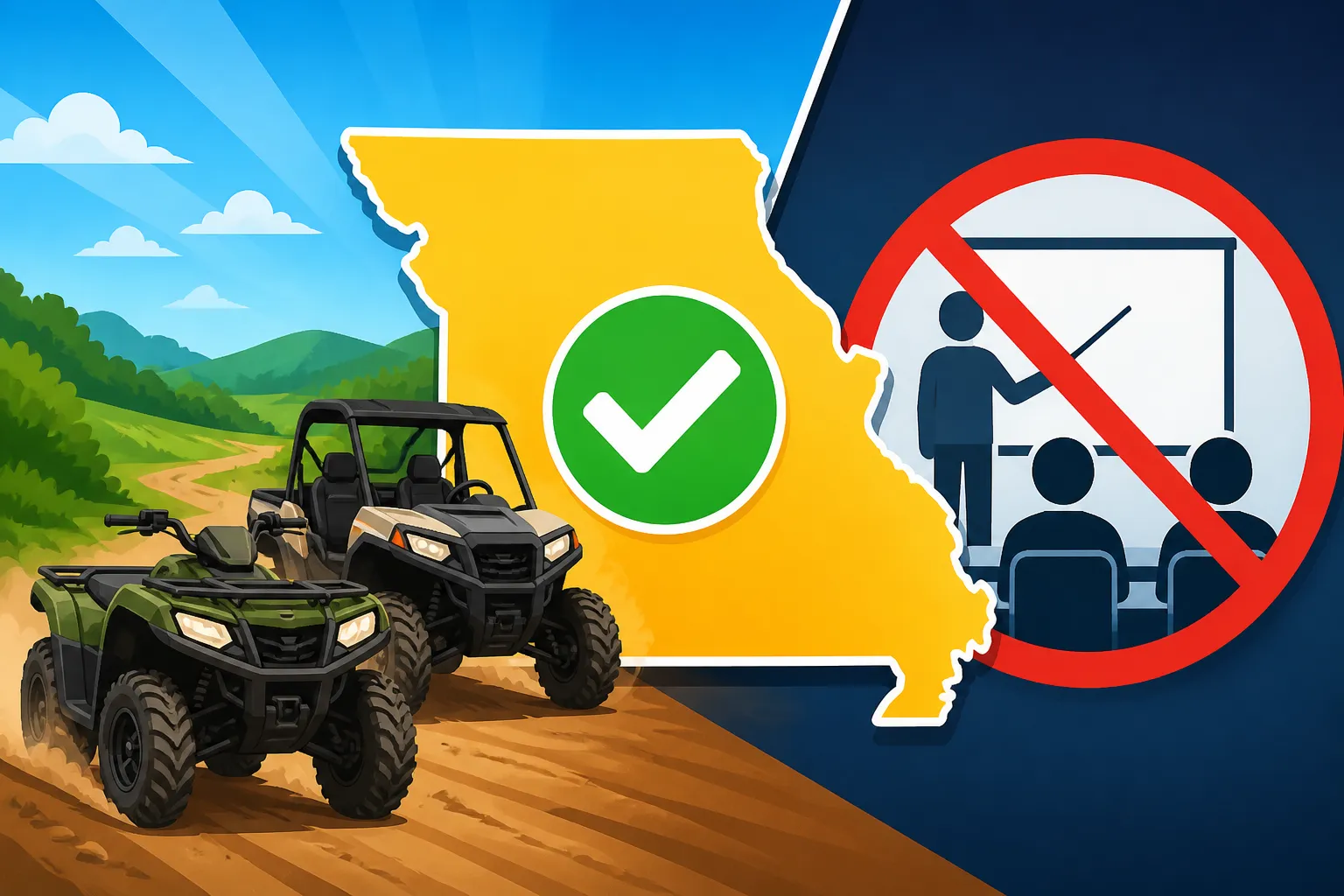
Missouri does not generally require ATV and UTV riders to complete a state safety course or carry a rider certificate simply to ride. In other words, there is no universal state-issued credential that every off-road rider must earn before operating a machine.
That is a limited answer, not a blanket pass. It does not mean every place is open to riding, that every age can ride without restrictions, or that every machine can be used on a road. Access rules depend on where you plan to ride, what type of machine you have, and whether a state agency, land manager, event organizer, rental business, or local ordinance sets additional conditions.
It is also important to separate a training requirement from a permit requirement. A permit may authorize use of a particular public riding area or trail system. It does not necessarily show that you have taken a course, and having a course certificate does not automatically authorize you to ride somewhere that requires a permit. Missouri’s public-land rules vary by location; start with Missouri Rules for Riding Public Land and then check the specific riding area’s requirements.
The short version is:
- Missouri does not generally require all ATV and UTV riders to hold a statewide safety-course certificate.
- You may still need a permit, decal, or other authorization for a particular location.
- Age, supervision, equipment, and machine-width rules can still apply.
- A local government or private operator may set conditions that differ from the general statewide picture.
- Taking a course can be worthwhile even when the state does not require one.
For a focused explanation of the certificate question, see Does Missouri Require an ATV Safety Course?. The rest of this guide explains why the answer is not the same as “there are no rules.”
A safety course, a permit, and a riding rule are different things
It helps to think of riding requirements as separate questions instead of one yes-or-no test. A rider can meet one requirement and still fail another. For example, completing a training course does not make a closed trail open, and buying a trail permit does not prove that a young rider has the skills to handle a machine safely.
| Requirement | What it usually answers | What it does not automatically do |
|---|---|---|
| Safety course or rider certificate | Whether a rider has completed training required by a specific authority or program | Grant permission to ride on private property or a restricted public trail |
| Trail or park permit | Whether a machine or rider has the required authorization for a particular riding area | Prove that the operator has completed a course |
| Registration or decal | Whether a machine has the required state paperwork for a particular use | Make every road or trail legal for that machine |
| Age and supervision rule | Who may operate in a particular setting and whether an adult must supervise | Replace instruction or establish that a child can safely manage a machine |
| Equipment rule | Which safety equipment or machine features are required at a location | Guarantee that the equipment is appropriate for the rider |
| Local road ordinance or permit | Whether a machine may use certain roads under local conditions | Create a general statewide right to ride on roads |
This distinction matters most when you are planning a trip. A rider may have a state decal and still need a separate permit for a riding area. Likewise, a visitor’s out-of-state registration may not settle every question about trail access. Check the riding destination, not just the machine’s paperwork. If you’re visiting Missouri, Missouri Rules for a Visiting Rider explains why a visitor should verify the local access rules before unloading.
The same principle applies to a course. Missouri’s lack of a general course mandate means that a course is not a universal gatekeeper. It does not prevent a land manager from setting its own conditions, and it does not stop an event organizer or rental company from requiring instruction, an orientation, or proof of experience.
When you hear that “no course is required,” ask a more specific question: required by whom, for which machine, and for which place? That follow-up prevents a common mistake—assuming a statement about statewide training applies equally to a state park, national forest, private riding park, local road, or rental counter.
Why the statewide answer does not settle every riding location
Missouri is not one large, uniform ATV trail system. State agencies, federal land managers, local governments, private landowners, and commercial riding areas control different places. Each can have distinct access rules. The absence of a statewide course certificate does not erase those differences.
State parks and designated riding areas
A riding area may require a permit and may have rules about helmets, flags, spark arresters, noise, passenger capacity, youth riding areas, machine width, or supervision. These rules can be more important to your trip than whether the state requires a course.
Before you leave, check the official information for the specific park or area you intend to use. Make sure the route is open to your type of machine and verify whether your machine fits any width limit. Do not assume that a registration decal substitutes for a park permit. For an overview of permit questions, see Missouri State Park ORV Permit Prices and [Missouri Rules for Riding a National Forest].
A posted rule may also distinguish between a machine type and a rider type. A side-by-side can face a different permit or trail-access rule from a quad. A child can face supervision or area restrictions that do not apply to an adult. The park may require certain equipment regardless of whether anyone has completed a course.
If staff offer an orientation or recommend a beginner area, treat that as useful information rather than a sign that training is optional in practice. A formal certificate may not be required, but a short explanation of trail markings, passing etiquette, and local hazards can prevent a costly or dangerous mistake.
Conservation areas and other public property
A public parcel is not automatically open to ATVs. Some conservation areas and other managed lands restrict motorized use to specific roads or prohibit it altogether. Rules can depend on the land’s purpose, designated routes, seasonal closures, and posted notices.
This is one reason a safety card cannot function as a universal access pass. Riders should confirm that motorized riding is allowed on the specific land and route. If the land is closed to ATVs, having a certificate, a helmet, and a permit from a different venue does not change that. Read the signs at the entrance and check current land-manager information before planning a route.
National forest and federal land
Federal land can have its own motor-vehicle designations, seasonal restrictions, permit requirements, and trail rules. A road shown on a map is not necessarily open to an ATV, and a trail open to one machine class may not be open to another. Do not rely on a state rule or a map from a different riding area to decide whether a route is legal.
The practical approach is to identify the exact ranger district or recreation area, then check its current route designations and alerts. Conditions can change after storms, maintenance, fire danger, or other closures. If a permit is required, make sure you understand where it applies and what proof you need to carry. Training remains a separate issue: it can prepare you to ride, but it does not replace authorization from the land manager.
Private property and commercial parks
On private property, the landowner’s permission is central. A rider should not assume that an open-looking trail, field, or gravel lane is available for public use. Permission should cover the place and type of riding you intend to do, especially if the property is leased, shared, or used for farm operations. The details are covered in [Missouri Rules for Riding Private Property].
A commercial riding park can set its own operating conditions. It may require an orientation, a waiver, proof of age, an approved helmet, or other safety steps even though Missouri does not impose a general statewide course requirement. Ask before traveling. An online listing or a friend’s experience from a previous season may not reflect the park’s current policies.
Age and supervision rules still matter
No statewide course requirement should not be confused with permission for every rider of every age to ride every machine. Age and supervision rules can vary by setting. A child may be allowed to ride in one place under adult supervision but restricted from a particular public trail, road, or machine class elsewhere.
The key questions are:
- Who is operating the machine? Rules may treat children and adults differently.
- Where will the ride take place? A park, forest, private property, and public road may each have different rules.
- What machine is involved? A youth ATV, full-size quad, and side-by-side do not necessarily follow identical conditions.
- What does “supervision” mean there? Confirm whether an adult must be present, able to observe, or otherwise meet a stated condition.
- Is the rider allowed in that specific area? Some locations have youth-only areas or prohibit certain riders from particular routes.
For a child’s first ride, do not use the absence of a course mandate as your safety standard. Start by checking the applicable age rules, including [Missouri Minimum Age to Ride Public Land] and [Missouri Supervision Rules for Young Riders]. Then consider whether the machine is a sensible size and power level for that child. A rider who can reach the controls may still lack the strength, judgment, or experience to manage a heavy machine on a slope or in a rut.
The vehicle’s label and manufacturer guidance matter, too. A child should not be placed on a machine simply because an adult can ride it comfortably or because it has a passenger seat. Fit should account for the rider’s ability to reach the controls, steer, brake, and maintain a stable riding position. On a side-by-side, use the intended seat and restraints, and never treat a cargo area as a passenger seat.
Supervision should be active, not ceremonial. An adult standing far away or riding ahead around a blind bend may not be in a position to help. For a beginner, the supervising adult should be close enough to observe, communicate, and stop the ride when conditions become too difficult. Agree on hand signals or a simple stop command before starting, especially if engine noise makes conversation difficult.
A safety course may help a young rider learn basic control and judgment, but it does not replace adult responsibility. Nor does a parent’s completion of a course certify a child. Every rider needs practice on a suitable machine in a controlled area before tackling faster, narrower, rougher, or busier trails.
Why training is still useful when it is not mandatory
A legal minimum answers whether a rule requires something. It does not tell you what will make a ride safer. ATV and UTV crashes can happen to experienced riders, and many hazards are not obvious to a beginner. Training gives riders a chance to learn before a small error becomes a rollover, collision, or serious injury.
A good course can cover practical skills such as:
- Pre-ride checks and basic maintenance.
- How to operate the controls and stop smoothly.
- Braking and turning without losing control.
- Reading slopes and choosing a safe line.
- Keeping an appropriate following distance.
- Recognizing when a route is beyond the rider’s ability.
- Riding within the machine’s capacity and the manufacturer’s guidance.
- What to do if a machine tips, stalls, or becomes stuck.
- Trail etiquette and communication with other riders.
- Protecting the environment and staying on designated routes.
That kind of instruction is particularly useful for new riders, teenagers, people moving from a small ATV to a larger one, and drivers who are familiar with cars but new to off-road handling. A side-by-side may have a steering wheel and seat belts, but it behaves differently from a passenger car. A quad may look straightforward, yet shifting body position, braking, and turning can demand practice.
Training also helps experienced riders when their habits have grown casual. Riders who have spent years on private land may not know a public area’s passing conventions, sound limits, trail markers, or equipment checks. A refresher can help a group agree on basic procedures before setting out.
If you choose a course, look for instruction suited to the machine and the rider. A course designed for a young ATV operator may not cover the same concerns as a class for side-by-side drivers. Check who provides the course, what skills it teaches, whether it includes practical riding, and whether the location recognizes its certificate for any specific purpose. Do not assume a course marketed online is required or accepted by every park, event, or employer.
Some riders use online videos or manuals as a supplement. They can help explain controls and preparation, but watching a demonstration is not the same as practicing emergency braking or handling a turn under supervision. A listing on Amazon may help you compare printed manuals or protective equipment, but verify that the material applies to your machine and that any helmet or protective gear meets the applicable requirements. Do not treat a purchase receipt as proof of training.
A course is only one part of risk reduction. Riders should wear appropriate protective equipment, follow the machine manufacturer’s instructions, avoid alcohol or drugs, ride at a pace that allows them to react, and stop when fatigue or weather makes judgment worse. For youth riders, the adult’s choice of machine and route matters as much as the child’s willingness to learn.
A practical pre-ride checklist for Missouri riders
Because there is no single statewide course card to settle the question, a short location-specific checklist is more useful than relying on a general statement.
Confirm where riding is allowed
Identify the actual property and route, not just the nearest town or trail system. Check whether ATVs or UTVs are allowed, whether your machine class is permitted, and whether the route is currently open. Look for seasonal closures, storm damage, hunting-season notices, and restrictions on riding off designated trails.
If your plan includes more than one land manager, check each part separately. A permit or rule at one trail system may not apply after you cross onto a different property. This is especially important on multi-day rides, where riders may move between a park, forest, private land, and a public road.
Check permits and machine paperwork
Find out whether the riding area requires a day permit, annual permit, registration, decal, or other document. Confirm whether the permit is for the machine, the operator, or both, and whether it must be displayed or carried. Keep required paperwork accessible and protected from mud and rain.
If you are riding a machine brought from another state, do not assume that its existing decal or registration satisfies every Missouri requirement. Reciprocity and venue access are related but not identical questions. Check Missouri ORV Reciprocity With Other States and the specific trail manager’s current rules.
Verify the machine fits the route
Measure the machine if the trail has a width limit. Check the manufacturer’s recommended passenger capacity and operating instructions. Confirm required lighting, flag, spark arrester, or other equipment for that destination. A machine that is legal on one route may be too wide or otherwise unsuitable for another.
Do a basic inspection before loading or riding. Check tires, brakes, throttle, steering, lights, belts or chains as applicable, fuel, and visible leaks. Make sure the machine has no loose cargo that can shift or snag. Carry tools and recovery equipment suited to the ride, but do not let a winch or recovery strap encourage you to enter terrain you should avoid.
Match rider, machine, and conditions
Choose a route based on the least experienced rider in the group. A route that feels easy to one adult may be overwhelming for a child or a first-time operator. Start with a short, familiar loop and leave room to turn back. Avoid putting a beginner on a steep, narrow, crowded, or deeply rutted trail as a first lesson.
Conditions can change the difficulty of a familiar route. Wet clay, loose gravel, standing water, washouts, fallen limbs, and low visibility can turn an ordinary trail into a hazard. If the weather or trail condition is beyond the group’s ability, choose a different route or postpone the ride.
Agree on the group plan
Before starting, identify the lead rider and the last rider, set a pace, and agree on where to regroup. Make sure everyone knows how to signal a stop or problem. Keep enough distance to avoid dust and allow room for braking. Do not leave a new rider alone at an intersection or assume they know which trail marker to follow.
Tell someone who is not riding where you plan to go and when you expect to return. Carry a charged phone, but do not count on having service in every riding area. If the group separates, a simple plan is more useful than trying to improvise in a remote location.
Common misunderstandings about the missing course mandate
“No course is required, so I can ride anywhere”
No. The absence of a statewide course requirement does not grant access to private property, closed routes, conservation land, or roads that prohibit the machine. Permission and land-use rules still control. Check the land manager’s information and follow posted signs.
“My permit means I’m trained”
No. A permit is generally an access authorization, not a skills assessment. It does not show that you know how to brake, turn, handle a slope, or supervise a young rider. Treat permits and training as separate parts of preparation.
“My course certificate lets me skip the permit”
Usually, no. A certificate does not replace a required park or trail permit. Confirm what the destination requires and carry the required proof. The same is true in reverse: a permit does not necessarily satisfy a course requirement imposed by a specific event or operator.
“An out-of-state card answers the Missouri question”
Not necessarily. A visiting rider should check both Missouri’s applicable rules and the riding area’s conditions. A training card from another state might be useful evidence of experience, but do not assume every local authority recognizes it for every purpose. For access and reciprocity questions, see Missouri ORV Reciprocity With Other States.
“A side-by-side follows the same rules as an ATV”
Not always. Missouri rules and local riding-area policies can distinguish ATVs, utility vehicles, and recreational off-highway vehicles. Road use is a particularly important area of difference. A side-by-side’s seat belts, roll cage, and steering wheel do not automatically make it a street-legal vehicle. Confirm the machine classification and the exact road-use conditions before entering a public road.
“A helmet is a substitute for training”
A helmet helps protect the rider, but it cannot prevent every crash or replace skill and judgment. Helmet rules may also differ by age, machine, location, or activity. Check the rules for your situation, including Missouri Helmet Law for Riders Under 18, and choose properly fitted protective gear.
“A child can ride an adult’s ATV if an adult is nearby”
The adult’s presence does not make an unsuitable machine a good fit. The child must be able to operate the controls safely and follow instructions, and the location’s age and supervision rules still apply. Choose equipment and terrain for the child’s real ability, not an assumption that they will “grow into” the machine during the ride.
“If the rental counter let me take it out, I must be allowed everywhere”
A rental agreement and a trail permit do not necessarily authorize use on every road or trail. Ask the rental operator where the machine may be ridden, what rules apply, and whether you need a separate permit. Review [Missouri Rules for Riding a Rented Machine] before assuming the rental includes every required authorization.
The bottom line
Missouri’s lack of a general statewide ATV and UTV safety-course requirement means riders are not universally required to earn a state rider certificate before using an off-road machine. It does not mean that permits, age limits, supervision, equipment rules, trail restrictions, or local requirements disappear.
Check the specific land manager and route, confirm the machine is allowed, and verify any permit or equipment conditions before you ride. For a new operator—especially a young rider—consider hands-on training even when no law requires it. The best standard is not simply whether the state demands a card; it is whether each rider can handle that machine, on that route, under the conditions they will actually face.
Disclaimer
This article is for general informational purposes only and does not constitute professional advice. Laws, prices and regulations vary by location and change over time. Consult a qualified professional for guidance on your specific situation.