Meeting a Horse on a Shared Trail
A horse appearing around a blind bend can turn an ordinary Missouri trail ride tense in seconds, especially when your engine is loud and there is nowhere obvious to pull over. The safest response is to slow early, stop, make your machine quiet, and let the horse’s rider guide the encounter. This guide explains how to prepare, pass safely, and avoid making a close call worse.
Prepare for horses before you unload
Confirm that the route allows both uses
“Shared trail” can mean different things: a route may be open to several kinds of users, a segment may cross an equestrian route, or riders may simply encounter horses near a trailhead. Don’t assume an ATV or UTV route is open to horses—or that every horse trail permits motorized vehicles. Check the official land manager’s current map, posted notices, and trailhead signs before riding.
That check matters in Missouri, where a trip might involve a state park, a Mark Twain National Forest trail system, a private riding park, or a route that changes character as it passes between areas. A route near Chadwick or Sutton Bluff, for example, still needs to be checked for its specific permitted uses and conditions; the name of a recreation area alone does not tell you what is open to your machine or to horses. Start with Missouri Trail Maps From State Parks and [Missouri Rules for Riding a National Forest] when planning a public-land trip.
If the map or signs are unclear, contact the land manager before you ride rather than treating uncertainty as permission. Read Reading the Trailhead Board Before You Unload when you arrive, and check Missouri Trail Closures to Check First for restrictions that may affect your planned route. Stay on the trails designated for your vehicle. Riding around a closure or using an unauthorized connector can put you in the path of other users and create conflicts that a little planning could have avoided.
Set your group up to respond calmly
Before starting the engine, agree on what everyone will do if the group meets a horse. Pick one person to communicate with the rider, and tell the others to stay behind that person instead of crowding forward. A group that stops in an orderly line is easier for an equestrian to assess than several machines fanning out across the trail.
If you use a mapping app such as onX Offroad, review the route before the ride and save the information you’ll need for areas where phone service may be unreliable. Look for crossings, junctions, narrow sections, and places where your group might be able to wait without blocking a trail. A map is a planning aid, not permission to ride: confirm access rules and obey posted directions. Consider Missouri Trail Conditions Before You Ride as part of that same pre-ride check.
Talk through a few practical points with your group: who will speak, how everyone will stop, and how you’ll handle a horse approaching from behind or around a blind corner. Remind riders not to rev the engine, honk, or try to squeeze past. Those decisions are much easier to make in the parking area than in a tight, noisy encounter.
What to do when you see a horse
Slow down, stop, and make the machine quiet
As soon as you see a horse—or hear a rider calling from around a bend—ease off the throttle and slow down smoothly. Avoid a sudden approach, sharp turn, or abrupt stop close to the animal. When there is a safe place to do so, stop well before the horse and leave room for the rider to decide what happens next. If other trail users are behind you, signal them to stop too.
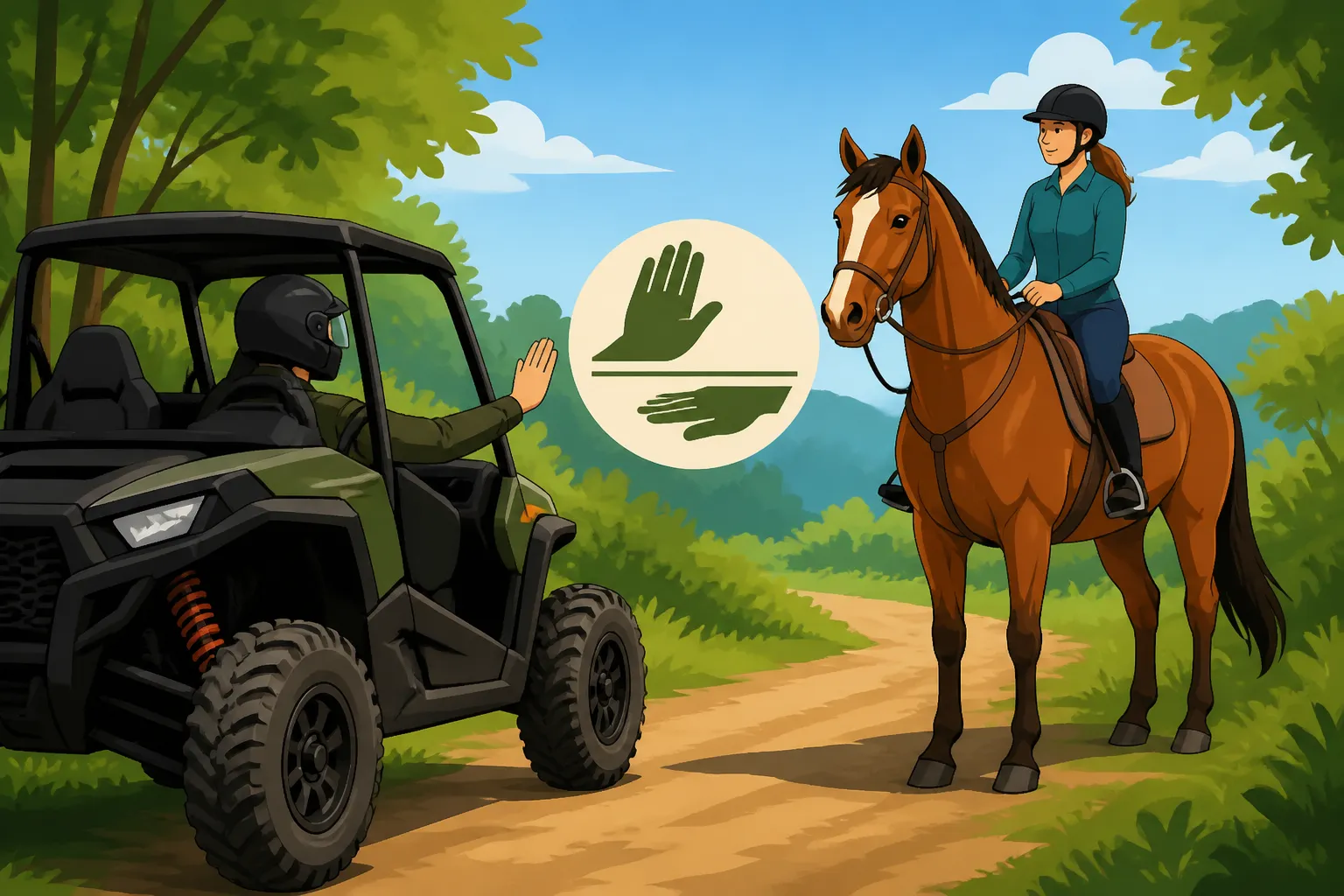
Turn off the engine when the horse is close enough that the noise could be unsettling. If your machine has accessories that rattle or a radio playing, quiet those as well. Stay on the trail or in a safe pullout; don’t cut into brush to create space, since a horse may react to movement in the vegetation or have nowhere safe to go. Keep your hands steady and your body relaxed rather than waving or making sudden gestures.
Let the rider know you are there in a calm voice. A simple “We’re stopped—what would you like us to do?” is more useful than assuming you know which side the horse will tolerate. Horses differ, trail conditions differ, and the rider can see how their animal is responding. The guidance in Missouri Trail Etiquette on Shared Ground is especially relevant here: leave room, communicate, and don’t turn a narrow passage into a contest over who goes first.
Let the rider direct the pass
Often the safest choice is to wait while the horse passes. Keep the engine off and give the animal as much space as the trail safely allows. Avoid standing immediately beside the horse, moving toward its head, or stepping into its path. Don’t reach out to touch it, even if it appears calm. The rider is responsible for handling the animal; your job is to make your machine predictable and give them room.
Sometimes the rider may ask you to move to a particular side or wait in a specific place. Follow their direction if you can do so safely. The ground may slope, the trail edge may be unstable, or brush may limit the horse’s view. If you’re unsure whether a suggested position is safe for your group, explain that calmly and ask the rider how they would like to proceed. Avoid starting the engine until the horse is far enough away and the rider indicates that it is safe.
If the horse is approaching from behind, don’t accelerate to get away or turn suddenly to face it. Move to a safe stopping place if one is available, stop, and speak so the rider knows where you are. If the horse appears nervous, stay quiet and still while the rider manages the situation. For more detail on the encounter itself, see Meeting a Horse on a Shared Trail only as a reference for the etiquette involved; in the moment, the rider’s directions and posted trail rules should guide what you do.
| Situation | Safer response | Avoid |
|---|---|---|
| You spot a horse ahead | Slow early, stop at a safe distance, and turn off the engine when appropriate | Riding closer to get a better look |
| A horse appears around a blind bend | Stop before the narrow section if possible and speak calmly | Accelerating, honking, or swerving |
| The trail is too narrow to pass | Wait for the rider to choose a safe way through | Pushing past or riding into brush |
| A horse comes up behind your group | Stop in a safe place and let the rider know you are there | Speeding up or making a sudden turn |
| The rider asks you to move | Follow their direction when it is safe, and ask if you’re unsure | Assuming one side is always safer |
| The horse seems unsettled | Stay quiet and still while the rider handles the animal | Restarting the engine or gathering close to the horse |
Handle difficult encounters without escalating them
Narrow trails and blind corners
A narrow trail gives both you and the rider fewer options. When visibility is limited, slow down before the bend, keep your machine under control, and be ready to stop. That is especially important on Ozark routes, where curves, uneven ground, vegetation, and changes in elevation may limit how far ahead you can see. A horse may be quiet and still be close enough that a fast approach startles it.
If you meet at a pinch point, stop and let the rider assess the space. Don’t insist on passing just because your machine can technically fit. The trail edge could be loose, steep, muddy, or covered in vegetation that hides a drop or obstacle. Wait for the rider to choose a position, then follow their instructions slowly. If there is no safe way to pass, be prepared to back away carefully or wait until the horse has moved through.
Give the horse extra room at junctions and trailheads, where users may be turning, regrouping, or trying to read signs. Keep your group together and avoid blocking an intersection while you wait. If the route becomes too crowded or the encounter shows that the trail is a poor fit for your ride, turn around at a safe place rather than pressing on. Missouri Trail Etiquette on Shared Ground and [Missouri Rules for Riding a Club Trail] can help you think through responsibilities on routes used by multiple groups.
When the encounter does not go smoothly
If a rider asks you to stop or back up, do so calmly and make sure the rest of your group understands the plan. Use brief hand signals or a quiet voice; don’t shout across the trail. If you need to restart your engine to move, tell the rider first and wait until they say it is safe. Start gently rather than revving. If the horse remains anxious, give the rider time and space instead of trying repeated maneuvers.
If a horse bolts, do not chase it, follow it, or try to block its path with your machine. Keep your group stopped and out of the way. The rider may need to regain control or move to a safer area. If someone is injured or the animal is in immediate danger, contact the appropriate emergency service or land manager. Don’t leave the scene simply because your group has managed to get past.
After the encounter, take a moment to check that everyone is ready to continue. If the trail feels unsafe, turn around or choose a different route. Note where the meeting happened so you can report a recurring conflict or confusing signage to the responsible land manager. Stick to authorized routes and follow posted conditions; [Missouri Rules for Riding Off the Trail] explains why going around an obstacle or making a new line can create additional problems.
Make shared-trail riding safer for everyone
Keep noise, speed, and spacing under control
A horse may hear your machine before it can see you. Keep speed conservative near trailheads, bends, intersections, and any area where another user could be hidden from view. Avoid unnecessary throttle bursts, aggressive acceleration, and loud music. A quieter, more predictable approach gives the rider a better chance to notice you and decide how to handle the meeting.
Leave enough space between machines that each person can stop without rear-ending the rider ahead. If the first person encounters a horse, the rest of the group should not keep rolling forward out of curiosity. Wait for the lead rider to communicate that the situation is clear. A long group can take more time to pass than expected, so don’t restart and follow closely behind the first machine.
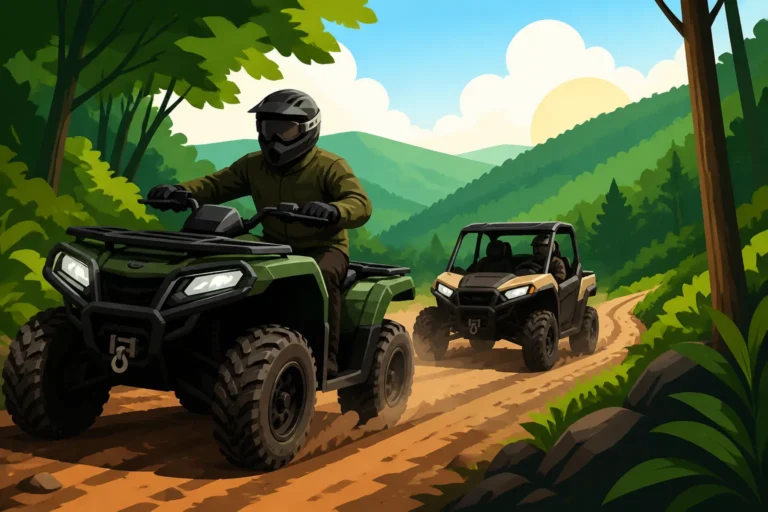
Consider how your machine’s size affects the encounter. A side-by-side can take up much of a narrow trail, while an ATV may be easier to position but still loud and unfamiliar to a horse. Never assume a smaller machine is automatically harmless or that a horse is accustomed to motorized traffic. Be patient, keep your movements measured, and let the equestrian set the pace for passing.
Choose routes and timing with care
Before loading up, think about whether your intended ride is appropriate for a shared route. If you’re taking a new rider, a young passenger, or a large group, a narrow mixed-use trail may be a stressful place to learn trail etiquette. Choose a route with clear permitted uses and enough room to stop safely, and make sure everyone knows the plan. For routes where reception may be limited, onX Offroad can help with preparation if you review and save your map information in advance; confirm trail access with the land manager separately.
Conditions matter, too. Rain can make shoulders soft and stopping distances less predictable, while heavy vegetation can reduce sightlines. If the trail is crowded, visibility is poor, or your group is not comfortable sharing the route, consider postponing or choosing another legal riding area. Don’t ride onto a horse-only trail simply because it looks like a useful shortcut. Checking Missouri Trail Closures to Check First and [Missouri Rules for Riding Public Land] before departure can prevent a wasted drive as well as an uncomfortable encounter.
A respectful meeting is usually uneventful: you stop, quiet the machine, communicate, and wait for the horse and rider to pass safely. If you remember only one practical rule, make it this: don’t make the rider guess what your machine will do next. Predictable behavior, patience, and a little room go a long way on Missouri trails.
Disclaimer
This article is for general informational purposes only and does not constitute professional advice. Laws, prices and regulations vary by location and change over time. Consult a qualified professional for guidance on your specific situation.