Missouri ATV Trails Near Kansas City
If you’re looking for ATV trails close to Kansas City, the frustrating part is that the nearest places to unload legally may still mean a real road trip—and a county road or private field is not automatically an open riding area. This guide compares Missouri options, explains what to check before you tow, and helps you choose a ride that fits your machine and schedule.
Missouri ATV trails within reach of Kansas City
Finger Lakes State Park is a practical first destination
Finger Lakes State Park, near Columbia, is one of the more manageable Missouri state-park options for a Kansas City-area rider. The drive is typically a couple of hours, depending on where you start and traffic. That makes it more realistic for a full-day outing than destinations deep in the Ozarks, especially if you want to avoid making a weekend of it.
The park’s off-road area uses trails across reclaimed mine land. Expect a different feel from a smooth forest path: terrain can be uneven, dusty, muddy, or rutted depending on conditions and recent weather. Check the park’s current information before heading out for operating rules, trail status, permitted machine types, and any restrictions that apply to your vehicle. Don’t assume every trail is open to every machine just because the park allows off-road riding.
A useful starting point is [Finger Lakes State Park in Missouri](Finger Lakes State Park in Missouri). Before leaving home, confirm where the off-road riding area is, what permit or admission steps apply, and whether your ATV or UTV meets the park’s requirements. A day trip can unravel quickly if you arrive with the wrong paperwork, a machine that is too wide for the route, or gear that doesn’t meet posted rules.
St. Joe State Park makes more sense for a full weekend
St. Joe State Park, near Park Hills in southeastern Missouri, is a much longer haul from Kansas City than Finger Lakes. It can be worth considering if your group wants a larger destination and plans to ride for more than a few hours. For many Kansas City riders, the distance makes an overnight stay more comfortable than trying to squeeze the trip into a rushed day.
The park’s off-road area includes a mix of terrain shaped by its mining history. That means changing surfaces and conditions, not a uniform trail experience. A machine that feels easy to manage on a familiar farm track may handle differently on loose sand, hills, or uneven ground. Take time to understand the route options and stay within the areas designated for your vehicle.
For a longer outing, look into [Riding the Sand Flats at St. Joe](Riding the Sand Flats at St. Joe) and [Camping at a Missouri ORV Area](Camping at a Missouri ORV Area). Check the park’s official information for camping availability, trail access, vehicle rules, and closures before you build an itinerary around a particular loop. If you are towing from the Kansas City area, also plan fuel, food, and a place to secure the trailer rather than assuming everything will be available right beside the riding area.
Chadwick and Sutton Bluff are farther Ozarks options
Chadwick and Sutton Bluff are not quick local rides from Kansas City. They are better treated as Ozarks trips, with extra planning for travel time, trail conditions, and services. Chadwick is associated with forest riding near the Ava Ranger District, while Sutton Bluff is in Reynolds County. Both require riders to pay close attention to the specific trail system and its rules rather than treating public land as open riding everywhere.
The nature of the ride can differ from a state-park OHV area. Forest trails may be narrow, rocky, affected by storms, or closed for maintenance. A route that looks straightforward on a map can involve loose rock, creek crossings, steep sections, or long stretches without convenient services. Read current notices and trailhead information before unloading.
If you are comparing the two, start with [Chadwick's 80 Miles in Missouri](Chadwick's 80 Miles in Missouri) and [Sutton Bluff's 45 Miles in Missouri](Sutton Bluff's 45 Miles in Missouri). Check whether your machine fits the restrictions for the exact trails you plan to ride. Some trail systems have width limits, and a side-by-side that is fine on one route may not be allowed on another.
| Riding area | Relative effort from Kansas City | Good fit for | Check before you go |
|---|---|---|---|
| Finger Lakes State Park near Columbia | Often manageable as a day trip | Riders wanting a closer state-park option | Current trail access, machine requirements, permits, and closures |
| St. Joe State Park near Park Hills | Better suited to a long day or overnight | Riders planning a larger destination outing | Park rules, trail conditions, camping, and vehicle eligibility |
| Chadwick area | Long Ozarks trip | Riders prepared for forest-trail conditions | Forest notices, trail restrictions, permits, and access |
| Sutton Bluff area | Long Ozarks trip | Riders whose machines meet the trail system’s limits | Width rules, closures, weather impacts, and permit requirements |
How to choose the right ride for your machine and group
Start with vehicle width and type
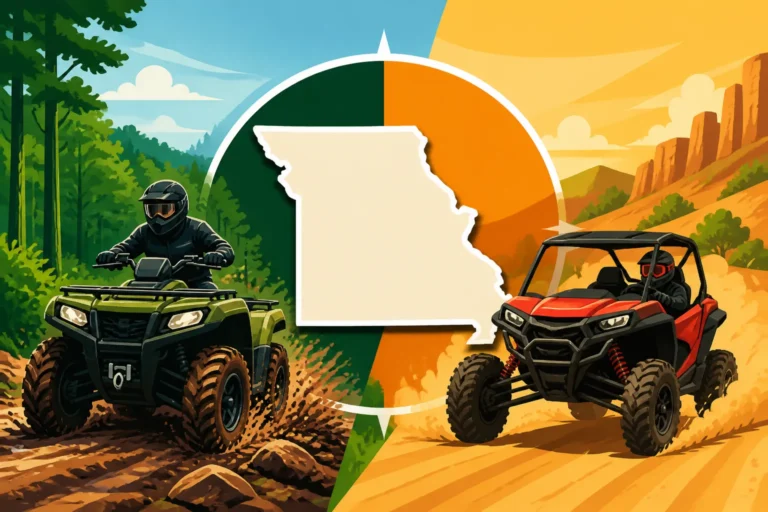
Before choosing a park, identify exactly what you are riding: ATV, side-by-side, or another off-highway vehicle. Then find the trail system’s machine-specific rules. Width is particularly important. A narrow trail may be suitable for a quad but not for a wider UTV, and a machine’s stated width can be different from its practical width once accessories, mirrors, or other add-ons are included.
Measure the machine as you intend to ride it, including any equipment that could affect clearance. Then compare that measurement with the rules for the particular trail, not just the general rules for the park or forest. If you’re shopping for a machine with Missouri trips in mind, [Best Machine Width for Missouri Parks](Best Machine Width for Missouri Parks) and [Machines Under 50 Inches for Missouri Forests](Machines Under 50 Inches for Missouri Forests) can help frame the difference between riding areas.
Also check whether the place you want to visit allows your machine category at all. “ATV trails” is often used casually, but it doesn’t guarantee that a side-by-side is allowed on the same routes. When in doubt, ask the managing office or park directly before towing. That quick check can save you from arriving at a gate with a vehicle that cannot use the trail you planned around.
Match trail difficulty to the least experienced rider
A group usually rides at the pace of its least experienced person, not its most confident one. If someone is new to off-road riding, choose a place with suitable beginner routes and room to take breaks. Don’t make a narrow, rocky route the first ride for a new rider simply because an experienced friend says it is easy.
Kids and passengers also affect the decision. Check age, supervision, passenger, and equipment rules for the exact riding area. State-park rules can differ from general state rules, and a youth-friendly route at one location does not mean every trail is appropriate for a child. Review [Missouri Trails for Beginners](Missouri Trails for Beginners) and [Missouri Trails Good for Kids](Missouri Trails Good for Kids) as you narrow down options.
Be candid with your group about comfort and skill. A newer rider may be happy with a shorter loop and more frequent stops, while a confident rider may want a longer route. Agree on a turnaround point before setting out, and avoid splitting up unless everyone knows the route, has a way to communicate, and understands where to meet if plans change.
Plan for conditions, not just the map
Trail conditions change after heavy rain, dry spells, wind damage, and maintenance work. A map can show where a trail goes, but it cannot promise that the route is open or pleasant to ride on the day you arrive. Call or check official trail notices shortly before departure, especially if your plans depend on a particular loop or crossing.
For navigation, apps such as onX Offroad can help you review routes and save maps for areas where cell service may be limited. Treat the app as a planning aid, not permission to ride. Confirm land boundaries and access rules with the land manager, follow posted signs, and stay on authorized routes. If you use onX Offroad, download the relevant map before leaving areas with reliable service and keep a separate backup plan in case your phone loses power.
A little route planning also makes the day less stressful. Pick a trailhead, note a reasonable riding window, tell someone where you expect to be, and decide what you’ll do if weather or a closure changes the plan. For a broader checklist, see [Missouri Trail Conditions Before You Ride](Missouri Trail Conditions Before You Ride) and [Missouri Trail Closures to Check First](Missouri Trail Closures to Check First).
Permits, access, and the rules riders should not guess about
A vehicle decal is not the same as a trail permit
Missouri title, registration, and decal rules are one part of ownership; access permits for a specific riding area are another. Having paperwork for your machine does not automatically grant access to a state park, national forest trail, private riding park, or conservation area. Likewise, a park permit should not be treated as a substitute for any title or decal requirement that applies to your machine.
Before you leave, identify the land manager for the exact location and check that manager’s requirements. State parks and national forest areas can have different permit systems, operating rules, and equipment requirements. A useful overview is [Missouri ORV Permits Explained](Missouri ORV Permits Explained). For a specific destination, verify which permit applies, how it is obtained, and whether it must be displayed or kept available during the ride.
Keep proof of payment and required paperwork where you can reach it. A phone photo may be convenient, but don’t assume it replaces whatever form of permit or document the site requires. If a rule is unclear, ask the managing office before you reach the trailhead.
Public land is not all open to ATVs
A common mistake is seeing a gravel road, field entrance, or stretch of public land and assuming it is open to off-road riding. Land ownership alone does not mean motorized recreation is allowed. On conservation areas, national forest land, state land, and other public property, riding may be limited to designated routes or prohibited altogether.
Private land requires permission from the owner. That includes pasture, woods, farm lanes, and informal paths that appear to connect with a public road. Don’t rely on a neighbor’s permission, an old online map, or the fact that tire tracks are visible. Ask the owner directly and get the boundaries and allowed routes clear before riding. For more on this distinction, see [Missouri Rules for Riding Public Land](Missouri Rules for Riding Public Land) and [Missouri Landowner Permission Requirements](Missouri Landowner Permission Requirements).
County roads and streets are not substitutes for trail connections unless a specific law or local authorization allows the use. Road rules can differ by vehicle type and location, and a trail permit does not make a machine street legal. If a route requires riding on a road, confirm the applicable rules before using it rather than improvising at the roadside.
Prepare for a day away from the metro area
Once you leave the Kansas City region, cell coverage, fuel stops, and quick repair options may become less convenient. Carry enough water, food, protective gear, and basic tools for the planned ride. For a group, bring a first-aid kit and a way to communicate if riders become separated. Check the forecast and avoid entering creek bottoms or low crossings when heavy rain is expected.
Give your machine a basic check before loading: tires, brakes, lights where required, fluids, battery, and tie-down points. A loose strap or low tire can turn the drive into a frustrating stop before you even reach the trails. Clean the machine after muddy rides, too; dried mud can hide damage and add strain to components.
OnX Offroad can be useful for saving a planned route and checking your position, but download maps ahead of time and carry a charging option. Keep a paper note with the destination, trailhead, and a contact number as a simple backup. And if the managing agency posts a closure or route restriction, follow that notice even if your app still shows the trail.
A simple plan for your first Kansas City-area ride
Build the trip around one main riding area
For a first outing, choose one destination rather than trying to ride multiple areas in the same day. Finger Lakes may be a sensible starting point for riders who want to keep the drive more manageable. If your group is set on an Ozarks forest ride or St. Joe State Park, plan the trip around that location and allow enough time to travel without rushing the unload and safety checks.
Before departure, confirm the address of the actual riding entrance, not just the park’s general address. Check the rules for your machine, required permits, trail status, and any equipment requirements. Save the route and contact details, and make sure everyone knows the meeting point if vehicles arrive separately. Using onX Offroad to save a route can help with navigation, but use official land-manager information to confirm where riding is allowed.
Use a pre-trip checklist
A quick checklist catches many of the problems that otherwise show up at the gate:
- Confirm the riding area is open and appropriate for your ATV or UTV.
- Check machine-width limits, permitted vehicle types, and rider requirements.
- Find out which permits are needed and how the site handles them.
- Pack helmets and any other required protective or safety equipment.
- Inspect the machine, trailer, hitch, tires, and tie-downs.
- Bring water, food, basic tools, a first-aid kit, and a phone charging option.
- Download maps and save the trailhead location before leaving strong cell service.
- Tell someone your destination and expected return window.
The best Missouri ATV trails near Kansas City are not necessarily the closest dots on a map. They’re the places your machine is allowed to ride, your group can handle comfortably, and you can reach with enough time to enjoy the day. Verify access before you tow, keep to designated routes, and leave room in the plan for weather, closures, and the slower pace that makes a ride safer and more enjoyable.
Disclaimer
This article is for general informational purposes only and does not constitute professional advice. Laws, prices and regulations vary by location and change over time. Consult a qualified professional for guidance on your specific situation.