Missouri Supervision Rules for Young Riders
Missouri parents often face two questions at once: whether a young rider may operate an ATV or UTV, and how closely an adult must supervise. The answer depends on where the machine will be ridden. This article explains the practical distinctions between state park riding areas, national forest land, private property, and road use.
What supervision means for a rider under 16
In Missouri, “under 16” is an important age marker in ATV rules, but it does not create one blanket rule for every kind of land or every machine. A state park trail, a national forest route, private property, and a public road can each have different requirements. Before riding, check the rules for the specific site and activity rather than relying on a general idea that a parent being nearby is enough.
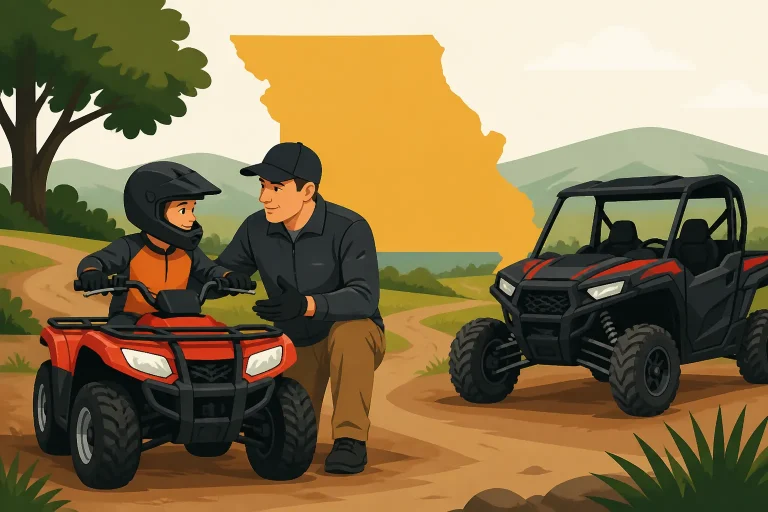
For Missouri state park ORV riding areas, riders under 16 must be supervised by a responsible adult. The adult does not have to be the child’s parent, but should be an adult the supervising rules recognize as eligible. Do not assume that a person watching from a parking area or from a distant campsite counts as active supervision. Confirm the current park instructions about where the adult must be and whether the adult needs to be riding with, or immediately accompanying, the young rider.
The distinction matters because supervision is more than signing a waiver or driving the child to the trailhead. The adult should be able to keep track of the rider, respond quickly, and help ensure the child follows marked routes and site rules. If the rider is new, or if the route has difficult terrain, close supervision may be sensible even when a rule does not specify exactly how close the adult must stay.
A separate rule may apply to children 12 and under at Missouri state park ORV areas: they may be restricted to the designated youth riding area rather than the general trail system. Do not treat adult supervision as permission to take a younger child onto every trail. Check the site’s current age and area restrictions before unloading. For more on that distinction, see Why a 12-Year-Old Rides Only the Youth Area and Missouri Youth Riding Area Rules.
A state park rule also should not be treated as the rule for all public land. Forest routes, local riding parks, and private land may set their own age, supervision, permit, and equipment requirements. Before a trip, check the rules for the exact property and riding area. Missouri Rules for Riders Under 16 provides a broader look at the age-related rules, while Who Can Supervise a Rider Under 16 focuses on who may serve as the adult supervisor.
| Where the child rides | What to check before the trip | Why it matters |
|---|---|---|
| Missouri state park ORV area | Adult supervision rules and any youth-area restriction | A young rider may have access only to a designated area |
| Mark Twain National Forest riding area | Current forest rules, route access, and permit requirements | Forest rules may differ from state park rules |
| Private property | Permission, property-specific conditions, and safe boundaries | A landowner’s permission does not automatically settle every safety or legal question |
| Public road | Road-use rules that apply to the machine and rider | Park supervision rules do not authorize road riding |
For a more detailed discussion of eligible supervisors, see Who Can Supervise a Rider Under 16. If you are comparing age rules across locations, Missouri Minimum Age to Ride Public Land may also help, but always confirm the rule with the land manager before traveling.
Rules change with the place, not just the rider’s age
A common planning mistake is to look up the age rule for one riding area and apply it elsewhere. Missouri’s riding opportunities involve different managers, and a permit or registration decal does not replace the rules set by the property owner or agency.
State park ORV areas
At state park ORV facilities, check the site’s posted rules before riding. These can cover supervision, youth areas, helmets, flags, sound limits, machine width, and permits. A child may be allowed to ride in a specific youth area but not on the larger trail network. The adult’s presence does not cancel a separate age or trail-access limit.
For a family trip, identify the youth area and main riding area on the park map before unloading. Ask staff if the map or posted signs leave anything unclear. Rules can apply differently to an ATV and a side-by-side, so confirm whether the child will be operating the machine, riding as a passenger, or both. The passenger rules are not necessarily the same as the operator rules.
A park permit is about access, not blanket approval for every rider or every machine. Do You Need a Permit for Missouri State Park Trails? explains the permit question, and Missouri Park Access for Riders Under 16 is a useful companion when planning for a young rider.
National forest and other public land
Do not assume that a state park’s youth-area restriction applies in the same way on national forest land. Forest routes have their own access rules, and the permitted route may depend on the machine, current closures, and the forest’s requirements. Check the official information for the relevant riding area before setting out. [Missouri Rules for Riding a National Forest] covers the broader public-land question.
The same caution applies to conservation areas and other public properties. A trail or road that looks rideable is not necessarily open to ATVs. A child’s ability to ride under adult supervision does not make an otherwise closed route legal.
Private property
On private property, get permission from the landowner and clarify where riding is allowed. Agree on boundaries, gates, speed expectations, and whether the child may ride without an adult directly alongside. Permission to use the property is not a substitute for supervision, good judgment, or any applicable law. See [Missouri Rules for Riding Private Property] for more on riding on private ground.
Public roads
A public road is a different setting from an off-road trail. Road use can bring separate rules for machine type, permits, equipment, licensing, insurance, and where the machine may travel. Do not infer that a young rider who is allowed on an ORV trail can also operate the same machine on a road.
This is especially important for side-by-sides. Missouri treats ATVs, utility vehicles, and recreational off-highway vehicles differently in some contexts. Before riding on or crossing a road, check the applicable rules for the machine and route. Missouri Rules for Riders Under 16 and Missouri Rules for Crossing a Highway can help frame the questions, but local and site-specific restrictions still need to be checked.
Plan the ride around the young rider
Even when the rules allow a child to ride, the machine and route need to suit the child. An adult’s supervision cannot compensate for a machine that is too large, controls the child cannot operate reliably, or terrain beyond the rider’s current ability.
Before riding, assess whether the child can reach and use the controls, steer and brake smoothly, and stop the machine when asked. The rider should understand how to respond if the machine stalls, tips, or becomes stuck. Give the child clear instructions about stopping, following the adult, and staying on the marked route. Start on a manageable area and build up gradually rather than treating a long or difficult trail as a first ride.
Use properly fitted protective gear, including a helmet and any additional equipment required by the riding location. Check the machine before the trip: brakes, throttle, tires, steering, lights where needed, and any required safety equipment. Keep the machine’s instructions available and make sure the adult knows how to shut it off and operate its controls in an emergency.
A basic pre-ride routine can make supervision more effective:
- Confirm the location is open to the machine and rider.
- Check age, adult-supervision, youth-area, and passenger rules.
- Confirm permits, decals, and equipment requirements.
- Choose a route that matches the child’s experience and the machine’s limits.
- Set simple boundaries: where the child may ride, how far ahead to go, and when to stop.
- Agree on a signal or plan if the adult and child lose sight of each other.
- Recheck the route and site notices on arrival, since conditions or closures may change.
If the ride is at a state park, make sure the child understands that signs, gates, and staff instructions take priority over the planned route. If the trail is closed or the youth area is full, do not improvise by moving to an unapproved area. A shorter ride in an appropriate space is a better choice than stretching the rules.
Renting or borrowing a machine
A rental does not automatically include permission for a child to ride. Ask the rental provider which ages may operate the machine, what supervision is required, and whether the rental agreement imposes additional limits. Also confirm whether the riding-area permit is included or must be obtained separately. The land manager’s rules still apply even if the rental provider allows the child to operate the machine. See [Missouri Rules for Riding a Rented Machine] before relying on a rental company’s general description.
For a borrowed machine, the owner should explain its controls, starting procedure, braking, and any features that affect safe operation. Do not assume a child can safely operate a machine simply because its seat or advertised size seems suitable. The adult should supervise a test in a safe, permitted area before heading onto a trail.
A safety course can be useful for a young rider, even where a course is not required for the planned ride. It can help a child understand basic operation, terrain, and trail etiquette. Check the specific site and rules to see whether any training is required or recommended. Does Missouri Require an ATV Safety Course? explains the general question.
A practical checklist for parents and supervisors
A good plan answers three separate questions: Is this rider allowed here? Is this machine allowed here? Can this adult supervise this ride safely? If any answer is unclear, pause and check with the property manager or the responsible agency before riding.
Use this checklist before taking a young rider out:
- Identify the exact riding area. “Missouri public land” is too broad to establish which rules apply.
- Check the child’s age category. Pay particular attention to rules for riders under 16 and any separate restriction for children 12 and under.
- Confirm the supervisor’s eligibility. Do not assume that any adult, or an adult merely nearby, satisfies the rule.
- Ask what supervision means at that site. Verify whether the adult must ride with the child or remain in a defined area.
- Check access by machine type. An ATV and a UTV may not share the same trail access or passenger rules.
- Review the route and current notices. Closures and restrictions can change, so check again before the ride.
- Match the route to the rider. Consider experience, machine handling, weather, visibility, and the difficulty of the terrain.
- Use required protective equipment. Confirm the site’s rules instead of assuming that equipment requirements are identical everywhere.
- Keep the adult engaged. Supervision is an ongoing responsibility, not a one-time check at the trailhead.
- Have a plan to stop. If the child is tired, frightened, having trouble with the controls, or not following instructions, end the ride or move to a safer area.
For example, a parent planning a state park visit with a 10-year-old should check whether the child is limited to a youth riding area, who may supervise, and what gear and permit are required. The parent should not assume that an adult escort makes the full trail system available. A 14-year-old going to a forest riding area needs a different check: confirm the forest’s current rules, route access, and any applicable supervision requirements rather than importing the state park rule.
For a child riding on private land, the adult should still set clear boundaries and verify permission. For a road crossing or a route that includes a public road, check the road-use rules separately. The same rider, adult, and machine may be treated differently as soon as the location changes.
When in doubt, call or contact the manager of the riding area before loading the machine. Ask the question in concrete terms: the child’s age, machine type, whether the child will operate or ride as a passenger, and the route you intend to use. That is more useful than asking only whether “kids can ride,” because the answer may depend on all four details.
Disclaimer
This article is for general informational purposes only and does not constitute professional advice. Laws, prices and regulations vary by location and change over time. Consult a qualified professional for guidance on your specific situation.