Reading a Frame Number on an Old Quad
Trying to title or register an older ATV in Missouri can feel like a scavenger hunt, especially when the crucial frame number—that unique identifier for your machine—seems to have vanished or is buried under years of mud and rust. This guide is here to walk you through exactly why that number is so vital, where to meticulously look for it on your vintage quad, and how to decipher it, ensuring you can get your machine properly documented and ready for the trails without unnecessary headaches.
Why Finding Your ATV's Frame Number is So Important in Missouri
When you own an ATV in Missouri, that specific string of numbers and letters isn't just a serial number; it's the very identity of your machine, crucial for proving ownership, registering it for use, and even for insurance purposes. Without it, you’re essentially trying to operate an anonymous vehicle, which can lead to all sorts of legal and practical snags down the road.
The Lifeline to Legality: Titling and Registration
In Missouri, every ATV needs a title, even if it's not registered with a decal for public lands. That title, issued by the Missouri Department of Revenue, is your legal proof of ownership. And the cornerstone of that title is the Vehicle Identification Number (VIN) – or frame number, as it's often called for ATVs. Without a clear, verifiable VIN, you simply cannot get a title. This means you won't be able to legally sell the machine, and if you ever need to replace a lost or damaged title, you'll be in a real bind.
Furthermore, if you plan to ride your ATV on designated state park trails, such as those at St. Joe State Park or Finger Lakes State Park, or in national forest areas like Chadwick, you'll need an ORV permit. While this isn't the same as a traditional "registration" with a plate, the Missouri Department of Revenue still requires your ATV to be properly titled. They cross-reference the VIN to ensure the machine isn't stolen and belongs to you. Imagine showing up at a trailhead after a long drive, only to be turned away because your machine's paperwork is incomplete due to an unreadable VIN. It's a frustrating scenario many riders unfortunately face. Learning about [Titling an ATV in Missouri] is a vital first step for any new owner.
Proving Ownership and Preventing Fraud
Beyond the official state requirements, the frame number serves as your machine's fingerprint, unequivocally linking you to your quad. If your ATV were ever stolen, this number is what law enforcement would use to track it down and verify it's yours once recovered. Without it, proving you're the rightful owner becomes incredibly difficult.
For anyone [Buying a Used ATV Privately in Missouri], the VIN is the first thing you should check. It allows you to perform a title lookup, ensuring the seller actually owns the machine and that it hasn't been reported stolen. Websites and even the Department of Revenue can sometimes run a quick check if you have the VIN. A seller who can't readily provide or show you the VIN, or who presents a title with a different VIN, should immediately raise a red flag. This also applies when you're the one selling – a clean, readable VIN on your title and frame makes the transaction much smoother and instills confidence in your buyer, potentially even streamlining the process if you use a service like LawDepot to draft a [Missouri Bill of Sale for an ATV].
Where to Locate the Frame Number on an Older Quad
Older ATVs can be notoriously tricky when it comes to locating their frame numbers. Unlike modern cars that often have VINs visible through the windshield, ATV frame numbers are typically stamped directly into the metal, making them susceptible to dirt, rust, and wear over time. It's not uncommon for owners of vintage machines to spend a good chunk of time scrubbing, scraping, and searching before finding what they need.
Common Locations on the Frame
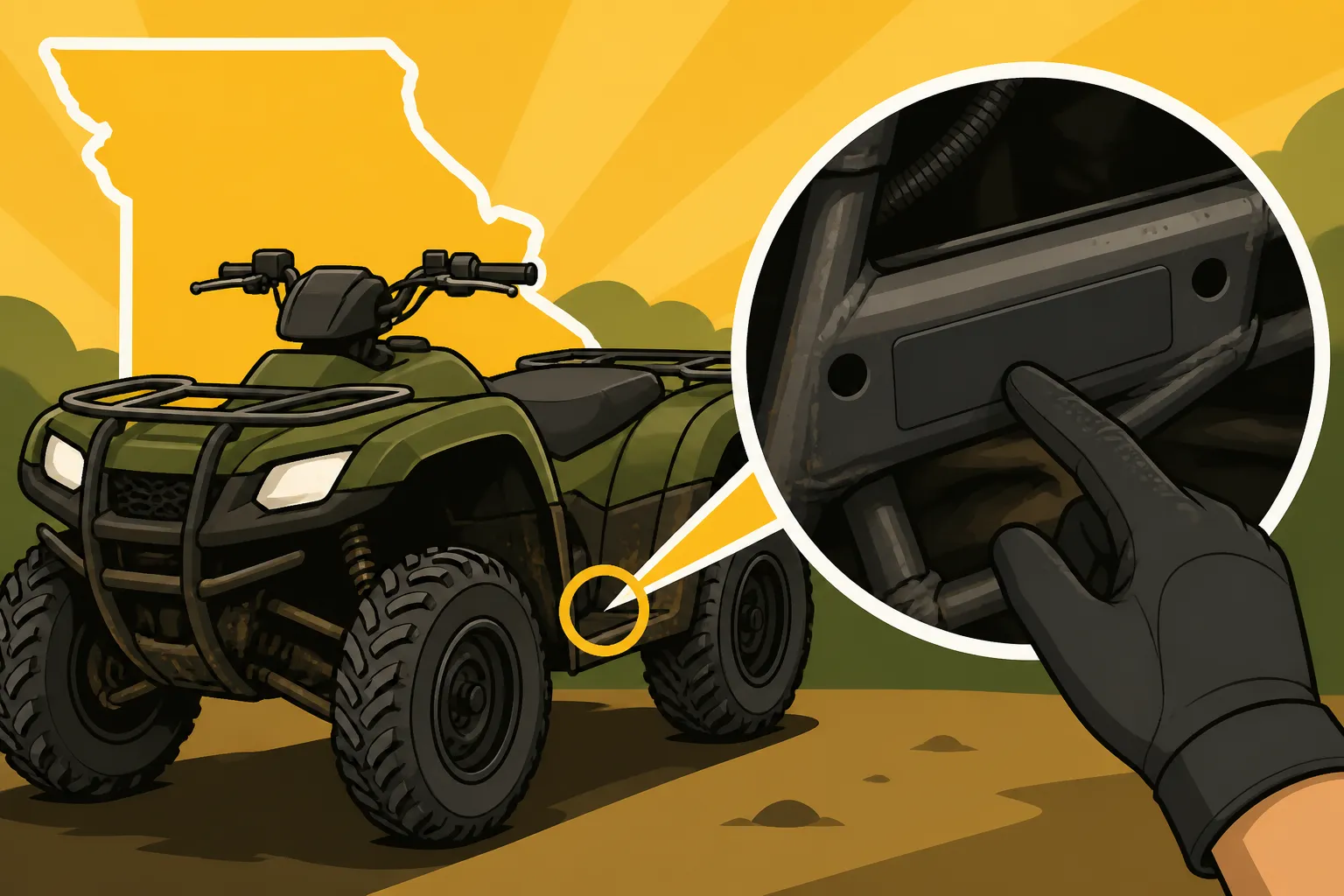
Manufacturers typically stamp the VIN in specific, durable locations on the ATV's frame. These spots are usually chosen because they are less likely to be damaged in a crash and are part of the main structural integrity of the machine. The most common place to start your search is on the right side of the steering neck or headstock. This is the vertical tube at the very front of the frame where the handlebars and front suspension attach. The number is often stamped vertically or horizontally on the tube itself, or on a small metal plate welded to it.
Another frequent location, especially on older models, is along the lower left-hand frame rail. This rail runs underneath the engine and transmission, from the front to the back wheel. You might need to get down on your hands and knees, or even slide under the ATV, to get a good look. Sometimes, the VIN is on a small plate attached to this rail, near a foot peg or the engine. Always remember that what [What Missouri Counts as an ATV] relies on this identifying number.
Occasionally, you might find a partial serial number or manufacturing code on the engine casing itself. However, it's crucial to understand that this engine number is usually not the primary VIN required for titling. The state of Missouri wants the frame number, as the engine can be replaced without changing the identity of the vehicle. So, if you find a number on the engine, keep looking for one stamped into the frame itself.
Overcoming Obstacles: Rust, Paint, and Mud
Finding the frame number on an old quad often means battling the elements. Years of trail riding, storage, and neglect can obscure the stamped digits. Here's a systematic approach to tackle these obstacles:
First, clean the suspected areas thoroughly. Use a stiff wire brush to remove caked-on mud, dirt, and loose rust. For more stubborn grime, a degreaser or automotive cleaner can work wonders. Once the initial layer is off, you might still find light surface rust or old paint. Fine-grit sandpaper (around 200-400 grit) can carefully remove this without damaging the underlying metal or the numbers. Be gentle – you don't want to sand off the VIN, just the obstruction.
Sometimes, the numbers are so faint they seem to disappear. In these cases, a little trick can help: after cleaning, try rubbing chalk or a pencil lead over the area. The chalk or graphite will settle into the depressions of the stamped numbers, making them stand out against the metal. A strong flashlight, angled across the surface, can also create shadows that highlight the raised or indented digits. Patience is key here; you might need to clean, rub, and inspect several times. If you're dealing with serious rust, a penetrating oil applied generously and left to soak can loosen it up before you try to brush it away. Just ensure you clean up any residue so you can clearly see the numbers.
Deciphering Your ATV's Frame Number (VIN)
Once you've finally located that elusive frame number, the next step is to understand what it means. For modern vehicles, including ATVs manufactured since 1981, the VIN is a standardized 17-character code. However, if you have a truly vintage quad, it might predate this standard, which presents its own set of considerations.
The 17-Character Standard: What Each Section Means
For ATVs made in 1981 or later, the VIN is a 17-character sequence, a globally recognized standard that provides a wealth of information about your machine. Here’s a quick breakdown of what each section generally represents:
- Characters 1-3: World Manufacturer Identifier (WMI)
- This tells you the country of origin and the manufacturer. For example, '1' or '4' often indicates the USA, 'J' means Japan, and 'Z' is for Italy. The second and third characters then specify the particular manufacturer (e.g., 'JH2' for a Honda ATV).
- Characters 4-9: Vehicle Descriptor Section (VDS)
- These six characters describe the vehicle itself, including attributes like the model, engine type, body style, and sometimes gross vehicle weight rating. Each manufacturer uses a slightly different code here, so you might need to consult an online VIN decoder or your owner's manual for precise details. The ninth character is usually a check digit, a mathematical calculation to ensure the VIN's authenticity and detect transcription errors.
- Characters 10-17: Vehicle Indicator Section (VIS)
- This last section is unique to each vehicle.
- Character 10: Model Year. This is a letter or number indicating the model year. For example, 'A' might be 1980, 'B' for 1981, 'Y' for 2000, '1' for 2001, etc.
- Character 11: Assembly Plant. This character identifies the specific factory where the ATV was assembled.
- Characters 12-17: Sequential Production Number. These are the unique serial numbers assigned to your specific ATV as it rolled off the assembly line, distinguishing it from every other ATV made by that manufacturer in that model year.
- This last section is unique to each vehicle.
Understanding this structure helps you verify the information on your title and ensure it matches your machine. For instance, if your title says your ATV is a 2005 model, but the 10th character of the VIN indicates a 1998 model, you've got a problem that needs investigating before you proceed with [Missouri's Thirty-Day Titling Deadline] or pay the [Missouri's $8.50 ATV Title Fee].
Here's a simplified table for understanding the 17-character VIN:
| VIN Section | Characters | Description |
|---|---|---|
| WMI | 1-3 | World Manufacturer Identifier: Country of origin and manufacturer (e.g., 1 for USA, J for Japan) |
| VDS | 4-9 | Vehicle Descriptor Section: Model, engine type, body style, safety features, check digit (manufacturer-specific) |
| VIS | 10 | Model Year: Identifies the year the vehicle was manufactured (e.g., K for 1989, W for 1998, 5 for 2005) |
| VIS | 11 | Assembly Plant: The specific factory where the vehicle was assembled |
| VIS | 12-17 | Sequential Production Number: Unique production sequence number for your specific vehicle |
When the VIN Isn't 17 Characters Long
If your ATV was manufactured before 1981, it likely won't have the standardized 17-character VIN. Prior to this, manufacturers used various systems, and VINs could be anywhere from 6 to 13 characters long. These shorter VINs still served the same purpose – identifying the machine – but they lack the standardized information embedded in the later models.
For these older machines, you'll still need to provide the frame number to the Missouri Department of Revenue for titling. If the number is shorter, simply provide the exact sequence you find. The key is that it must be readable, match any existing paperwork (like an old title or [A Certificate of Origin for a New Missouri Machine]), and be consistently located on the frame. If you're encountering issues with a non-standard VIN, you might need to reach out to the manufacturer (if they still exist and support older models) or consult a local ATV expert for help deciphering it. Sometimes, historical records or forums dedicated to vintage ATVs can provide insights into what certain manufacturer-specific codes mean. Regardless of length, if you have a non-matching or missing VIN, you could still face [Missouri's Late Titling Penalty].
What to Do If You Can't Read or Find the VIN
Despite your best efforts with cleaning, scrubbing, and shining flashlights, there might be instances where the frame number on your old quad is truly unreadable, completely rusted away, or simply impossible to locate. This can be a significant roadblock to legal ownership and use in Missouri, but it's not always a dead end.
Exhausting All Avenues
Before throwing in the towel, take a few more exhaustive steps. Revisit all the common locations mentioned earlier, but also explore less obvious spots. Some manufacturers might have stamped the VIN near other components like engine mounts, under the seat, or even on a cross-member of the frame. Remove any plastic bodywork that might be obscuring the view. Sometimes, the number is on a small, riveted metal plate rather than stamped directly into the frame.
If you know the make, model, and approximate year of your ATV, search online forums or owner groups for that specific machine. Other owners might have encountered the same issue and can guide you to obscure VIN locations. Manufacturer archives, if available, can sometimes provide diagrams or specific instructions for locating the VIN on their older models. This is where patience really pays off, because finding that number could save you a lot of hassle.
The Missouri Department of Revenue's Role and Alternatives
If, after all your diligent searching, the VIN remains unreadable or missing, you'll need to contact [The Missouri Department of Revenue and ATVs]. They have specific procedures for handling these types of situations. You cannot simply make up a VIN or try to title a machine without one.
Typically, the process involves a thorough inspection by a Missouri State Highway Patrol officer or a designated law enforcement agency. This officer will examine the ATV to verify its identity, check for any signs of tampering, and determine if a legitimate VIN exists anywhere on the machine. They may be able to locate a hidden or secondary VIN that you missed. If no verifiable VIN can be found, or if it's too damaged to read, the Department of Revenue might assign a special VIN to your ATV. This assigned VIN will then be stamped onto the frame by the state, and you'll be able to proceed with the titling process using this new, state-issued identification number.
This process is designed to prevent fraud and ensure that all vehicles on Missouri trails and roads are legitimate. It will involve additional paperwork and potentially extra fees. You'll likely need to provide any other documentation you have, such as a previous bill of sale (even if it's incomplete) or a canceled check from the purchase. If you don't have a formal bill of sale, services like LawDepot can help you generate a clear document for future transactions. Be prepared for a bit of a waiting period, as these inspections and VIN assignments take time to process. Getting this issue resolved upfront will save you from potential fines or legal issues down the line, and help you understand the true [Missouri ATV Title Cost].
Disclaimer
This article is for general informational purposes only and does not constitute professional advice. Laws, prices and regulations vary by location and change over time. Consult a qualified professional for guidance on your specific situation.