What Missouri Counts as an ATV
It can be incredibly confusing trying to figure out if your beloved off-road machine is considered an "ATV" in the eyes of Missouri law. This isn't just bureaucratic jargon; it directly impacts how you title it, if you need a decal, and even where you're allowed to ride. This guide will meticulously break down the specific characteristics Missouri uses to classify an ATV, helping you navigate the system with confidence.
Understanding Missouri's Legal Definition of an ATV
Missouri takes a very specific approach when it comes to classifying an All-Terrain Vehicle (ATV), and it's not always what people assume. Unlike some states that might focus heavily on engine size or general appearance, Missouri zeroes in on a few critical physical characteristics to draw the line. This distinction is paramount because it dictates whether your machine requires a state title and the distinctive three-year decal, or if it falls into another category entirely, like a Utility Vehicle (UTV) or a Recreational Off-Highway Vehicle (ROV). For many riders, the assumption is, "If it's off-road, it's an ATV," but that simply isn't the case here in the Show-Me State. Understanding these nuances from the outset can save you a ton of headaches down the road.
Why the Definition Matters to Owners
The state's official definition isn't just for dusty legal books; it has very real, tangible consequences for you as an owner. If your machine meets Missouri's definition of an ATV, you are legally obligated to [Titling an ATV in Missouri] with the Missouri Department of Revenue. This process involves proving ownership and paying certain fees. Once titled, you'll then obtain a three-year decal, which essentially acts as your machine's registration for public land use where allowed, like state parks and national forests. Without this title and decal, you could face fines or be denied access to designated riding areas, turning a fun day on the trails into a frustrating encounter.
Conversely, if your machine doesn't fit the ATV definition, you might be surprised to learn that it doesn't get a decal at all, and its legal status for road use or public land access changes dramatically. Many side-by-sides, for instance, fall into the UTV or ROV categories and have a completely different set of rules governing them. This often leads to confusion for owners who bought a side-by-side thinking it would be treated the same as a quad. Understanding whether your machine is an ATV or something else is the first step in ensuring you're compliant with all state laws and can enjoy your off-road adventures without worry.
The Difference Between "ATV" and "Off-Road Vehicle"
It's easy to use "ATV" and "off-road vehicle" interchangeably, but in Missouri, there's a crucial legal difference. "Off-road vehicle" is a broad umbrella term that encompasses almost anything designed for unpaved terrain – ATVs, UTVs, ROVs, dirt bikes, and even some specialized golf carts. It's a general descriptor, not a legal classification for specific registration or titling purposes. The state uses this broader term in some statutes, but when it comes to the nitty-gritty of ownership and operation, the more precise definitions come into play.
The term "ATV," however, refers to a very specific type of machine as defined by Missouri statutes, and it's this precise definition that triggers specific requirements for [Registering an ATV in Missouri] and obtaining a decal. For example, a dirt bike, while clearly an off-road vehicle, is not an ATV under Missouri law and has its own set of rules entirely. The legislature carved out distinct categories because the characteristics and typical uses of these machines differ, leading to different safety considerations and regulatory needs. Always refer to the specific legal definitions rather than general terms when trying to determine your machine's status.
The "Straddle Seat" and "Handlebars" Rule
When Missouri defines an ATV, two of the most critical physical characteristics it looks for are a "straddle seat" and "handlebars for steering control." These aren't just minor details; they are fundamental to how the state distinguishes an ATV from other types of off-road vehicles. Think of it as the core identity markers for what we traditionally think of as a "quad" or a four-wheeler. Without these two features, your machine simply won't be classified as an ATV for titling and decal purposes in Missouri, regardless of its engine size or the number of wheels. It’s a clear, visual identifier that helps law enforcement and license office personnel quickly categorize vehicles.
What Constitutes a Straddle Seat
A "straddle seat" is precisely what it sounds like: a seat designed for the operator to sit astride it, much like you would a motorcycle or a horse. This means your legs straddle the engine or a significant portion of the machine's body. The seat is typically narrow, long, and often allows for some forward and backward movement to shift weight during aggressive riding. It's built for an individual operator, though some ATVs are explicitly designed with a longer, wider seat to accommodate a single passenger behind the operator. Even then, the fundamental design remains one where the rider straddles the machine.
This design choice has implications for rider control and safety. Sitting astride allows the rider to use their body weight to shift the machine's balance, which is crucial for navigating uneven terrain, sharp turns, and climbs. It’s a very active form of riding, requiring constant engagement from the operator. The absence of a straddle seat immediately signals that a machine, even if it has four wheels and goes off-road, is not a Missouri ATV. If you're looking for clarification on what specific legal documents might outline such definitions, resources like LawDepot often provide templates for legal descriptions or agreements that can help clarify vehicle types in various contexts, though not specific to Missouri statutes.
Handlebars for Steering Control
The second half of this crucial duo is "handlebars for steering control." Again, this is a direct parallel to a motorcycle. An ATV is steered by pushing and pulling handlebars, which are typically T-shaped and allow for direct manipulation of the front wheels. This control mechanism provides a very intuitive and responsive steering experience, allowing riders to quickly react to trail conditions and maneuver through tight spaces. The connection between rider input on the handlebars and the machine's direction is immediate and physical, contributing to the "all-terrain" agility that ATVs are known for.
This handlebar steering is another key differentiator. It's a hallmark of a single-operator, highly maneuverable off-road vehicle. If your machine has a steering wheel, like a car, it immediately falls out of the "ATV" definition in Missouri, regardless of its other features. The combination of a straddle seat and handlebars paints a clear picture of the type of machine the state is aiming to regulate under its ATV laws. It's these two features together that truly define [How a Straddle Seat and Handlebars Define an ATV].
How This Differentiates from Car-Style Controls
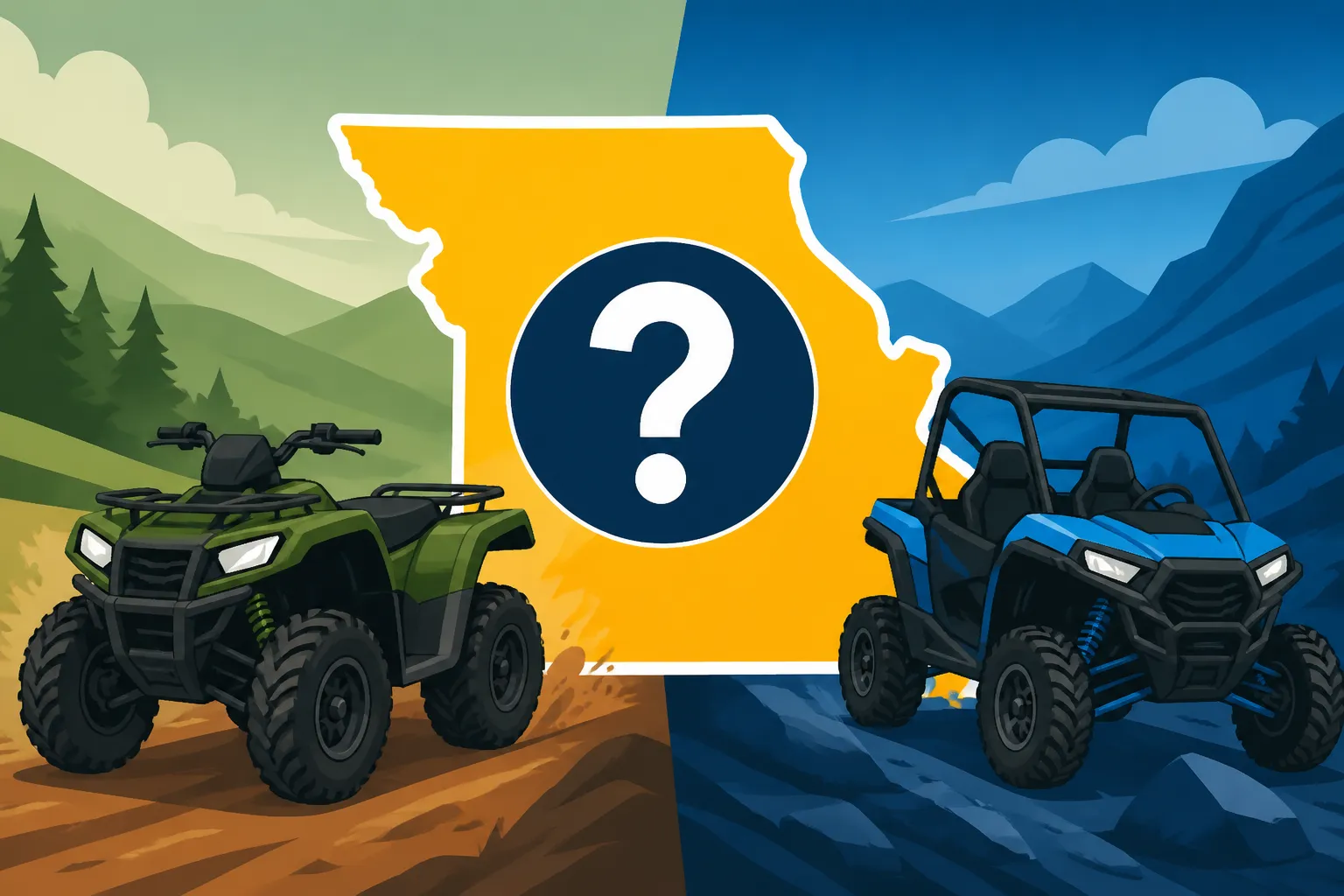
The presence of a straddle seat and handlebars fundamentally differentiates an ATV from machines with car-style controls, which typically include a steering wheel and foot pedals for acceleration and braking. Utility Vehicles (UTVs) and Recreational Off-Highway Vehicles (ROVs) are prime examples of machines that utilize car-style controls. These vehicles often feature bucket seats or bench seating, where the occupants sit in the machine rather than on it, and operate it with a steering wheel, just like a small car or golf cart. This difference is not just about aesthetics; it reflects a distinct design philosophy for stability, passenger capacity, and operational characteristics.
For instance, a UTV, with its roll cage, seatbelts, and steering wheel, is engineered for a different kind of stability and often for carrying cargo or multiple passengers. The car-like controls contribute to a more familiar and often less physically demanding driving experience compared to the active body movements required to effectively ride an ATV. Missouri's legal framework recognizes these fundamental design differences and assigns different classifications and regulatory requirements accordingly. This is [Why Missouri Splits ATVs, UTVs and ROVs] into separate categories.
The 50-Inch Width Constraint
Beyond the straddle seat and handlebars, Missouri's definition of an ATV includes a critical dimensional constraint: the machine must be "50 inches wide or less." This measurement refers to the overall width of the machine, typically measured from the widest point of the tires. This isn't an arbitrary number; it's a common standard used across various states and land management agencies to categorize vehicles suitable for narrower trails. It directly impacts where your machine can legally be ridden, especially on designated ATV trails within state parks, national forests, and other public lands.
Measuring Your Machine for Compliance
Determining your ATV's width for compliance is straightforward but important. You'll want to measure your machine from the outermost edge of one tire to the outermost edge of the tire on the opposite side. This should be done at the widest point, which is almost always across the front or rear tires, depending on your machine's design. Don't eyeball it; use a tape measure to get an accurate reading. Some manufacturers list the "overall width" in their specifications, but it's always a good idea to double-check, especially if you've added aftermarket wheels or tires that might extend beyond the original factory specifications. A little extra width, even an inch, can push you over the limit and change your machine's classification.
When measuring, ensure your tires are properly inflated, as this can slightly affect the width. Also, consider any accessories that might protrude, although typically the tires are the widest point. If you're buying a used machine, particularly one that has been modified, this measurement becomes even more crucial to verify before you make the purchase. Taking the time to accurately measure [Measuring a Machine Against 50 Inches] will save you potential grief and ensure you're within the legal bounds for what Missouri considers an ATV.
Why 50 Inches is a Critical Threshold
The 50-inch threshold is critical because it's a defining characteristic for how ATVs are typically designed and how trails are often constructed. Many dedicated ATV trails are narrow, winding, and intended for single-track vehicles or machines that can fit through tight spaces. A machine wider than 50 inches simply won't fit on many of these trails, or if it does, it could cause damage to the trail itself or surrounding vegetation. This width limit helps preserve the integrity of the trail system and ensures a consistent riding experience for machines designed to navigate such terrain.
For Missouri, a machine exceeding this width moves it out of the ATV classification and often into the "Recreational Off-Highway Vehicle" (ROV) or "Utility Vehicle" (UTV) category, both of which are treated differently under state law. This means that if your machine is wider than 50 inches, even if it has a straddle seat and handlebars, it won't be titled or issued a decal as an ATV in Missouri. Instead, it will fall under the regulations for side-by-sides, which have different rules regarding road use and public land access.
Machines That Exceed the 50-Inch Limit
What happens if your machine is wider than 50 inches? Well, under Missouri law, it's not an ATV. Full stop. It will likely be classified as a Utility Vehicle (UTV) or a Recreational Off-Highway Vehicle (ROV). These vehicles, often referred to collectively as "side-by-sides," are designed with a wider stance, offering greater stability and often more passenger capacity. They typically feature roll cages, seat belts, and car-like controls (steering wheel, foot pedals) rather than handlebars and a straddle seat.
The implication here is significant: [Why Missouri Does Not Register Side-by-Sides] in the same way it does ATVs. Side-by-sides do not receive the same three-year decal that ATVs do. Instead, they require a title, much like a car, but generally are not "registered" for off-road use with a public decal. Their road-legal status is entirely dependent on specific local ordinances or special permits, and they have different rules for operating on public lands. If you own a wider machine, understanding this distinction is crucial for compliant operation. [What a Side-by-Side Owner Does Instead in Missouri] involves familiarizing themselves with these separate regulations, often requiring local permits for road access.
The 1,500-Pound Dry Weight Test
Another key factor Missouri uses to define an ATV is its dry weight. The law specifies that an ATV must have a "dry weight of 1,500 pounds or less." This characteristic, in conjunction with the width, straddle seat, and handlebars, completes the physical profile that distinguishes a traditional ATV from its heavier, often larger, off-road counterparts. This weight limit is an important safety consideration, as lighter machines tend to handle differently and are generally designed for more agile, rider-active operation compared to heavier utility or multi-passenger vehicles.
Understanding "Dry Weight"
"Dry weight" is a specific term in the automotive and powersports industry, and it refers to the weight of the vehicle without any fluids or cargo. This means no fuel in the tank, no engine oil, no coolant, no brake fluid, and no passengers or additional gear. It's essentially the bare weight of the machine as it rolls off the assembly line, minus the consumables. Manufacturers typically list this specification in the owner's manual or on their website, making it relatively easy to find. This standardized measurement ensures consistency across different models and brands when comparing against the state's legal definition.
It's important not to confuse dry weight with "curb weight" or "gross vehicle weight rating" (GVWR). Curb weight includes all necessary operating fluids but no cargo or passengers. GVWR is the maximum permissible weight of the vehicle when fully loaded with passengers, cargo, and fluids. Missouri specifically uses dry weight for its ATV definition to ensure a consistent, factory-based measurement that isn't influenced by how a user might choose to equip or fuel their machine. For detailed explanations of such terms in a legal document context, online resources that provide templates for vehicle descriptions, like those found on LawDepot, can be helpful.
How to Determine Your ATV's Dry Weight
The easiest and most accurate way to determine your ATV's dry weight is to consult the manufacturer's specifications. This information is almost always available in the owner's manual that came with your machine, or it can be found on the manufacturer's official website under the specifications tab for your specific model year. A quick online search for "[Your ATV Make] [Your ATV Model] [Year] dry weight" will typically yield the correct figure. It's crucial to look for "dry weight" specifically, as other weight figures might be listed, like curb weight or shipping weight, which are not what Missouri is looking for.
If for some reason you cannot find the official dry weight, you might have to get creative. Some public scales can weigh your vehicle, but you would need to drain all fluids to get an accurate dry weight, which is impractical for most owners. Relying on the manufacturer's data is by far the best approach for verifying if your machine falls under [The 1,500-Pound Dry Weight Test in Missouri]. If you're buying a used machine, ask the seller for this information or look it up yourself before finalizing the purchase, as this can profoundly affect its legal classification.
Implications of Exceeding 1,500 Pounds
If your off-road machine has a dry weight exceeding 1,500 pounds, then, just like with the width limit, it will not be classified as an ATV under Missouri law. This means that even if it has a straddle seat and handlebars, it will be treated as either a UTV or an ROV. The implications are similar to exceeding the 50-inch width limit: no ATV decal, and a different set of rules for titling, operation, and trail access. Many of the larger, more powerful four-wheel drive quads, especially those with extensive utility features or two-up seating, can push or exceed this 1,500-pound limit.
This distinction is important because it means [Weighing a Machine Against 1,500 Pounds] is a critical step in understanding its legal status. Heavier machines generally have a different footprint on trails, and their increased mass changes handling characteristics, which is why the state draws this line. Owners of heavier machines will need to understand the specific regulations for Utility Vehicles (UTVs) or Recreational Off-Highway Vehicles (ROVs) to ensure compliance, as they are not eligible for the standard ATV registration and decal process.
Why Engine Size Doesn't Define a Missouri ATV
It’s a common misconception that an ATV's classification is primarily determined by its engine size, often measured in cubic centimeters (CCs). Many riders from other states, or those familiar with dirt bike classifications, might assume that a smaller machine is a "youth ATV" and a larger one is an "adult ATV" based on engine displacement. However, Missouri law takes a different approach entirely. When it comes to defining what counts as an ATV for titling and decal purposes, the state explicitly does not use engine size as a determining factor.
Focus on Physical Characteristics, Not CCs
Instead of engine size, Missouri's definition of an ATV focuses exclusively on the physical characteristics we've already discussed: the presence of a straddle seat, handlebars for steering, a maximum width of 50 inches, and a maximum dry weight of 1,500 pounds. These are the objective, measurable criteria that determine whether your off-road vehicle is legally an ATV in the Show-Me State. This approach simplifies the classification process by removing the complexity of countless engine sizes and instead focusing on universal design elements. Whether your ATV has a 90cc engine or a 1000cc engine, as long as it meets these physical dimensions and control requirements, it's considered an ATV for Missouri's titling and decal purposes. This is [Why Missouri Uses No Engine Size] in its definition.
This focus on physical design over engine displacement highlights the state's emphasis on how the machine is operated and its footprint on the terrain, rather than its raw power output. A smaller, less powerful machine that meets these criteria will be treated the same for titling and registration as a high-performance, large-displacement quad, as long as both adhere to the width and weight limits.
The Myth of "Big Bore" Machines and Classification
Because Missouri doesn't factor engine size into its ATV definition, the concept of a "big bore" machine automatically falling into a different category is simply a myth here. A powerful 800cc or 1000cc ATV, often referred to as a "big bore" quad, is still an ATV under Missouri law, provided it has a straddle seat, handlebars, is 50 inches wide or less, and has a dry weight of 1,500 pounds or less. The raw power or displacement of the engine has no bearing on its classification for titling or decal issuance.
This can be a surprise to some, especially those who come from states where engine size might dictate certain restrictions or classifications. But in Missouri, [Why a Big Bore Quad Still Counts] as an ATV is purely because it meets the physical and operational criteria, not because of what's under the hood. So, if you're riding a beast of a quad that checks all the boxes for a straddle seat, handlebars, width, and weight, rest assured, it's an ATV in Missouri, and you'll title it and get your three-year decal just like any other qualifying machine.
Distinguishing ATVs from Other Off-Road Vehicles
One of the biggest sources of confusion for off-road enthusiasts in Missouri is understanding the subtle yet significant differences between an ATV and other types of off-road vehicles, particularly UTVs and ROVs, often lumped together as "side-by-sides." While they all offer exhilarating experiences on unpaved terrain, Missouri law draws clear lines based on their design and operational characteristics. Failing to understand these distinctions can lead to incorrect assumptions about titling, registration, and permitted uses.
Utility Vehicles UTVs and Their Purpose
Utility Vehicles, or UTVs, are generally designed with a focus on work and practicality, though many are also used extensively for recreation. Think of machines like a Polaris Ranger, a John Deere Gator, or a Kubota RTV. These vehicles typically feature a wider stance than an ATV, a steering wheel, foot pedals for control, bench or bucket seating for multiple passengers (often two to six), a cargo bed, and a roll-over protection structure (ROPS) or roll cage. Their design emphasizes stability, cargo capacity, and the ability to tow, making them ideal for farm work, hunting, construction sites, or accessing remote areas with gear.
Under Missouri law, UTVs generally fall outside the ATV definition due to their width (almost always exceeding 50 inches), their dry weight (often over 1,500 pounds), and their car-like controls. This means they are classified differently, and as a result, they do not receive the standard [Missouri's Three-Year ATV Decal]. Instead, they are usually titled, but not "registered" in the same way with a decal. Their ability to be driven on public roads or trails depends heavily on local ordinances or specific agricultural exemptions. For documentation, a bill of sale or similar agreement outlining the specific type of vehicle, perhaps drafted with the help of a service like LawDepot, would clearly identify it as a UTV rather than an ATV. This is [Utility Vehicles Outside the Missouri System].
Recreational Off-Highway Vehicles ROVs and Their Design
Recreational Off-Highway Vehicles, or ROVs, are the other main category of "side-by-sides." While they share many design elements with UTVs – namely a steering wheel, foot pedals, bucket or bench seating, roll cage, and wider stance – their primary purpose is typically recreational thrill-seeking. Models like the Polaris RZR, Can-Am Maverick, or Kawasaki Teryx are classic examples. They are often built for higher performance, more aggressive suspension, and agile handling on challenging trails, with less emphasis on cargo hauling compared to UTVs.
Just like UTVs, ROVs nearly always exceed Missouri's 50-inch width and 1,500-pound dry weight limits, and they use a steering wheel rather than handlebars. Therefore, they are not classified as ATVs and do not receive the three-year decal. Instead, [Recreational Off-Highway Vehicles and Missouri Titles] are issued for these machines, but they are not subject to the same off-road registration requirements. Rules for street legal operation for ROVs are typically more structured, often involving local permits and specific equipment requirements like safety flags, headlights, taillights, and sometimes even a driver's license.
The Crucial Differences in Seating and Controls
The most crucial differences, as Missouri law highlights, boil down to seating and controls. An ATV demands a straddle seat and handlebars, requiring the rider to actively engage with the machine's balance and steering. It's a single-operator experience, though some two-up models exist that still adhere to the straddle-seat concept. This design makes ATVs incredibly agile and responsive to rider body English, perfect for navigating tight, technical terrain.
UTVs and ROVs, on the other hand, feature seating arrangements where occupants sit in the vehicle, much like a car. They are operated with a steering wheel and foot pedals, offering a more stable, often less physically demanding, and multi-passenger experience. This fundamental distinction is why Missouri has separate classifications. It's not just semantics; it's about the inherent design and operational characteristics that necessitate different regulatory approaches. Understanding these core differences is key to knowing whether your machine is an ATV, a UTV, or an ROV in Missouri. This is [What the Law Calls a Utility Vehicle] and [What the Law Calls a Recreational Off-Highway Vehicle] and explains [Why a Side-by-Side Has No Decal to Buy].
The Practical Implications of Missouri's ATV Definition
Understanding Missouri's precise definition of an ATV isn't just an academic exercise; it has very real, practical implications for you as an owner. From the paperwork you fill out at the license office to where you can actually take your machine for a ride, the classification impacts nearly every aspect of ATV ownership in the state. Ignoring these distinctions can lead to frustration, fines, or even having your riding privileges curtailed. Knowing exactly how your machine is categorized is the first step towards being a responsible and compliant off-road enthusiast.
Titling and Decals for Defined ATVs
If your machine meets all of Missouri's criteria for an ATV – straddle seat, handlebars, 50 inches wide or less, and 1,500 pounds dry weight or less – then you are required to title it with the Missouri Department of Revenue. This involves proving ownership, usually with a manufacturer's certificate of origin for a new machine or a properly signed-over title for a used one. Once titled, you will also be issued a distinctive three-year decal. This decal serves as your proof of off-road registration and must be visibly displayed on your ATV, typically on the right front fork.
This decal is critical for legal operation on public lands where ATVs are permitted, such as state parks and national forests. Without it, you could be cited or denied entry. For example, if you bought your quad from a private seller and it meets the criteria, you'd need to go to a license office with the signed title to get it transferred into your name and obtain your decal. [Missouri's Thirty-Day Titling Deadline] is important to remember to avoid penalties. The process ensures that all true ATVs operating in the state are accounted for and that owners are contributing to the system that helps maintain riding areas.
Trail Access and Restrictions Based on Classification
The most direct impact of your machine's classification is on where you can legally ride. Designated ATV trails in Missouri state parks, like St. Joe State Park, and national forests, such as the Chadwick Motorcycle and ATV Use Area, are primarily designed for and restricted to machines that fit the ATV definition. This means machines with a width of 50 inches or less, a straddle seat, and handlebars. If your machine is wider than 50 inches, it won't fit on many of these trails and is expressly prohibited from others.
This is a point of frequent misunderstanding for owners of side-by-sides. While your UTV or ROV might be an "off-road vehicle," it typically won't be allowed on trails specifically designated for ATVs. You'll need to research specific parks or areas that accommodate wider machines, which often have separate, wider trails or allow UTVs/ROVs on specific multi-use routes. Always check the rules of any riding area before you load up and head out, as access varies widely based on whether your machine is classified as an ATV, UTV, or ROV. This ensures everyone's safety and prevents damage to trails not designed for wider, heavier vehicles.
Insurance and Liability Considerations
While Missouri does not mandate liability insurance for ATVs operated solely on private property or designated off-road trails (unless a specific permit or park rule requires it), the classification of your machine can still have significant implications for your insurance coverage. Most insurance providers categorize off-road vehicles based on these very distinctions – ATV, UTV, ROV – and will tailor their policies accordingly. For instance, a policy written for an ATV might not automatically cover a UTV, or vice versa, due to differences in their design, performance, and risk profiles.
If you plan to use your machine on public roads or areas where a local ordinance permits it (which is more common for UTVs/ROVs with special permits), insurance typically becomes a requirement. When seeking coverage, be crystal clear with your insurance agent about how Missouri classifies your specific machine. Providing accurate information about whether it's an ATV, UTV, or ROV based on the state's definitions will ensure you get the appropriate coverage. An inadequately insured machine could leave you vulnerable to significant financial loss in the event of an accident or theft, so understanding your machine's legal classification is crucial for making informed insurance decisions.
Disclaimer
This article is for general informational purposes only and does not constitute professional advice. Laws, prices and regulations vary by location and change over time. Consult a qualified professional for guidance on your specific situation.