What the Law Calls a Recreational Off-Highway Vehicle
Navigating the world of off-highway vehicles in Missouri can feel like deciphering a secret code. You hear terms like "ATV," "UTV," "side-by-side," and "quad," and often they're used interchangeably, leading to massive confusion when you're trying to figure out what paperwork you need or where you can actually ride your machine. This guide is here to untangle that knot, specifically addressing what the law in Missouri truly means when it refers to a "Recreational Off-Highway Vehicle," or ROV, and what that means for you as an owner.
The Missouri Department of Revenue's View of ROVs
It’s genuinely frustrating when you purchase a shiny new machine, excited to hit the trails, only to find out that the state government has a completely different name and set of rules for what you call your "side-by-side." The Missouri Department of Revenue, the agency responsible for titling and registration, has very specific definitions for various types of off-highway vehicles, and understanding these distinctions is crucial for staying on the right side of the law. While many of us lump all multi-passenger off-road vehicles into the "UTV" or "side-by-side" bucket, Missouri law makes a distinct carve-out for what it officially calls a Recreational Off-Highway Vehicle. This isn't just bureaucratic jargon; it directly impacts how your vehicle is titled and, more importantly, whether it's eligible for a state decal. The consequences of not knowing the difference can range from minor headaches at the license office to significant issues if you're ever stopped while riding. It's a prime example of how everyday language doesn't always align with legal definitions, leaving owners scratching their heads. For more general information on how the state handles these machines, take a look at [The Missouri Department of Revenue and ATVs].
Understanding the Core Definition of a Recreational Off-Highway Vehicle
When we talk about an ROV in Missouri, we're not just throwing around another term for fun. The state has specific criteria that define an ROV, setting it apart from other off-road machines like traditional ATVs. This distinction is paramount because it dictates what kind of paperwork you’ll deal with and what permissions your machine might need for road or trail use. Many people walk into a license office assuming all their off-road vehicles are treated the same, only to discover a whole new set of rules for their side-by-side that differ dramatically from their quad.
Key Characteristics: Steering Wheel, Non-Straddle Seat, Side-by-Side Configuration
The absolute core of Missouri's definition for a Recreational Off-Highway Vehicle centers on three primary physical characteristics: a steering wheel, a non-straddle seat, and a side-by-side configuration. Think about your typical ATV or quad; you sit astride it, like a horse, and steer with handlebars. An ROV, on the other hand, mimics a small car more closely. You sit in a seat, usually a bucket seat or bench seat, not straddling the engine. You control it with a steering wheel, much like an automobile, and the passengers sit beside the driver, not behind them. This "side-by-side" seating arrangement is where the common nickname for these vehicles comes from. It's this design – built for recreational purposes with automotive-style controls and seating – that legally defines it as an ROV in Missouri. This is a critical point that helps differentiate it from a traditional ATV, which has very different operational characteristics. For those interested in the titling implications of these vehicles, you can read more at [Recreational Off-Highway Vehicles and Missouri Titles].
Differentiating ROVs from Utility Vehicles UTVs
Here's where things get even murkier for many owners. The line between an ROV and what some call a Utility Vehicle (UTV) can seem incredibly blurry, and frankly, sometimes it is blurry in common parlance. Many people use "UTV" and "side-by-side" interchangeably. However, Missouri law generally reserves the "Recreational Off-Highway Vehicle" definition for machines primarily designed for sport and recreation. While a UTV might also have a steering wheel and side-by-side seating, its design intent is often geared more towards work. Think cargo beds, higher payload capacities, and features aimed at hauling or farming.
An ROV, conversely, is typically engineered for performance, sport riding, or pure recreational touring, often featuring sport suspensions, less emphasis on cargo capacity, and a focus on driver and passenger comfort for extended rides. While you could use an ROV to haul a small load, its primary design and marketing are for fun. The state's legal framework often looks at this intended purpose, even if the physical attributes appear similar. Understanding [What the Law Calls a Utility Vehicle] can further clarify these subtle but important distinctions.
Why Weight and Width Limits Don't Define an ROV for Titling
It's common to hear discussions about vehicle width, weight, or even engine size when talking about off-road machines, especially concerning trail access. However, for the purpose of Missouri's legal definition of an ROV versus an ATV, these measurements are not the primary distinguishing factors. While a machine's dimensions, particularly its width, absolutely impact where you can ride it (for instance, some state park trails have width restrictions), they don't change its fundamental legal classification as an ROV for titling.
The focus for titling an ROV remains on those key characteristics: steering wheel, non-straddle seating, and the side-by-side arrangement. So, whether your ROV is 60 inches wide or 72 inches wide, it's still considered an ROV by the Department of Revenue. These physical measurements become more relevant when discussing specific trail regulations or potential road use permits, not for determining its initial vehicle type designation. If you want to understand how weight factors into other categories of machines, you might check out [Weighing a Machine Against 1,500 Pounds].
What This Means for Titling and "Registration" in Missouri
Understanding the legal definition of an ROV isn't just an academic exercise; it has real-world implications for how you interact with the state's vehicle administration system. The process for an ROV differs significantly from that of an ATV, which often catches new owners off guard and can lead to frustration if they aren't prepared. This segment dives into the practicalities of titling your ROV and explains why you won't be getting the same type of "registration" sticker as your ATV-owning friends.
ROVs and Missouri's Titling Requirements
Despite the lack of a state registration decal, Recreational Off-Highway Vehicles absolutely do require a title in Missouri. This is a crucial point that sometimes gets overlooked. Just like a car or a traditional ATV, your ROV needs a valid Missouri title to prove ownership and facilitate transfer when buying or selling. When you purchase a new ROV from a dealer, you'll receive a Manufacturer's Statement of Origin (MSO) or Certificate of Origin (COO), which you'll use to apply for your initial Missouri title. If you buy a used ROV, the seller must provide you with a properly signed-over Missouri title.
Failing to title your ROV within the specified timeframe (usually 30 days) can result in late fees and other penalties, so it's essential to get this done promptly after purchase. The titling process for an ROV is very similar to that for a conventional ATV, requiring submission of the correct forms, proof of ownership, and payment of the titling fee. It might feel redundant if you're not getting a "registration" decal, but the title is your fundamental proof of legal ownership. For more detailed instructions on the general process, refer to [Titling an ATV in Missouri] or [A Certificate of Origin for a New Missouri Machine].
Why ROVs Don't Get a Decal Like ATVs
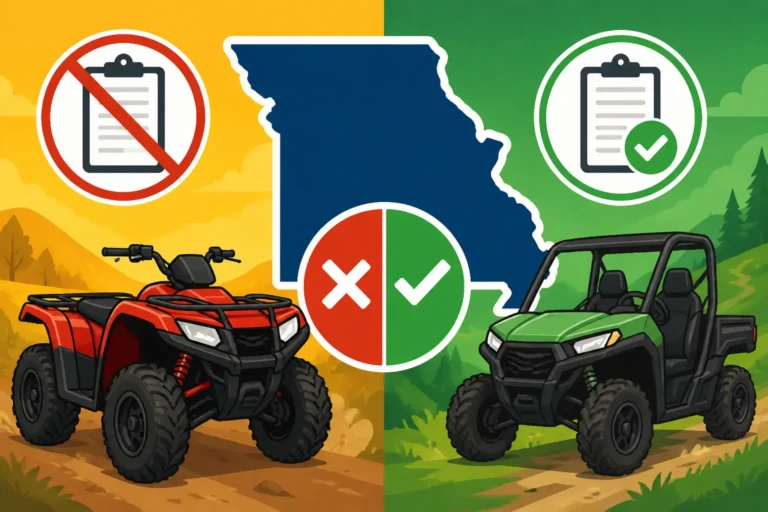
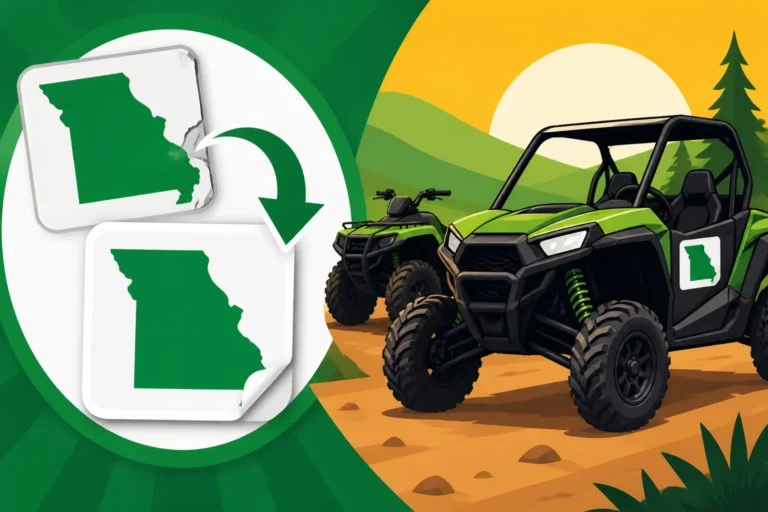
This is perhaps the biggest point of confusion and frustration for ROV owners in Missouri. Unlike ATVs, which receive a three-year state decal that serves as their "registration" for off-road use, Recreational Off-Highway Vehicles do not receive such a decal. Many ROV owners will go to the license office, present their paperwork, and expect to walk out with a sticker for their machine, only to be told that ROVs are not part of that state decal program. This isn't an oversight or an error; it's by design in Missouri law.
The state's definition for the ATV decal program specifically applies to vehicles that fit the traditional ATV definition (straddle seat, handlebars). Since an ROV, by its legal definition, does not fit that description, it simply isn't eligible for the decal. This means that if you own a side-by-side, you won't have a state-issued sticker for off-road use, and you won't have a regular renewal process for it either. This lack of a "registration" is a fundamental difference, and it directly leads into how these machines are handled for road use, which can be perplexing for new owners. You can learn more about this specific exclusion at [Why Missouri Does Not Register Side-by-Sides] and [Missouri's Three-Year ATV Decal].
Implications for Road Use and Local Permits
Because ROVs do not receive a state-issued off-road registration decal, their legal status for operating on public roads is distinctly different from that of an ATV. You won't be able to just slap on a decal and hit certain roads as an ATV might. Instead, ROVs in Missouri are generally restricted from public roads unless specific exceptions apply, or a local jurisdiction (city or county) has passed an ordinance allowing their use.
Missouri has a "3-mile rule" that can apply to ROVs, allowing limited road use for specific purposes, and many cities and counties have enacted their own ordinances to permit ROVs on local streets, often requiring local permits, insurance, and specific safety equipment. These local permits are entirely separate from any state titling, and their requirements vary widely. So, while your ROV may be titled, its ability to travel on public roads will depend on where you are and what local laws are in place. This is why you'll often see owners of side-by-sides seeking out [Missouri's Special Permit for Road Use] or navigating [Missouri's 3-Mile Rule for Side-by-Sides] to understand their options.
Common Misconceptions and Clarifications
The world of off-highway vehicle regulation is rife with misconceptions, especially when it comes to the nuances of legal definitions versus common usage. It's easy to get lost in the terminology, and without clear guidance, many owners find themselves inadvertently breaking rules or missing important steps. Let's clear up some of the most common misunderstandings surrounding ROVs in Missouri.
"Side-by-Side" vs. "ROV": Are They the Same?
This is a really common point of confusion. In everyday conversation, and even in marketing from manufacturers, the terms "side-by-side" and "UTV" are often used interchangeably to describe those multi-passenger off-road vehicles with steering wheels and non-straddle seating. From a legal standpoint in Missouri, however, "Recreational Off-Highway Vehicle" (ROV) is the official term for those machines primarily designed for recreation with a steering wheel and side-by-side seating.
So, while virtually every "side-by-side" you encounter will legally be classified as an ROV in Missouri, it's the ROV designation that carries the legal weight for titling and registration purposes. When dealing with the Department of Revenue or local law enforcement, it's always best to refer to your vehicle by its legal classification to ensure clarity and avoid misunderstandings. This distinction is vital for accurate paperwork, whether you're selling your machine or just trying to understand its status. You can see how this plays out in practice by understanding [What a Side-by-Side Owner Does Instead in Missouri].
What About Insurance?
Since ROVs don't get a state "registration" decal for off-road use, some owners might mistakenly believe that insurance isn't necessary. This couldn't be further from the truth. While Missouri doesn't universally mandate insurance for off-road use of an ROV, it is almost always a wise, if not critical, investment. Many private trail systems, organized rides, and certainly any local ordinance allowing street use will require proof of liability insurance for your ROV. Lenders also typically require comprehensive coverage if you have a loan on your machine.
Beyond requirements, consider the financial risk. Accidents happen, and without insurance, you could be personally liable for significant damages or medical bills. It’s always prudent to carry at least liability insurance, and comprehensive coverage offers even greater peace of mind. Check with your insurance provider about policies that cover off-road vehicles specifically. While it might not be a state registration requirement, it's a practical necessity for safe and responsible ownership. Understanding [Missouri ATV Insurance Requirements] can help you determine the best coverage for your ROV. When looking for important documents like a bill of sale to ensure a clear transaction for your ROV, resources like LawDepot can provide useful templates, emphasizing the importance of legal paperwork even for machines without a state decal.
Missouri Off-Highway Vehicle Comparison
To help clarify the distinctions between these vehicle types as defined by Missouri law, here's a quick comparison:
| Feature | All-Terrain Vehicle (ATV) | Utility Vehicle (UTV) | Recreational Off-Highway Vehicle (ROV) |
|---|---|---|---|
| Seating | Straddle seat | Side-by-side, non-straddle | Side-by-side, non-straddle |
| Steering | Handlebars | Steering wheel | Steering wheel |
| Design Intent | Sport/Recreation, single rider | Work, hauling, utility functions | Sport/Recreation, passenger comfort |
| Missouri Title Req. | Yes | Yes (if primarily for recreation/off-road) | Yes |
| Missouri Decal | Yes (3-year) | No | No |
| Road Use (State Law) | Limited exceptions, often local | Limited exceptions, often local | Limited exceptions (e.g., 3-mile rule), local |
| Typical Appearance | Quad, 4-wheeler, motorcycle-like | Often includes cargo bed | Often sporty, bucket seats, no cargo bed |
Disclaimer
This article is for general informational purposes only and does not constitute professional advice. Laws, prices and regulations vary by location and change over time. Consult a qualified professional for guidance on your specific situation.