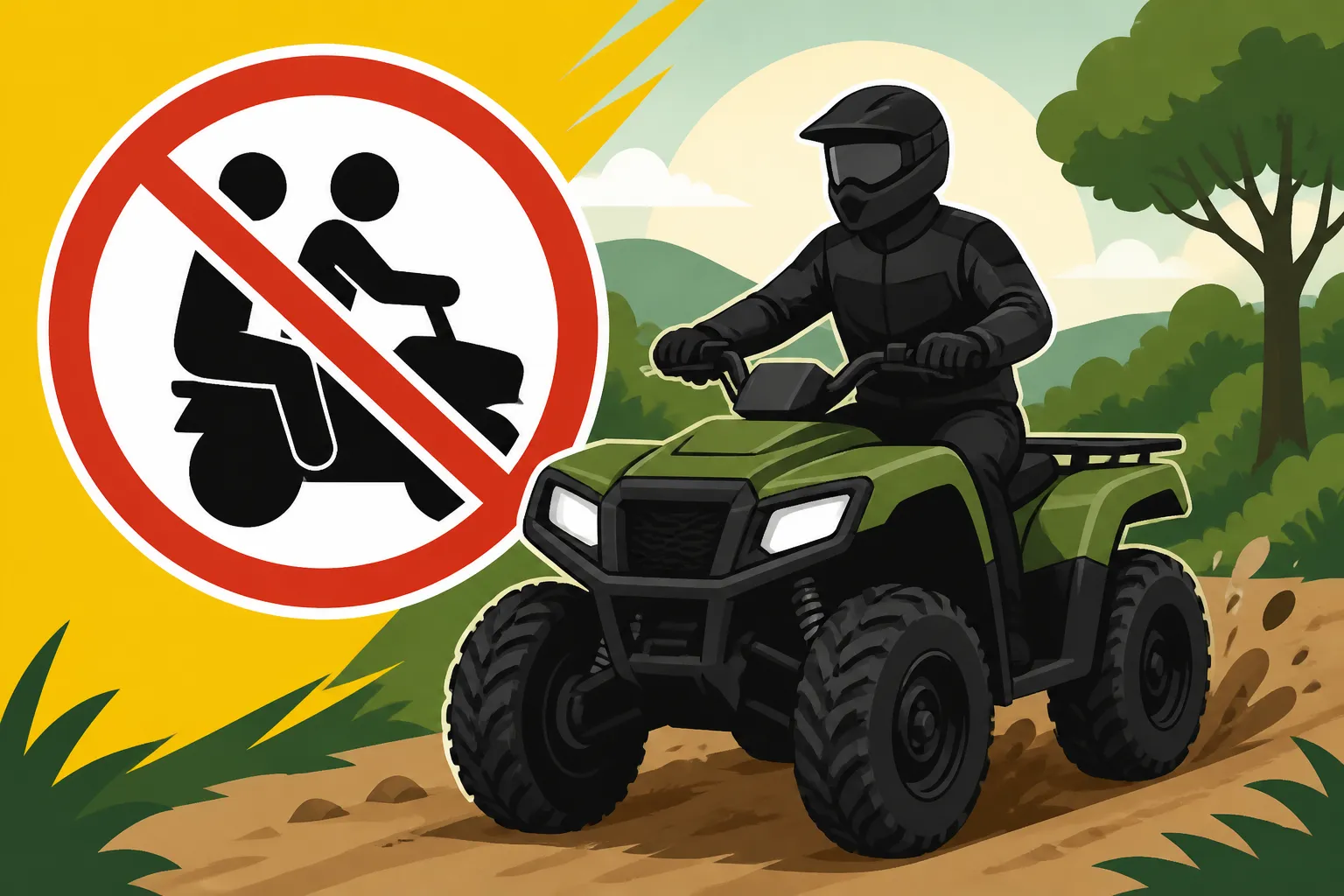
No Passengers on a Missouri Park ATV
A passenger can seem like a small change to a trail ride, especially when an ATV has a long seat or a child wants to ride along. But Missouri state park ATV rules do not allow passengers on an ATV. Here’s how to understand the rule, avoid confusing ATVs with UTVs, and plan a ride that fits the machine and park requirements.
The passenger rule at Missouri state parks
At a Missouri state park off-road riding area, an ATV is for one rider. Do not carry a passenger on the ATV, even for a short distance or on a machine that appears to have room for two. A long seat, extra footrests, or a passenger holding on does not change what type of machine it is or make carrying a second rider acceptable under the park’s ATV rule.
That distinction matters because people often use “ATV” as a catch-all for off-road vehicles. Park rules can treat a single-rider ATV differently from a UTV or side-by-side, which has seating designed for an operator and passenger or passengers. The rule about passengers on ATVs should not be read as permission to carry someone in any other vehicle, either. UTVs have their own requirements, and the park’s rules for that machine still apply.
| Situation | Practical reading of the rule |
|---|---|
| One person riding an ATV | The ATV rule is built around a single rider. Follow the park’s other requirements as well. |
| Two people on an ATV | Do not ride this way at a Missouri state park. A second seat or a short trip does not create an exception. |
| A passenger in a UTV or side-by-side | Check the rules for that vehicle type, including seating, restraint, age, and permitted-area requirements. |
| A child riding on an adult’s ATV | Do not carry the child as a passenger. Check youth-rider and supervision rules for a child operating a suitable machine. |
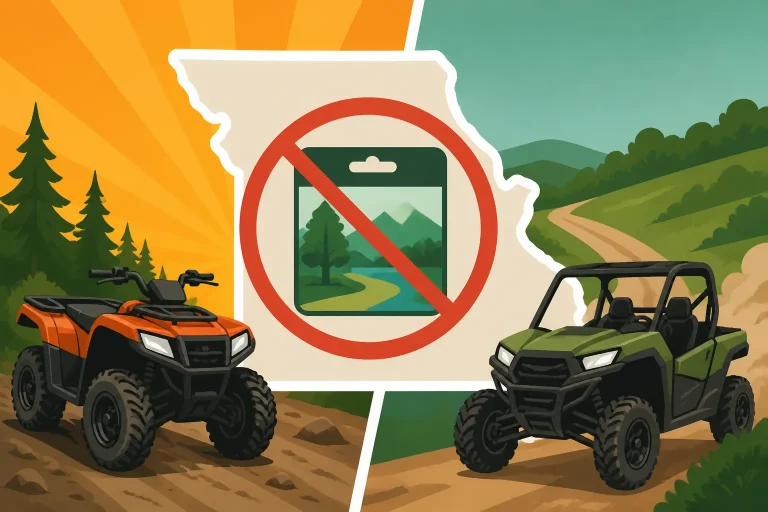
| A state park permit or decal | It does not override the passenger restriction. A permit is not permission to carry a passenger on an ATV. |
The restriction applies to riding in the park, not just to a fast or difficult section of trail. Do not assume it is acceptable to carry a passenger from the parking area to a trail, between trail sections, or along an easy route. If a passenger cannot ride safely in a vehicle that the park allows for that purpose, the practical answer is to make another plan—not to take the ATV with two people.
Rules can be easy to miss when a group is focused on permits, trail conditions, and loading. Review Missouri ORV Permits Explained and Do You Need a Permit for Missouri State Park Trails? as separate questions from who may ride on a machine. The passenger restriction remains a separate operating rule.
Why a passenger changes the ride
ATVs are designed around a rider who straddles the seat and controls the machine with handlebars. The rider shifts body weight to help steer and balance. Adding a passenger changes how the ATV responds, whether or not the passenger is small or experienced. The extra weight can affect balance, braking, turning, and how the machine handles slopes, ruts, rocks, and sudden stops.
A passenger can also interfere with the operator’s movement. On a narrow trail, the operator may need to shift weight or reposition quickly. A passenger who leans the other way, grabs the operator, or moves unexpectedly can make control harder. A second person may also lack a secure, manufacturer-designed place to sit and keep feet clear of the tires and controls.
Those risks are not limited to high-speed riding. A slow trail can still include uneven ground, a sharp turn, a steep pitch, a hidden rut, or another rider coming the other way. Even a brief ride from one spot to another can involve a loss of balance or a sudden need to stop.
The passenger rule also makes the expectation clear for all riders. Park trails are shared spaces, and a consistent one-rider rule for ATVs avoids arguments about whether a particular seat, rider size, or distance makes a second person acceptable. It leaves less room for riders to make their own safety exceptions on the trail.
A passenger’s ability to hold on is not a substitute for a proper passenger position and restraint system. Nor does a passenger’s experience riding an ATV make the machine suitable for two. If the vehicle is designed for one rider, a second rider cannot make it safe simply by sitting carefully.
This does not mean every off-road machine has the same passenger rule. A UTV has a different design and may provide separate seating and restraints, but its occupants still have to follow the applicable operating requirements. For the distinction, see Missouri Rules for a Passenger in a UTV. Do not transfer a UTV rule to an ATV just because both vehicles use the same trail system.
What counts as a passenger and what does not create an exception
In everyday conversation, people may describe a second person on a machine as “riding along,” “just sitting behind me,” or “holding the child.” For the park rule, the relevant point is simple: if someone is riding on the ATV with the operator, that person is a passenger. Calling the trip a quick test, a short transport, or a slow ride does not change the situation.
A child riding on an adult’s ATV is still a passenger. A child’s age or size does not create an exception to the one-rider restriction. Nor does the child’s helmet, riding gear, or willingness to hold on. For a child who is old enough and capable of operating a machine, the question is different: the child must ride an appropriate machine as its operator and meet the park’s youth and supervision rules. Review Missouri Park Access for Riders Under 16 and Missouri Supervision Rules Under Sixteen before planning a youth ride.
A parent or guardian should not assume that supervision means riding together on one ATV. Supervision can mean being present and keeping the young rider within appropriate limits, while the child operates a separate, suitable machine if permitted. A child who is not ready to operate independently should not be carried as an ATV passenger as a workaround.
The same logic applies to adults. A passenger who is an experienced rider, a spouse, a friend, or a guide is still a passenger when riding on the ATV. The operator’s confidence and the passenger’s comfort do not replace the park’s rule.
A two-seat-looking ATV can be especially confusing. Seats and accessories vary, and a machine may have aftermarket equipment that makes it appear more accommodating. Avoid deciding eligibility by appearance alone. The park’s category for the vehicle and the rules that apply to that category matter. If you are uncertain whether the machine is an ATV or another type of off-highway vehicle, verify the classification with the park before unloading.
Likewise, an ATV registration decal, a state park permit, or a different state’s registration does not establish that a passenger is allowed. Those documents address vehicle identification or access requirements; they do not convert a single-rider ATV into a two-person vehicle. Read Does Your Decal Cover the Park Trail Permit? for the separate question of vehicle registration and park access. Even when all paperwork is in order, riders still have to obey rules governing how the machine is operated.
ATV and UTV rules are not interchangeable
ATVs and UTVs are often parked together, trailered together, and described casually as “quads” or “side-by-sides.” For passenger decisions, use the actual vehicle category rather than the general label. An ATV is operated from a straddle seat with handlebars. A UTV or side-by-side generally has a different seating arrangement and controls. That design difference is one reason passenger rules are not identical.
If you plan to take a passenger, first confirm that the machine is permitted at the riding area and that the applicable rule allows passengers in that type of vehicle. Then check the specific conditions: whether the seat is designed for the passenger, whether required restraints are present and used, whether the passenger is allowed on that trail, and whether any age or supervision limits apply. Do not infer those details from a vehicle’s size or from what another rider is doing.
The passenger rule for an ATV does not mean a UTV is automatically allowed to carry any number of people. Occupants need appropriate seats, and the operator must follow the vehicle’s requirements. If a UTV has a stated seating capacity, do not exceed it. A passenger should not sit on a cargo area, rack, fender, or other place not designed for a person.
Nor does a UTV’s ability to carry passengers mean it can use every trail. Vehicle-width restrictions, trail closures, permits, and park-specific rules still matter. A wide machine may be excluded from some routes even when the operator and passengers are correctly seated. Check the park’s current rules and trail information before choosing a vehicle.
| Before taking a passenger | Check |
|---|---|
| Identify the vehicle | Confirm whether it is an ATV, UTV, or another vehicle type under the park’s rules. |
| Confirm trail access | Make sure that vehicle type and width are allowed on the planned route. |
| Check passenger capacity | Use only seats designed for occupants, and do not exceed the vehicle’s capacity. |
| Review restraints | Follow requirements for seat belts, helmets, or other protective equipment that apply to the vehicle and park. |
| Check youth requirements | Confirm any age, supervision, or youth-area restrictions before bringing a young rider. |
| Keep permits separate | Confirm the correct access permit, but do not treat it as an exception to operating rules. |
If the goal is to ride together, selecting the right vehicle before the trip is easier than trying to solve the problem at the trailhead. A UTV that meets the park’s requirements may be an option for a group that needs passenger seating. If it is not allowed on the desired trail—or the group does not have an appropriate machine—consider separate ATVs, a different riding area, or a different outing.
See Why Passengers Are Barred on Park Trails for the safety reasoning behind the restriction, and Missouri Rules for a Passenger in a UTV for the separate passenger question. Those are related topics, but they are not interchangeable rules.
How to plan a ride without risking a rule violation
A little planning avoids a frustrating conversation at the staging area and keeps the group from having to change plans after unloading. Use this process before the trip:
- Identify every vehicle. Write down whether each one is an ATV or UTV rather than relying on a broad label such as “ORV.” If you are unsure, check the manufacturer’s description and confirm the category with the park.
- Decide who will operate each machine. An ATV at a Missouri state park is for one rider. Do not plan to carry a passenger on it, including a child.
- Check youth rules separately. A young person operating a machine raises questions about allowed age, supervision, machine suitability, and any youth-only riding area. Those rules do not create an exception for passengers on an ATV.
- Confirm vehicle access and permits. Verify that each vehicle may use the intended riding area and that the required permit is in place. A permit answers an access question, not a passenger question.
- Review current park notices. Check park rules, trail closures, and any vehicle-specific conditions before loading. Posted rules at the park may clarify local details.
- Make a backup plan. If one member of the group cannot operate a permitted machine, arrange another activity or use a suitable vehicle only if it is allowed. Do not improvise by putting two people on an ATV.
If renting, ask the rental provider which vehicle category is being supplied, how many occupants it is designed for, and what the relevant park rules require. A rental agreement or a staff member’s informal suggestion does not override park rules. Check [Missouri Rules for Riding a Rented Machine] for issues that can arise when the machine and access permit are arranged through different parties.
Bring required protective equipment for each rider and follow the park’s instructions. Do not assume that wearing a helmet makes an otherwise prohibited passenger arrangement acceptable. Protective gear reduces some risks; it does not change how many people may ride on an ATV.
At the trailhead, follow signs and staff directions. If someone asks you to change the plan, stop and clarify the requirement before entering the trail. It is better to leave a passenger behind or switch to a permitted vehicle than to proceed and risk being turned away or cited. If an unexpected situation arises during a ride, do not use it to justify continuing with an unauthorized passenger; contact park staff or use an appropriate safe way to resolve the problem.
Keep the distinction in mind throughout the trip: permits, trail access, and passenger rules are different parts of compliance. Having the right permit does not make a passenger legal on an ATV, and a UTV’s passenger capacity does not guarantee that every route is open to it. Reviewing all three questions—vehicle type, route access, and occupant rules—before departure is the most dependable way to plan.
Frequently Asked Questions
Can two people ride one ATV at a Missouri state park?
No. Missouri state park ATV rules do not allow a passenger on an ATV. Do not treat a short trip, low speed, or extra-looking seat as an exception.
Does a park permit allow a passenger?
No. A permit concerns access to the riding area. It does not override the rule limiting an ATV to one rider.
Can a child ride on an adult’s ATV?
Not as a passenger at a Missouri state park. A child who may be eligible to ride must meet the park’s requirements for operating an appropriate machine, including applicable youth and supervision rules.
Can a passenger ride in a UTV?
UTVs are treated differently from ATVs, but that does not mean every passenger arrangement is allowed. Check the park’s current rules, vehicle capacity, restraint requirements, trail access, and any youth restrictions.
Disclaimer
This article is for general informational purposes only and does not constitute professional advice. Laws, prices and regulations vary by location and change over time. Consult a qualified professional for guidance on your specific situation.