Missouri Rules on Conservation Areas
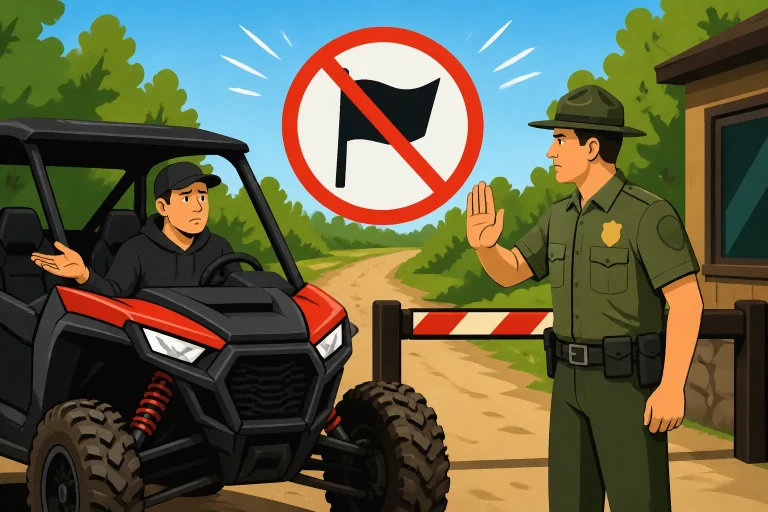
Missouri conservation areas can look like open public land, but that does not make them ATV or UTV riding areas. The key question is not whether you have a decal or an out-of-state permit; it is whether the specific area allows your machine on a particular route. Here’s how to check before you unload, and what to do if the rules are unclear.
The short answer: a conservation area is not automatically open to ATVs
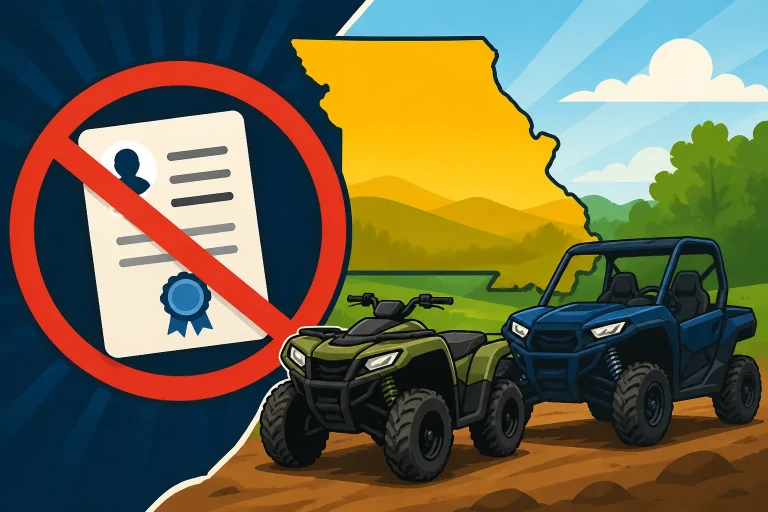
Missouri conservation areas are managed for wildlife, habitat and public recreation. They are not generally ATV trail systems. Having a Missouri registration decal, a permit from another state, or a hunting or fishing permit does not by itself authorize recreational ATV or UTV riding on conservation area land.
The practical starting point is to assume you cannot ride there unless the Missouri Department of Conservation (MDC) identifies a route or use that allows it. Area rules may restrict motor vehicles to roads open to public use, prohibit off-road travel, or impose additional limits. A road, gate or track that looks passable is not proof that it is open to your machine.
This distinction matters because several permissions get confused:
- Permission to enter an area is not necessarily permission to operate a motor vehicle there.
- Permission to use a road does not necessarily mean an off-highway vehicle may use it.
- A hunting, fishing or other activity permit does not automatically allow ATV travel.
- An ATV registration decal or trail permit does not create access where the land manager has prohibited riding.
For the wider picture, see Missouri Rules for Riding Public Land. Conservation areas have their own management rules, so general public-land guidance is not a substitute for the rules of the particular area.
| What you have or see | What it does not establish |
|---|---|
| A Missouri ATV decal | That the conservation area allows recreational riding |
| An out-of-state registration or decal | That Missouri recognizes it as permission to ride on MDC land |
| A state park or forest riding permit | That the permit covers conservation areas |
| A hunting or fishing permit | That you may ride an ATV to a hunting or fishing spot |
| An unblocked road or visible track | That the route is open to your machine |
| A nearby trailhead or public access point | That the adjoining conservation area allows ATV travel |
The safest approach is to check the specific area information and posted signs before the trip. If the permitted use is not clear, contact MDC rather than relying on a map, an old forum post, or what another rider says.
What counts as a conservation area, and why the boundary matters
A conservation area is land managed by MDC. It may include woods, fields, water access, parking lots, gates, roads and facilities for activities such as hunting, fishing, hiking or wildlife viewing. Those features can make an area feel like a park or a multi-use recreation site, but the permitted activities may be quite different from those at a designated off-road riding area.
The first job is to confirm who manages the land. A place described informally as a “public trail,” “conservation land” or “access area” might be managed by MDC, a state park, the U.S. Forest Service, the Army Corps of Engineers, a local government or a private organization. Each can have separate rules. A permit valid in one system does not automatically apply to another.
This is especially important where properties meet. A rider might legally use a nearby trail system, forest road or public road, then encounter a conservation area boundary. Continuing across that line can turn an otherwise permitted ride into unauthorized vehicle use. A trail map may show the surrounding recreation area without clearly displaying every management boundary, so check the land manager’s map and area-specific notices.
A route on a map is not necessarily an ATV route
Maps can show roads for several reasons: access for maintenance, emergency response, wildlife management, hunting access or ordinary road traffic. A line on a map does not necessarily indicate that public ATV riding is allowed. Likewise, a road that appears on a general navigation app may be closed to public vehicles, limited to particular users or unsuitable for an ATV.
Pay attention to how the route is described. “Public road,” “area road,” “service road,” “trail” and “ATV trail” are not interchangeable terms. If the map or sign does not say that ATVs are allowed, do not infer permission from the road’s appearance.
For a closer look at this distinction, see Conservation Area Roads in Missouri. The important point is that road access and off-road recreation are separate questions, and a vehicle’s legal status on public roads may also matter.
Area rules can add restrictions
MDC manages individual properties for different purposes. One area may have a gate, seasonal closure, restricted access route or special-use notice that another area does not. Rules can also apply to particular facilities or portions of an area rather than its entire boundary.
A general page about conservation areas cannot tell you whether a specific road is open today, whether a gate is seasonal, or whether special authorization applies to a particular user. Those details need to be checked for the area you plan to visit. Start with the area’s official information, read signs at the entrance and follow any posted closure or vehicle restriction.
Missouri Rules for Riding Conservation Areas is useful for the broader issue, while the specific area notice is what you need for trip planning.
Permits and reciprocity do not create conservation-area access
A frequent source of confusion is the word “permit.” Missouri has different permits and permissions for different lands and activities. A permit connected with a state park or a national forest does not grant permission on an MDC conservation area unless the relevant land manager says it does.
That is true even if the permit is valid for the same kind of machine. A state park riding permit is for the applicable park system and its designated riding opportunities. A forest permit applies to the locations and uses covered by that permit. A conservation area is a separate property-management system.
The same principle applies to permits from another state. Reciprocity, where it applies, concerns recognition of a particular registration or permit for a particular purpose. It does not override the rules of the landowner or land manager. An out-of-state decal cannot make a closed route open, and it cannot turn a conservation area into a public ATV trail.
If you are riding elsewhere in Missouri, Missouri ORV Permits Explained can help sort out the permit systems. For visitors, Missouri ORV Permit for a Visitor covers a separate question: what a permit may be needed for at a destination that actually allows off-road riding. Neither topic should be read as permission to ride on conservation area land.
Activity permits are not vehicle permits
A valid permit for hunting, fishing, trapping or another activity may allow you to take part in that activity under its rules. It does not necessarily provide access by ATV. Keep the activity authorization and vehicle authorization separate in your planning.
For example, a person may be allowed to hunt on an area but still be required to travel on foot from a designated parking location. A permit to fish does not automatically allow a rider to drive to the water’s edge. And the need to carry gear, retrieve equipment or reach a location more easily does not create an exception on its own.
Some land managers may grant narrow authorizations for specific access needs or management purposes. Those are not general riding privileges. If you believe an exception may apply, ask MDC directly what authorization is required, who may use it, which route it covers and whether it is limited by season or other conditions. Do not treat a verbal assumption or another person’s access arrangement as your own authorization.
Why a permit from another system may be irrelevant
Missouri has several distinct places where off-highway vehicles may be permitted under specific rules. State parks, national forest lands and private riding areas can each have their own access conditions. Their permits address those locations, not every public parcel in the state.
That is why a rider should identify both the land manager and the approved riding location before purchasing a permit or hauling a machine. If the goal is a legal trail ride, choose a site that explicitly accepts the machine and check its current rules. [Missouri Rules for Riding a National Forest] explains another land-management system, but its rules do not transfer to MDC areas.
How to check an area before you bring a machine
A few minutes of checking can prevent a long drive followed by a turn-around at the gate. Use the steps below for the exact property, not just the general region.
- Confirm the land manager. Look up the property’s official name and determine whether MDC manages it. Do not rely only on a local nickname or a search result that calls it a park or trail.
- Open the official area information. Check the area map, access details and current notices. Look specifically for motor-vehicle restrictions and any statement about ATVs, UTVs or off-road vehicles.
- Identify the proposed route. If you intend to use a road, verify that it is open to public use and that your particular vehicle is allowed on it. A route labeled as a road is not automatically an ATV route.
- Check for closures and seasonal conditions. A route may be closed temporarily, seasonally or for management work. Check notices close to the day of your visit, especially after storms or during hunting seasons.
- Read signs at the entrance and along the route. Posted rules and barriers matter. Do not pass a gate, move a barrier or continue past a restriction because the track looks open.
- Ask MDC when the rule is unclear. Give the staff the area name, the type of machine and the route you plan to use. Ask whether recreational ATV or UTV use is allowed, not just whether the area is open to visitors.
- Have a different destination ready. If the area does not allow riding, choose a designated riding location rather than improvising on nearby public land.
A useful call or message is specific: “May I ride this ATV on this named road within this conservation area for recreation?” That is more likely to get a clear answer than asking whether ATVs are “allowed in the area,” because access may depend on the route, vehicle and purpose.
If your plans depend on conditions on the ground, also check Missouri Trail Closures to Check First. The article’s focus is broader trail planning, but the same habit—checking for a current closure before loading—helps avoid wasted travel.
What to verify when an exception is mentioned
Occasionally, a rider may hear that a certain route is open to a particular person or that an exception exists for access, disability or official work. Treat that as a question to verify, not as general authorization.
Ask:
- Who issued the authorization?
- Does it apply to recreational use or only a specific purpose?
- Does it cover this exact machine and route?
- Is it limited to a named person, season or date?
- Must the authorization be carried or displayed?
- Are there additional conditions, such as a designated parking point or travel window?
An exception granted for one person or purpose does not necessarily extend to companions. Nor does it make other routes on the property open. Follow the authorization as written and ask the issuing office if any part is unclear.
Common situations that lead to accidental violations
The rules are easiest to follow when you recognize the assumptions that often cause problems. These situations can seem harmless, but none is a reliable substitute for checking the area’s rules.
“The road is open, so the ATV can use it”
A road open to the public may be intended for ordinary highway vehicles. It does not automatically authorize an ATV or UTV, especially if the machine is not lawful for that road under the applicable rules. Even where an area road is open to some motor vehicles, check whether off-highway machines are specifically permitted.
Do not assume a county road, a public road crossing the area, and an internal conservation-area route all have the same rules. If the ride depends on using a public road, verify the vehicle’s road-use status separately from the conservation-area rules. Missouri Rules for Riding a County Road addresses road use as a distinct issue.
“I have a hunting permit, and I need to reach my spot”
A hunting permit does not by itself authorize ATV travel. Access may be limited to designated parking areas or routes, and carrying equipment does not change the vehicle restriction. Hunters should check the area’s access instructions and plan for any walking distance or permitted transport method.
The same caution applies to retrieving game or equipment. Do not assume that an activity-related need creates permission to drive off-road. If an area has a specific policy or an accommodation process, confirm it with MDC before the trip.
“Other riders have used this trail”
Past use is not proof that a route is currently open or that it was authorized. A gate may have been open for staff, a maintenance vehicle or a specific permitted use. A track may be old, unofficial or on adjoining private property. Conditions and rules can change, and another rider’s permission may be limited to that person.
Before following a track, identify where it goes and who manages the land. If the route crosses a conservation area boundary, stop and confirm the rules rather than treating the tire marks as a trail designation.
“I have permission from the nearby landowner”
A private landowner can give permission for their own property, subject to applicable law, but cannot authorize riding on adjoining MDC land. Check the boundary carefully, especially where fields, woods and access roads meet. Missouri Landowner Permission Rules explains why permission from a landowner matters on private ground; it does not replace authorization from a separate public land manager.
If you are unsure whether a path crosses onto conservation property, do not ride it until you can confirm the boundary. A map, posted boundary marker or direct question to the land manager can help resolve the uncertainty.
“My machine is registered, so riding it is allowed”
Registration and access are different. A decal may be required for certain uses, but it does not grant permission on every public property. The same is true of an out-of-state registration. Before riding, check the property rules, the route, and any permit conditions that apply to that particular destination.
This distinction also helps with planning elsewhere in the state: a riding permit may be required at one site and not be valid at another. Does Missouri Honor Out-of-State Registration? is relevant to registration questions, but the answer to whether you can ride a particular conservation area still depends on the area’s access rules.
If ATVs are not allowed, choose a destination that expressly permits riding
A conservation area can still be a worthwhile place to visit without an ATV. Depending on the site, visitors may be able to pursue activities such as walking, wildlife viewing, hunting or fishing under the area’s rules. Choose the activity that is allowed there rather than trying to adapt the property to an off-road ride.
For a machine-based outing, look for an established riding area that clearly identifies its permitted vehicles, routes and access requirements. Confirm the machine’s dimensions and any equipment rules before traveling. Some riding locations have width limits, sound requirements or other conditions that differ from conservation area rules.
If you want to ride on private land, obtain the owner’s permission before entering and stay within the agreed boundaries. Permission should cover the route and the type of use, not just access to a property generally. Keep in mind that permission from a private owner does not permit crossing a conservation area to reach that property.
A simple pre-trip decision can prevent confusion:
- Is the destination managed by MDC? Check its conservation-area rules.
- Does the official information expressly allow ATV or UTV use? If not, do not assume it is permitted.
- Is the route identified as open to that machine? A general road or foot trail is not enough.
- Does a permit apply to this exact property? Confirm the land manager and permit coverage.
- Are there current closures or special restrictions? Check again before leaving.
The central rule is straightforward: a conservation area is not a recreational ATV route unless MDC has specifically made it one or authorized the use in a defined way. Registration, reciprocity, activity permits and informal precedent do not replace that permission.
Frequently Asked Questions
Can I ride my ATV on a Missouri conservation area road?
Do not assume so. A road may be open to some public vehicles without being an approved ATV route. Check the specific area’s rules and confirm whether the machine and proposed use are allowed.
Does a Missouri ATV decal let me ride on conservation areas?
No. A decal does not create access rights. The area’s rules determine whether a vehicle may be used there.
Does an out-of-state permit or decal count in Missouri conservation areas?
It does not, by itself, grant access to MDC land. Reciprocity and registration questions are separate from the land manager’s rules for a specific area.
Can I use an ATV to reach a hunting or fishing location?
A hunting or fishing permit does not automatically authorize ATV travel. Check the area’s access rules and any specific authorization that may apply.
Who should I contact if the area information is unclear?
Contact MDC and provide the area name, machine type and proposed route. Ask whether recreational use by that vehicle is allowed on that specific route.
Disclaimer
This article is for general informational purposes only and does not constitute professional advice. Laws, prices and regulations vary by location and change over time. Consult a qualified professional for guidance on your specific situation.