Spark Arresters on Missouri Public Land
Spark Arresters on Missouri Public Land
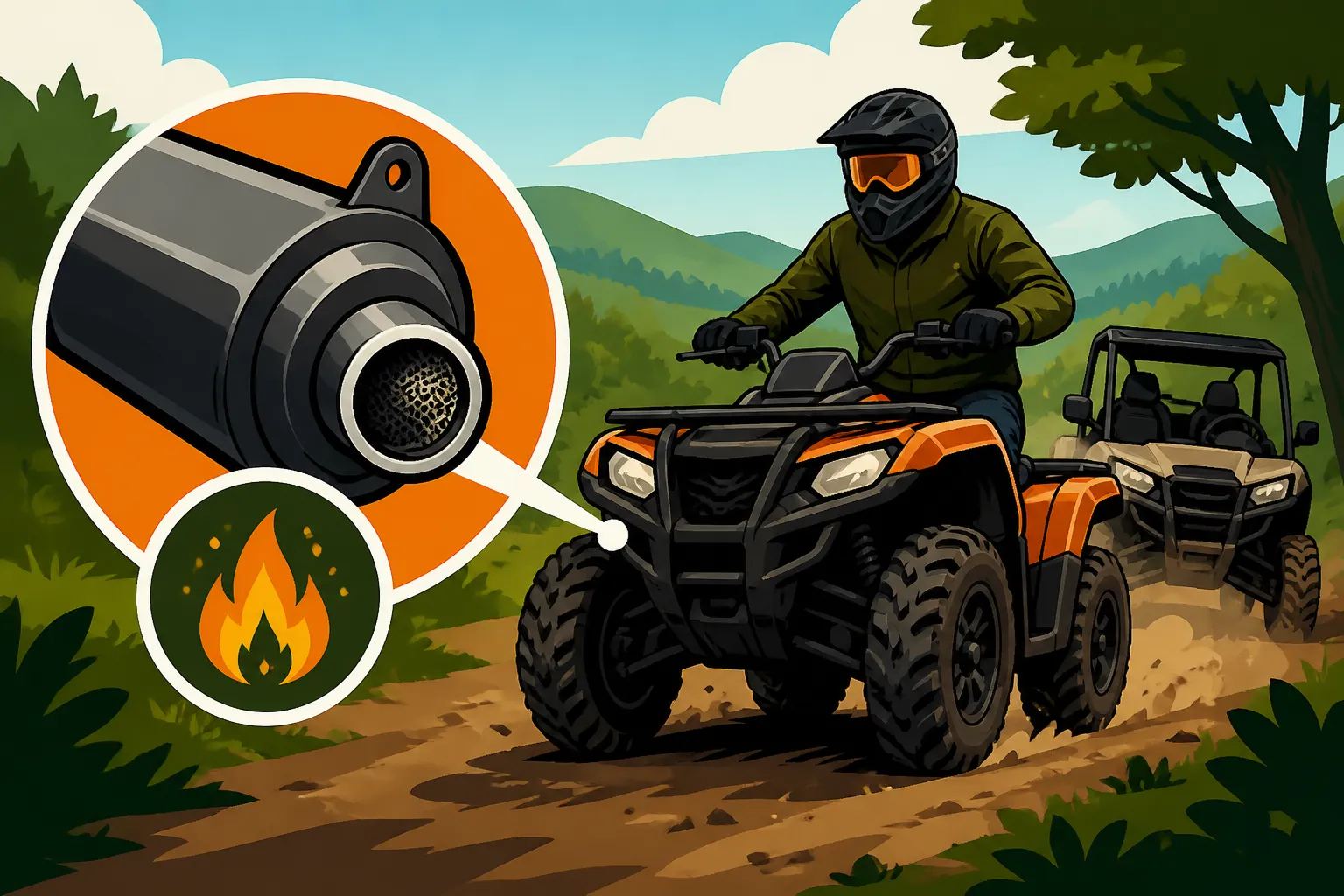
A spark arrester can look like a small exhaust part, but riding without the right one may mean being turned away from a trail—or creating a fire hazard. Missouri public land does not follow one universal rule: requirements depend on the land manager, riding area, and machine. Here’s how to check what applies, identify a suitable arrester, and inspect it before you unload.
What a Spark Arrester Does
A spark arrester is a device in an engine’s exhaust system that helps prevent hot particles from leaving the exhaust and starting a fire. Depending on its design, it may trap particles in a screen or use another approved method to stop them from being discharged. It is a fire-prevention measure, not a guarantee that a machine can never ignite dry vegetation.
A spark arrester is different from a muffler. A muffler reduces exhaust noise; an arrester controls the risk of burning particles escaping. Some exhaust assemblies combine both functions, but having a muffler does not automatically mean the exhaust has an effective spark arrester. A quiet machine can still have no arrester, and an arrester does not necessarily make an exhaust quiet enough for a separate sound rule.
The device is also not the same as a catalytic converter or a flame screen just because those parts sit in the exhaust. What matters is whether the machine has an arrester that meets the applicable land manager’s requirements and is in working condition. A screen that has been removed, damaged, clogged, or replaced with an incompatible part may not provide the protection the rule calls for.
Spark arresters are most relevant to gasoline-powered machines, including many ATVs, UTVs, motorcycles, and other off-highway vehicles. If your machine is electric, it has no combustion exhaust in the ordinary sense, but do not assume that this settles every access requirement. The riding area may have separate rules for vehicle type, access, or equipment. Check the rules for that location rather than relying on a general assumption.
The requirement is about more than passing a gate check. A hot particle landing in dry grass, leaves, or other combustible material can start a fire. Risk changes with weather and vegetation, but the basic prevention measure is the same: keep the exhaust system intact and use a suitable arrester wherever required. A machine that was compliant last season may no longer be compliant after an exhaust modification or repair.
That makes the arrester a separate item to check from your trail permit. A valid permit does not confirm that the machine has required safety equipment, and an arrester does not grant permission to ride. For the distinction between access authorization and equipment rules, see Missouri ORV Permits Explained and Missouri Rules for Riding Public Land.
Missouri Public Land Does Not Have One Universal Rule
“Public land” includes places managed by different agencies, and each area can have its own rules. A national forest, a state park riding area, a conservation area, and a local property may not have identical equipment requirements. A rule for one trail system should not be treated as a statewide pass for every other one.
The Mark Twain National Forest is managed under federal rules and local forest requirements. Before riding there, check the current information for the specific riding area and trail system, including any posted orders or notices. Forest access may also depend on whether a route is open to the kind of machine you have. A required permit and a required spark arrester are separate checks: one does not replace the other. The Missouri National Forest ATV Permit and What the Mark Twain Forest ATV Permit Covers can help clarify the permit side, while the forest’s current riding information is the place to confirm equipment requirements.
Missouri state park riding areas have their own rules and entry procedures. Do not assume that a machine accepted at a forest trailhead will meet a state park’s requirements, or vice versa. Check the official information for the particular park and riding area before traveling. The park may also apply rules about sound, flags, helmets, vehicle width, or other equipment. Those requirements can exist alongside an arrester rule rather than instead of it. For related park considerations, see Missouri’s 86-Decibel Limit at a Park Gate and Missouri Park Access for Riders Under 16.
Conservation areas require particular care. Public ownership does not mean every road, trail, or type of vehicle use is open. Some properties or routes may prohibit ATV and UTV use altogether, regardless of the machine’s equipment. Confirm that the route is open to your vehicle before you focus on the equipment list. [Missouri Rules on Conservation Areas] explains why access should be checked separately from general public-land rules.
| Riding location | What to check before you go | Why a general assumption can fail |
|---|---|---|
| National forest trail system | Forest requirements, trail status, local notices, permit rules, and any spark-arrester standard | Federal land rules and local closures may apply together |
| State park riding area | The park’s current riding rules, equipment requirements, and entry procedures | Park rules can differ from forest rules |
| Conservation area | Whether the route and vehicle type are allowed, plus property-specific rules | Public ownership does not mean motorized access is allowed |
| Local or other managed property | The responsible manager’s instructions and posted restrictions | The property may have its own conditions or no ATV access |
This comparison is a starting point, not a substitute for checking the actual location. A trail may close temporarily, a route may be open only to certain vehicle classes, or a posted order may add a condition that is not obvious from a general description of the property.
When checking, look for specific wording about “spark arresters,” “approved” or “qualified” devices, and the kinds of vehicles covered. If the instructions are unclear, contact the land manager or the office responsible for that riding area before the trip. Ask about the exact machine and exhaust setup, not just whether “ATVs” are allowed. A UTV, motorcycle, or modified ATV may be treated differently under the property’s access rules.
Also confirm the date and scope of any information you find. A permit page may tell you how to buy access but say little about required equipment. A general page about a forest may not cover a particular trail system’s temporary closure or special condition. Use the location-specific rules and notices, then keep a copy or screenshot of the relevant information for your trip.
Choosing and Verifying an Arrester
Start with the machine’s original exhaust and owner’s manual. Some factory exhaust systems include a spark-arresting component, but do not rely on the machine’s age, brand, or quietness as proof. Look up the exact model and year, then confirm whether the installed exhaust contains an arrester and whether it is approved for the riding area’s requirements.
If the exhaust has been changed, treat the setup as unverified until you confirm it. A replacement muffler, performance exhaust, or repair part may not include the same arrester as the original assembly. A screen that fits physically is not automatically an approved device. Do not cut, drill, remove, or alter exhaust components to improve flow or change sound unless the manufacturer’s instructions and the applicable rules allow the configuration.
The term “spark arrester” can appear in product descriptions without enough detail to establish compliance. Before buying, verify all of the following:
- The part is made for the machine’s make, model, year, and exhaust configuration.
- The manufacturer identifies it as a spark arrester, not merely a muffler or exhaust insert.
- Its design and approval meet the standard or rule required by the land manager.
- The part can be installed securely using the intended mounting points.
- It can be inspected and serviced as directed by the manufacturer.
If you are shopping through a marketplace such as Amazon, use the listing as a place to compare parts, not as proof that a device will satisfy a trail rule. Check the manufacturer’s specifications and confirm compatibility before ordering. When a land manager requires a particular standard or approval, make sure the documentation for the exact part addresses that requirement. If it does not, ask the seller or manufacturer for clarification before relying on it.
A mechanic or exhaust specialist may help identify what is installed, particularly when a machine has been modified or the original parts are no longer available. Bring the machine’s model information and, if possible, the land manager’s exact requirement. “It has a screen” is not always enough to establish that the part is the right type or is installed correctly.
Keep the paperwork for replacement parts and any manufacturer documentation with your riding records. That paperwork may not substitute for a physical inspection, and it does not guarantee that every land manager will accept the setup. But it can help you answer questions about the part’s identity and intended use, especially if the exhaust is not factory-original.
When you are uncertain, the low-risk choice is to postpone the ride until you can verify the machine. Guessing at the gate can cost time and travel, while riding with a questionable exhaust can create a safety and compliance problem. If you cannot establish that the installed device meets the requirement, have the setup checked or use a machine whose equipment is confirmed.
Inspecting and Maintaining the Exhaust
An arrester is only useful if it is present and functioning. Before each ride, take a few minutes to inspect the outlet and surrounding exhaust components while the machine is cool. Follow the owner’s manual for any maintenance procedure; do not reach into a hot exhaust or take apart a system in a way the manufacturer does not recommend.
A practical pre-ride check includes:
- Confirm the part is present. Look for the arrester or its identifying component in the exhaust assembly. Do not assume a part is installed because the machine has a stock-looking muffler.
- Check for visible damage. Look for cracks, loose fasteners, a distorted outlet, missing retaining hardware, or other signs that the assembly has shifted or been altered.
- Look for signs of removal or modification. A missing screen, cut outlet, or nonstandard insert deserves investigation before riding.
- Follow the service instructions. Some designs require periodic cleaning or replacement. Use the procedure and interval specified for the machine or component.
- Recheck after repairs. Exhaust work, a new muffler, or a performance modification can change whether the system still has a suitable arrester.
- Secure the assembly. A loose component can fall out or become ineffective on rough terrain. Confirm that fasteners and retainers are installed as intended.
Do not treat carbon buildup as a reason to remove the screen permanently. A clogged component can affect engine operation, but removing it may make the machine noncompliant and increase fire risk. Use the manufacturer’s cleaning procedure or have a qualified technician inspect it. If the component is damaged beyond service, replace it with the correct part rather than improvising with a generic screen.
The exhaust also becomes hot during operation. Keep dry grass, leaves, and other debris away from the machine when parking, stopping, or unloading. An arrester is one layer of fire prevention, not permission to idle or park over combustible material. Be especially deliberate in dry conditions and obey any fire restrictions or area closures.
Avoid testing an exhaust by revving the engine near dry vegetation or by trying to see whether visible sparks emerge. That is not a reliable inspection method and can create the very hazard the device is meant to reduce. Use the proper documentation and inspection procedure instead. If you see smoke, smell burning vegetation, or notice a fire starting, stop safely, move away from immediate danger, and contact emergency services or land staff as appropriate.
If an official or gate attendant checks the machine, cooperate and ask which specific requirement is not met if the device is rejected. A missing or unclear part may need to be addressed before the machine can enter. Do not argue that a permit, registration decal, or prior visit proves compliance; those documents address different matters. The Spark Arrester Checks at a Staging Lot and What Gets Checked at a Forest Trailhead provide related context on what may be reviewed at an access point.
A Before-You-Load Checklist
The easiest way to avoid a wasted trip is to check access and equipment before the trailer is packed. Make the checks in this order:
- Choose the exact riding area. Identify the property, trail system, and entrance you plan to use. A broad destination name may include multiple areas with different rules.
- Confirm your vehicle can ride there. Check that the route is open to your machine’s type and dimensions. Do not assume that an ATV rule applies identically to a UTV or motorcycle.
- Review current notices. Look for closures, temporary restrictions, fire-related notices, and special conditions. Check again before leaving, particularly after storms or during dry weather.
- Separate the permit check from the equipment check. Confirm what access permit is needed, then separately verify the spark-arrester requirement and any other equipment rules.
- Identify the installed exhaust. Check the machine’s manual, parts information, and any modification records. If the system is aftermarket, verify the exact component.
- Inspect the arrester. Make sure it is present, secure, undamaged, and maintained according to the manufacturer’s instructions.
- Keep useful records accessible. Save the trail information, permit details, and component documentation where you can reach them without digging through the trailer.
For visitors coming from another state, do not assume that an out-of-state registration decal or equipment approval automatically satisfies every Missouri riding-area requirement. Access rules can vary by land manager, and a permit may be required even when the machine is registered elsewhere. Check Missouri ORV Reciprocity With Other States and Does Missouri Honor Out-of-State Registration? for the separate reciprocity question, then verify the spark-arrester rules with the manager of the specific property.
If a trailhead attendant or officer says the arrester is missing or unacceptable, ask what part of the requirement is not met and whether the manager can direct you to the written rule. If the machine is not compliant, do not try to solve the problem by removing a component or making an improvised repair at the trailhead. Leave the machine unloaded or return it to the trailer, then correct the issue before riding.
The same caution applies when a trail is closed. A compliant machine and valid permit do not override a closure or authorize riding off a marked route. Check Missouri Trail Closures to Check First before hauling out, and stay on designated routes once you arrive.
Rules and access conditions can change, so build a short verification step into every trip rather than relying on what worked at another property. The useful question is not simply, “Does Missouri require a spark arrester?” It is, “What does this specific land manager require for this machine on this route, and can I show that my installed device meets it?” Answering that before loading is the most practical way to protect your trip, your machine, and the land.
Frequently Asked Questions
Does a muffler count as a spark arrester?
Not automatically. A muffler reduces noise, while a spark arrester helps prevent hot particles from leaving the exhaust. Some assemblies perform both functions, but confirm that the specific installed part is an arrester accepted under the riding area’s requirements.
Does every public riding area in Missouri have the same spark-arrester rule?
No. Requirements can depend on the land manager and the specific area. Check the current rules for the trail system you intend to ride rather than assuming that a rule at one public property applies everywhere.
Does an ATV permit prove that my machine has an acceptable arrester?
No. A permit grants access under its terms; it does not establish that the machine meets separate equipment requirements. Verify the permit and the exhaust device independently.
Can I ride if the arrester screen is damaged or missing?
Do not rely on a damaged or missing component. The machine may fail an inspection and could create a fire hazard. Repair or replace the part according to the manufacturer’s instructions, then confirm that the setup meets the land manager’s rule.
Disclaimer
This article is for general informational purposes only and does not constitute professional advice. Laws, prices and regulations vary by location and change over time. Consult a qualified professional for guidance on your specific situation.