Teaching a Young Rider in Missouri
Teaching a child to ride safely in Missouri means balancing confidence with limits: the right machine, close supervision, and a suitable place to practice. Rules can differ between private property, state park trails, and national forest riding areas. This guide explains how to prepare a young rider, build skills gradually, and check the requirements that apply before heading out.
Start With Where the Child Will Ride
Before choosing a machine or planning a lesson, decide where the child will ride. A private field, a marked youth area, and a public trail system are not interchangeable practice spaces. Each has its own hazards, access rules, and supervision requirements.
Private property is not a rules-free zone
A quiet, open section of private land can be a good place to introduce throttle control, braking, and turning. Get permission from the landowner, even if the property belongs to a relative or the family has used it before. A lease or casual invitation does not always grant permission to ride, so clarify which areas are available and any conditions the owner sets. Missouri Landowner Permission Requirements
Private land does not remove the need for safe equipment and responsible supervision. Keep practice away from public roads, steep slopes, livestock, ponds, machinery, and other riders. Check the ground for holes, wire, loose debris, and soft spots before starting. A familiar pasture can change after rain or farm work.
Also make sure the machine is appropriate for the setting and the child. A large adult ATV is not automatically safe just because the child can reach the footrests. Controls must be manageable, and the rider must be able to steer, brake, and stop without stretching or losing balance.
Public riding areas add their own conditions
Public recreation sites may require a riding permit, protective equipment, an approved safety flag, a spark arrester, or other machine-specific features. Rules can differ between a state park and a national forest area, and a permit for one place should not be assumed to work at another. A general overview is in Missouri ORV Permits Explained.
Supervision rules also depend on the place and the rider’s age. Missouri’s public-land rules and individual recreation-site rules are not one universal set of instructions. A young rider may be allowed only in a designated youth area at a particular park, even if an older teen can use other trails under adult supervision. Check the current rules for the specific facility before you travel.
If you plan to ride at a state park, review Missouri Supervision Rules Under Sixteen and Missouri Youth Riding Area Rules. If you are heading into a national forest riding area, check [Missouri Rules for Riding a National Forest]. Confirm details with the managing agency or site before loading up, since access conditions and local operating rules can change.
Street riding is a separate question
A young rider learning on private land or designated off-road trails should not be moved onto a public road as a shortcut to more practice. Road access is governed by separate rules, and what applies to an ATV may not apply to a side-by-side. A street permit, where available, does not make an off-road machine suitable for a child or turn an ordinary trail into a road route.
For a broader distinction between public-road use and off-road riding, see Are ATVs Street Legal in Missouri?. Keep a beginner’s practice away from roads unless you have confirmed that the particular machine, rider, route, and local rules all permit that use.
| Practice setting | What to verify | Good beginner approach |
|---|---|---|
| Private property | Landowner permission, boundaries, hazards, and any site conditions | Use a flat, open area with a clear stopping zone |
| State park ORV area | Park access permit, age and supervision rules, youth-area limits, and required gear | Start only in the area approved for the child’s age and ability |
| National forest riding area | Forest permit, trail access, machine restrictions, and current closures | Choose an open, easy route and stay on designated trails |
| Public road | Whether the machine and rider qualify under the applicable road rules | Do not use roads as a beginner practice area |
Match the Machine to the Rider
A safe teaching plan begins with the machine, not the trail. A child who is physically small or inexperienced may struggle to control a machine that is too heavy, too powerful, or too wide, even if it is marketed as a family vehicle.
Check fit while the machine is stationary
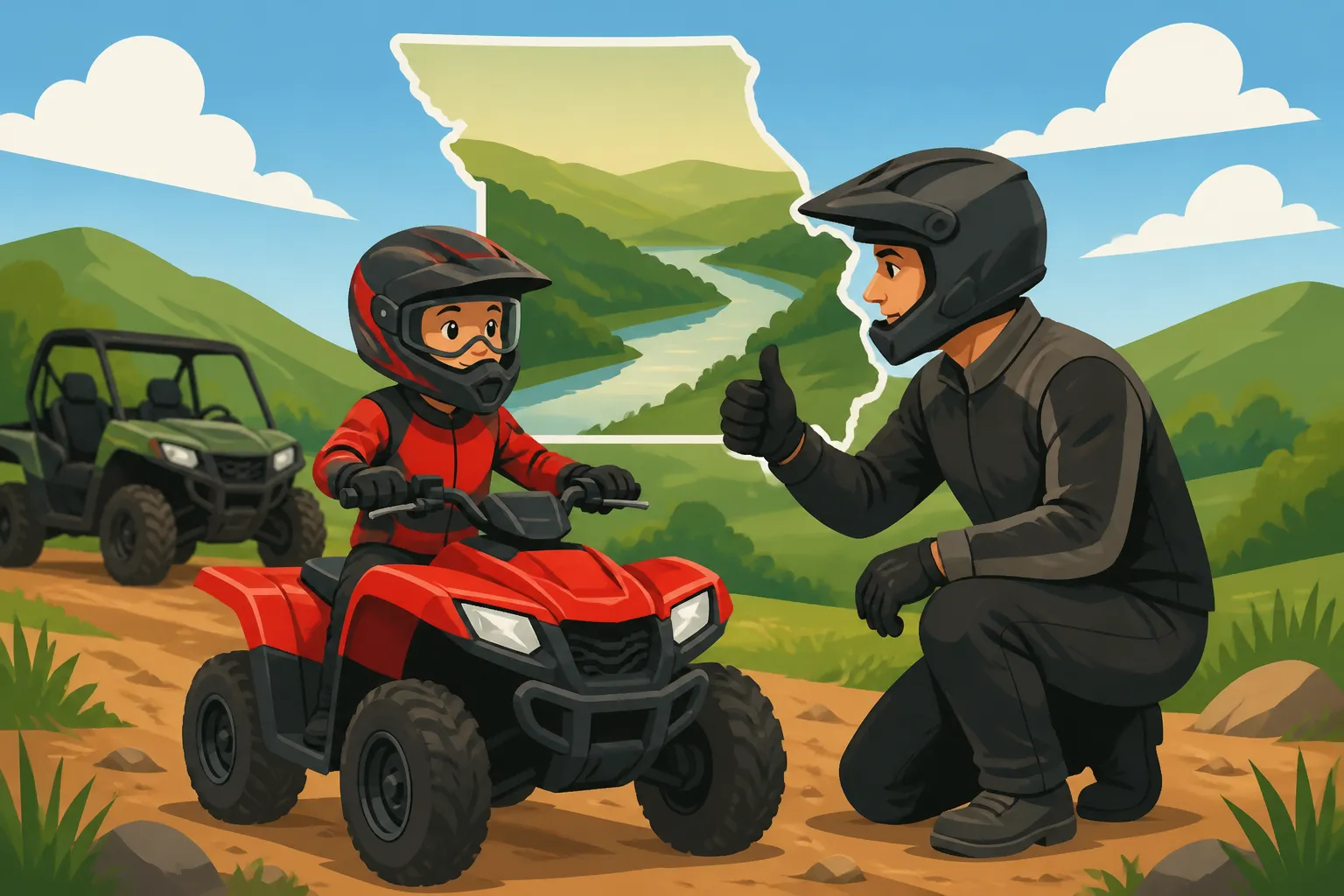
Have the child sit on the turned-off machine with an adult holding it steady. The rider should be able to sit upright, reach the handlebars without leaning far forward, and operate the controls without taking a hand or foot away from its proper position. Check that the child can reach and operate the brake and throttle smoothly.
For a straddle-seat ATV, the child should be able to keep a stable position and shift weight without sliding around. For a side-by-side, check that the child fits the seat and restraint system properly. A child who cannot sit securely or use the controls as designed is not ready for that machine, even if an adult plans to ride along.
Do not rely on age alone. Children of the same age can differ substantially in height, strength, coordination, attention, and judgment. Ask whether the child can remember and follow instructions under pressure, not only while sitting still.
Power and weight matter as much as seat height
An engine that feels manageable to an adult may accelerate too quickly for a new rider. A heavy machine can be difficult to stop, turn, or recover if it begins to tip. Do not treat an adjustable throttle limiter as a substitute for proper sizing: it can limit acceleration, but it does not make a machine lighter or correct a poor fit.
Read the manufacturer’s guidance for the machine and consider its intended rider. Avoid modifying the machine to make it seem suitable if the child cannot operate it as designed. An adult passenger on an ATV is not a solution to a poor fit; ATVs are generally built for one rider, and Missouri’s rules for passengers depend on the machine and setting. Review Missouri Passenger Rules on an ATV before planning a ride with more than one person.
For a side-by-side, seating capacity is not the same as permission for a child to operate it. The adult must determine whether the child can reach controls and understand the vehicle’s handling. A UTV’s size, weight, and momentum can make it particularly challenging for a beginner.
Buy or borrow protective gear that fits
A helmet should fit snugly and stay in place when the rider moves their head. A loose helmet can shift when it is needed most. Choose protective gear designed for off-road riding, and check that it is in good condition and appropriate for the child’s size. Eye protection, gloves, long sleeves, long pants, and sturdy over-the-ankle boots help reduce exposure to flying debris, scrapes, and hot components.
For a side-by-side, use the restraints and protective structure as intended. A belt that is too loose or incorrectly positioned may not protect a child effectively. Do not assume a child’s bicycle helmet is appropriate for off-road motorized riding; use equipment intended for the activity and follow the manufacturer’s fitting directions.
If you are sourcing equipment online, Amazon can be one place to compare size charts and product descriptions, but a listing is not proof that gear fits or meets the requirements of a particular riding area. Check the product details, return conditions, and the site’s gear rules. Whenever possible, have the child try the helmet and protective equipment on before the ride.
Teach the Controls Before Moving
A child should understand the machine’s controls and basic safety expectations before the engine is running. Teaching in small steps gives the adult time to see whether the child is ready to move on. If the child becomes tired, distracted, or overwhelmed, stop rather than pushing through the lesson.
Set simple rules first
Agree on a few clear rules that the child can repeat back. For example:
- Ride only when the supervising adult says it is time to start.
- Keep both hands on the controls and feet in the intended positions.
- Stay within the marked practice area.
- Slow down when asked, and stop immediately when signaled.
- Never approach another person, animal, machine, or road without permission.
- Do not carry a passenger or let another person take over.
Use a signal the rider can recognize if engine noise makes talking difficult. Agree on what the signal means and practice it while parked. If the child does not respond reliably, the lesson is not ready to progress.
Keep the first session short. Children may lose concentration before they show obvious physical fatigue. End on a calm note, not after a close call or a disagreement about continuing.
Walk through the machine with the engine off
Point out the throttle, brakes, ignition, kill switch, gear selector, and any other controls the rider may need. Explain what each control does in simple language. Ask the child to show you rather than merely nodding along.
Have the child practice the basic actions while the machine is stationary and secured. They should know how to shut the engine off and what to do if they are unsure. Do not begin riding until the child can identify the main controls and follow the stop instruction.
Then demonstrate at walking pace in the practice area. Show how to start smoothly, keep a steady speed, turn gently, and stop in a chosen spot. A demonstration is more useful when it is slow and visible than when it is fast or impressive.
Progress in small, repeatable steps
A sensible sequence is:
- Position and controls: Check posture, hand and foot placement, and the ability to reach the controls.
- Starting and stopping: Practice starting only with adult permission, moving a short distance, and stopping smoothly.
- Straight-line travel: Use a broad, level area with plenty of room to slow down.
- Wide turns: Begin with gentle arcs in both directions, leaving room to recover.
- Stopping at a signal: Ask the rider to stop at a clear signal from a safe distance.
- Simple changes in terrain: Add mild, predictable variation only after the rider can control the machine on level ground.
Do not use speed as a measure of progress. The goal is consistent control, not a fast lap. If the child has trouble with a skill, return to a simpler version of it. Keep obstacles, jumps, steep slopes, deep mud, water crossings, and tight trails out of beginner practice.
The adult should be close enough to intervene
Supervision means watching the rider, not just being somewhere on the property. Choose a position where you can see the entire practice area and respond quickly. Avoid supervising while operating another machine, using a phone, or managing several activities at once.
When an adult rides alongside a child, leave enough space to avoid a collision and make sure the child knows not to follow blindly. The adult’s presence does not replace the child’s own ability to stop, steer, and understand instructions. If the child cannot control the machine independently at a basic level, riding in a more demanding setting is premature.
Move to Public Trails Only When Ready
A beginner may be capable of riding in an open field but not ready for a public trail. Trail conditions can change quickly, and the rider may face other machines, narrow sections, uneven ground, blind corners, wildlife, and riders approaching from the opposite direction. Choose the first public ride for the child’s actual ability, not the adult’s preferred route.
Confirm age and supervision requirements
Missouri does not use one single rule for every riding location. Some locations set specific age limits or require adult supervision, while a facility may also separate younger riders into a designated practice area. A parent or guardian should verify the rules directly with the site and ensure the supervising adult meets the site’s requirements.
Do not assume that an adult’s registration or permit covers a child’s access. Check whether each rider or machine needs a separate permit, what proof must be carried, and whether the machine is allowed on the route. Does Your Decal Cover the Park Trail Permit? explains why vehicle paperwork and trail access can be separate matters.
Missouri does not require a statewide ATV rider certificate in the same way some states require a formal licensing card, but that does not mean every child can ride anywhere without conditions. A riding site can set its own rules, and safe training remains important even when no certificate is required. See [Does Missouri Require an ATV Safety Course?] for the difference between a statewide course requirement and site-specific conditions.
Choose a beginner-friendly first route
Before unloading, read the trailhead board and check for closures, difficulty information, and posted restrictions. A route that looks short on a map can still be challenging if it includes loose rock, narrow turns, steep grades, or water. Ask staff about current conditions if the posted information is unclear.
Plan a short ride with an easy way to turn back. Avoid crowded periods for a first outing if you can choose a quieter time, and make sure the child knows how to move aside safely when another rider approaches. Do not pressure a child to continue when they are frightened or tiring.
A beginner’s first public ride should not be the time to test the machine’s full capability. Stay on designated routes and avoid passing, racing, or following an adult through a difficult section the child cannot handle independently. If the adult would need to tow, push, or physically hold the machine through the route, it is probably not the right first trail.
Teach trail behavior along with riding technique
A public trail is shared space. Teach the child to slow down near people, other machines, animals, and blind turns. Keep a safe following distance and explain that dust, noise, and limited visibility affect everyone. Stop only in a place where the machine is safely out of the travel path.
Make clear that a marked route is the boundary. Riding off-trail can damage vegetation and soil, disturb wildlife, and create new hazards. A young rider should never be asked to cut across land to save time or follow an unmarked track because it appears easier.
If the site requires a flag, helmet, sound control, or other equipment, check it before leaving home. A site’s rules may not match the requirements that apply on a road, so do not carry assumptions from one setting to another. Read Missouri Flag Rules at a State Park and Missouri Sound Limits on Public Land when those requirements apply to your destination.
Make Safety a Routine, Not a Lecture
Children learn best when safety is built into the normal sequence of getting ready, riding, and packing up. A long lecture at the trailhead is less useful than a few repeatable checks that the child understands and can take part in.
Use the same pre-ride check each time
Before every session, inspect the machine and the child’s gear. Check that the controls work, tires appear properly inflated, and there are no obvious leaks or loose parts. Confirm that the helmet and other gear fit and are fastened. Secure loose clothing and tie back hair that could interfere with controls or moving parts.
Make sure the child understands the boundaries for that session. On private land, point out the practice area and places that are off-limits. At a public site, identify the route, meeting point, and what to do if the group becomes separated. Keep the plan simple enough for the rider to remember.
A useful pre-ride routine might include:
- Inspecting the machine before starting.
- Putting on and checking protective gear.
- Reviewing the stop signal and practice boundary.
- Confirming the adult who is supervising.
- Checking weather, trail conditions, and closures.
- Stopping the session if the child is tired, upset, or no longer following directions.
Respond calmly to mistakes
A beginner will make small errors. Correct them promptly and calmly, then decide whether to repeat the exercise or stop for the day. Shouting can make a child react unpredictably, while minimizing a serious mistake can teach the wrong lesson. Explain what happened, what action would be safer, and whether another attempt is appropriate.
A tip-over or near miss is a reason to pause and reassess. Check the child and machine before restarting. Consider whether the machine is too large, the surface is unsuitable, the rider is tired, or the skill needs more practice. Do not treat a child’s willingness to continue as proof that continuing is safe.
Keep a simple record of progress
You do not need a formal certificate or elaborate training log to track progress. A short note after a session can help you remember which skills the child can perform consistently and what needs more practice. Record the machine used, the location, the conditions, and any difficulty the child encountered.
Use progress to make better decisions, not to justify moving too quickly. A rider who handles wide turns in a field may still need practice stopping on a slope or responding to other riders. Readiness is specific to the task and setting. A child can be ready for a controlled practice area but not ready for a busy trail.
The adult’s responsibility is to keep adjusting the lesson to the rider. That may mean choosing a smaller machine, repeating the basics, or ending the ride early. Those are sensible decisions, not setbacks.
Frequently Asked Questions
Does Missouri require a safety course before a child rides?
Missouri does not have a universal statewide ATV rider certificate requirement. However, individual riding areas can have their own rules, and a course or structured instruction can still help a young rider learn safer habits. Verify the requirements for the specific place you plan to visit.
Can a child practice on private property without permission?
No. Get permission from the landowner and agree on where riding is allowed. Private property also needs a safe practice area, suitable equipment, and close adult supervision.
Can a child ride public trails just because an adult is present?
Not necessarily. Age limits, supervision requirements, machine restrictions, and youth-area rules can vary by location. Check the rules for the particular park or forest area before going.
Is a youth ATV automatically safe because it is made for children?
No. A child-sized model still needs to fit the rider, suit their ability, and be operated in an appropriate area. Read the manufacturer’s guidance and check that the child can control the machine’s throttle, steering, and brakes.
Disclaimer
This article is for general informational purposes only and does not constitute professional advice. Laws, prices and regulations vary by location and change over time. Consult a qualified professional for guidance on your specific situation.