Riding Private Ground in Missouri
Riding on private ground in Missouri can seem simpler than using a public trail, but permission, property boundaries, leases, and vehicle paperwork can still create confusion. The key is to separate access from permits: a landowner can authorize riding on their property, but that permission does not automatically settle every legal, safety, or registration question. Here’s how to plan a private-land ride without relying on assumptions.
Get clear permission before riding
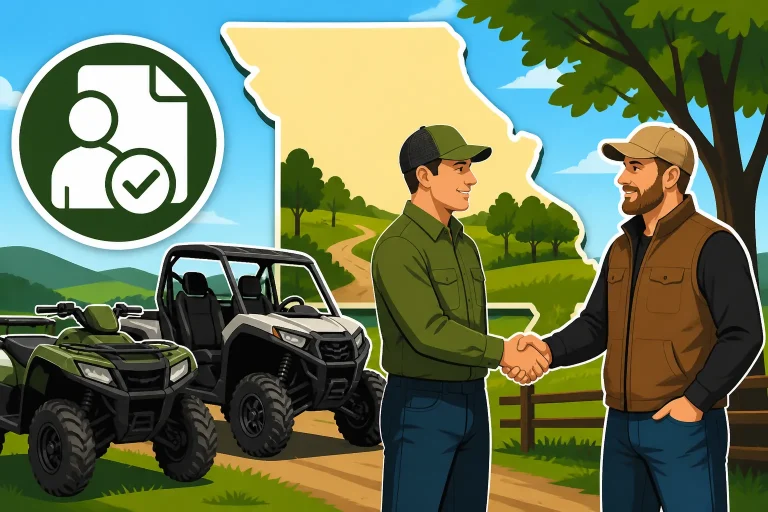
Start with the person or organization that has authority to allow vehicle use on the land. That may be the owner, but it could also be a farm operator, hunting club, property manager, or someone with a written lease. A relative’s invitation or a gate left open is not a reliable substitute for permission from someone authorized to grant it.
Ask about the specific property and the specific kind of use. Permission to hunt, walk, or work on a farm does not necessarily include permission to ride an ATV or UTV. Similarly, approval to use a lane to reach a field does not automatically mean you can explore the rest of the property.
Missouri property can involve several overlapping arrangements. A landowner may lease fields to a farmer, allow a hunting group to use the woods, and retain access for family members. Each arrangement may cover different activities. If you are not sure who can authorize riding, ask the owner or property manager rather than relying on another user’s understanding.
For a one-time visit, a direct conversation may be enough to establish permission, but confirm the details before unloading. For regular riding or group access, written terms can prevent later misunderstandings. Keep the agreement practical and specific. It can say:
- Who is allowed to ride, including whether guests may come along.
- Which machines are permitted, such as ATVs, UTVs, or both.
- Where riding is allowed and which areas are off-limits.
- Whether there are approved trails, lanes, or crossing points.
- When access is allowed and whether it changes during hunting or farm seasons.
- Whether passengers, dogs, or towing are permitted.
- Who to contact if a gate is locked, a route is blocked, or a machine causes damage.
This does not need to become an elaborate contract for every casual ride. The point is to avoid relying on a vague “you can ride here” when the owner meant one field, one date, or one route. More detail matters when a group is involved, access is repeated, or the property is shared with other users.
A written agreement also helps distinguish permission from ownership. You may be allowed to ride on the land without receiving any lasting right to use it. The owner can set conditions, change routes, or withdraw access. A lease or hunting arrangement may not include riding rights unless those rights are stated. For more on that question, see Does a Farm Lease Carry Riding Rights? and Missouri Landowner Permission Requirements.
Treat boundaries as part of permission
Permission applies to the land covered by the agreement, not automatically to neighboring acreage. A trail that crosses a fence, follows a creek, or runs beside a field may pass through more than one owner’s property. Confirm the route instead of assuming a path is open because it looks established.
Look for posted signs, gates, fences, property markers, and instructions from the owner. These clues can help, but they are not always a complete boundary map. If the route is uncertain, stop and ask. Do not ride through a gate simply because it is unlatched, and do not assume that a road or trail is public because it is used by several people.
If the owner gives permission to cross a neighboring parcel, clarify whether that permission comes directly from the neighbor or is based on a formal access arrangement. A landowner cannot grant access to property they do not control.
Understand what private-land permission does and does not cover
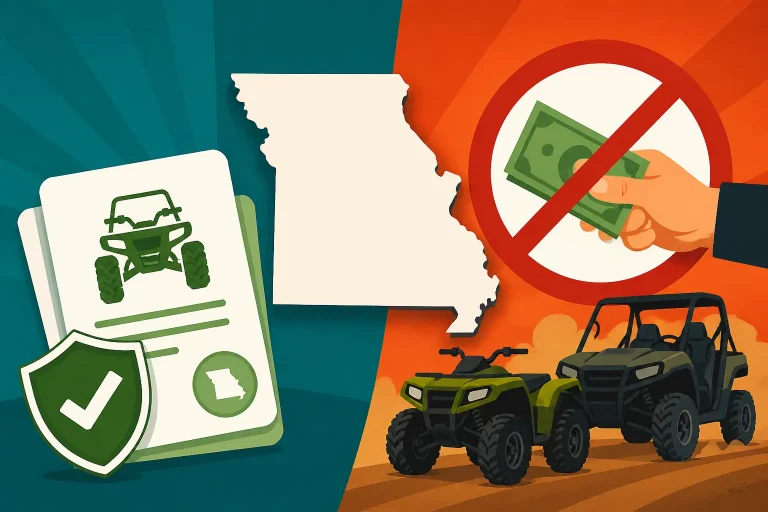
Permission answers one question: whether you may enter and ride on the land covered by the owner’s approval. It does not automatically provide a public-land permit, legal access to a nearby road, or authorization to ride beyond the property boundary.
A state park, national forest, or other public riding area has its own access rules. A private-land agreement does not replace the permit or other requirements for a public riding system. In the other direction, a public riding permit does not grant access to someone’s private property. Keep those permissions separate. Missouri Rules for Riding Public Land and Missouri ORV Permits Explained cover the public-land side.
| Situation | What permission or paperwork may apply | What not to assume |
|---|---|---|
| Riding only on land where you have permission | Confirmed landowner or authorized manager approval | That permission includes neighboring land |
| Using a designated public riding area | The permit and rules for that specific area | That private-land permission replaces a public permit |
| Crossing or traveling along a road | Applicable road-use rules and any required local authorization | That a private-land invitation makes the road legal to ride |
| Riding under a farm or hunting arrangement | Terms that specifically address ATV or UTV use | That access for farming, hunting, or foot travel includes vehicle use |
| Owning or buying an ATV | Any title or registration requirements that apply to the machine and its use | That riding privately settles all vehicle paperwork |
A useful distinction is between a machine’s ownership documents and an access permit. A title is an ownership record; a registration decal and a riding-area permit serve different purposes. Whether you need particular ATV paperwork can depend on the machine and how it will be used. Do not assume that private-property riding removes every title or registration obligation, or that obtaining a decal gives you permission to use private land. Check the applicable Missouri requirements for your machine and intended use through Registering an ATV in Missouri.
Machine classification matters too. Missouri’s ATV, utility vehicle, and recreational off-highway vehicle categories do not always share the same requirements. If you ride a side-by-side, do not assume that rules written for a straddle-seat ATV apply to it. The state’s categories are discussed in Why Missouri Splits ATVs, UTVs and ROVs.
Keep private access separate from road access
A private farm lane, driveway, or trail is not necessarily the same thing as a public road. But a route does not become private merely because it is narrow, unpaved, or beside a farm. If a ride leaves the owner’s property and enters a public street or highway, a new set of rules may apply.
Before planning a route that includes a public road, confirm the road’s status and whether that machine may use it under the applicable rules. A landowner cannot grant permission to ride on a public road where that use is not authorized. Likewise, a permit or exception for road use does not authorize riding on a neighbor’s land. See Are ATVs Street Legal in Missouri? for the separate road-use issue.
Set boundaries for routes, timing, and shared use
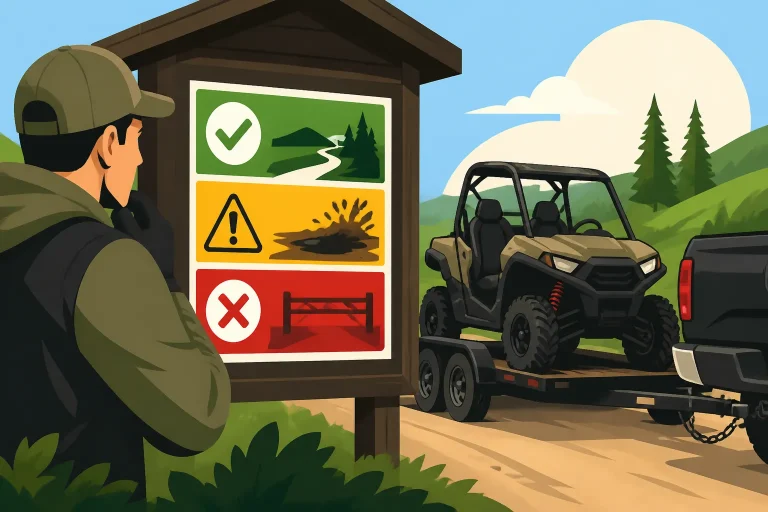
A clear route plan protects both the rider and the property. Ask which trails or lanes are approved, where turns are allowed, and which areas must stay closed. This is especially important on land that includes crops, livestock, timber, water, steep banks, or active farm work.
Riding off an agreed route can damage property even when the rider has general permission to be there. Tires can tear up soft ground, rut a field, damage a planted area, disturb wildlife, or create a hazard for equipment. The landowner may also have chosen a route to keep riders away from a home, livestock, hunting area, or sensitive ground.
Ask about conditions that can change access. The owner might close a route after heavy rain, during planting or harvest, while livestock are moved, or during a scheduled hunt. A trail that is suitable in dry weather can become damaging or unsafe when saturated. If the ground is soft enough to rut, take a different route or postpone the ride.
When several people use the property, find out how to avoid conflicts. The owner may have guests walking, hunters using blinds, farm vehicles moving between fields, or contractors working near a trail. Agree on how riders will respond when they encounter another user. Slow down, give people room, and follow any instructions to stop or reroute.
For group rides, one person should make sure every participant understands the property rules before engines start. Do not assume that permission for the organizer extends to every guest. Confirm group size, arrival and departure times, parking, and whether spectators or support vehicles may enter. If the owner limits the number of machines, stick to that limit.
Gates, fences, and livestock
Ask whether gates should remain open or closed, and follow the owner’s instructions every time. A gate may control livestock, separate properties, or prevent access to a hazard. Leaving it open can create a serious problem; closing a gate that should remain open can also interfere with the owner’s operation. If the instruction is unclear, ask before riding through.
Do not use fences as obstacles or ride around a gate to reach a closed area. Avoid startling livestock, and keep enough distance to let animals move without pressure. If an animal is in the route, stop and give the owner or person managing the animals time to handle the situation. Never chase livestock for recreation.
Water, slopes, and other sensitive ground
Ask whether creeks, ponds, levees, banks, and wet areas are included in the permitted route. A landowner’s permission is not an invitation to tear through every part of the property. Water crossings and steep banks can damage land, hide hazards, and make a machine difficult to recover.
Missouri weather can change a route quickly. After heavy rain, a low crossing may be deeper or faster than expected, and a rutted trail can worsen with each pass. If a route looks unsafe or more damaging than it did when permission was granted, turn around and contact the owner rather than improvising a new path.
Plan for safety, liability, and property care
Private land is not automatically a controlled riding area. It may have no marked trails, staff, signs, or emergency services close by. Before unloading, identify hazards with the owner: ditches, wire, old equipment, steep drop-offs, thin ice, wells, construction areas, and locations where farm machinery may operate.
Set basic rules for everyone in the group. Riders should use protective equipment suited to their machine and conditions, ride at a pace that allows them to see and respond to hazards, and avoid riding alone in remote areas when possible. A passenger should only ride on a machine designed and equipped for passengers, and the owner’s permission does not make an unsuitable passenger setup safe.
Agree on how to handle an emergency. Know the property’s access point and address, keep a charged phone available where service exists, and make sure someone outside the group knows where you are riding. In areas with limited cell coverage, plan for communication and recovery before heading out. If a machine becomes stuck, do not risk a rollover or enter unsafe water trying to retrieve it.
Consider insurance and responsibility
Ask the landowner whether they have conditions for riders, such as proof of insurance or limits on group size. Requirements can vary by arrangement, and a casual invitation should not be treated as a promise that the owner’s insurance covers every rider, machine, injury, or damage.
Review your own insurance documents and ask your insurer what coverage applies to off-road use, property damage, injuries, and trailer transport. Coverage can depend on the policy, machine, activity, and location. Do not assume that a homeowners policy, auto policy, or public-land permit provides the coverage you need.
A written agreement can record safety expectations and contact details, but it should not be treated as a substitute for appropriate insurance or professional advice about liability. If the arrangement involves recurring commercial activity, organized events, paid access, or a large group, the owner and organizer may need to consider additional requirements before hosting rides.
Leave the property as agreed
Stay on authorized routes, pack out trash, and avoid making new trails unless the owner has approved them. Do not cut branches, move barriers, dig, or alter a trail without permission. If you cause damage, tell the owner promptly and discuss the next steps rather than leaving the issue for someone else to find.
Respect limits on noise, speed, hours, and machine type. A property owner may allow a quiet utility machine for farm work but not a group of recreational riders. If the owner sets a quiet-hours rule, follow it even if you believe the machine is not especially loud. Keep loading and unloading considerate of neighbors, and do not block gates, driveways, or farm access.
At the end of the visit, close or leave gates as instructed, remove equipment and litter, and let the owner know if you saw a hazard or damaged area. A good private-land relationship depends on more than receiving permission once. It depends on showing that the rider can follow conditions and respect the property.
Use this checklist before unloading
A short check-in can prevent most access problems. Use this sequence for a one-time visit, and repeat it when the route or conditions change.
- Confirm who can authorize the ride. Ask the owner or a person clearly empowered to manage access.
- Describe the planned use. State the machine type, number of riders, date, and purpose.
- Confirm the route and limits. Identify allowed trails, closed areas, boundary crossings, parking, and gate instructions.
- Ask about timing and other users. Check for farm work, livestock movements, hunting, maintenance, or temporary closures.
- Clarify road connections. Find out whether the route stays on private land and what to do if a public road is involved.
- Check the machine paperwork. Confirm the title or registration requirements that apply to the machine and how it will be used.
- Review safety and insurance. Discuss known hazards, emergency access, any insurance conditions, and the group’s plan.
- Reconfirm if conditions change. Heavy rain, new work, or a changed route may mean the original approval no longer fits.
For recurring access, keep a copy of any written terms and the owner’s contact information where the group can find them. Make sure guests receive the same rules before arriving, not after they have unloaded.
The safest assumption is that permission is limited to what was actually approved. If an owner says you can use a particular trail, stay on it. If a lease, hunting agreement, or public-road connection is involved, clarify those separate rights instead of treating them as included. For broader private-property details, see [Missouri Rules for Riding Private Property].
Frequently Asked Questions
Do I need a public-land ORV permit to ride only on private land?
A permit for a particular public riding area does not generally serve as a private-land access pass. If your ride stays entirely on private property, ask the landowner about access and check any vehicle paperwork rules that apply. If you enter a public riding area, follow that area’s permit requirements.
Does a farm or hunting lease automatically allow ATV riding?
Not necessarily. A lease may authorize farming, hunting, or another activity without including recreational vehicle use. Check the lease and confirm with the person who has authority over the property. See Does a Farm Lease Carry Riding Rights?.
Can I ride on a private road or driveway?
Only if you have permission from someone authorized to grant it, and only within the terms of that permission. If the route connects to or uses a public road, public-road restrictions may also apply. A private invitation does not override rules for public roads.
Does landowner permission replace an ATV title or registration?
No. Permission concerns access to the land; title and registration concern the machine and its legal status or use. Requirements can depend on the vehicle and how it is operated, so confirm them separately with the appropriate Missouri source.
Disclaimer
This article is for general informational purposes only and does not constitute professional advice. Laws, prices and regulations vary by location and change over time. Consult a qualified professional for guidance on your specific situation.