The Missouri Park Flag on a Flexible Mast
A flag that looks tall enough beside the garage can sit too low once it is mounted on an ATV, and a road-use flag may not meet a park’s separate rules. For Missouri state park ORV riding, the key is a visible orange flag on a flexible mast at the required height. Here’s how to choose, mount, and check one before you unload.
What Missouri’s park flag requirement means
The flag requirement applies to riding in designated off-road vehicle areas, not automatically to every place in Missouri where an ATV or UTV might be ridden. State park trail systems have their own access conditions, and a flag is only one of them. Confirm the current rules for the specific riding area before your trip, especially if you are visiting a park you have not used before.
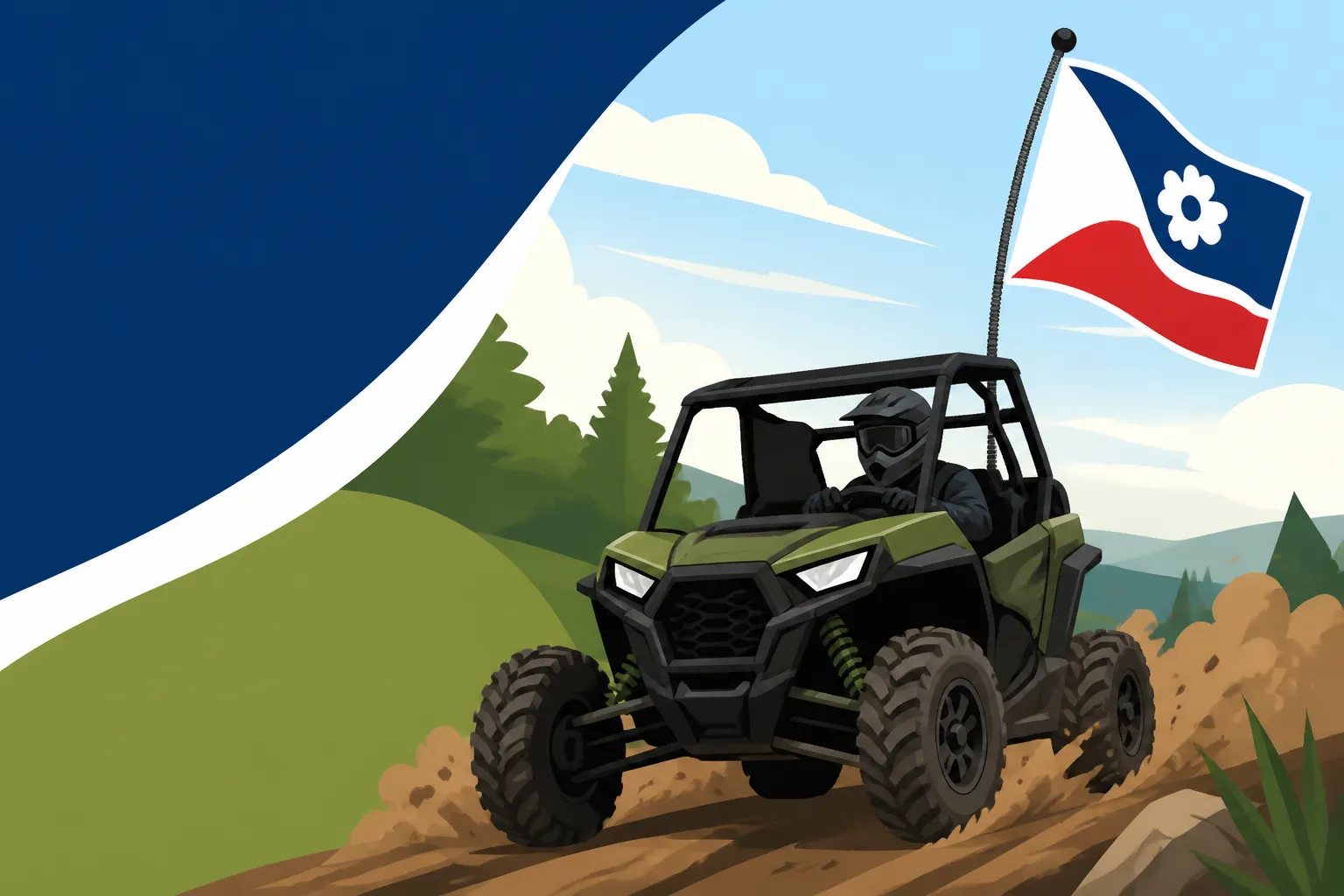
The park standard to plan around is an orange flag with at least 64 square inches of visible area, mounted on a flexible mast that reaches at least 72 inches above the ground. Those are two separate measurements: the flag needs enough area, and the assembled mast needs to put it high enough. A flag can satisfy one part while failing the other.
A flexible mast is designed to bend rather than act like a rigid pole if it brushes vegetation or takes a light bump. Flexibility also helps the flag move and remain noticeable. It does not mean the mast should flop around so much that the flag drags, folds over, or stays hidden behind the machine.
The height requirement is about the installed setup, not the number printed on the mast package. A mast advertised as a certain length may attach to a low point on the machine, and its base, mounting angle, or flag position can affect the final height. Check the height with the machine on level ground and the mast in its normal riding position. If you are uncertain how the park measures it, ask the park before relying on an interpretation.
The flag’s orange area is another point to check carefully. A small flag can look bright and conspicuous in a product photo but still be too small. Look at the actual dimensions and calculate the flag’s area if necessary. For a rectangular flag, multiply its width by its height. A flag measuring 8 inches by 8 inches has 64 square inches of area; a narrow flag with the same area may be harder to spot from some angles, so consider visibility as well as the minimum.
The park flag is not a substitute for an ORV permit, a trail-appropriate machine, or other equipment the riding area requires. Review Missouri ORV Permits Explained and the relevant park information before you travel. A flag that passes inspection does not guarantee access if the machine is too wide for a trail, the permit is missing, or the area is closed.
Why flexibility and visibility matter
A flag is a simple warning marker, but it has a practical job: make a rider easier to see over brush, uneven ground, and other machines. The mast needs enough height to lift the flag into view, while the flag needs enough surface area and contrast to be noticed. A flexible mast helps reduce the chance of a rigid pole snagging or breaking during ordinary trail contact.
The system works only when the full setup remains upright and visible. A flag folded around the mast, buried behind a cargo box, or hidden by gear may technically be attached but is not doing its job well. Before setting off, look at the machine from a distance and from several directions. If the flag disappears behind the machine when viewed from the side, change the mounting position or choose a setup that gives it a clearer sightline.
How to choose a flag and flexible mast
Start with the park’s stated requirements, then compare complete flag-and-mast setups against them. Do not assume that a listing labeled “ATV flag” is automatically suitable for a Missouri state park. Product names are broad, and dimensions, mast length, mounting hardware, and flexibility can vary.
| What to check | What to look for | Why it matters |
|---|---|---|
| Flag color | Orange, with good visibility | A bright, contrasting flag is easier to notice on a trail |
| Flag area | At least 64 square inches | A smaller flag may not meet the park standard |
| Mast height | At least 72 inches above the ground when installed | Package length alone may not show the final mounted height |
| Mast behavior | Flexible, but stable enough to hold the flag up | It should bend without collapsing or dragging |
| Mount | Secure and suited to your machine | A poor fit can loosen, tilt, or obstruct riding |
| Flag condition | Intact, clean, and easy to see | Tears, folds, or fading can reduce visibility |
Check the flag’s actual dimensions
Read the listed dimensions rather than judging from a product photo. If a listing gives only one dimension, ask the seller for the other. A flag’s overall area is not always the same as the visible orange area if parts are covered by seams, a sleeve, or a mounting pocket. A little extra surface area can make it easier to meet the minimum without relying on borderline measurements.
Also consider how the flag behaves when the machine moves. A stiff flag or one that curls around the mast may be less visible than a flat, bright flag. Check whether it is designed to stay open in the airflow or whether it needs a particular orientation. If it arrives folded, inspect how it hangs once mounted and whether it can be kept visible without modifying it.
Make sure the mast is flexible and tall enough in place
A mast’s advertised length does not necessarily equal its height above the ground when mounted. A mount may sit below the rack or frame, and a mast angled backward can reduce its vertical reach. Measure the assembled setup on level ground, from the ground to the required reference point under the park’s rule. When in doubt, ask the park whether it measures to the top of the mast or the flag.
Look for a mast intended to flex during contact, not a rigid rod that happens to be long. At the same time, a very soft mast may vibrate or bend so much that the flag becomes hard to see. The useful middle ground is a mast that gives under light pressure but returns upright and holds the flag in a clear position.
The mount should attach securely to a part of the machine that can support it without interfering with controls, passengers, or cargo. A mounting point on the rear rack may work on one model and be unsuitable on another. Check the machine manufacturer’s guidance and the flag kit’s instructions. Avoid placing a mount where it can obstruct a light, snag clothing, catch a strap, or become a hazard when someone gets on or off.
Some riders shop online for a flag and mast, including through Amazon. Treat the product details as a starting point, not proof that the setup qualifies. Confirm the flag dimensions, mast type, hardware compatibility, and installed height yourself. If the listing is vague, choose a product with clear measurements or contact the seller before buying.
Match the kit to the machine
An ATV and a UTV may need different mounting solutions. A UTV’s roof, roll structure, cargo bed, or bodywork can affect where a mast fits and how much of the flag is visible. An ATV may have less room for a base, and a rear rack can be loaded with gear that blocks a low-mounted flag.
Before choosing a mounting location, think through the full ride configuration. Include passengers, a helmet, cargo, a spare tire, or other accessories that could cover the flag from the side or rear. A setup that is visible on an empty machine may become obscured when the machine is ready for a day on the trail.
If you ride more than one machine, do not assume one flag kit will fit both safely. A kit can be transferred only if it attaches securely, meets the height requirement on each machine, and leaves the flag unobstructed. Keep the right mount and any small hardware together so that the flag does not end up being improvised at the staging area.
Mount and inspect the flag before riding
A short inspection at home is easier than discovering a problem at the park entrance. Assemble the flag according to its instructions, mount it on the machine, and check both the measurements and visibility before loading the trailer.
- Choose a suitable mounting point. Use a secure location that does not interfere with steering, lights, passengers, cargo, or normal access to the machine. Check that the mount is intended for the machine or rack where you plan to use it.
- Install the mast as directed. Tighten the hardware enough to prevent the base from twisting or loosening, without damaging the rack or mounting surface. If the setup uses a clamp, confirm it sits evenly and does not shift when you gently test the mast.
- Measure the height on level ground. Check the installed height with the machine in its normal position. Do not rely on the mast’s loose length or measure from the rack instead of the ground.
- Check the flag area and orientation. Confirm the flag meets the area requirement and hangs in a way that keeps the orange surface visible. Make sure it is not folded around the mast or hidden behind equipment.
- Look at the machine from a distance. Check the flag from the front, sides, and rear. If the flag blends into the background or disappears behind the machine, adjust the position or setup.
- Recheck the mount after transport. Tie-downs, trailer movement, or loading can loosen or bend parts of the kit. Inspect it again after unloading and before entering the riding area.
A flexible mast may sway, but the base should remain secure. If the entire mount rotates, slides, or pulls away from the machine when you test it gently, do not ride with it that way. Tighten or reposition the mounting hardware according to its instructions. If the attachment point is damaged or unsuitable, use a different mount rather than relying on a loose connection.
Keep the flag clean enough to remain bright and easy to see. Mud, dust, or a deep fold can reduce its visibility. After a ride, check for cracks, fraying, bent sections, and loose fasteners. A mast that has taken a hard hit may not spring back into position. Replace damaged parts rather than assuming they will hold up for another outing.
Carry a simple backup plan if the flag kit uses small removable pieces that are easy to lose. This does not mean improvising a substitute from a rigid pole or undersized flag. It means keeping the proper fasteners and any manufacturer-provided replacement pieces together so a missing part does not leave you unable to install the setup correctly.
The park entrance is the wrong place to start measuring or searching for missing parts. If your flag fails the check, the result can be a delay or being turned away. Turned Away at a Park Gate for No Flag explains why it pays to treat the flag as part of the pre-trip inspection, alongside the permit and machine requirements.
Keep park rules separate from road rules
A common source of confusion is assuming that one orange flag standard covers every kind of riding in Missouri. Park requirements and public-road requirements are different rule sets. The dimensions or height that work for a road-use situation may not satisfy a state park, and a park flag does not by itself make an ATV or UTV legal to use on a road.
Missouri road rules can involve different machine classifications, permits, equipment, and flag specifications. For example, the road-use flag requirement discussed in Missouri’s 7-Foot Safety Flag is not a substitute for checking the park’s own flag standard. The two settings serve different purposes and are assessed under different rules. Compare How Park Flag Rules Differ From Highway Rules before assuming that a single flag setup covers both.
A road permit also does not automatically grant entry to a park trail, and an ORV permit does not authorize general road use. Read Missouri ORV Permit for a Visitor if you are traveling from another state, and check the riding area’s own instructions for permits, flags, machine limits, and closures. If you are planning to use public roads on the way to a trailhead, confirm the road rules separately rather than treating the park flag as road approval.
Park requirements may differ by riding location or be updated, so check the official information for the specific site before leaving home. A park’s web page, reservation or permit information, or direct contact with park staff can clarify a detail that product listings cannot. Ask precise questions: whether the flag area is measured by its dimensions, what point the mast height is measured from, and whether the rule applies to every machine entering the ORV area.
A useful pre-trip check is to confirm four things: the flag is the required color and area, the flexible mast reaches the stated height when mounted, the mount fits your machine securely, and the location you intend to ride accepts your machine and permit. The flag is a small piece of equipment, but overlooking it can disrupt the whole trip. Reviewing Missouri Flag Rules at a State Park and Why a Road-Legal Flag Fails at a Park Gate can help keep the two standards straight.
Frequently Asked Questions
Does Missouri require a flexible mast at a state park?
The park standard discussed here calls for an orange flag on a flexible mast. Check the current requirements for the specific ORV riding area before you go, because park rules and access conditions can change.
How high should the flag be?
Plan for a mast that places the flag at least 72 inches above the ground when installed. Confirm how the specific park measures that height, and measure the assembled setup rather than relying on the mast’s advertised length.
How large does the flag need to be?
The park standard is at least 64 square inches of orange flag area. Check the dimensions and make sure the visible surface is not hidden by a fold, sleeve, gear, or the machine itself.
Can a highway flag meet the park requirement?
Possibly, but do not assume so. Highway and park requirements are separate, and a flag that meets one standard may not meet the other. Check both rule sets if you plan to ride in both settings.
Disclaimer
This article is for general informational purposes only and does not constitute professional advice. Laws, prices and regulations vary by location and change over time. Consult a qualified professional for guidance on your specific situation.