Who Can Supervise a Rider Under 16
Missouri’s ATV rule for riders under 16 can be easy to misread: the state does not specify a minimum age for driving, but younger riders generally need supervision. The key questions are who may supervise, where the rider is operating, and what “authorized adult” means in practice. Here’s how to apply the rule without treating supervision as permission to ride anywhere.
Missouri’s supervision rule for riders under 16
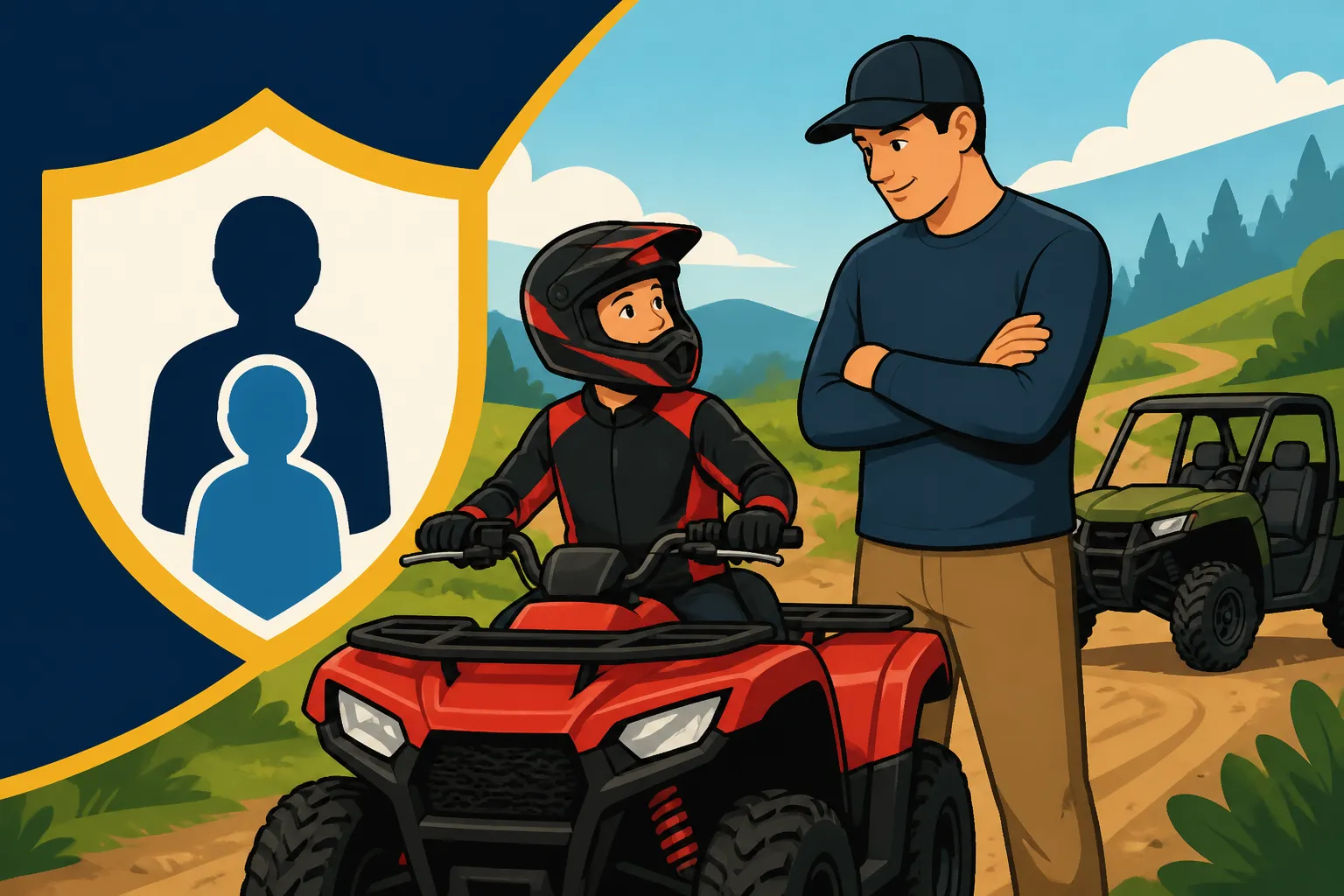
According to the Missouri State Highway Patrol, a person under 16 cannot operate an ATV unless supervised by a parent, guardian, or authorized adult. The stated exception is operation on private property owned by the rider’s parent or guardian.
That rule has two important parts. First, the listed supervisor must be a parent, guardian, or someone who qualifies as an authorized adult. Second, the private-property exception is limited to property owned by the parent or guardian. A rider should not assume that a neighbor’s land, a relative’s property, or any privately owned place automatically falls under the exception.
The Missouri State Highway Patrol also states that Missouri has no age requirement for driving an ATV. That does not cancel the under-16 supervision rule. It means the state does not set a general minimum driving age in the information provided, while still requiring a qualifying supervisor for riders under 16 except on the specified property.
| Situation | What the Missouri rule says | Practical takeaway |
|---|---|---|
| Rider is under 16 and operating an ATV | The Missouri State Highway Patrol requires supervision by a parent, guardian, or authorized adult. | Confirm who qualifies as an authorized adult before the ride. |
| Rider is under 16 on private property owned by a parent or guardian | The Missouri State Highway Patrol lists this as an exception to the supervision requirement. | Check that the property is owned by the parent or guardian; permission alone is not the same fact. |
| Rider is 16 or older | The under-16 supervision rule does not apply on its terms. | Other safety, equipment, registration, and location rules may still apply. |
| Rider is under 18 | The Missouri State Highway Patrol says ATV drivers under 18 must wear helmets. | Supervision does not replace required protective equipment. |
For more context on how the age rule fits with other requirements, see Missouri Supervision Rules for Minors and Missouri Minimum Age to Ride an ATV. The important distinction is that “no minimum age” is not the same as “no conditions for young riders.”
Who can supervise, and what “authorized adult” means
The Missouri State Highway Patrol names three categories: a parent, a guardian, or an authorized adult. The provided rule does not define an authorized adult in more detail. It does not specify a minimum age for that adult, say whether written permission is required, or explain whether the adult must be a relative.
Because the rule leaves those details open, avoid treating a friend, older sibling, family acquaintance, or other adult as automatically authorized. Before a ride, confirm the interpretation with the relevant official authority, especially if the rider will be on public land or traveling somewhere beyond the family’s property.
A parent or guardian is the clearest fit under the wording. If another adult will supervise, ask the parent or guardian to establish that arrangement and check what the applicable rules require. Written permission can help make the family’s plan clear, but do not assume that a note by itself establishes legal authorization unless the appropriate authority confirms it.
The law also does not spell out, in the facts available here, exactly how close the supervisor must be, whether the supervisor must ride another ATV, or how much direct observation is required. Those are sensible points to settle before heading out. From a safety standpoint, supervision should be active enough for the adult to monitor the child, communicate quickly, and intervene if the rider gets into trouble. That is practical guidance, not a claim that Missouri’s rule defines supervision in those exact terms.
A useful pre-ride conversation covers:
- Who is responsible for supervising the rider?
- Does that person qualify as a parent, guardian, or authorized adult?
- Where will the rider be allowed to operate?
- What signals or communication method will the rider and supervisor use?
- What conditions mean the ride stops, such as fatigue, poor visibility, or loss of control?
- Does the rider understand where not to go and how to stop safely?
Families working through paperwork as well as supervision can read Why a Missouri Rider Under 16 Cannot Register and How a Parent Registers a Machine for a Teenager. Registration questions and the supervision rule are separate: getting a machine registered does not establish who may supervise its young rider.
Where the rule applies, and where the exception is narrow
The exception is specifically for private property owned by the rider’s parent or guardian. This matters because people often use “private property” casually to mean any land that is not a public trail. The wording given by the Missouri State Highway Patrol is narrower: ownership by the parent or guardian is the relevant detail.
If the property belongs to someone else, do not assume the exception applies just because the owner has invited the family to ride. Permission to use land and the supervision exception are different questions. The Missouri State Highway Patrol says ATV drivers must obtain permission to operate on private property, but permission alone does not change the stated ownership condition for the under-16 exception.
Public riding areas require a separate check. Missouri has off-road vehicle areas at St. Joe State Park and Finger Lakes State Park, and the Missouri Department of Natural Resources says off-road vehicle permits must be purchased before arriving at those parks. Those permit facts do not answer who qualifies as a supervisor or establish a separate age rule at a park. Check the applicable park rules before planning a ride with a young operator. See Missouri Park Access for Riders Under 16 and Teaching a Young Rider in Missouri for related planning topics.
The same care applies to roads and highways. Supervision does not make an otherwise prohibited ride legal. According to the Missouri State Highway Patrol, ATVs generally may not be operated on Missouri highways except in specified situations, including government operation for official use or agricultural use between sunrise and sunset. The patrol also says an ATV operator on a highway must have a valid operator’s license. A young rider should not be taken onto a road on the assumption that an adult’s presence overrides those restrictions.
Before choosing a location, identify what kind of land it is and what rules apply there:
- Parent- or guardian-owned private property: This is the specific location identified as an exception to the under-16 supervision requirement.
- Other private property: Obtain the landowner’s permission, and do not assume the under-16 exception applies merely because the land is private.
- A designated public riding area: Check the site’s access, permit, equipment, and age requirements before traveling.
- A road or highway: Check the separate highway restrictions. Supervision alone does not authorize highway operation.
This is why a family should settle the location and the supervisor together rather than relying on a general statement that the child is “with an adult.” For more about landowner permission, see Missouri Landowner Permission Requirements.
A practical safety plan for an under-16 rider
Meeting the supervision requirement is only one part of deciding whether a young person is ready to ride. The Missouri State Highway Patrol’s publication ATVs: Safety Comes First provides information on proper ATV handling, related laws, and safety hints. Families can use that material alongside machine-specific instructions and a discussion of where the rider may go.
Start with a machine and setting the rider can manage. Explain how to start, stop, steer, and respond if the ATV behaves unexpectedly. A young rider should know how to stop the engine and how to get the supervisor’s attention. Agree on a route and boundaries before starting, and make clear that the rider must not leave those limits without permission.
Protective equipment matters even when a responsible adult is present. According to the Missouri State Highway Patrol, a securely fastened helmet is required for ATV drivers under 18. The patrol also says ATVs must display a Department of Revenue registration sticker. For a young rider, checking the machine and equipment before the ride is a straightforward way to avoid confusing “supervised” with “ready to go.”
Keep the first ride conservative. Use a controlled area, avoid unfamiliar terrain, and stop if the rider seems tired, distracted, or uncomfortable. An adult can set clear rules about speed, spacing, turns, stopping points, and whether the rider may approach other people or vehicles. Those are safety practices, not substitutes for checking the applicable legal rules.
A quick pre-ride checklist can help:
- Confirm the rider is under the supervision of a parent, guardian, or adult confirmed to be authorized.
- Confirm whether the location is parent- or guardian-owned property or another type of land.
- Obtain the landowner’s permission when riding on private property that belongs to someone else.
- Check the location’s access and permit rules before leaving home.
- Make sure the ATV has its required registration sticker and that the rider has a properly fastened helmet.
- Explain the boundaries, communication plan, and conditions for stopping the ride.
- Keep the ATV off roads unless the specific highway rules allow the planned operation.
The core answer is simple, but applying it carefully takes a little planning: an under-16 rider generally needs a parent, guardian, or authorized adult supervising, with a specific exception for private property owned by the parent or guardian. When the adult’s authority or the riding location is uncertain, verify before the ATV is started.
Sources
- Missouri Department of Revenue — Titling & Registration for All-Terrain Vehicles (ATVs) (checked November 3, 2026)
- Missouri Department of Natural Resources — Off Road Vehicle ORV Riding Permit | Missouri Department of Natural Resources (checked November 3, 2026)
- Missouri State Highway Patrol — SHP-448.pdf (checked November 3, 2026)
- Missouri State Highway Patrol — MSHP News Release (checked November 3, 2026)
- Missouri State Highway Patrol — MSHP News Release (checked November 3, 2026)
Disclaimer
This article is for general informational purposes only and does not constitute professional advice. Laws, prices and regulations vary by location and change over time. Consult a qualified professional for guidance on your specific situation.