Missouri Fines for Riding a Closed Trail
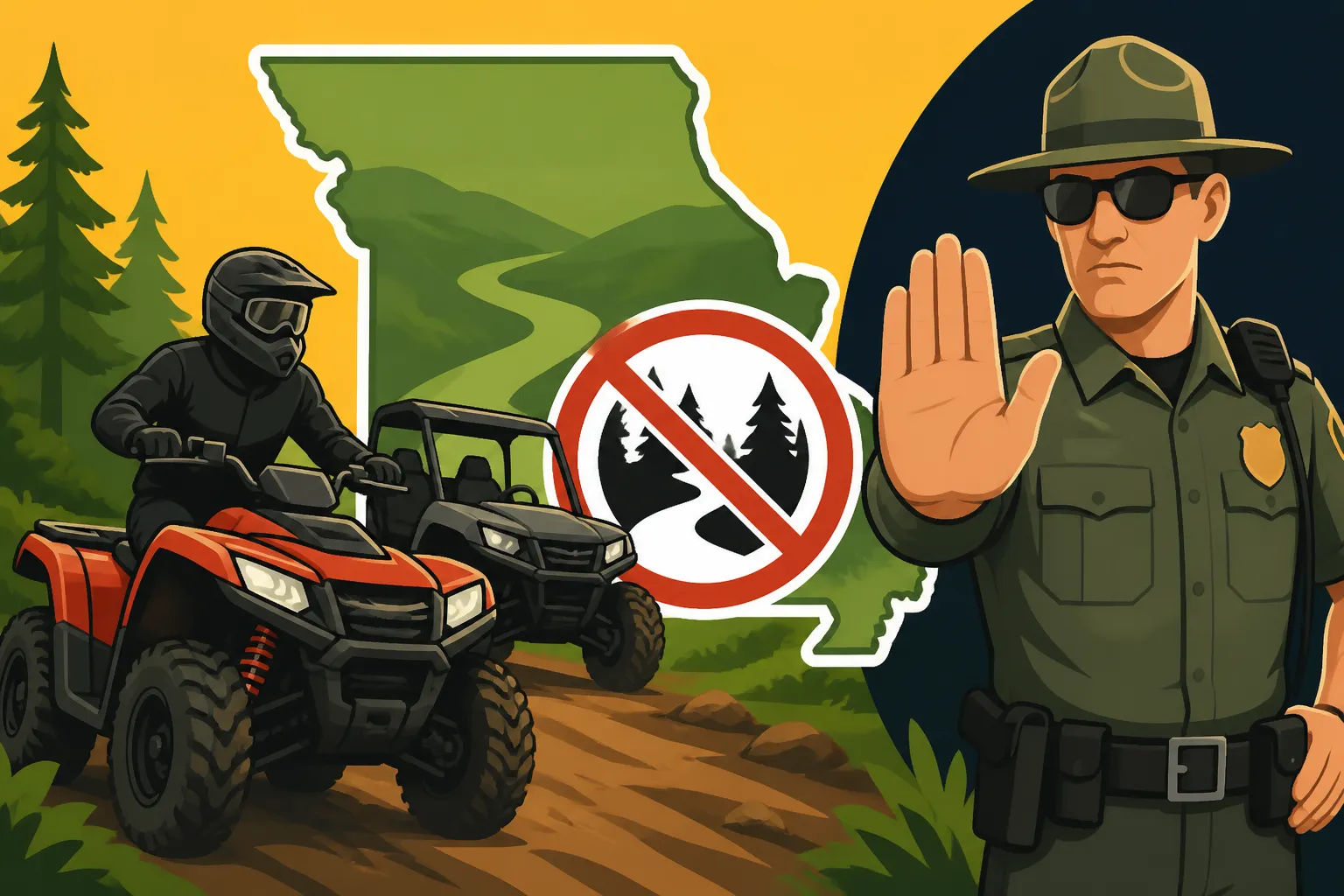
Riding past a closed-trail sign can turn a planned Missouri ATV or UTV outing into a citation, even if you have a current permit. The amount of a fine is not one statewide figure: it depends on who manages the land, the rule you broke and what happened. Here’s how to think through the consequences and what to do if you encounter a closure.
Why a closed trail can lead to a fine
A riding permit does not give you permission to use every trail at a site. It generally applies only under the land manager’s rules, and those rules can limit access by route, season, machine type or current trail condition. A trail can be closed even while other routes nearby remain open.
Closures may be temporary or ongoing. A manager might block a route for maintenance, storm damage, unsafe conditions, wildlife or habitat protection, or another land-use concern. The specific reason is less important at the trailhead than the restriction itself: if an official sign, barrier or current notice says the route is closed, don’t ride it.
The potential fine depends on the land and the conduct involved. Missouri does not have one simple fine that applies to every closed ATV or UTV trail. Different agencies and property owners may enforce different rules, and a rider may face a separate issue if the ride also involved trespass, damage, an unpermitted area or a road-use violation.
A closure is also different from a missing permit. Riding an open trail without the required permit may bring one kind of enforcement; riding a closed trail can be a separate violation even if you have paid for access. For permit basics, see Missouri ORV Permits Explained and Missouri Fines for No ORV Permit.
| Situation | Why the fine or consequence can differ | Sensible next step |
|---|---|---|
| You enter a route marked closed | The land manager’s closure rules apply to that property and trail | Turn around and use an open route |
| You ride off the marked trail to get around a closure | Off-trail travel may violate a separate land-use rule and can cause damage | Return to an authorized route without crossing more ground |
| You ride a closed route on public land | The managing agency’s rules and enforcement process govern | Check that agency’s current notice or contact its office |
| You ride on private property without permission | Access depends on the landowner’s permission; a trail map is not permission | Leave the property and contact the owner if appropriate |
| The route is open, but you lack the required permit | The issue is access authorization, not necessarily a closure | Confirm the permit required for that specific area |
Treat barriers and posted closure notices as meaningful even if the trail looks passable. A gap beside a gate or a track around a sign does not mean the route is open. If you are unsure whether a notice applies to the trail you planned to ride, stop and confirm before proceeding.
Why the exact penalty depends on the location
Missouri riding areas are not all controlled by the same authority. A state park, a national forest, another public-land property and a privately operated riding area may each have different rules and enforcement procedures. A closure at one location does not automatically tell you what the consequences would be at another.
The type of restriction matters, too. A rider may be cited for disregarding a closure, but the facts can involve more than one rule. For example, a route might be closed to motorized use while walking access remains allowed, or it might be closed to all visitors. A rider who goes around a barrier, damages property or continues after being told to stop may raise additional concerns beyond simply missing a closure notice.
That is why guessing a dollar amount from a friend’s experience can mislead you. A penalty discussed for one trail system, agency or type of conduct may not apply to another. If you receive a citation, read the document carefully: it should identify the alleged violation and explain the next step. Direct questions about the charge, court process or payment to the issuing authority or the contact listed on the citation.
The land manager’s rules are especially important on public land. See Missouri Rules for Riding Public Land for the broader access context. If you are riding a national forest route, the applicable forest rules and notices matter; What a Mark Twain Forest Officer Cites Riders For covers a related enforcement situation. State park enforcement can differ, so What a State Park Ranger Can Cite You For may help explain why a park’s requirements should not be assumed to match a forest’s.
Don’t confuse a closed-trail citation with a road-use ticket. Riding an ATV or UTV on an unauthorized road is a different issue from riding a closed trail, although a single outing can involve both. If your route includes roads, review Missouri Fines for Illegal ATV Road Use separately.
What to do when you find a closure
A safe response is simple: stop, turn around and take a route that is clearly open. Don’t move a sign or barrier, ride around the end of a closure, or follow tracks that appear to bypass it. A visible track is not proof that someone had permission to ride there.
Use this process if a closure affects your planned route:
- Stop before entering the closed area. If the sign is visible from the trail, don’t ride past it to get a closer look.
- Check the notice for its scope. It may identify a trail number, section, date, hazard or type of use. If the sign is unclear, don’t assume the narrowest interpretation.
- Look for an official update. Check the land manager’s current trail information, posted notices or site staff. A closure may have changed since you planned the trip.
- Choose a route marked open. Confirm that your machine is allowed on it. Width limits and other access rules may rule out a route even when it is open.
- Ask an authorized staff member if you still have doubts. A rider’s guess or an old online post is not a substitute for the manager’s current direction.
It helps to check closures before leaving home, then read the trailhead board again when you arrive. Updates can happen after a map or route plan was saved. Checking a Missouri Trail Notice Before You Load and Missouri Trail Closures to Check First are useful reminders to verify access close to the time of the ride.
If you discover a closure while already on the trail, don’t continue farther in search of a way around it. Turn back the way you came if that route is safe and permitted. If a blocked route leaves you uncertain about the legal way back, contact site staff or the appropriate authority rather than crossing a different closed area.
Avoid riding off-trail to bypass a closure, even if the detour looks short. Off-trail travel can damage soil or vegetation, create a new unauthorized route, or lead you onto land where you lack permission. On private property, a trail shown on a map does not establish that riding is allowed; see Missouri Rules for Riding Private Property for the role of landowner permission.
How to avoid a citation on your next ride
Plan around the rules of the specific riding area, not just the rules that apply to your machine generally. Before loading, verify that the site is open, your intended route is open to motorized use, and your ATV or UTV meets the area’s requirements. A current permit does not override a closure, and permission to ride one trail does not grant access to every nearby path.
Keep the information you need easy to check: the name of the riding area, the land manager’s contact details, the current trail map or notice, and any permit information. If a sign or route marker conflicts with an older map, treat the posted restriction as the immediate direction and ask the manager to clarify it.
If an officer or site employee contacts you, stop in a safe place and follow their instructions. Stay calm, provide information when required, and avoid arguing roadside about whether a sign was clear. If you receive a citation, keep a copy and follow its instructions for responding. The issuing authority can explain the specific alleged violation and applicable process.
The practical takeaway is that the fine for riding a closed trail is not a single statewide amount to memorize. The location, managing authority and circumstances determine what rule applies. The safest way to avoid the penalty is to verify the current status of your route, obey closure signs and barriers, and turn around whenever access is uncertain.
Disclaimer
This article is for general informational purposes only and does not constitute professional advice. Laws, prices and regulations vary by location and change over time. Consult a qualified professional for guidance on your specific situation.