Missouri Rules for Riding Off the Trail
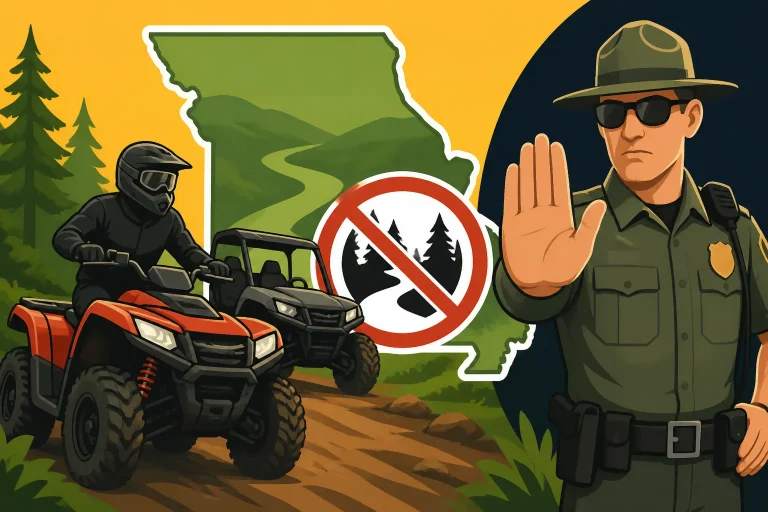
When a trail ends, a shortcut across the woods can seem harmless—but on public land, leaving the marked route may violate site rules and damage ground that takes years to recover. Missouri does not have one statewide permission slip for off-trail riding. The rules depend on who manages the land, what routes are open, and whether you have permission to cross private property.
The short answer: stay on routes open to your machine
In Missouri, having an ATV or UTV permit, decal, or registration does not automatically let you ride anywhere. Those documents may meet a specific access requirement, but they do not make closed trails or unmarked ground available for riding. Public-land managers set the routes riders may use, and their rules can vary by property and vehicle type.
On a designated riding area, treat the signed or mapped routes as the boundaries of where you can ride. Do not cut between trails, create a new route around mud, or ride into a closed area because it looks passable. A route that appears on an old map may have since been closed, rerouted, or restricted to particular machines.
| Where you are riding | Practical rule | What to check |
|---|---|---|
| State park ORV area | Use the designated riding routes and follow site rules | Current park notices, route maps, vehicle limits, and permit requirements |
| National forest riding area | Stay on routes open to your vehicle and follow closures | Current route information and any seasonal or emergency notices |
| Conservation area | Do not assume ATV riding is allowed | The area’s specific rules and any posted restrictions |
| Private land | Get permission from the landowner before riding | Property boundaries, permitted routes, and any conditions |
| Club or commercial park | Follow the operator’s marked routes and rules | Whether your machine and planned route are allowed |
Different land agencies and private operators can use different rules. A route open to one kind of off-highway vehicle may not be open to a wider or heavier machine. Start with Missouri Rules for Riding Public Land and check the rules for the particular property before unloading.
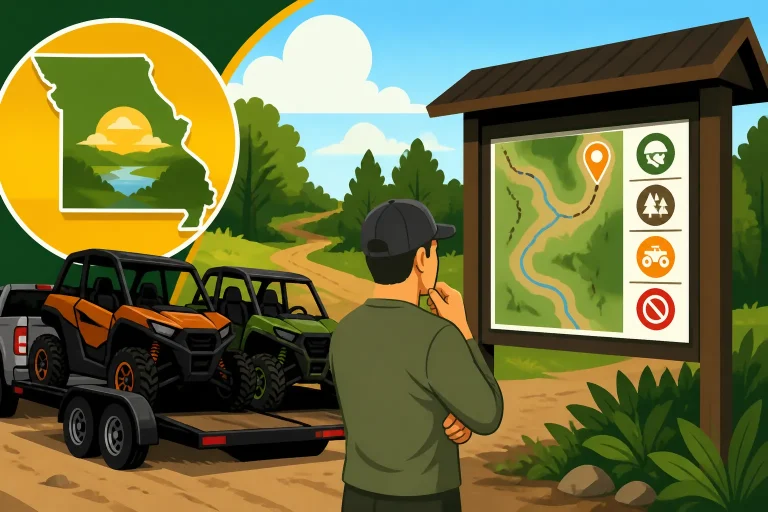
A trail map is not a general invitation
A map helps you plan, but it does not override signs, gates, temporary closures, or restrictions posted at the site. If signs conflict with an older map, follow the signs and ask the land manager for clarification. If a route is not clearly open to your machine, do not assume it is legal to use.
This matters especially where multiple kinds of routes sit close together. A forest road, hiking trail, horse trail, maintenance track, and ORV route may look similar from the saddle, but they do not necessarily carry the same access rules. Riding onto a trail intended for another use can create a safety hazard as well as a rule violation.
A permit does not authorize off-trail travel
A permit generally relates to access under a particular program or at a particular location. It does not grant permission to leave the authorized network. Before a trip, confirm both questions: whether you need a permit and which routes you may use. Missouri ORV Permits Explained covers the permit side; the land manager’s route map and current notices determine where riding is allowed.
The same distinction applies to a state registration decal. A decal may be required for a machine under Missouri’s registration system, but it is not a substitute for permission to ride on a specific property. The rules for public land are different from permission to use private ground.
Rules depend on the land
State parks and designated ORV areas
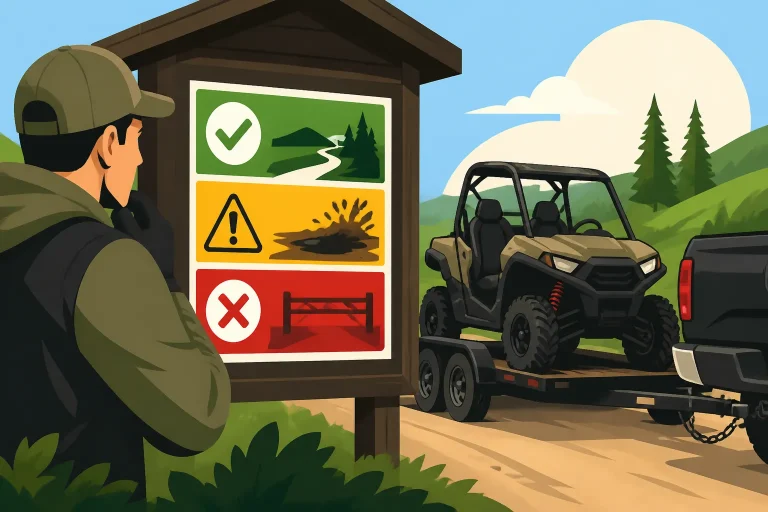
At a state park riding area, ride only on routes open to ORVs and follow the posted requirements. A trailhead board may list operating rules, closures, vehicle restrictions, and safety requirements. Read it before riding, even if you have visited the property before: conditions and access can change.
Do not treat the land between marked routes as an alternate trail. Riding through vegetation, around a barrier, or across a closed section may damage habitat or create a new track that other riders follow. If a trail is blocked or difficult, turn around or use an official detour if one is provided. Do not make your own.
Check for site-specific rules beyond route access. A property may have separate requirements for permits, equipment, noise, flags, helmets, youth riders, or vehicle width. A machine that is legal to ride at one location may not meet another location’s requirements. Current site information matters more than assumptions based on another park.
National forests
On national forest land, the key question is whether a route is designated and open to your machine. Do not infer permission from the fact that a track exists. Some tracks are for management, fire response, or other authorized use rather than public ORV riding. Gates, signs, route maps, and current notices can indicate restrictions.
Closures may be temporary or seasonal, including restrictions related to weather, maintenance, wildlife, or damage. Make a fresh check before you travel, particularly after storms or when riding in an area with changing conditions. Missouri Rules for Riding a National Forest and Missouri Trail Closures to Check are useful starting points, but check the current information from the responsible land manager as well.
If a route is muddy, eroded, or blocked, continuing around the problem can widen the damage and put you outside the authorized route. Turn back rather than cutting a bypass. When in doubt, contact the local ranger district or ask staff at the trailhead.
Conservation areas
Do not assume a conservation area allows ATV or UTV riding simply because it is public land or has roads. Access rules can differ from those at ORV parks and national forests. In many cases, roads or trails on conservation land are not open for general ATV riding. Check the rules for the specific area before you arrive; Missouri Rules for Riding a Conservation Area explains why this distinction matters.
A road that appears suitable for a quad may be intended for other users or limited purposes. Follow posted signs and the area’s official rules rather than relying on tire tracks or another rider’s presence as proof that the route is open.
Private land and club trails
On private land, get permission from the landowner or an authorized manager before riding. Permission should cover where you may ride, not just whether you may enter the property. Ask about boundaries, gates, roads, stream crossings, and any areas that are off limits. A lease, hunting arrangement, or neighborly relationship does not necessarily include ATV access. See Missouri Landowner Permission Requirements and Missouri Rules for Riding Private Property.
Club trails and private riding parks have their own access rules. A membership, day pass, or event entry usually applies only to the area and routes specified by the operator. Follow its signs and instructions, and do not leave a marked trail to explore adjacent land unless the operator expressly allows it.
What counts as going off the trail—and why it matters
For practical purposes, you are off the trail when you leave the route authorized for your vehicle and begin riding on unmarked ground, a closed route, or a route reserved for another use. A route does not become legal simply because it is visible, already has tire marks, or seems to connect two open trails.
Common examples include:
- Cutting through trees or brush to join another trail.
- Riding around a locked gate, closure sign, or barrier.
- Creating a bypass around mud, fallen trees, or a damaged section.
- Using a hiking or equestrian trail as an ATV route.
- Crossing a field or streamside area without permission.
- Leaving an authorized route to reach a scenic spot or campsite.
Off-trail riding can damage plants and soil, widen muddy areas, increase erosion, and disturb wildlife. It can also make routes harder to maintain and encourage more riders to follow an unauthorized track. In wet conditions, a single shortcut can leave deep ruts that persist after the ground dries.
There are also practical safety concerns. A new path may lead into private land, a steep slope, a drainage, or an area where other trail users are not expecting motorized traffic. A machine can get stuck or damaged away from the maintained route, and help may be harder to reach. Staying on the designated network makes it easier for others to anticipate where riders will be.
The consequences depend on the property and the circumstances. A land manager may require a rider to leave, issue a citation, or take other enforcement action. If the route crosses private land, riding without permission can raise a trespass issue as well. Do not assume that a warning or a fine is the only possible outcome; the rules and response depend on the specific location and conduct. Missouri Rules for Riding a Closed Trail and What a Mark Twain Forest Officer Cites Riders For offer more detail on closures and enforcement.
How to avoid an off-trail violation
A little planning prevents most problems. Use this routine before and during a ride:
- Identify the land manager. Confirm whether the site is a state park, national forest, conservation area, private park, or privately owned land. The manager determines which rules apply.
- Find the current route information. Use the site’s current map or official route information, not just an old screenshot or a track shared by another rider.
- Confirm your machine is allowed. Check any vehicle-size or type restrictions and make sure the route is open to your ATV or UTV.
- Check permits separately. Confirm whether the location requires an access permit, and understand what that permit covers. Do not treat it as permission to leave the route.
- Read signs at the entrance and along the route. Follow posted closures and detours, even if your map appears to show an open route.
- Ask before crossing private property. Get clear permission for the route and boundaries. If you cannot confirm permission, choose another route.
- Turn around when a route is unclear or blocked. Do not make a bypass or follow an unofficial track around an obstacle.
- Check again during the ride. Temporary closures and changing conditions can make a route unavailable after you have started.
If you are unsure whether a particular road or trail is open, stop and verify before riding it. A quick call to the land manager is safer than relying on another rider’s claim or assuming that a visible track is authorized. For broader access questions, see Missouri Rules for Riding Public Land and Missouri Rules for Riding a Club Trail.
Disclaimer
This article is for general informational purposes only and does not constitute professional advice. Laws, prices and regulations vary by location and change over time. Consult a qualified professional for guidance on your specific situation.