The $6 Missouri ATV Day Permit
The $6 Missouri ATV day permit is easy to confuse with a registration decal, a forest permit, or permission to ride on a road. They are not interchangeable. Here’s what the day permit is for, how to check whether it fits your trip, and what to confirm before you unload at a trailhead.
What the $6 Missouri ATV day permit covers
The $6 day permit refers to a short-term riding permit for an ATV at a participating Missouri state park off-road riding area. It is an access permit: it covers a particular kind of riding at a particular managed location for a limited time. It does not register your ATV, make it street legal, or give you permission to ride on every public trail in Missouri.
That distinction matters because Missouri has several separate systems. A machine may need a state title or registration decal for one purpose, a park permit for another, and a separate permit for a different riding area. The permit you buy at a state park gate does not automatically cover a national forest trailhead or a city street.
The $6 amount is part of the permit’s familiar name, not a reason to assume that fee is still current or applies to every rider and machine. Fees and permit procedures can change. Before you leave, confirm the current price, eligibility, and purchase method with the official authority for the place you plan to ride.
The day permit is most useful when you are planning a short visit to a designated park riding area and do not need a longer-duration permit. For example, it may suit a one-day outing better than purchasing a multi-day option. But the details depend on the riding area and the machine. A UTV or side-by-side may have a different permit category and fee from an ATV, even when both vehicles use the same facility. Check the applicable category rather than selecting the lowest listed option.
Think of the permit as access for a defined visit, not as a general “Missouri ATV pass.” Before paying, confirm:
- The exact trail system or riding area where the permit is accepted.
- Whether the permit covers your vehicle type and width.
- The date or period for which it is valid.
- Whether it must be displayed on the machine, carried by the rider, or both.
- Whether the permit is assigned to a specific machine or rider.
- Whether you need to buy it online, at the entrance, or from another approved seller.
- Whether the area is open and the trails you want to use are available.
The broad overview in Missouri ORV Permits Explained can help you sort out the different permit systems before narrowing down what you need for a specific destination.
A day permit is not a registration decal
Missouri’s ATV registration decal and an off-road riding permit serve different purposes. A registration decal is part of the state’s registration system for qualifying ATVs. A park day permit is permission to use a particular riding facility for a limited visit.
One does not substitute for the other. Buying a park permit does not title or register your ATV, and a registration decal does not necessarily let you ride a managed trail without that trail system’s own permit. If you are unsure whether your machine needs a state decal, start with Do You Need a Permit for Missouri State Park Trails? and check the separate registration guidance in Registering an ATV in Missouri.
A state park permit is not a road permit
A park riding permit is not permission to ride an ATV or UTV on a public road. Road use has its own rules and exceptions, and local road permits are separate from trail access permits. The same machine might be allowed on a marked off-road trail with the appropriate access permit but still be prohibited from using the public road that leads to the trailhead.
Do not plan a route that depends on riding along a road unless you have checked the specific road-use rules and any required local permission. Are ATVs Street Legal in Missouri? explains why trail access and road access are different questions.
Which permit system applies to your ride
The right permit depends first on where you plan to ride. Missouri has state-managed riding areas, federal forest lands, local road systems, private parks, and private land. They do not all use the same permit or accept the same proof of permission.
| Where you plan to ride | Permit question to ask | What not to assume |
|---|---|---|
| State park off-road riding area | Does this area require a park riding permit, and which category applies to my machine? | A state registration decal automatically covers park access |
| National forest trail system | Is a separate forest permit required for this trail system and riding period? | A state park permit works at a forest trailhead |
| Local street or road | Does the local authority allow this machine on this road, and is a road permit required? | A trail permit authorizes road use |
| Private riding park | What does the park’s admission or permit cover? | A state permit is accepted at a private facility |
| Private property | Do I have the owner’s permission, and are there other applicable rules? | Ownership of the ATV is permission to ride on someone else’s land |
For a state park visit, check the specific park’s current off-road riding information before buying. Do not assume every state park has ATV trails or uses the same access process. Trail access may also depend on opening hours, closures, weather, maintenance, and machine requirements. Missouri Trail Closures to Check First is worth reviewing before you load the trailer.
For a forest ride, check the forest’s own permit instructions. Chadwick, for example, has its own permit information; it is not simply another location where a state park day permit automatically applies. The details in What the Mark Twain Forest ATV Permit Covers can help clarify why a forest permit is a separate purchase.
If you are visiting a private park, ask that park directly whether it requires an entry pass, vehicle permit, rider waiver, or other paperwork. A state-issued permit may not satisfy a private operator’s requirements. Likewise, a private park pass does not replace a permit required by a public riding area.
Start with the destination, not the permit name
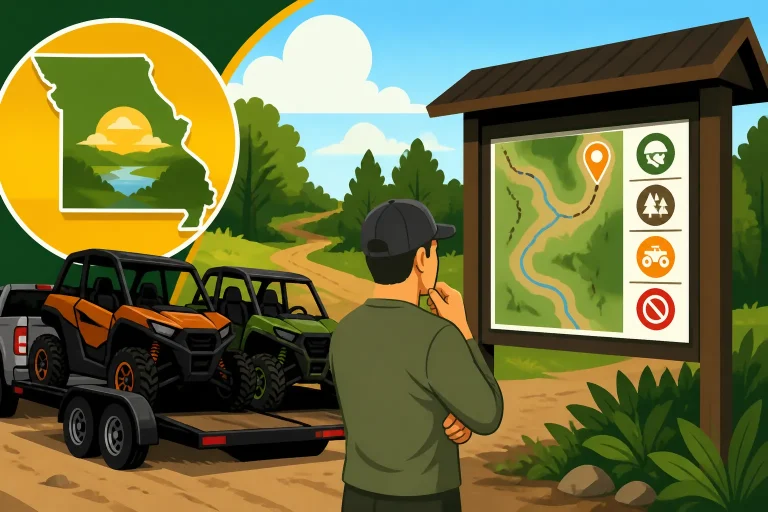
A common mistake is searching for “Missouri ATV permit,” finding a permit with a low daily fee, and assuming it will work for the chosen trip. Instead, start with the trailhead or riding area. Find the official page or contact point for that location, then identify its specific permit.
This simple order prevents a frustrating mismatch:
- Choose the exact riding area.
- Identify who manages it.
- Check that manager’s current rules and permit requirements.
- Match your vehicle to the correct category.
- Confirm the permit period and purchase instructions.
- Check trail status and any equipment restrictions.
- Keep proof of purchase where you can access it during the ride.
The process is especially useful if your weekend includes more than one destination. A single purchase may not cover each stop. If you plan to ride a state park one day and a forest trail the next, treat them as separate permit checks rather than assuming one pass travels with you.
ATV and UTV categories may differ
Do not assume an ATV day permit applies to a UTV or side-by-side. Permit categories can depend on vehicle type, width, or the rules of the specific area. Some trail systems have width restrictions that matter even when the vehicle’s engine, registration, or intended use seems similar to an ATV’s.
Check the machine’s width using the method the riding area specifies, and make sure the vehicle is permitted on the trails you intend to use. The permit fee is only one part of that check. A permit does not override a trail’s width limit or other operating rule. For the separate park category, see [Missouri State Park UTV Permit Cost].
How to buy the permit and avoid a wasted trip
The purchase method can vary by location. A park may let riders buy online, purchase at an entrance, or use another official sales channel. A forest permit may follow a different process. Check the current instructions before traveling, especially if you expect to arrive outside staffed hours or have limited mobile service.
If the official system allows online purchase, verify that you have selected the right day, riding area, and machine category before submitting payment. Save the confirmation in a way that will still work if your phone has no signal. That might mean saving the confirmation offline, carrying a printed copy if available, or keeping the permit number in a note that does not depend on a data connection. The current purchase options and instructions are covered in [Missouri ORV Permit Online].
Do not assume an online receipt is the only proof you need. Follow the location’s directions about displaying the permit or carrying it. Some areas may require a permit sticker or other visible proof; others may use a different process. A receipt can help if there is a question, but it may not replace a display requirement.
A waterproof document pouch can keep a printed confirmation and other ride paperwork from getting soaked or covered in dust. Amazon is one possible source for a basic pouch, but any durable, secure option that suits your machine and riding conditions can do the job. Keep personal details protected, and avoid leaving documents where they can fall off or be read by passersby.
Confirm the permit period carefully
“Day permit” sounds self-explanatory, but the exact validity period is a detail to verify. Do not assume it lasts for twenty-four hours from purchase, covers a full weekend, or can be used on any date. Check whether the permit is tied to a calendar date, a particular day of use, or another defined period.
If your outing crosses midnight, includes more than one riding day, or involves a late arrival, confirm how the permit period is counted. Buying the wrong period can mean paying again or being unable to ride as planned. If a multi-day option is available, compare its validity with your itinerary rather than relying on the label alone. Missouri Three-Day ORV Permit addresses the longer-duration option and the questions to ask before choosing it.
Also check whether the permit is refundable or transferable before you purchase. Do not assume that a closure, bad weather, or a change in plans will qualify for a refund. If you have concerns about a scheduled closure or uncertain conditions, check the trail status first and ask the issuing authority about its current policy.
Check hours, closures, and machine restrictions
A valid permit does not guarantee that every trail will be open when you arrive. Weather, maintenance, seasonal restrictions, land-management decisions, or other conditions may close some or all of a riding area. A day permit is especially easy to waste if the trip is planned around one trail that turns out to be unavailable.
Before loading, check:
- The riding area’s operating hours and entry rules.
- Whether the trail system is open on your planned date.
- Any temporary closures or weather-related restrictions.
- Width, sound, spark-arrester, helmet, flag, or other equipment rules.
- Whether riders need to stay on marked routes.
- Whether the area has age, supervision, or passenger restrictions.
- Where permits are checked and where vehicles may be parked.
A quick stop at the official trail information page or a call to the managing office can save a long drive. Do not rely only on a map, an old social media post, or a friend’s experience from a previous season. The trail may still appear on a map even when a segment is closed.
Reciprocity and out-of-state riders
A Missouri day permit is generally about access to the facility named in its rules, not about recognizing another state’s registration or trail pass. If you are visiting from another state, keep two questions separate:
- Does Missouri recognize or accept your out-of-state registration or decal for the relevant state requirement?
- Does the riding area require its own access permit, regardless of where your machine is registered?
A positive answer to the first question does not necessarily settle the second. Reciprocity rules and trail permits address different things. An out-of-state decal might be relevant to registration, but the park or forest can still require its own permit for riding there. Conversely, buying a facility permit does not automatically resolve any registration requirement that applies to your machine.
For a visiting rider, check the home-state paperwork and the destination’s permit instructions before departure. The overview at Does Missouri Honor Out-of-State Registration? explains why a visitor should not treat a registration decal as a universal trail pass. If you are coming from a neighboring state, the more specific reciprocity pages, such as Missouri Reciprocity With Kansas, can help frame the registration question, but you still need to check the riding-area rules directly.
Carry the documents that apply to your situation, such as registration information and permit confirmation, in a secure place. A phone photo can be helpful as a backup, but do not rely on a photo alone if the authority requires an original document or visible decal. Keep the permit instructions accessible, too, so you can show that you purchased for the correct day and vehicle type.
Amazon may carry waterproof phone pouches that help protect a device holding an offline receipt, but test the pouch before a ride and do not let it interfere with safe operation. A printed backup is sensible when you expect poor reception. Amazon is also one place to look for a small document sleeve that can stay with your trail paperwork; choose one that closes securely and does not obstruct any required permit display.
When riding somewhere unfamiliar, review the general rules for the land you are entering. Missouri Rules for Riding Public Land can help you understand why a permit for one managed area does not grant access to every public parcel or trail.
Before you head out
Use a short pre-trip check to make sure the $6 day permit, or whichever current day permit applies, is actually the right one for your ride. Confirm the destination first, then verify its official permit requirements and current fee. Confirm that your machine fits the permitted category and any trail-width limit. Check the dates, validity period, purchase method, proof requirements, and open status.
Keep these points in mind:
- The familiar $6 name should not replace checking the current fee.
- The ATV day permit is for a specific riding-access purpose, not general registration.
- A state park permit may not be valid at a forest, private park, or local road.
- A UTV or side-by-side may require a different permit category.
- Out-of-state registration and trail access are separate questions.
- Trail closures and operating hours can affect a paid visit.
- A receipt or phone screenshot may not replace a required decal or display.
If the permit description does not clearly answer a question, contact the official manager before you buy. Ask about your exact machine, the exact riding area, and the date you plan to go. That is more useful than asking only whether “an ATV permit” is required, because the answer may change with the vehicle, land manager, and route.
Finally, remember that access permission does not remove the need to follow trail rules. Stay on routes open to your machine, respect posted closures, and carry whatever proof the location requires. A little checking at home can keep a low-cost day permit from turning into a wasted drive or an avoidable ticket.
Disclaimer
This article is for general informational purposes only and does not constitute professional advice. Laws, prices and regulations vary by location and change over time. Consult a qualified professional for guidance on your specific situation.